
Yes, seasonal foundation movement is usually normal. It happens when soil around your footings swells and shrinks with moisture changes across the year, and most of it reverses on its own. Track it with dated photos and simple crack measurements, and call a professional if any crack grows past a quarter inch, runs horizontally, or comes with sagging floors. Managing moisture around your foundation is almost always the first fix worth trying.
TL;DR:
- Most foundation movement during seasonal changes is expected and reversible, but cracks wider than a quarter inch or horizontal cracks require professional inspection.
- Soil type, moisture levels, irrigation habits, and nearby tree roots significantly influence soil swelling or shrinking, often causing foundation shifts.
- Monitoring crack width, orientation, and changes over multiple seasons helps determine whether movement is normal or warrants urgent repair.
- Improving yard drainage and controlling moisture around the foundation can reduce seasonal soil movement and prevent damage.
- Structural repairs should follow moisture management and verification of ongoing movement, with professional assessment essential for true settlement issues.
Table of Contents
- What Seasonal Foundation Movement Actually Means
- Why Soil, Water, and Roots Drive the Movement
- Signs Your Foundation Is Shifting
- Simple Tests to Track Movement Yourself
- Cutting Seasonal Swings With Better Drainage
- What a Professional Inspection and Repair Actually Involve
- How the Seasons Actually Cycle Through Your Foundation
- How Professionals Diagnose What’s Really Happening
- A Publisher’s Take: Fix the Water Before You Fix the House
- Get a Free Inspection Before Small Movement Becomes a Big Repair
- Where This Information Comes From
- Sources
- FAQ
What Seasonal Foundation Movement Actually Means
Seasonal foundation movement is the small, cyclical rise and fall of your house’s footings as the soil beneath them absorbs and releases water. Clay-heavy soil swells when it’s wet and contracts when it dries, and that swing pushes and pulls on the concrete sitting on top of it. In most cases, the foundation shifts a little in spring and fall, then settles back close to its original position.
Permanent settlement is a different animal. It doesn’t reverse with the seasons. It’s a one-way sink caused by soil compaction, poor original compaction under the slab, erosion, or a structural failure that keeps getting worse regardless of rainfall. You can usually tell the two apart by timing: seasonal movement tracks wet and dry spells, while settlement keeps trending in one direction month after month, year after year.
Some movement is expected almost anywhere, but slab-on-grade homes built on expansive clay see it the most, since the entire foundation rests directly on the soil doing the swelling and shrinking. Crawl space and basement foundations feel it too, just distributed across piers, footings, or walls instead of one continuous slab. Knowing which pattern you’re looking at determines whether you watch and wait or bring in an engineer.
Why Soil, Water, and Roots Drive the Movement
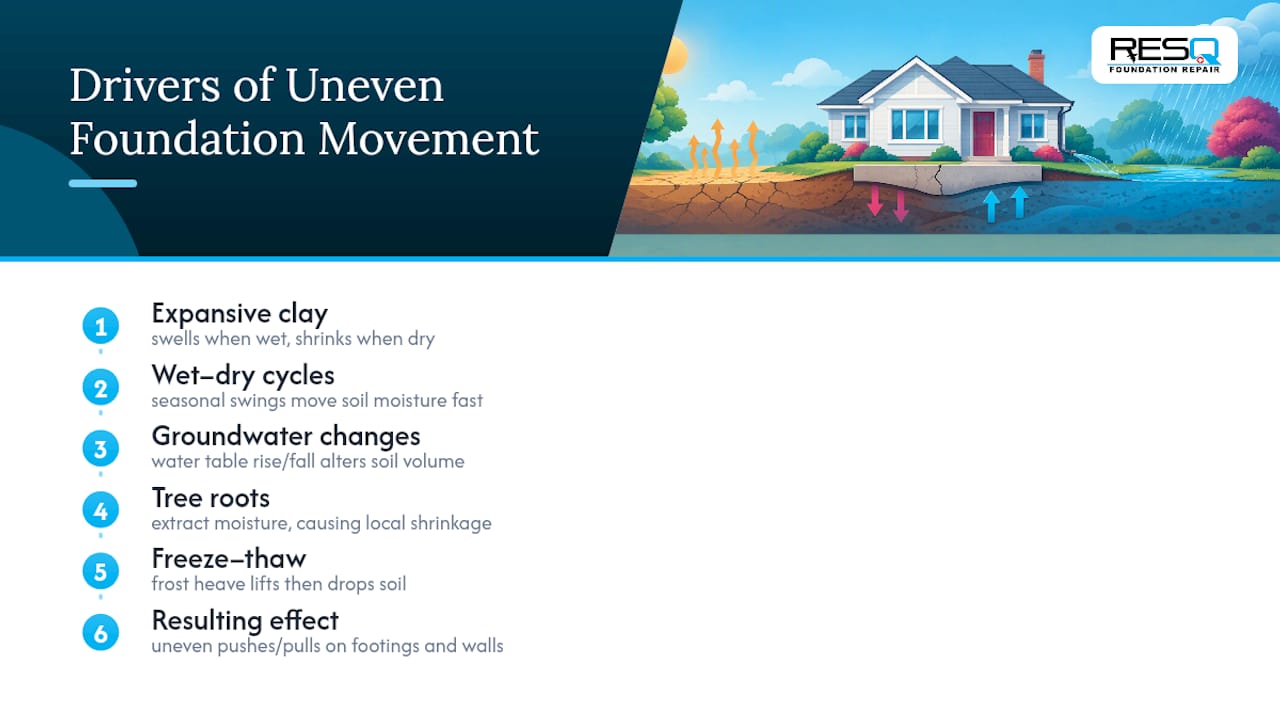
Expansive clay is the main culprit. These clays can swell to several times their dry volume when saturated and shrink dramatically when they dry out, according to the Arizona Geological Survey. That swelling and shrinking pushes unevenly against footings, especially when one side of the house stays wetter than the other.
Wet-dry cycles compound the problem. A rainy spring followed by a dry summer can move soil moisture by a wide margin in just a few months, and irrigation habits make it worse if you’re watering one side of the yard heavily and neglecting the other. Groundwater fluctuations add another layer, particularly in low-lying lots.
Trees are an underrated factor. Root systems pull moisture from the soil near your footings, sometimes enough to cause localized shrinkage even when the rest of the yard stays damp, a dynamic well documented in research on tree root influence on foundations in expansive clay. In colder regions, freeze-thaw cycles add frost heave to the mix, lifting soil as it freezes and dropping it again as it thaws.
Signs Your Foundation Is Shifting
Interior symptoms tend to show up first. Doors and windows that used to close easily start sticking, drywall develops diagonal cracks near corners, and floors that were once level start to slope in one direction. Exterior clues include vertical or step cracks in brick and block, gaps opening between the foundation and the soil line, and sidewalks or patios that no longer sit flush with the house.
Measuring and documenting these signs correctly matters more than most homeowners realize. A crack’s orientation and width tell you far more than its length. Horizontal cracks are more concerning than vertical ones because they suggest lateral pressure, not just settling.
- Measure crack width with a ruler or a crack gauge, not a guess.
- Photograph every crack in the same lighting with the ruler included in the frame.
- Note the date, the weather that week, and whether the crack has widened since the last check.
- Check both interior drywall and exterior masonry, since they often move at different rates.
- Flag anything running horizontally along a basement wall for closer attention.
If you’ve never done a full walkthrough, a 12-point foundation check gives you a structured way to catch problems early rather than waiting for a door to jam shut.
Simple Tests to Track Movement Yourself
You don’t need special equipment to monitor seasonal shifts. A few low-tech tests, repeated over months, tell you whether your foundation is behaving normally or drifting into trouble.
- Ball test. Set a round object, like a marble, on your floor near a suspected low spot. If it consistently rolls the same direction, you’ve got a slope worth tracking.
- Paint crack test. Apply a thin line of waterproof paint across a crack. FEMA recommends this method because a break in the paint film shows active movement even when the crack itself looks unchanged to the eye.
- Photo log with a ruler. Take the same photo every few months, always with a ruler in frame, so width changes are objective, not a guess.
- Smartphone level app. Run it along door frames and floors quarterly to catch gradual tilting.
Cracks wider than a quarter inch, horizontal cracks in basement walls, doors that go from sticking to not closing at all within weeks, and floors that visibly sag all warrant a professional look, per the threshold FEMA uses in its own inspection guidance.
Pro Tip: Test in at least two different seasons before drawing conclusions. A crack that looks alarming in August drought conditions sometimes closes back up by December, and you won’t know the difference unless you’re checking both.
Cutting Seasonal Swings With Better Drainage
Moisture control is the cheapest, most effective lever you have over seasonal movement. Regulating how much water reaches the soil around your footings limits how far that soil swings between wet and dry, which keeps the whole cycle smaller and less damaging.
- Clean gutters twice a year and extend downspouts at least five feet from the foundation.
- Grade soil so it slopes away from the house, not toward it.
- Keep large trees and heavy shrubs a safe distance from footings to limit root-driven moisture loss.
- Skip irrigation zones that spray directly against the foundation wall.
- During extreme drought, targeted watering near (not against) the foundation can offset severe shrinkage.
If your yard already slopes the wrong way, a proper grading fix solves more seasonal movement problems than most people expect. For homes with persistent damp crawl spaces or basements, waterproofing or dehumidification becomes worth considering once drainage fixes alone aren’t cutting it.
What a Professional Inspection and Repair Actually Involve
A real inspection starts with a visual survey inside and out, then moves to actual measurements: floor levels, wall plumb readings, and a check of grading and soil conditions around the perimeter. If the findings suggest structural risk rather than simple seasonal drift, a structural engineer gets involved to confirm what’s driving the movement.
Repair paths vary by what’s actually wrong:
- Drainage and moisture correction, often the first step before anything structural.
- Concrete leveling or polyurethane foam lifting for sunken slabs, walkways, or garage floors.
- Piering or underpinning when settlement is confirmed as permanent rather than seasonal.
- Crawl space encapsulation when moisture is driving both movement and air quality problems.
Many contractors recommend fixing moisture issues before committing to major structural work, since correcting the water problem sometimes resolves symptoms that looked like they needed piers. Soil type, house load, and how long the movement has been active all shape which repair actually makes sense, and a foundation settlement repair overview breaks down how those factors change the recommendation.
How the Seasons Actually Cycle Through Your Foundation
Spring tends to bring the sharpest swing. Snowmelt and spring rains saturate soil that spent winter contracted or frozen, and expansive clay swells fast, sometimes pushing floors and door frames out of alignment within weeks. Summer drought reverses the process. Clay dries and shrinks, pulling away from footings and often opening the same cracks that closed up in spring.
Fall sits in between, usually calmer unless a wet autumn follows a severe summer drought, in which case the rehydration can be dramatic. Winter’s effect depends heavily on climate. In freeze-prone regions, frost heave adds a separate movement cycle layered on top of the moisture cycle, since freezing soil expands and lifts, then drops again on thaw.
Field studies tracking subgrade soil have recorded measurably lower stiffness during saturated periods compared to dry ones, confirmed by seasonal variation research from Iowa State’s transportation institute, which helps explain why the same house can feel solid in October and slightly off in April. This isn’t random. It’s a predictable cycle tied to your regional climate, and NIST’s technical review of geotechnical hazards notes that shifting precipitation and temperature patterns are making these cycles less predictable than they used to be, which is one more reason consistent monitoring matters more now than it did a decade ago.
How Professionals Diagnose What’s Really Happening
Beyond a visual walkthrough, professionals lean on a handful of specific techniques to separate ordinary seasonal drift from a genuine structural problem. Elevation surveys using laser levels or manometer systems establish a precise baseline of floor height across the house, then repeat measurements over months reveal whether a low spot is stable, seasonal, or actively worsening.

Soil testing digs into what’s actually under the slab. Engineers may pull samples to check for expansive clay content, moisture levels at different depths, and how compacted the fill soil is, since improperly compacted fill behaves very differently from undisturbed native soil. Grading and drainage assessments map how water moves around the property, often revealing that a downspout dumping water six feet from the foundation has been driving movement the whole time.
For more complex cases, engineers sometimes install simple crack monitors, small gauges fixed across a crack that record any widening over weeks or months with more precision than a ruler and a photo. This kind of instrumented monitoring bridges the gap between a homeowner’s own paint test and a full structural evaluation, giving an engineer hard data instead of a guess about whether a crack is stable or actively growing.
A Publisher’s Take: Fix the Water Before You Fix the House
Foundation RESQ sees the same pattern constantly: homeowners jump straight to worrying about piers when a gutter extension and better grading would have solved most of the symptom. Moisture management isn’t a stalling tactic. It’s usually the correct first move, and it costs a fraction of structural repair.
That said, don’t let “it’s probably seasonal” become an excuse to ignore a crack that’s clearly growing. Monitor honestly, act on the thresholds, and get an inspection before small movement becomes an expensive fix.
— Kayle
Get a Free Inspection Before Small Movement Becomes a Big Repair
Some contractors offer free inspections that distinguish seasonal drift from real structural risk, instead of jumping straight to a pitch for piers.

If your monitoring turns up a crack past that quarter-inch threshold, or a door that’s gone from sticking to jammed shut, it’s worth having someone look before the next wet season makes it worse. Foundation RESQ’s foundation and crawl space repair services cover the moisture-first approach this article walks through, including drainage correction, crawl space encapsulation, and concrete leveling with PolyRenewal® foam for sunken slabs and walkways. For structural cases where underpinning is the right call, the same visit covers that assessment too.
Repair costs vary by scope, so Foundation RESQ also offers financing options for homeowners who’d rather spread out a larger repair than delay it. Schedule your free inspection and get a clear answer on whether what you’re seeing is normal seasonal movement or something that needs attention now.
Where This Information Comes From
The Arizona Geological Survey covers how expansive soils drive seasonal movement. FEMA provides the inspection and crack-testing methods referenced throughout. NIST Technical Note 2371 details climate effects on geotechnical performance, and NDSU Extension explains drought-driven shrinkage in plain terms.
Sources
- Problem Soils | Arizona Geological Survey – AZGS
- Implications of future hazards and conditions on geotechnical engineering practice (NIST TN.2371)
- Dry soil may cause building problems — NDSU Extension
FAQ
How can you tell if your foundation is shifting?
Watch for sticking doors and windows, diagonal drywall cracks near corners, sloping floors, and gaps opening between the foundation and soil outside. The FEMA paint crack test and a simple ball-on-floor test are two low-cost ways to confirm active movement rather than relying on a one-time look.
Is it illegal to sell a house with foundation issues?
No, it’s not illegal in most states, but sellers are generally required to disclose known foundation problems to buyers. Disclosure laws vary by state, so check your state’s specific real estate disclosure requirements before listing a home with known issues.
Is it normal for a house to settle after foundation repair?
A small amount of continued seasonal movement after a repair is common, since soil around the foundation keeps cycling with moisture regardless of the fix. What’s not normal is progressive sinking or new cracks appearing near the repaired area, which should prompt a follow-up inspection.
How much foundation settlement is normal?
Minor seasonal shifts of a fraction of an inch, tracking wet and dry periods, are generally considered normal. Cracks wider than a quarter inch, horizontal cracking, or one-directional sinking that doesn’t reverse point toward a problem that needs professional evaluation rather than routine seasonal drift.