
The most practical sump pump discharge options are a graded lawn spread, a buried pipe to an infiltration area, a dry well, a French drain or rain garden, and a storm-drain connection where the local code allows it. Before picking one, check your yard’s slope and soil, confirm whether a storm lateral exists, and call your building or public works department to rule out anything that needs a permit.
TL;DR:
- Proper site evaluation involves checking slope, soil infiltration, existing storm laterals, and legal restrictions before selecting a discharge method.
- Discharge options vary from surface spread and buried pipes to infiltration systems and municipal connections, depending on yard conditions and local rules.
- Protect underground pipes by choosing durable materials, burying below the frost line, and including cleanouts and check valves to ensure long-term functionality.
- Infiltration systems like dry wells, French drains, and rain gardens require pretreatment and overflow planning to prevent clogging and backups.
- Always verify permit requirements, avoid discharging onto neighbors or public areas, and consider frost protection and proper maintenance to prevent ice hazards and system failures.
Table of Contents
- Common sump pump discharge options and when each one fits
- How to choose: site factors, permit checks, and neighbor considerations
- Pipe materials, burying depth, frost protection, and sizing basics
- On-site infiltration: dry wells, French drains, and rain gardens
- Storm-sewer and natural outfall connections: permits and limits
- Winterizing your discharge line to prevent ice hazards
- Maintenance and testing checklist for the discharge path
- How a contractor evaluates a discharge system
- Why maintainable design beats hidden cosmetic fixes
- If you want a professional opinion on your discharge setup
- FAQ
- Sources
Common sump pump discharge options and when each one fits
Most homes end up choosing from a handful of proven routes, and the right one depends on your lot’s slope, soil, and local rules more than personal preference.
- Graded lawn spread: water exits a short pipe and flows across a sloped lawn away from the house; works well on lots with at least a few inches of fall and no neighboring low spots.
- Buried PVC or corrugated pipe: runs underground to a discharge point farther from the foundation; keeps the yard usable and avoids surface tripping hazards.
- French drain or infiltration trench: a gravel-filled trench that lets water soak into the soil gradually; suited to lots with decent drainage but not enough slope for surface spread.
- Dry well: an underground chamber that collects and slowly infiltrates discharge; a good fit for tight lots with no room for surface drainage, as long as soil infiltration is adequate.
- Rain garden or vegetated swale: a shallow, planted depression that filters and absorbs water; works where there is space and moderate infiltration capacity.
- Storm-drain connection or natural outfall: ties into a municipal storm line or routes to a creek or ditch; only an option where permitted and where a lateral or legal outfall exists.
Flood-prone lots, small urban yards, and lots backed up against a neighbor’s property usually rule out a few of these before you even start designing.
How to choose: site factors, permit checks, and neighbor considerations
Narrowing the list starts with a short walk around your property, not a trip to the hardware store.
- Check slope away from the foundation and note any low spots between the pump outlet and the property line.
- Measure distance from the outlet to the foundation, to any neighboring structure, and to the property line.
- Run a simple infiltration check by digging a small test hole, filling it with water, and timing how fast it drains.
- Confirm whether your home sits in a mapped floodplain or near the base flood elevation; see this flood resilience measures guide for useful planning tips.
- Call your building department or public works office to ask whether a storm lateral exists and whether a permit applies.
Municipal rules vary widely: some require a permit for any storm-sewer tie-in, some restrict surface discharge seasonally, and most prohibit directing concentrated flow onto an adjacent lot or public sidewalk, according to municipal sump pump guidance. Keep outlets at least a few feet from your neighbor’s fence line and avoid aiming discharge toward a shared driveway.
Pro Tip: Call before you dig, even for a shallow discharge line. A quick utility locate request avoids a far more expensive mistake later.
Pipe materials, burying depth, frost protection, and sizing basics
Material choice and burial depth decide whether a discharge line lasts years or fails in its first winter.
- PVC and ABS both hold up underground; avoid gluing PVC fittings to ABS pipe since the solvents are not compatible and the joint will eventually fail.
- Corrugated pipe costs less and flexes around obstacles but clogs more easily and is harder to clean out.
- Bury depth typically runs below the local frost line, with a gentle, continuous slope so the line never traps standing water.
- Driveway and sidewalk crossings need a sleeve or deeper burial to handle vehicle and foot traffic without crushing the pipe.
- A check valve near the pump prevents water from flowing back into the pit between cycles and keeps the pump from short-cycling.
- Pump sizing depends on flow rate against the vertical lift (head) and pipe friction, not horsepower alone; a pump that looks oversized on paper can still underperform if the discharge run has too many bends.
For homes in a flood-prone area, FEMA Technical Bulletin 10 recommends backup power, positive backflow prevention, and discharging above the base flood elevation rather than relying on pump capacity alone.
On-site infiltration: dry wells, French drains, and rain gardens
Any infiltration-based outlet needs pretreatment and an overflow plan, or it will clog and back up within a season or two.
- Dry wells need a pretreatment sump ahead of the chamber, a filtering screen to catch sediment, an access point for cleanout, and an overflow or surcharge connection for storms that exceed capacity.
- Drain-down timing matters for mosquito control: design the dry well so it drains within roughly 72 hours after a storm, per Penn State’s dry-well design guidance.
- French drains suit lots with moderate infiltration but not quite enough room or slope for a rain garden, and they’re generally easier to inspect along their length than a buried dry well.
- Rain gardens need a stabilized inlet, often with stone, to prevent erosion, plus vegetation that tolerates both standing water after storms and dry spells between them.
One pretreatment detail worth remembering: dry wells and infiltration systems that skip pretreatment often need the entire gravel bed dug out and replaced once sediment clogs it, a repair that costs far more than installing a cleanout access point up front.
Rain garden sizing depends heavily on roof and yard runoff area and local soil, so treat any general size range as a starting point and verify against rain garden design guidance for your specific site.
Storm-sewer and natural outfall connections: permits and limits
Tying into a municipal storm line or routing to a creek is often the simplest-looking option, and often the most restricted one.
- Many municipalities require a permit before connecting to a storm lateral, and some prohibit the connection outright regardless of whether a lateral is present nearby.
- Seasonal restrictions are common in places with combined sewer systems, where excess groundwater during wet months can overwhelm treatment capacity.
- Hydraulic suitability matters even where a connection is allowed: the storm line needs enough capacity to handle your pump’s flow without backing up, and discharge should never concentrate onto a neighboring lot.
- To request a connection permit, call your public works or stormwater department, ask what documentation they require, and get the permit conditions in writing before any excavation starts.
Natural outfalls to a ditch or creek carry the same permit requirements in most jurisdictions and add questions about erosion control at the outlet point.
Winterizing your discharge line to prevent ice hazards
Freeze-ups turn a working discharge system into a sidewalk hazard almost overnight.
- Route or alternate outlets away from walkways and driveways so repeated ponding doesn’t refreeze into an ice sheet.
- Bury the line below the frost line where possible, and consider pipe insulation, heat trace cable, or a bubble pot (a buried chamber that lets water disperse below the frost line) for above-ground sections.
- If ice does form on a public sidewalk or street, treat it right away and notify your public works department, since many municipalities hold property owners responsible for hazards created by their discharge.
Maintenance and testing checklist for the discharge path
A clear-looking outlet can still be functionally blocked, so testing beats assuming.
- Run the pump manually and watch the outlet for steady flow and full drain-down, not just a trickle.
- Walk the discharge route looking for low spots, pooling, or soggy ground that suggests a hidden blockage.
- Clean pretreatment sumps and inspect dry-well or French drain access points on a regular schedule, especially after heavy storms.
- Test the check valve and confirm backup power is functional if your area is flood-prone.
Pro Tip: Exercise the pump monthly, even in dry weather. A pump that hasn’t run in months is far more likely to fail the first time you actually need it.
Call a professional when the test reveals a blockage you can’t locate, a check valve that won’t seat, or a pump that runs constantly without clearing the pit.
How a contractor evaluates a discharge system
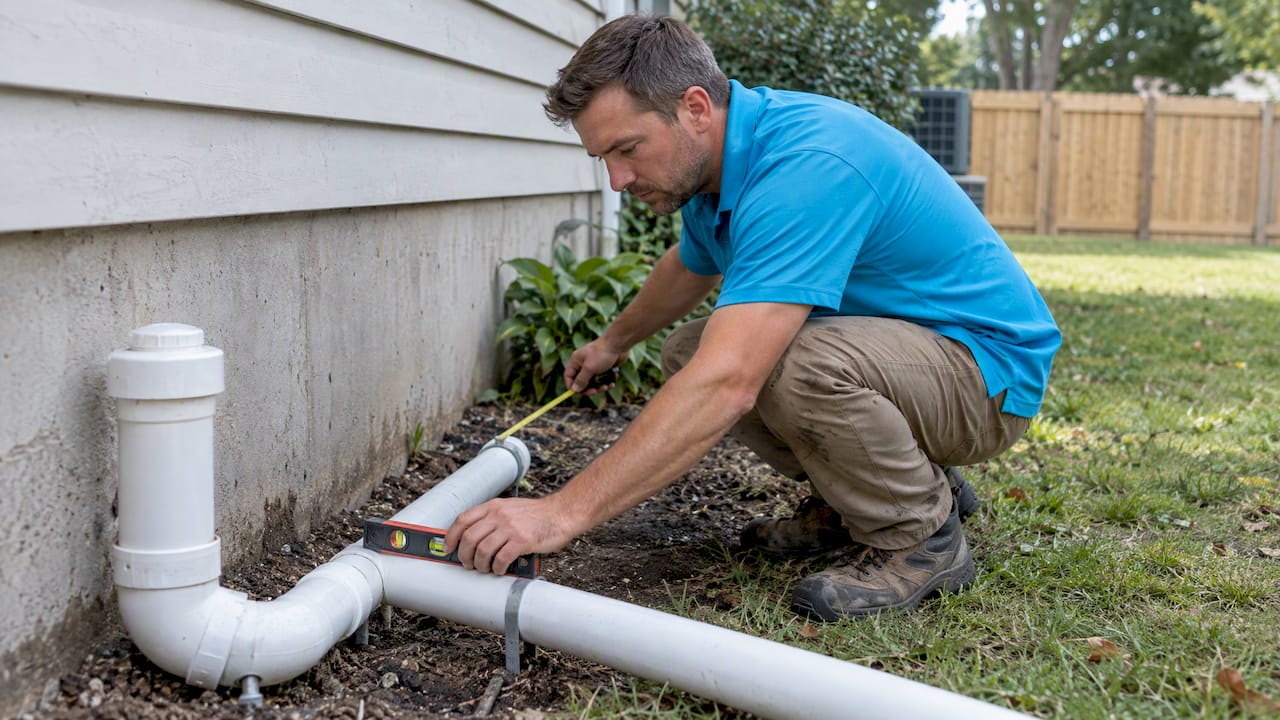
A professional visit to evaluate a sump pump discharge path usually starts with a site survey: slope, soil, distance to property lines, and whether a storm lateral exists. From there, the next steps are a permit check, a pretreatment plan if infiltration is involved, and an installation that leaves cleanouts and access points reachable for future maintenance. Our sump pump repair services and discharge line protection work follow that same sequence on every job.
Why maintainable design beats hidden cosmetic fixes
A buried pipe with no cleanout looks tidy until it clogs, and then the whole yard gets dug up to find it. Professionals favor designs with visible access points, pretreatment, and overflow controls because those details are what keep a dry well or discharge line working for years instead of one season.
— Kayle
If you want a professional opinion on your discharge setup
A graded lawn or a quick buried pipe handles plenty of homes, but tight lots, flood-prone areas, or a discharge line that keeps backing up call for a proper site evaluation. Sump pump repair, discharge-line protection, and basement waterproofing can be designed around site survey and permit checks that contractors typically run, matched to soil and slope rather than a generic fix.

- Site evaluation that checks slope, soil infiltration, and existing storm laterals before recommending a route.
- Sump pump repair and discharge-line protection designed with accessible cleanouts, not buried and forgotten.
- Basement waterproofing paired with discharge planning when seepage and drainage issues overlap.
A free inspection is the fastest way to find out which option fits your property, and you can book one through our services page when you’re ready.
FAQ
Where should sump pump discharge go?
Discharge should go somewhere water won’t flow back toward the foundation or onto a neighbor’s property, typically a graded lawn area, a buried pipe to a dry well or French drain, or a storm drain where permitted. Checking slope and local rules before you dig matters more than the specific method you pick.
How far can you run a sump pump discharge?
There’s no single universal distance limit since it depends on pump capacity, pipe friction, and local rules, though keeping the outlet well away from the foundation and property line is standard practice everywhere. Municipal guidance commonly recommends routing discharge away from structures and public walkways to avoid ponding and ice hazards, as outlined in local sump pump guidance.
Should sump pump discharge be above ground or buried?
Either works, but buried lines avoid tripping hazards, freeze less in cold climates when placed below the frost line, and keep the yard usable. Above-ground discharge is simpler to inspect and cheaper to install, which makes it a reasonable choice for temporary setups or lots with strong natural slope.
Is ABS or PVC better for sump pump discharge?
Both PVC and ABS hold up well underground, and the main rule is never to glue PVC fittings onto ABS pipe since the solvents aren’t compatible and the joint will fail over time. Pick one material and stay consistent through the whole run rather than mixing them.
Sources
These references cover the engineering and code details homeowners need before finalizing a discharge plan.
- PSU — Design and construction of dry wells
- FEMA Technical Bulletin 10
- UVM rain garden manual
- Arlington County — Sump pump brochure