What if you could stop your basement walls from bowing using a material ten times stronger than steel that is thinner than a coin? Seeing a horizontal crack or a slight inward curve in your foundation triggers immediate anxiety. You probably worry about the massive cost of structural work or the terrifying possibility of a wall collapse. When homeowners first see these signs, they often ask, what is carbon fiber foundation repair, and can a fabric strip really hold back tons of soil pressure?
We understand that your home is your most significant investment, and seeing it under threat is stressful. You deserve a solution that provides permanent stability without turning your basement into an industrial zone. This guide explains how this high-tech, non-invasive method permanently stabilizes bowing foundation walls without the need for heavy steel beams. We will walk through the specialized bonding process, compare it to traditional methods, and show you how to protect your home’s resale value with a repair that is nearly invisible and fully paintable.
Key Takeaways
- Understand what is carbon fiber foundation repair and how this aerospace-grade material provides a permanent, non-invasive solution for bowing walls.
- Learn why carbon fiber is ten times stronger than steel in tension, allowing it to resist thousands of pounds of hydrostatic pressure from wet soil.
- Discover how the low-profile design of reinforcement straps preserves your usable basement space and remains nearly invisible once painted.
- Explore a professional installation process that is significantly faster and less disruptive than traditional steel I-beam methods.
- See how localized expertise in Tallahassee soil conditions ensures a stable foundation and protects your home’s long-term resale value.
What is Carbon Fiber Foundation Repair?
Carbon fiber foundation repair is a structural reinforcement method that uses high-tensile fabric strips bonded directly to masonry walls. It’s designed to stop foundation walls from bowing or leaning inward. This movement usually happens because of hydrostatic pressure, which is the force exerted by water-saturated soil pushing against your home’s exterior. When you ask what is carbon fiber foundation repair, it’s best to think of it as a permanent shield that prevents further wall movement without the need for invasive excavation.
For more technical insights into this technology, Composites Construction UK provides a detailed resource on how carbon fibre reinforced polymer is used for strengthening and restoration projects.
This isn’t a new or experimental fix. The core material, known as Carbon Fiber Reinforced Polymer (CFRP), was originally developed for aerospace engineering and bridge reinforcement. In residential applications, it provides a high-tech alternative to traditional steel. It’s the ideal choice for walls showing horizontal cracks or inward bowing of less than two inches. Because the material is so thin, it doesn’t take up usable space in your basement or crawl space.
The Components of the System
A standard installation involves three critical parts that work together to create a unified structural barrier. These components ensure the repair stays bonded to the home for the long term:
- High-strength carbon fiber straps: These thin, flexible strips provide the primary tensile strength. They are incredibly difficult to stretch or break.
- Industrial-grade epoxy resin: This adhesive creates a deep-rooted bond between the carbon fiber and the concrete or block wall, essentially making them one unit.
- Top and bottom anchors: These specialized brackets tie the wall reinforcement into the floor slab and the overhead floor joists. This prevents the wall from pivoting at its base or top.
When to Choose Carbon Fiber Over Piers
Understanding the difference between lateral and vertical movement is key. Carbon fiber is a solution for wall stabilization; it isn’t meant for lifting a house that is sinking. You should look for specific warning signs to know which repair you need. If you see a long horizontal crack running through the middle of your wall, you’re likely dealing with bowing caused by lateral pressure. This is where carbon fiber excels.
In our region, many homes don’t have full basements but rely on crawl space stem walls. The clay-heavy soil in Florida expands significantly when wet, putting immense pressure on these shorter walls. For effective foundation stabilization in Tallahassee, carbon fiber offers a low-profile way to secure these crawl spaces. It provides a permanent remedy for bowing without losing the clearance needed for future maintenance or inspections.
How Carbon Fiber Reinforcement Works
To truly understand what is carbon fiber foundation repair, you have to look at the physics of resistance. When wet Florida clay expands, it exerts thousands of pounds of pressure against your foundation. This is known as hydrostatic pressure. Carbon fiber works by providing a counter-force through incredible tensile strength. Tensile strength is the material’s resistance to being pulled apart. Because carbon fiber cannot stretch or break under these conditions, it acts as a rigid brace that refuses to yield to the soil’s weight.
The effectiveness of this system lies in the “unity effect.” We don’t just lean a strap against the wall. Through a specialized application process, the carbon fiber and the concrete block become a single structural unit. This integration ensures that the strength of the fiber is fully transferred to the masonry, stopping the bowing process in its tracks. If you’re noticing these structural shifts, it’s wise to consult with a specialist to see if this reinforcement is the right fit for your home.
The Chemical Bond: More Than Just Glue
The success of the repair depends almost entirely on the bond created by industrial-grade epoxy resin. This isn’t a simple adhesive that sits on the surface. Instead, the epoxy is engineered to penetrate the microscopic pores of the concrete. Once it cures, it creates a permanent structural weld that is often stronger than the concrete itself.
Surface preparation is the most critical step in this science. We grind the wall to remove paint, dirt, or loose debris, revealing a clean and porous surface. Without this step, the epoxy cannot achieve the deep-rooted connection required to hold back the earth. A professional installation ensures the bond is absolute, creating a barrier that won’t peel or delaminate over time.
Load Distribution and Stabilization
Unlike some repairs that focus on a single point of failure, carbon fiber straps distribute pressure across the entire height of the wall. This prevents the “hinge” effect where a wall might crack and pivot in the center. The system is designed to stabilize the wall exactly where it is, preventing any further inward movement.
To complete the stabilization, the straps are secured with top and bottom anchors. The top anchor ties the strap to the sill plate or floor joists, while the bottom anchor secures it to the foundation floor. This creates a continuous line of defense from the top of the wall to the bottom, ensuring the entire structure remains upright and secure against the elements.
Carbon Fiber vs. Steel I-Beams: Which is Better?
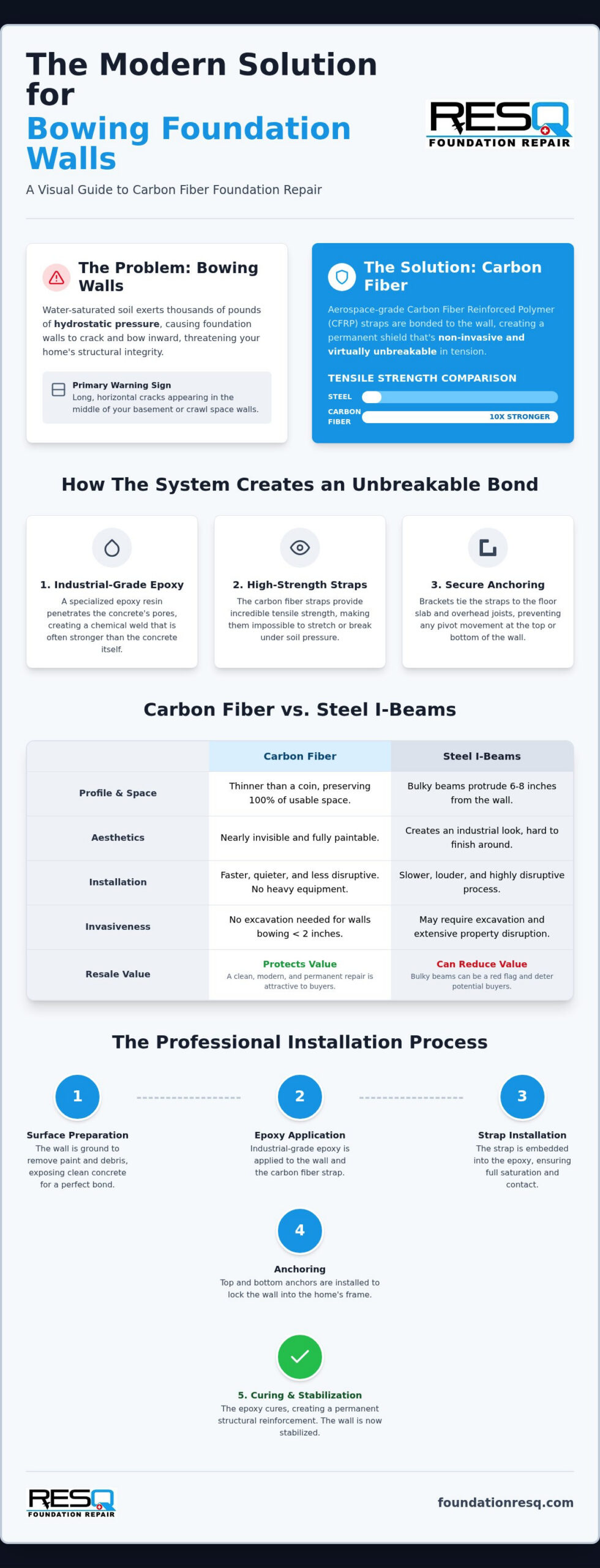
Choosing between carbon fiber and steel I-beams often comes down to the severity of the damage and your long-term goals for the property. While steel has been a traditional choice for decades, homeowners asking what is carbon fiber foundation repair usually discover it is the more efficient modern alternative. Steel beams are heavy, labor-intensive, and protrude four to six inches from the wall. In contrast, carbon fiber straps are nearly flat, allowing you to maintain your square footage without structural interference.
Installation time is another significant factor. A carbon fiber project typically takes just one day to complete because it doesn’t require heavy machinery or floor excavations. Steel beams require bolting into the floor and floor joists, which is a much more invasive process. For walls with moderate bowing of two inches or less, carbon fiber provides a more cost-effective value. It offers the same permanent stabilization as steel but with a significantly smaller footprint and a faster turnaround.
Space and Aesthetic Considerations
One of the biggest advantages of carbon fiber is its low profile. Because the straps are as thin as a coin, they don’t prevent you from finishing a basement or performing a crawl space encapsulation. You can’t easily hide a steel beam behind a standard drywall installation without building out the wall even further, which wastes valuable space.
We often refer to this as the “invisible repair.” Once the epoxy has cured, the straps can be painted over to match the rest of your wall. This is a vital feature for protecting your home’s resale value. Prospective buyers are often intimidated by the sight of bulky industrial steel beams, which can make a home harder to sell. Carbon fiber provides a clean, professional look that reassures buyers the structure is secure without looking like a construction site.
Performance in the Florida Climate
Tallahassee’s high humidity and heavy rainfall create a unique challenge for structural components. Steel is naturally susceptible to corrosion and rust, especially in damp crawl spaces or basements where moisture levels are hard to control. If the protective coating on a steel beam is scratched during installation, the humid Florida air can lead to structural degradation over time.
Carbon fiber is completely immune to moisture, rust, and chemical degradation. It thrives in the humid environments common to our region. This durability ensures that the stabilization remains permanent without the need for ongoing maintenance or rust-proofing. By choosing a material that is naturally resistant to the elements, you’re building a long-term barrier that will protect your home’s foundation for the life of the structure.
The Professional Installation Process
Professional installation is a methodical process that ensures the structural integrity of your home remains intact for decades. When we explain what is carbon fiber foundation repair to homeowners, we emphasize that the success of the system depends on precision. The process begins with a comprehensive structural assessment. Our technicians determine the exact spacing and count of the straps based on the height of your wall and the degree of the inward bow. This custom approach ensures that the load is distributed correctly across the entire foundation.
Once the plan is set, the actual installation follows a strict sequence to create a permanent bond. We grind the wall surface to reveal clean, porous concrete, which is essential for the epoxy to penetrate deeply. After preparation, we apply a base coat of industrial epoxy and carefully embed the carbon fiber strap into the resin. A final saturation coat is applied over the strap to seal the system, resulting in a smooth finish that is ready for the next phase of your home improvement project.
Preparing the Foundation Surface
The most vital part of the installation isn’t the strap itself, but the preparation of the concrete. To achieve a true mechanical bond, we must remove all paint, dirt, and loose concrete. This ensures the epoxy resin can anchor itself into the masonry. If there are existing cracks in the wall, we identify and fill them before the strap is applied. This creates a flat, structurally sound surface that allows the carbon fiber to work at maximum efficiency. In our humid Tallahassee climate, we also verify that the wall is sufficiently dry to ensure the resin cures with full strength.
If you have noticed horizontal cracking or bowing in your basement or crawl space, it is important to act before the damage worsens. You can schedule a professional inspection to determine if your foundation is a candidate for this stabilization method.
Finishing Touches and Aesthetics
Homeowners often worry that structural repairs will leave their basement looking like a construction site. Carbon fiber is the best solution for those who want a finished look. The system typically takes about 24 hours to cure fully, after which it becomes a permanent part of the wall. Unlike bulky steel beams, these straps are incredibly thin and can be painted over with standard basement paint. This allows the repair to blend seamlessly into the wall, making it nearly invisible to the naked eye.
After the installation is complete, we perform a thorough post-installation inspection. We verify the bond integrity of every strap and ensure the top and bottom anchors are securely tied into the home’s framing and floor slab. This final check provides the reassurance that your home is protected against soil pressure and that its resale value is preserved through a professional, warrantied repair.
Protecting Your Tallahassee Home with Foundation ResQ
Tallahassee homes face unique environmental pressures that require specialized structural knowledge. The expansive red clay common throughout North Florida puts immense stress on foundation walls, especially during our heavy rain seasons. When local homeowners ask what is carbon fiber foundation repair, they are looking for a remedy tailored to these regional conditions. We focus on long-term outcomes, providing a stable presence for residents who want to protect their property’s structural health against the elements.
Our team specializes in foundation stabilization specifically designed for the local geology. We often recommend a comprehensive approach to home health. This frequently involves integrating structural reinforcements with crawl space encapsulation Tallahassee. By addressing both the bowing wall and the moisture levels in the soil, we create a multi-layered defense that prevents future movement and protects the home from mold or wood rot.
The Foundation ResQ Difference
As a Groundworks brand, we utilize high-grade materials that have been tested across thousands of residential projects. Our specialists are trained to understand the specific behavior of North Florida soil, which behaves differently than the sandy coastal regions. This localized expertise allows us to determine the exact placement of carbon fiber straps to maximize their effectiveness. We pride ourselves on being a helpful neighbor rather than a flashy innovator. Our solution-focused approach ensures you receive the repair you need without the pressure of unnecessary upselling.
We stand behind our work with permanent, warrantied structural solutions. Every installation is designed to be a final line of defense for your home. We treat your property with the respect it deserves, ensuring that the work is methodical, thorough, and clean. By choosing a material that is ten times stronger than steel, we provide a high-tech upgrade that restores your home’s integrity and gives you peace of mind for the future.
Schedule Your Free Foundation Inspection
Taking the first step toward a stable home begins with a professional structural evaluation. During a free inspection, our team will measure the deflection in your walls and identify the specific patterns of cracking. We help you determine if your home is a candidate for what is carbon fiber foundation repair or if your foundation requires a different stabilization method. This assessment is designed to move you from a state of uncertainty toward a clear, informed resolution.
A professional inspection provides the reassurance that your home’s safety and resale value are protected. We look for the early warning signs of failure before they become catastrophic. Whether you have a full basement or a crawl space stem wall, our goal is to provide a permanent stop to wall movement. Secure your home’s future by scheduling an evaluation with our steadfast local experts today.
Secure Your Home’s Structural Integrity Today
Choosing the right stabilization method is the first step toward reclaiming your peace of mind. Carbon fiber provides a permanent remedy for bowing walls without the invasive footprint of traditional steel beams. It leverages aerospace-grade technology to create a structural barrier that is ten times stronger than steel in tension. Understanding what is carbon fiber foundation repair allows you to select a solution that maintains your home’s usable space while providing a paintable, nearly invisible finish.
As an A+ rated local Tallahassee service provider, Foundation ResQ delivers Groundworks certified installations designed for the specific soil conditions of North Florida. We offer lifetime transferable warranties on our structural repairs, ensuring that your property remains a safe and valuable asset. Secure your home’s future; schedule your free foundation inspection with Foundation ResQ today.
You don’t have to face foundation movement alone. Our team is ready to provide the steady guidance and technical expertise needed to restore your home’s strength. Take action today to protect your foundation for a lifetime.
Frequently Asked Questions
Is carbon fiber foundation repair permanent?
Carbon fiber foundation repair is a permanent structural solution. Because the material does not stretch, rust, or degrade over time, it provides a stable barrier against soil pressure for the life of the building. Most professional installations include a transferable warranty to ensure long-term protection. This durability makes it a reliable choice for homeowners seeking a final remedy for bowing walls.
Can I paint over carbon fiber foundation straps?
Yes, you can paint over carbon fiber foundation straps once the epoxy has fully cured. The saturation coat creates a smooth, low-profile finish that blends easily with concrete or block walls. Using a standard masonry paint allows the repair to become nearly invisible. This is a major advantage for those planning to finish their basement or maintain a clean appearance in their crawl space.
How much bowing can carbon fiber actually fix?
Carbon fiber is typically recommended for foundation walls that have bowed or deflected two inches or less. Industry standards generally suggest that if a wall has moved more than two inches, it may require more robust solutions like steel I-beams. When determining what is carbon fiber foundation repair suitability for your home, a professional assessment is necessary to measure the exact degree of inward movement.
Does carbon fiber foundation repair increase home value?
This repair protects your home’s resale value by resolving a major structural defect. A bowing wall is a significant red flag for buyers and home inspectors that can lead to failed sales. By providing a permanent, warrantied fix, you reassure potential buyers that the home is structurally sound. This prevents the steep price devaluations often associated with homes that have unresolved foundation issues.
How long does it take to install carbon fiber wall reinforcement?
Most carbon fiber wall reinforcement projects are completed in a single day. Because the process doesn’t involve heavy machinery or extensive excavation, technicians can prep the walls and apply the straps quickly. This minimal disruption is a significant benefit for homeowners compared to more invasive methods. The epoxy reaches its full structural strength within 24 hours, providing immediate stabilization for the foundation.
What is the difference between carbon fiber and wall anchors?
The main difference is the installation method and the footprint. Wall anchors require digging in your yard to bury an anchor plate, which is then connected to a wall plate by a steel rod. Carbon fiber is entirely internal and non-invasive. It bonds directly to the wall surface, making it ideal for properties where exterior excavation is impossible due to landscaping, porches, or property lines.
Is carbon fiber better than steel beams for foundation repair?
Carbon fiber is often the better choice for moderate bowing because it is rust-proof and takes up no floor space. Steel beams are more invasive and protrude several inches from the wall, which can interfere with basement finishing. However, for severe wall failure or movement over two inches, steel beams provide the necessary heavy-duty support that fabric straps cannot offer in those extreme cases.
Can I install carbon fiber foundation straps myself?
No, you should not attempt to install these systems yourself. The effectiveness of what is carbon fiber foundation repair depends entirely on the chemical bond between the epoxy and the concrete. Professional installers use specialized grinders to achieve a specific surface profile and apply industrial-grade resins. Improper installation can lead to bond failure, leaving your home’s structure at risk of further movement or collapse.