
Return on foundation repair is the financial value you recover when you fix a foundation problem, measured against what you spent on the repair. The industry term is return on investment, or ROI, and in the foundation repair context it works differently than a kitchen remodel. You are not adding value. You are protecting the value you already have. Repairing foundation issues before selling typically recovers 70% to 100% of the repair cost by preventing a 10%–20% home value reduction. In high-demand markets, that ROI can reach 150%–200%. Understanding how that math works gives you real leverage when deciding whether to repair, delay, or sell as-is.
What is return on foundation repair and how is it calculated?
Foundation repair ROI measures how much of your repair cost you get back through a higher sale price or avoided price concessions. The calculation is straightforward: divide the value preserved by the cost of the repair, then multiply by 100.
The starting point is what an unrepaired foundation costs you. Homes with foundation problems typically lose 10%–20% of their market value. That loss shows up as buyer discounts, failed inspections, and deals that fall apart entirely. On a $400,000 home, a 15% discount equals $60,000 in lost equity.
Several factors shift your ROI up or down:
- Severity of damage. A hairline crack costs $250–$800 to seal. Major structural settling requiring pier underpinning runs $10,000–$30,000 or more. Minor repairs almost always produce higher percentage returns.
- Home price bracket. Repair costs are largely fixed by structural requirements, but the discount buyers demand scales with home price. On a $1,000,000 home, a 20% as-is discount equals $200,000, while the repair might cost $30,000.
- Local market demand. In competitive markets, buyers tolerate less risk. Foundation problems eliminate a larger share of your buyer pool, which drives prices down faster.
- Buyer financing rules. FHA and VA loans require homes to meet minimum property standards. An unrepaired foundation disqualifies your home from those loan programs entirely.
Pro Tip: Hire an independent structural engineer for $350–$1,200 before you get contractor bids. An engineer gives you an unbiased repair scope. Contractors who sell specific repairs may recommend more work than the structure actually needs.
What are the typical costs and repair methods that influence ROI?
National average foundation repair costs in 2026 range between $2,200 and $8,500 for most homeowners, with minor crack sealing at the low end and major underpinning at the high end. Knowing what each method costs helps you match the repair to the problem and avoid overspending.
| Repair Method | Typical Cost Range | Permanence |
|---|---|---|
| Crack sealing (epoxy/polyurethane injection) | $250–$800 | Moderate (5–10 years) |
| Mudjacking (slab lifting) | $500–$1,500 | Low to moderate (may resettle) |
| Polyurethane foam injection | $1,000–$2,500 | Moderate to high |
| Push piers | $1,000–$3,000 per pier | High (lifetime stability) |
| Helical piers | $1,500–$3,500 per pier | High (lifetime stability) |
The method you choose directly affects your ROI. Push piers and helical piers offer lifetime stability, while mudjacking may settle again within a few years. A temporary fix that fails before closing destroys buyer confidence and your negotiating position.
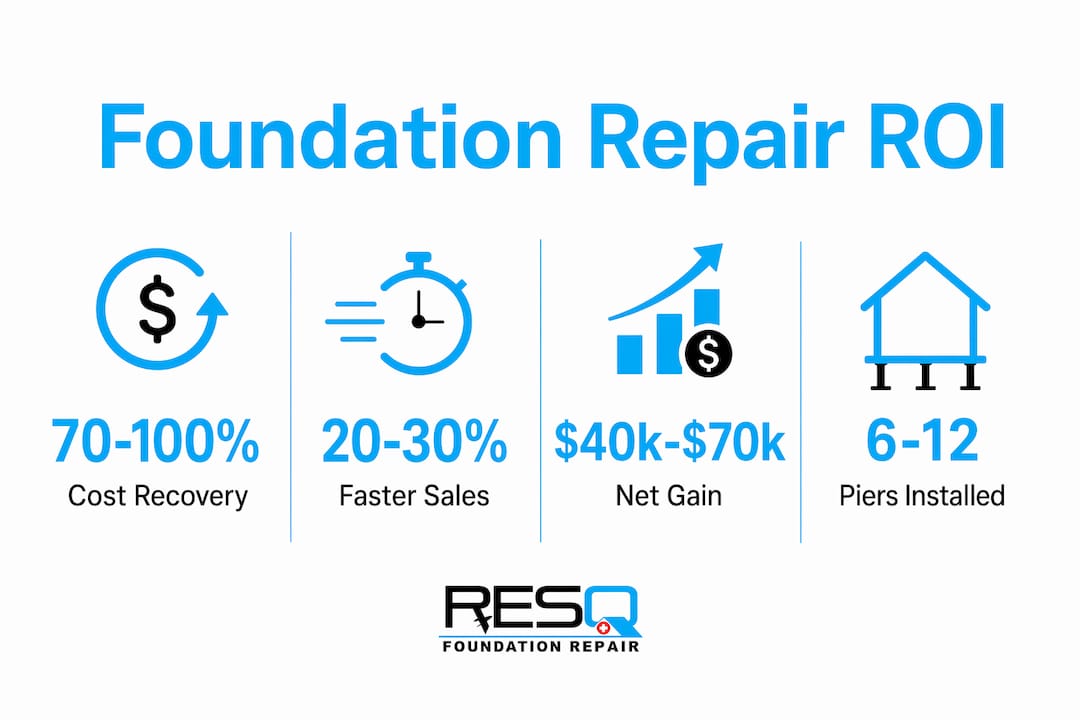
Pier installations typically require 6–12 piers per project. That puts a full pier job between $6,000 and $36,000 depending on pier type and count. That range sounds wide, but the structural engineer report narrows it to exactly what your home needs.
Pro Tip: Get at least three contractor bids and bring your structural engineer report to each meeting. Bids that exceed the engineer’s recommended scope are a red flag. Bids that fall far below it may indicate shortcuts.
The permanence of the repair also affects resale value directly. Buyers and their agents ask whether the fix is a patch or a permanent solution. Transferable warranties on permanent repairs increase buyer confidence and support higher offers. A lifetime warranty that transfers to the new owner is a selling point, not just a receipt.
How does foundation repair impact home value and marketability?
Foundation problems do not just reduce your sale price. They shrink your buyer pool, extend your time on market, and hand negotiating power to buyers. Repaired homes sell 20%–30% faster and attract a larger buyer pool, including FHA and VA borrowers, compared to homes with known foundation issues.

The table below shows how the two scenarios compare for a $450,000 home with a $20,000 foundation repair need.
| Scenario | List Price | Likely Sale Price | Net to Seller |
|---|---|---|---|
| Sell as-is with known issue | $450,000 | $360,000–$382,500 (15–20% discount) | $360,000–$382,500 |
| Repair first ($20,000 cost) | $450,000 | $440,000–$450,000 | $420,000–$430,000 |
The repaired scenario nets $40,000–$70,000 more after paying for the repair. That gap is your ROI in dollar terms.
Beyond price, consider what foundation problems do to buyer psychology. Most buyers walk away from a home with a flagged foundation, even when the repair is straightforward. Those who stay use the issue as leverage to demand concessions far above the actual repair cost. Early foundation repair helps sellers avoid deal-breaker issues in inspections and yields stronger negotiating positions with fewer concessions.
Documented repairs with transferable warranties also build trust. A buyer who sees a completed structural engineer report, a permitted repair, and a lifetime warranty from a qualified contractor feels confident. That confidence translates directly into stronger offers and fewer contingencies. You can review real repair outcomes to see how this plays out in practice.
What are the financial risks of delaying foundation repair?
Waiting to repair a foundation problem is not a neutral decision. It is a choice to let the damage grow and your costs multiply.
- Repair costs escalate quickly. Ignoring foundation problems can increase repair costs five-fold over several years. A $5,000 repair today can become a $25,000 repair within three years as settling accelerates and secondary damage spreads to walls, floors, and plumbing.
- Home insurance does not cover it. Standard homeowner policies exclude foundation settlement and structural movement. You absorb the full cost, and it grows while you wait.
- Buyers demand outsized concessions. When a foundation problem surfaces during inspection, buyers do not ask for the repair cost. They ask for the repair cost plus a risk premium. That premium often doubles the actual repair estimate.
- Deals fall apart entirely. FHA and VA lenders will not fund a home with an unresolved structural issue. Losing those buyers cuts your pool by a significant margin and forces you to accept lower offers from cash buyers who price in maximum risk.
- The discount scales with home value. Higher-priced homes gain exponentially more from the same fixed-cost repair. The longer you wait, the more equity you expose to that discount.
The best time to repair is on your own timeline, before listing. Fixing foundation issues on the homeowner’s schedule is more cost-effective than negotiating price concessions near closing, when you have the least leverage.
How to maximize your foundation repair investment returns
Getting the best financial outcome from a foundation repair is not just about choosing the right method. It is about managing the entire process from diagnosis to documentation.
- Start with an independent structural engineer. An unbiased repair scope from a licensed engineer costs $350–$1,200 and protects you from unnecessary work. Use that report as your baseline for every contractor conversation.
- Select qualified contractors. Check licensing, insurance, and references. Review the foundation repair contractor selection process to understand what separates a qualified bid from a risky one.
- Get multiple bids. Three bids minimum. Compare scope, not just price. A bid that omits waterproofing or drainage correction may look cheaper but leave the root cause unresolved.
- Prioritize permanent solutions. Push piers and helical piers cost more upfront but carry lifetime warranties. Temporary fixes like mudjacking may require repeat spending within a few years, which erodes your net ROI.
- Document everything. Keep the engineer report, permits, contractor invoices, and warranty documents in one file. Buyers and their agents will ask for this package. Having it ready signals professionalism and reduces buyer hesitation.
- Time the repair before listing. Repairs completed before listing give buyers nothing to negotiate against. Repairs disclosed but not completed invite speculation about cost and scope.
- Pair repairs with complementary improvements. Foundation repair combined with plumbing upgrades and cosmetic staging creates a stronger overall impression. Buyers evaluate homes holistically, and a solid foundation paired with a well-presented interior supports full-price offers.
Pro Tip: Ask your contractor whether the warranty is transferable to the next owner. A non-transferable warranty has almost no resale value. A transferable lifetime warranty is a concrete selling point you can put in your listing.
Key Takeaways
Foundation repair ROI is a value-preservation strategy: homeowners who repair before selling consistently net more than those who sell as-is, even after paying full repair costs.
| Point | Details |
|---|---|
| ROI range | Repairing before selling recovers 70%–200% of repair costs by preventing a 10%–20% home value loss. |
| Delay multiplies costs | Ignoring foundation problems can grow a $5,000 repair into a $25,000 repair within three years. |
| Higher-value homes benefit most | On a $1,000,000 home, a 20% as-is discount costs $200,000 versus a $30,000 repair. |
| Permanent repairs outperform patches | Push piers and helical piers carry lifetime warranties that transfer to buyers and support stronger offers. |
| Documentation drives buyer confidence | Engineer reports, permits, and transferable warranties reduce contingencies and accelerate closing. |
The number homeowners miss when they calculate foundation repair ROI
Most homeowners focus on the repair invoice and compare it to the sale price bump. That is the right instinct, but it misses two costs that quietly destroy ROI.
The first is the cost of time. Every month a foundation problem sits unrepaired, the damage spreads. Walls crack. Doors stick. Moisture finds new paths. I have seen homeowners delay a $7,000 repair for 18 months and end up with a $22,000 scope because the settling pulled a load-bearing wall out of plumb. The repair cost tripled. The sale price recovered less than the original repair would have cost.
The second is the cost of buyer psychology. Buyers do not price foundation problems rationally. They price them emotionally. A flagged foundation triggers fear, and fear is expensive. Buyers who stay in the deal after a foundation flag routinely demand two to three times the actual repair cost in concessions. I have watched sellers lose $40,000 in negotiated credits on a repair that would have cost $12,000 if done six months earlier.
The ROI calculation looks clean on paper. In practice, the best return comes from acting early, using an independent engineer, and choosing permanent repairs with transferable warranties. Peace of mind is real, but it is also the byproduct of a financially sound decision. Fix the foundation before it becomes the reason your deal falls apart.
— Kayle
How Foundationresq helps you protect your home’s value
Foundationresq specializes in permanent foundation repair solutions for homeowners in Tallahassee, FL and the surrounding area. Every project starts with a thorough assessment so you understand exactly what your home needs before any work begins.
Foundationresq’s permanent repair services include push pier and helical pier installation, crack sealing, crawl space remediation, and concrete leveling. All permanent repairs come with documentation designed to support your resale process, including transferable warranties that give buyers confidence. If you are preparing to sell or simply want to stop the damage from growing, Foundationresq offers free inspections and financing options to make the decision easier. Explore the full service catalog to find the right solution for your home.
FAQ
What is the average ROI on foundation repair?
Repairing a foundation before selling typically recovers 70%–100% of the repair cost by preventing a 10%–20% home value reduction. In high-demand markets, ROI can reach 150%–200%.
Does foundation repair increase home value?
Foundation repair primarily preserves existing equity rather than generating new appreciation. It prevents the 10%–20% price discount buyers demand for unrepaired structural issues.
How much does foundation repair cost in 2026?
National average foundation repair costs range from $2,200 to $8,500 for most homeowners. Minor crack sealing starts at $250, while major pier underpinning can exceed $30,000.
Is it better to repair a foundation before selling or sell as-is?
Repairing before selling almost always nets more money. Repaired homes sell 20%–30% faster and attract FHA and VA buyers, which expands your buyer pool and supports full-price offers.
What happens if I delay foundation repair?
Delaying foundation repair can multiply costs five-fold. A $5,000 repair left unaddressed for three years can grow to $25,000 as settling accelerates and secondary damage spreads.
Recommended
- Foundation Repair Cost Estimator: A 2026 Homeowner’s Guide – Tallahassee Foundation Repair | Foundation ResQ
- Permanent Foundation Repair Solutions: A Homeowner’s Guide to Lasting Stability – Tallahassee Foundation Repair | Foundation ResQ
- Who to Call When Your Foundation Cracks: Expert Contractors – Tallahassee Foundation Repair | Foundation ResQ