
That fuzzy white growth on your floor joists isn’t just a cosmetic issue; it’s a “check engine light” for your home’s structural health. Finding white mold on wood in crawl space areas often signals a moisture crisis that can threaten both your air quality and your home’s stability. In the humid climate of Tallahassee, these fungal colonies can spread quickly if they aren’t addressed at the source.
It’s understandable to feel concerned when you notice musty odors or strange white patches under your house. You might be confused about whether you’re looking at dangerous mold or simple mineral deposits, and the fear of structural floor failure is a heavy burden for any homeowner. We believe you deserve a home that feels solid and smells fresh. This article provides the clarity you need to identify the growth, understand its link to wood rot, and discover the permanent solutions that keep your crawl space dry. We’ll examine modern remediation techniques and the protective benefits of encapsulation to ensure your home remains a safe, stable environment for years to come.
Key Takeaways
- Learn to distinguish between active fungal growth and harmless mineral deposits to accurately assess your crawl space health.
- Discover why finding white mold on wood in crawl space beams is a critical warning sign for potential structural wood rot and floor failure.
- Understand how North Florida’s humidity and the “Stack Effect” pull moisture and musty odors from the soil into your home’s living areas.
- Identify the limitations of DIY cleaning methods and why professional abrasive cleaning is required to remove the deep root systems of mold.
- Explore how crawl space encapsulation and specialized dehumidification create a permanent barrier that stops mold from returning for good.
Identifying White Mold on Wood: Is it Fungus or Efflorescence?
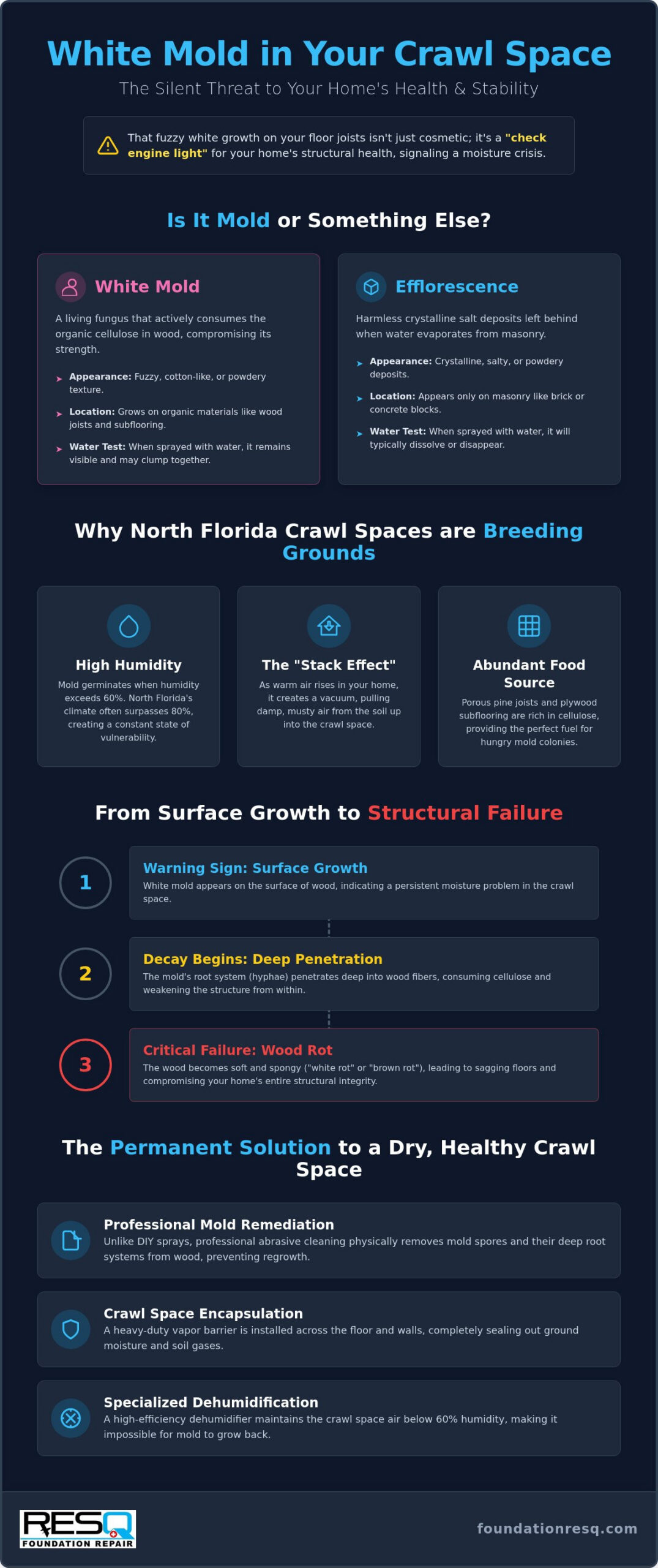
Finding white mold on wood in crawl space areas is often a startling discovery for homeowners. This growth is a living organism, a type of fungus that thrives on the organic cellulose found in your floor joists and subflooring. Unlike simple dust or debris, it doesn’t just sit on the surface. It actively consumes the material it inhabits. You can usually identify it by its distinct textures, which range from a fine, powdery coating to a thick, fuzzy, or filamentous blanket that looks almost like cotton. These thread-like structures, known as hyphae, are the roots of the mold that reach into the wood to extract nutrients.
If you aren’t sure what you’re looking at, try the “squirt test.” Spray a small amount of water on the white patch. If the substance seems to disappear or dissolve instantly, it’s likely mineral deposits. If it stays fuzzy or clumps together while remaining visible, you’re dealing with a fungal colony. While the presence of white mold on wood in crawl space beams doesn’t always mean the wood is currently rotting, it acts as a critical early warning system. This surface growth is often a precursor to more aggressive wood-decay fungus. These organisms penetrate deep into the fibers, eventually leading to “white rot” or “brown rot” that compromises the integrity of your home’s skeleton.
White Mold vs. Efflorescence
Efflorescence is a common sight in Tallahassee crawl spaces, but it’s frequently mistaken for mold. It consists of crystalline salt deposits left behind when water evaporates from porous materials like brick or concrete foundation blocks. The primary difference lies in the surface. Efflorescence almost exclusively appears on masonry, whereas mold requires an organic food source like wood. Both indicate a moisture problem that needs professional attention, but only mold represents a biological threat to your indoor air quality and structural components.
Common Types of White Mold in Crawl Spaces
In our local North Florida environment, Penicillium and Aspergillus are the most frequent culprits found in damp crawl spaces. These species often start as white surface growth before maturing into shades of green or gray as they produce spores. The color can also shift based on the specific humidity levels or the type of wood they’re feeding on. Because many wood-boring fungi begin as simple white spots, treating any visible growth early is the best way to prevent long-term structural damage. Identifying the specific type is less important than addressing the humidity that allows them to thrive.
Why Tallahassee Crawl Spaces Are Breeding Grounds for White Mold
Tallahassee presents a unique environment that is often ideal for fungal growth. Our region’s high relative humidity acts as the primary catalyst for most structural issues under the home. When humidity levels in a confined area exceed 60 percent, mold spores begin to germinate on organic surfaces. Because North Florida’s climate regularly pushes outdoor humidity well above 80 percent, most traditional crawl spaces are in a constant state of vulnerability. This moisture isn’t just a seasonal nuisance; it’s a persistent threat to your home’s stability.
The “Stack Effect” significantly worsens this problem. As warm air rises through your living spaces and exits through the attic, it creates a vacuum in the lower levels of your home. This upward pressure pulls damp, heavy air from the soil directly into your crawl space. This cycle continuously feeds the white mold on wood in crawl space structures by providing a steady supply of moisture and heat. Tallahassee’s specific soil composition also plays a role. Our clay-heavy soil tends to hold water longer than sandy coastal soils, leading to persistent groundwater seepage that lingers against your foundation walls long after the rain stops.
Organic food sources are abundant in these areas. Most homes in our community rely on untreated pine joists and plywood subflooring. These materials are porous and high in cellulose, which serves as the perfect fuel for mold colonies. Once the moisture is present, the fungus has everything it needs to begin the process of colonization and eventual decay.
The Impact of High Humidity and Temperature
Seasonal rains in the Florida panhandle saturate the ground, which then releases moisture vapor directly into the area under your home. In a traditional vented crawl space, there is very little natural airflow to dry this out. Instead, those vents often allow more humid air to enter, creating a stagnant, greenhouse-like environment. This trapped air facilitates the rapid spread of mold across your floor’s support system.
Plumbing Leaks and Drainage Issues
Internal moisture sources are just as problematic as the weather. Preventing moisture in crawl space environments starts with identifying poor drainage or small plumbing leaks. Even a tiny, undetected pinhole leak provides enough localized water to trigger a colony. Additionally, cold water pipes often “sweat” when they come into contact with the hot, humid air under your house. This condensation drips directly onto the wood, creating the damp conditions required for white mold on wood in crawl space beams to expand. If you’ve noticed musty smells or dampness, you can consult with a local expert to evaluate your home’s unique drainage and moisture protection needs.
The Structural Risks: How White Mold Leads to Wood Rot
It’s vital to distinguish between mold that lives on your wood and fungi that live inside it. While white mold on wood in crawl space areas is often a surface-level resident, it acts as a biological gateway. Mold primarily feeds on sugars and starches on the wood’s surface, but its presence confirms that moisture levels are high enough for wood-decay fungi to move in. These more aggressive organisms don’t just sit on the beam; they consume the lignin and cellulose that give your floor joists their strength. This progression is what leads to structural failure over time.
As these decay fungi take hold, you’ll likely see a transition from fuzzy surface growth to “white rot” or “brown rot.” White rot leaves the wood looking fibrous and bleached, while brown rot causes the wood to crack into small, brick-like cubes. Identifying Wood Rot in Crawl Space structures early is the only way to prevent a total loss of load-bearing capacity. Beyond the fungi themselves, mold-weakened wood acts as a beacon for secondary pests. Termites and carpenter ants are naturally drawn to softened, damp wood because it’s significantly easier to tunnel through than dry, healthy timber. This creates a dual threat where biological decay and insect damage work together to compromise your home’s skeleton.
Signs of Structural Decay
You don’t always need to be a professional to spot the early warning signs of decay. Look closely at your joists for “checking,” which are deep cracks that run across the grain rather than with it. If you notice that your floors feel bouncy or uneven in the living areas above, the supports below have likely lost their rigidity. A simple way to check is to probe the wood with a screwdriver; if the metal sinks in easily or the wood feels spongy, the internal fibers are already failing. These physical changes indicate that the white mold on wood in crawl space beams has transitioned into active rot.
Air Quality and Health Hazards
The health of your crawl space directly dictates the health of your family. Because of the “Stack Effect” we discussed earlier, approximately 50 percent of the air you breathe on your first floor originates from the crawl space. This means that every time your HVAC system runs, it pulls mold spores and musty odors into your living environment. Common symptoms of this exposure include persistent respiratory irritation, unexplained allergies, and headaches. These risks are even higher for pets and immunocompromised family members who are more sensitive to airborne fungal particulates. Protecting your home’s structure is also about protecting the people inside it.
How to Get Rid of White Mold in Your Crawl Space (Professional Steps)
While it’s tempting to reach for a bottle of bleach when you spot fungal growth, this common DIY approach often does more harm than good. Bleach is primarily composed of water. When applied to porous timber, the chlorine stays on the surface while the water soaks deep into the wood fibers. This often provides the white mold on wood in crawl space beams with the exact hydration it needs to grow back stronger. Professional remediation focuses on removing the hyphae, or the root systems, that have embedded themselves into the grain, ensuring the problem is solved at the source.
Professional remediation involves a rigorous physical removal process. Abrasive cleaning methods like soda blasting or specialized sanding are the industry standard for 2026. Soda blasting uses a high-pressure stream of sodium bicarbonate to physically lift the mold from the wood without stripping the structural material. This is followed by comprehensive HEPA vacuuming. This specialized vacuuming captures microscopic, dormant spores that have settled on surfaces throughout the crawl space. If these spores aren’t removed, they can reactivate the next time the humidity spikes, leading to a repeat infestation.
Once the wood is clean and dry, we apply commercial-grade antimicrobial coatings. These coatings act as a protective shield, preventing any remaining spores from re-colonizing the organic material. This multi-step process ensures the solution is permanent rather than a temporary cosmetic fix. If you’ve discovered growth under your home, it’s time to seek professional mold remediation services to restore your foundation’s health and stability.
Step 1: Professional Inspection and Testing
We begin by assessing the extent of the moisture intrusion and identifying the fungal species present. A critical part of this phase is testing the Wood Moisture Content (WMC). To stop active growth and prevent future outbreaks, the WMC must be brought below 19 percent. We also evaluate the structural integrity of your joists to determine if any supports have been weakened to the point of requiring reinforcement or replacement. This data-driven approach ensures we address the root cause of the white mold on wood in crawl space structures.
Step 2: Remediation and Spore Containment
Protecting your living area is our priority during the cleanup. We set up negative air pressure using high-efficiency air scrubbers to ensure spores don’t migrate into your home during the cleaning process. Any contaminated materials that are too damaged to salvage, such as saturated insulation or severely rotted subflooring, are carefully removed and disposed of according to strict safety protocols. If you’re looking for expert advice on material replacement, you can check out Cape Coral Insulation for professional insights. This containment prevents the “Stack Effect” from carrying contaminants into your breathing air while the work is performed.
Permanent Prevention: Crawl Space Encapsulation and Moisture Control
Remediating existing fungal growth is only the first half of a successful structural recovery. To ensure that white mold on wood in crawl space areas never returns, you must transform the environment under your home. Crawl space encapsulation serves as the ultimate seal of protection for your foundation. This process involves lining the floor and walls with a heavy-duty, reinforced vapor barrier. This barrier creates a permanent physical block that stops moisture from the soil from evaporating into your floor joists. By isolating your home’s skeleton from the damp earth, you remove the primary fuel source that mold needs to survive.
For a complete solution, we recommend a deep dive into Crawl Space Encapsulation Tallahassee homeowners can trust. A properly sealed space requires more than just a liner; it needs active climate control. A dedicated crawl space dehumidifier is essential for maintaining a stable relative humidity of approximately 50 percent. Unlike a standard basement unit, these professional-grade systems are designed to operate in the specific temperature and airflow conditions found under a home. Maintaining this dry environment ensures that wood moisture content remains low, making it biologically impossible for mold or wood-decay fungi to re-establish a colony.
The Role of Sump Pumps and Drainage
In the Florida Panhandle, heavy seasonal storms can lead to sudden groundwater intrusion. While a vapor barrier stops moisture vapor, a sump pump system is necessary to handle liquid water that might seep under the foundation footing. These systems work in tandem with proper exterior grading and gutter extensions to direct water away from the “envelope” of your home. When your drainage and encapsulation systems work together, they create a comprehensive shield that keeps your crawl space bone-dry, even during the most intense North Florida rain events.
Why Choose Foundation ResQ for Your Tallahassee Home?
Our team understands the specific geological and climatic challenges facing homeowners in our community. We don’t just offer quick fixes; we provide a methodical, remedy-based approach that addresses everything from initial mold removal to long-term foundation stabilization. As your steadfast local experts, we are committed to the physical health of your building and the safety of your family. We use industry-leading technology and specialized dehumidification systems to provide a permanent resolution to your moisture concerns. If you’re ready to protect your home’s structural integrity, schedule your free crawl space inspection with Foundation ResQ today!
Securing the Future of Your Home’s Foundation
Identifying white mold on wood in crawl space areas is a vital first step toward reclaiming your home’s structural health. We’ve explored how the unique humidity of Tallahassee fuels fungal growth and why surface-level fixes fail to address the underlying moisture crisis. By choosing professional remediation and permanent encapsulation, you’re not just cleaning a symptom; you’re installing a long-term defense system that protects your floor joists from decay and improves your indoor air quality.
Foundation ResQ provides the steadfast local expertise needed to navigate North Florida’s environmental challenges. Our comprehensive mold and structural solutions are backed by the Groundworks Advantage, ensuring your home receives the highest standard of care. We’re committed to delivering a stable, dry environment that restores your peace of mind. You don’t have to manage these complex structural concerns alone. Our team is here to provide the dependable guidance and technical precision your property deserves.
Protect Your Home with a Free Crawl Space Inspection
Taking proactive steps today ensures that your foundation remains strong and your living space remains healthy for many years to come.
Frequently Asked Questions
Is white mold in a crawl space as dangerous as black mold?
All mold species pose health risks, though they affect individuals differently. While “black mold” is often highlighted for its toxicity, white mold species like Penicillium or Aspergillus can still cause significant respiratory irritation, allergies, and headaches. Structurally, the presence of white mold on wood in crawl space areas is a critical warning sign. It indicates that moisture levels are high enough to support wood-decay fungi, which can eventually lead to floor failure if the environment isn’t stabilized.
Can I just spray bleach on the white mold to kill it?
Bleach is ineffective for treating mold on porous surfaces like wood floor joists. Because bleach is primarily water, the chlorine stays on the surface while the water soaks into the wood fibers. This often feeds the mold’s internal root system, known as hyphae, allowing it to return even stronger. Professional remediation requires abrasive cleaning, such as soda blasting, to physically remove the mold roots and ensure the organic material is truly clean.
How much does it cost to remove mold from a crawl space in Tallahassee?
The cost of remediation depends on several factors, including the square footage of your crawl space and the severity of the fungal growth. Every home in the Tallahassee area faces different moisture challenges, from high water tables to clay-heavy soil. Because each situation is unique, a professional inspection is required to provide an accurate estimate. We focus on identifying the root cause of the moisture to ensure your investment leads to a permanent solution rather than a temporary fix.
Will white mold on my floor joists cause my house to collapse?
White mold itself doesn’t eat wood fibers, but it serves as a biological precursor to wood-decay fungi. If the moisture levels that allow white mold to thrive aren’t corrected, more aggressive fungi will eventually move in and consume the cellulose within your joists. This process leads to sagging, bouncy floors and can eventually compromise the entire structural integrity of your home. Finding white mold on wood in crawl space beams is your signal to act before the damage becomes structural.
Does a dehumidifier actually stop mold from growing back?
A professional-grade crawl space dehumidifier is one of the most effective tools for permanent mold prevention. Mold spores require a relative humidity level above 60 percent to germinate and grow. By consistently maintaining your crawl space at approximately 50 percent humidity, you create a desert-like environment where mold cannot survive. When combined with encapsulation, a dehumidifier ensures that the wood moisture content stays well below the threshold required for fungal activity.
How can I tell the difference between mold and wood rot?
Mold typically appears as a fuzzy or powdery coating on the surface of the wood, whereas rot happens within the wood fibers themselves. You can often identify wood rot by looking for deep cracks that run across the grain or by checking for a spongy texture. A simple way to test is to probe the wood with a screwdriver. If the tool easily sinks into the material or the wood crumbles, you’re likely dealing with active wood rot that requires structural reinforcement.
What happens if I ignore white mold in my crawl space?
Ignoring mold growth allows the underlying moisture problem to worsen, which inevitably leads to structural decay and degraded air quality. The “Stack Effect” will continue to pull fungal spores and musty odors from the damp soil into your primary living areas. Over time, the cost of repair will increase significantly as surface mold transitions into deep wood rot, potentially requiring the replacement of floor joists and subflooring that could have been saved with earlier intervention.
Does homeowners insurance cover mold remediation in a crawl space?
Insurance coverage for mold typically depends on the source of the moisture intrusion. Most Florida policies cover mold remediation if it results from a sudden, accidental event, such as a burst pipe. However, damage caused by gradual leaks, high humidity, or poor maintenance is often excluded. It’s also important to note that many Florida homeowners insurance policies have a specific cap, often around $10,000, for mold-related claims. You should review your specific policy details with your agent.