
Concrete replacement is defined as a two-phase construction process: removing an existing slab and pouring a new one. That two-phase structure is exactly why concrete replacement costs more than a fresh pour. You pay for demolition, debris disposal, and site preparation before a single yard of new concrete is ordered. Industry data shows replacement runs $6–$18 per square foot installed, roughly 1.5 to 2 times the cost of comparable new concrete. Add 2026 cement price increases and steel tariffs, and the gap between replacement and new installation keeps widening. Understanding the full cost structure helps you budget accurately and negotiate smarter.
Why concrete replacement costs more: the two-phase problem
Concrete replacement is not one project. It is two separate projects billed together, and that distinction drives the price premium.
The first phase is demolition and removal. A crew must break up the existing slab using jackhammers or saw-cutting equipment, load the debris, and haul it away. Demolition for a 500-square-foot, 4-inch slab runs $1,875–$5,700 on its own. That cost exists entirely outside the price of new concrete. A fresh pour skips this phase completely.
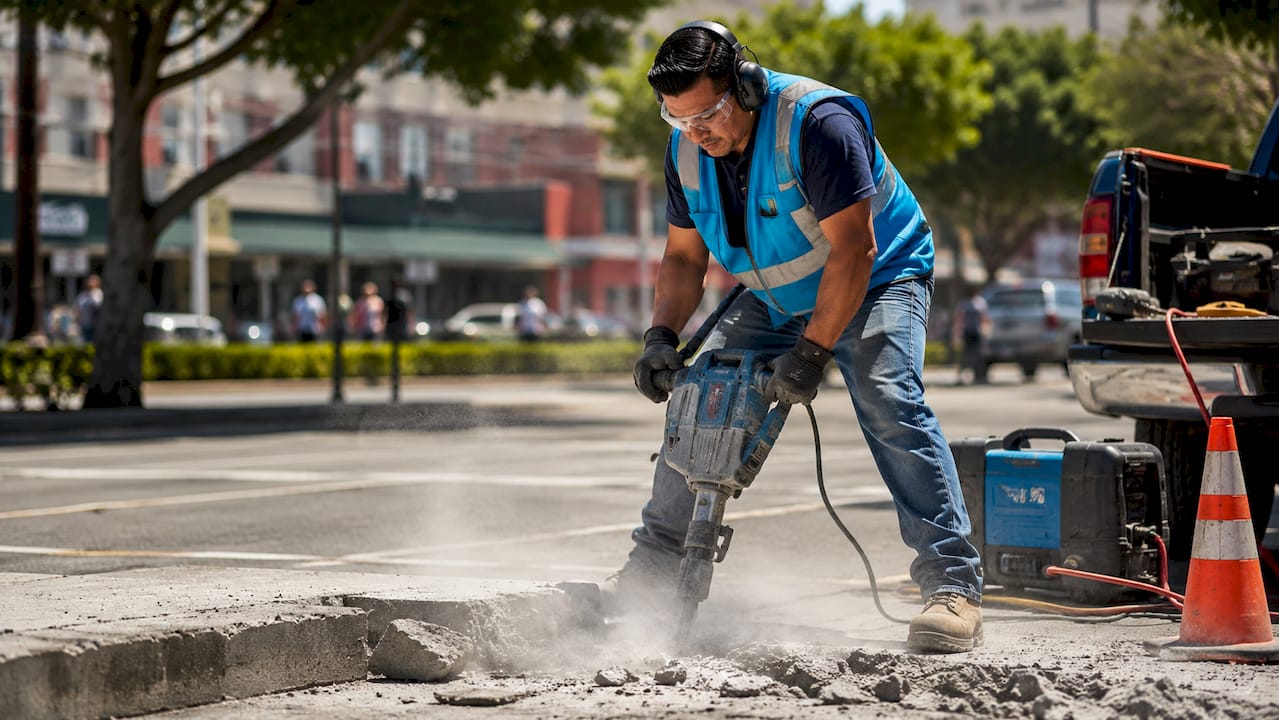
The second phase is the new installation: grading, sub-base preparation, forming, pouring, and finishing. Each phase requires its own crew mobilization, equipment rental, and scheduling window. Stacking both phases on one project means two separate cost structures, not one combined discount.
Pro Tip: Ask your contractor to provide a line-item bid that separates demolition, disposal, site prep, and new pour costs. A single lump-sum quote makes it impossible to compare bids or spot overcharges.
What are the main cost components that make replacement expensive?
Several distinct cost layers combine to push concrete replacement pricing well above a standard installation.
- Demolition labor and equipment. Jackhammer and saw-cut rentals run $75–$400 per day, and labor costs $50–$100 per hour per worker. A two-person crew working a full day on a mid-size driveway adds up fast.
- Disposal fees. Concrete debris is heavy. A 400-square-foot, 4-inch slab generates roughly 5 tons of material. Disposal fees run $25–$100 per ton, adding $250–$500 to the project before any new concrete is ordered.
- Reinforced concrete premiums. Slabs with rebar require manual steel cutting before disposal. Reinforced concrete removal raises labor and equipment time by 30–50% over plain slab work. That premium shows up directly in your quote.
- Site preparation. Once the old slab is gone, the sub-base often needs grading, re-compaction, or repair. Site prep adds $1–$3 per square foot and is non-negotiable if you want the new slab to last.
- New pour costs. Materials, forming, finishing, and curing add $4–$12 per square foot on top of everything above.
Comparing only the per-yard concrete price is the most costly mistake homeowners make. The concrete itself is often the smallest line item once demolition and prep are included.
Pro Tip: When reviewing bids, check whether disposal fees are included or listed as a separate estimate. Some contractors quote removal without factoring in local landfill or recycling charges, which can add hundreds to your final invoice.
How have 2026 material prices and tariffs driven up replacement costs?
Material costs in 2026 are not a temporary spike. Construction cost escalation is now structural, meaning contractors build escalation line items into every bid rather than treating them as contingencies.
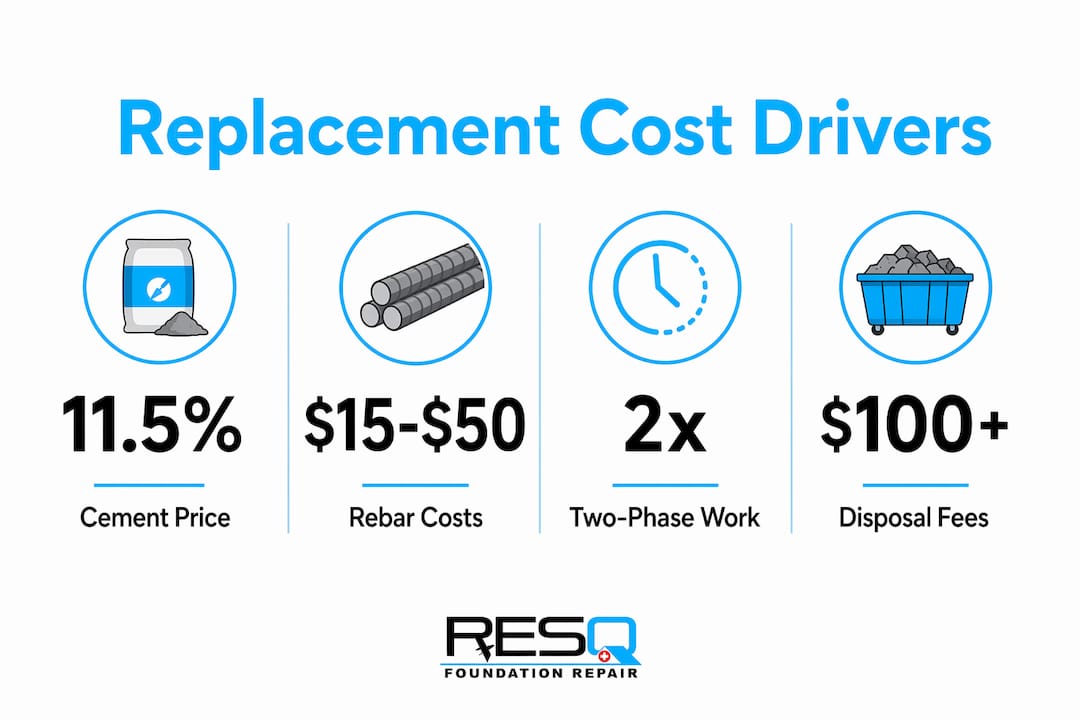
Cement is the biggest driver. Cement prices rose 11.5% year-over-year in 2026 due to capacity constraints and import tariffs on Canadian and Mexican cement. Cement represents 25–30% of ready-mix concrete cost, so an 11% cement increase translates directly into a higher price per yard. The cement industry operates as an oligopoly with high fixed costs, which means prices rarely fall even when demand softens. Homeowners should not expect relief in the near term.
Steel and rebar prices add another layer. Import tariffs pushed rebar costs up 5–10%, adding $15–$50 to reinforcement costs on a residential driveway and more on larger projects. For replacement jobs that require reinforced slabs, this cost hits twice: once during removal and again during the new pour.
| Cost factor | 2026 impact | Typical added cost |
|---|---|---|
| Cement price increase | 11.5% year-over-year rise | Higher per-yard ready-mix price |
| Steel and rebar tariffs | 5–10% price increase | $15–$50 per residential driveway |
| Weekend delivery premium | Scheduling surcharge | $8–$10 per cubic yard |
| Short-load fee | Small order penalty | $40–$60 per cubic yard |
| Disposal fees | Location-dependent | $25–$100 per ton |
Scheduling also affects price. Ready-mix plants prioritize large public infrastructure projects, leaving residential jobs competing for limited delivery windows. Weekend pours carry an $8–$10 per cubic yard premium. Small residential orders trigger short-load fees of $40–$60 per cubic yard. Timing your project for a weekday mid-season delivery can meaningfully reduce the final bill.
Pro Tip: Ask your contractor which ready-mix plant they use and whether they can schedule a full-load delivery on a weekday. Both choices directly affect your material cost.
Why is replacement 1.5 to 2 times more expensive than a new pour?
The 1.5 to 2 times cost multiplier is not an industry markup. It reflects the genuine complexity of running two construction phases on a single site.
- Two mobilizations. Each phase requires a separate crew arrival, equipment setup, and site cleanup. Contractors price mobilization into every visit.
- Increased labor intensity. Demolition is physically demanding and slower than forming and pouring. Safety precautions for debris handling and equipment operation add time to every hour billed.
- Equipment overlap. Jackhammers, skid steers, and dump trucks needed for demolition are separate from the tools used for forming and finishing. Rental costs stack rather than cancel.
- Sub-base remediation. The reason a slab failed often involves soil movement, poor drainage, or inadequate compaction. Ignoring sub-base repair risks costly rework on the new slab within a few years. Fixing the root cause adds cost upfront but protects the investment.
- Longer project timelines. A replacement job that takes three days costs more in labor and equipment than a new pour that takes one. Every additional day on site adds to the total.
Concrete replacement is not a single project with a bonus demolition step. It is two full construction projects sharing a site. The cost multiplier exists because the work genuinely doubles. Homeowners who understand this stop being surprised by quotes and start negotiating from an informed position.
Knowing when leveling beats replacement is equally valuable. Sunken but structurally sound slabs sometimes qualify for polyurethane foam lifting, which skips demolition entirely and cuts cost significantly.
What are practical tips to manage concrete replacement costs?
Controlling high concrete replacement prices requires preparation before you call a single contractor.
- Get itemized bids. Request quotes that separate demolition, disposal, site prep, and installation. Lump-sum bids hide cost overruns and make comparison impossible. Understanding how to read a detailed repair estimate applies directly to concrete bids: the same line-item logic reveals where contractors pad margins.
- Research local disposal fees. Call your county landfill or a local concrete recycler before accepting a contractor’s disposal estimate. Recycled concrete aggregate commands lower tipping fees in many markets, and some recyclers accept clean concrete for free.
- Schedule mid-week and mid-season. Avoid weekend pours and peak summer demand. Both trigger surcharges that add hundreds to a mid-size project.
- Ask about supplementary cementitious materials. Fly ash can replace 15–40% of Portland cement in a mix, saving $6–$8 per cubic yard without sacrificing strength. Fly ash costs roughly $55 per ton versus $165 per ton for Portland cement. Not every contractor offers this option, but it is worth requesting.
- Evaluate alternatives before committing. Concrete overlay or resurfacing works on slabs that are structurally intact but cosmetically damaged. Full replacement is only necessary when the slab has cracked through, heaved, or settled beyond repair. A qualified inspector can tell you which category your slab falls into.
- Address root causes first. Replacing a slab over failing soil or poor drainage guarantees another replacement in five to ten years. Budget for drainage correction or soil stabilization as part of the project, not as an optional add-on.
Pro Tip: Get at least three itemized bids. The spread between the lowest and highest quote on a replacement job often reveals which contractors are accounting for disposal and site prep and which are not.
Key takeaways
Concrete replacement costs 1.5 to 2 times more than a fresh pour because it combines two full construction phases, rising 2026 material prices, and mandatory site remediation into a single project bill.
| Point | Details |
|---|---|
| Two-phase cost structure | Demolition and new installation each carry separate labor, equipment, and mobilization costs. |
| Disposal adds hidden costs | A 400-square-foot slab generates 5 tons of debris at $25–$100 per ton in disposal fees. |
| 2026 material increases | Cement prices rose 11.5% year-over-year; rebar tariffs added 5–10% to steel costs. |
| Site prep is non-negotiable | Sub-base repair at $1–$3 per square foot prevents future slab failure and repeat replacement. |
| Itemized bids protect your budget | Lump-sum quotes hide overcharges; always request line-item breakdowns before signing. |
What I’ve learned about replacement costs that most homeowners miss
The number that surprises homeowners most is not the concrete price. It is the disposal fee. I have seen projects where debris hauling cost more than the new pour materials, especially on reinforced slabs where rebar cutting adds crew hours before a single chunk of concrete leaves the site.
The second surprise is how often the root cause goes unaddressed. A contractor replaces the slab, the homeowner pays the full bill, and two years later the new slab cracks in the same spot because the drainage problem underneath was never fixed. Replacement without remediation is not a repair. It is a delay.
The most reliable way to protect your budget is to treat the bid process like an audit. Every line item should have a unit price and a quantity. If a contractor cannot explain what sub-base repair costs or why disposal is estimated at a specific number, that is a signal worth taking seriously. Rising material costs mean there is less room for error in 2026 than there was three years ago. The margin for a poorly planned project has shrunk considerably.
— Kayle
Foundationresq can help you plan your concrete replacement budget
Concrete replacement is one of the more complex repair decisions a homeowner or property investor faces. Foundationresq specializes in evaluating whether full replacement is actually necessary or whether a less invasive option like concrete leveling makes more financial sense for your specific situation.
The team at Foundationresq brings local Tallahassee market knowledge to every assessment, including current material costs, disposal logistics, and sub-base conditions common to the region. If you are weighing the cost of a full replacement against alternatives, their concrete repair services page outlines the full scope of what a professional evaluation covers. For homeowners concerned about financing a larger project, the repair financing guide walks through options available in 2026. Request a free inspection before committing to any contractor quote.
FAQ
Why does concrete removal cost so much on its own?
Concrete removal requires specialized equipment, heavy labor, and debris disposal, all of which carry separate costs. Removal alone runs $2–$6 per square foot, independent of any new pour.
Does reinforced concrete cost more to remove?
Reinforced concrete with rebar requires manual steel cutting before disposal, which raises labor and equipment time by 30–50% over plain slab removal. That premium applies to both the demolition quote and the disposal fee.
Can I reduce costs by skipping sub-base repair?
Skipping sub-base repair saves money upfront but risks slab failure within a few years, requiring a full second replacement. Addressing soil and drainage issues during the original project is the lower-cost option over time.
Are there alternatives to full concrete replacement?
Concrete leveling using polyurethane foam injection works on slabs that are sunken but structurally intact, skipping demolition entirely. Leveling versus replacement depends on the slab’s structural condition, not just its appearance.
Will concrete prices drop in 2026 or beyond?
Cement industry pricing is structurally resistant to decline because of high fixed production costs and limited domestic capacity. The 11.5% year-over-year increase in 2026 reflects long-term supply constraints, not a temporary spike.
Recommended
- Concrete Leveling vs. Replacement: The Homeowner’s Guide – Tallahassee Foundation Repair | Foundation ResQ
- PolyRenewal Concrete Leveling Cost: 2026 Guide for Tallahassee Homeowners – Tallahassee Foundation Repair | Foundation ResQ
- Beyond the Cracks: Expert Concrete Lifting and Repair Solutions – Tallahassee Foundation Repair | Foundation ResQ
- What Does Concrete Leveling Involve? A Homeowner’s Guide – Tallahassee Foundation Repair | Foundation ResQ