
What if the rain isn’t actually creating that damp odor in your home, but simply waking up a problem that was already there? For many neighbors in our community, a heavy downpour acts as a catalyst for a biological engine hidden beneath the floorboards. It’s a frustrating experience to have your home smelling like a wet basement even though you don’t have one. You might feel a sense of embarrassment when guests visit or worry that persistent odors indicate a more serious structural issue. If you notice a musty smell in house after rain Tallahassee, you’re likely dealing with the effects of our region’s nearly 65 inches of annual rainfall interacting with a vented crawl space.
We understand that you want more than a temporary fix; you want the peace of mind that comes with a healthy, stable home. In this guide, we’ll help you identify the exact source of these smells and explain why they intensify during Florida’s wet season. You’ll learn how the stack effect pulls damp air upward into your living areas and why professional crawl space encapsulation is the most effective remedy. By the end of this article, you’ll have a clear path toward improving your indoor air quality and protecting your home’s integrity for the long term.
Key Takeaways
- Learn why Tallahassee’s unique red clay soil and heavy rainfall create the hydrostatic pressure that triggers persistent odors after a storm.
- Understand the “Stack Effect” and how it pulls damp, contaminated air from your crawl space directly into your primary living areas.
- Discover the professional steps to eliminate a musty smell in house after rain Tallahassee by addressing vapor drive at its source.
- Identify the critical differences between the natural, clean scent of rain and the stale odors that indicate hidden mold growth or structural moisture.
- Explore why crawl space encapsulation provides a permanent, protective barrier that improves indoor air quality and safeguards your home’s structural health.
Why Your Tallahassee Home Smells Musty After Heavy Rain
The immediate, earthy odor that fills your home during a storm isn’t just a sign of the weather changing. It’s often the first indication of vapor drive occurring beneath your feet. Vapor drive is the process where high-pressure outdoor moisture moves toward lower-pressure indoor air. When our local red clay becomes saturated, it acts like a dense sponge, holding onto water and creating significant force against your home’s foundation. This pressure doesn’t just move liquid water; it pushes stagnant air, soil gases, and moisture through porous concrete and into your crawl space or living areas.
The Role of Tallahassee’s Climate and Soil
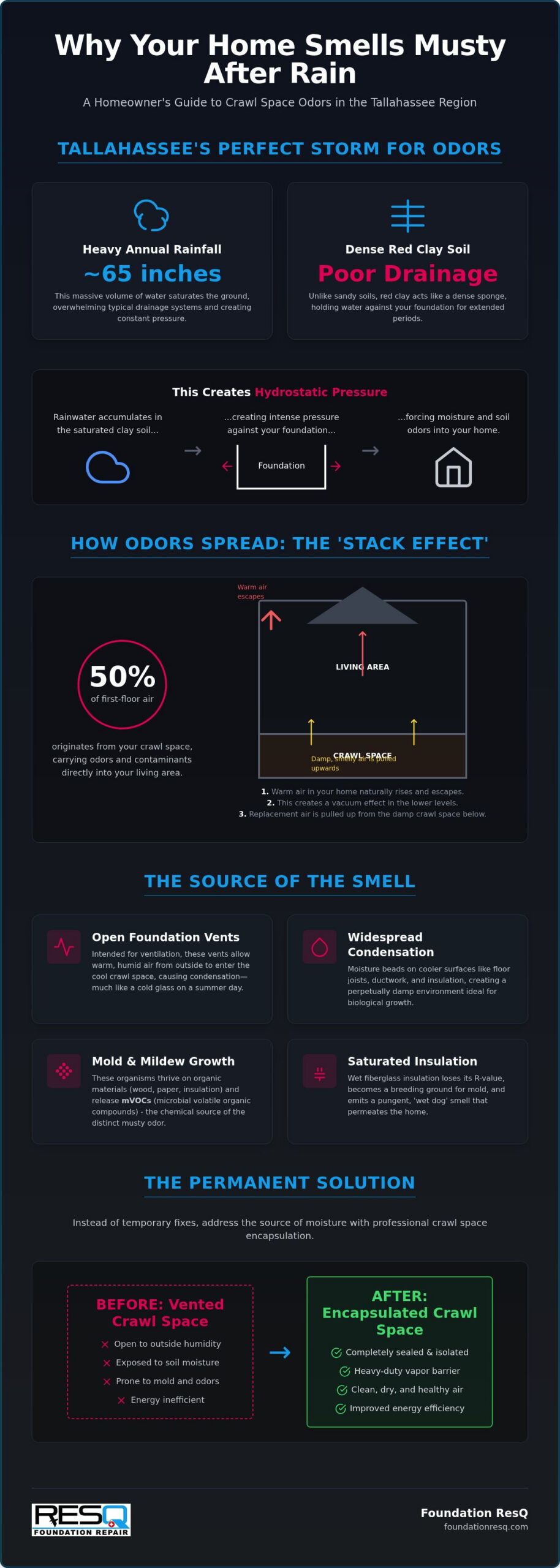
Tallahassee receives nearly 65 inches of rain annually, making it one of the wettest cities in the state. Our storms are frequently intense, often dropping 5 or more inches of water in a single afternoon. This massive volume of water quickly overwhelms standard residential gutters and drainage systems. Because North Florida features a high water table and rolling red clay hills, the ground remains saturated long after the clouds clear. While many residents blame “Florida humidity” for a musty smell in house after rain Tallahassee, the outdoor air is only half the story. The real culprit is the water trapped in the soil directly outside your foundation walls, which has nowhere to go but toward the dry interior of your home.
Hydrostatic Pressure: Pushing Odors Upward
As rainwater accumulates in the soil, it creates hydrostatic pressure. This is the physical weight of water pressing against your foundation. This force is powerful enough to push moisture through microscopic cracks in masonry or foundation slabs. This process often releases geosmin, a chemical compound produced by soil bacteria that creates a distinct, pungent earthy scent. In homes with vented crawl spaces or older slab foundations, this pressure acts as a pump, forcing damp air and organic odors upward.
This movement is often accelerated by the ‘Stack Effect’, a phenomenon where rising warm air in the home pulls replacement air from the damp ground below. These smells are particularly prominent in Tallahassee because our local geology prevents quick drainage. This keeps the “biological engine” of a damp crawl space active for days or even weeks after a storm. Understanding that the soil itself is pushing these odors into your home is the first step toward finding a permanent structural solution rather than a cosmetic fix.
The Crawl Space Connection: How the ‘Stack Effect’ Works
Many homeowners are surprised to learn that their indoor air quality is directly tied to the condition of the earth beneath their home. Up to 50% of the air you breathe on the first floor originates in your crawl space, moving upward through a process known as the Stack Effect. This physical phenomenon occurs because warm air is less dense and naturally rises, eventually escaping through the roof or upper-story windows. As this air leaves, it creates a pressure imbalance in the lower levels of the building. Your home acts like a vacuum, sucking up crawl space air through floorboards and utility penetrations to fill the void. When rain increases the humidity levels under your home, the Stack Effect carries those concentrated musty odors directly into your main living areas.
Anatomy of a Damp Crawl Space After Rain
Traditional foundation vents were designed to allow air circulation, but in the humid North Florida climate, they often serve as gateways for moisture. During a Tallahassee downpour, the outdoor humidity levels reach 100%. This warm, wet air enters the vents and immediately hits the cooler temperatures of the shaded crawl space. This temperature drop causes the air to reach its dew point, resulting in heavy condensation on floor joists, ductwork, and insulation. Saturated fiberglass insulation often takes on a pungent ‘wet dog’ or mildew scent that lingers for days. Because these vents remain open during the storm, they actually make the musty smell in house after rain Tallahassee significantly worse by inviting more moisture inside.
Biological Growth and Volatile Organic Compounds (VOCs)
The sharp, stale odor associated with damp homes is actually a chemical byproduct of active growth. Mold and mildew release microbial volatile organic compounds (mVOCs) as they digest organic materials like wood and paper. These organisms become highly active when they are ‘fed’ by the sudden influx of rainwater and high humidity. This explains the science of why mold smells stronger when it is hydrated and actively growing. Following the EPA’s guide to mold and moisture, the key to elimination is removing the water source. Beyond mold, wood rot in your floor joists contributes a heavy, sweet-yet-musty scent that indicates structural damage. If you suspect these biological processes are active under your home, a thorough inspection of your crawl space can determine if encapsulation is necessary to protect your family’s health.
Identifying the Source: Is it Mold, Mildew, or Foundation Seepage?
Distinguishing between the natural scent of the outdoors and a structural problem is the first step toward a resolution. After a storm, you might notice petrichor, which is the pleasant, clean scent of rain hitting dry earth. However, if a stale or heavy odor lingers inside your rooms, you aren’t smelling the rain itself. You’re smelling the interaction between rainwater and your home’s infrastructure. While most Tallahassee homes are built on crawl spaces or slabs rather than basements, a moisture problem often creates that unmistakable “wet basement” scent. Mildew is typically a surface-level fungal growth with a lighter odor, whereas mold is a deeper structural issue that penetrates porous materials and produces a much more persistent, pungent smell.
Visual cues often accompany a musty smell in house after rain Tallahassee. You should check for these physical signs of moisture intrusion:
- Cupping Wood Floors: Hardwood planks that turn up at the edges indicate high moisture levels in the subfloor.
- Fogged Windows: Persistent condensation on the interior of window glass suggests your indoor humidity is too high.
- Soft Baseboards: Discoloration or a spongy feel where the wall meets the floor often signals seepage behind the drywall.
The ‘Wet Soil’ vs. ‘Active Mold’ Scent Test
The specific profile of the odor can help you identify the root cause. Earthy or dirt-like smells usually indicate soil saturation or foundation seepage, where water is physically pushing through the concrete. In contrast, sharp, pungent, or “locker room” smells often point to active mold colonies. To confirm your suspicions, use a simple digital hygrometer to monitor your indoor air. While the ideal indoor humidity level is between 35% and 55%, you’ll likely see these numbers spike during a rainstorm if your home has a sealing or drainage issue. If your levels consistently exceed 60%, biological growth can start in as little as 24 to 48 hours.
Common Hiding Spots for Odor-Causing Moisture
Odors often originate in areas you cannot easily see. Fiberglass insulation in a crawl space acts like a giant sponge, trapping moisture and holding it against your wooden floor joists for weeks. This creates a hidden breeding ground for decay. You should also inspect behind baseboards where walls meet a concrete slab, as this joint is a common entry point for hydrostatic pressure. Additionally, check your HVAC ducts. When crawl space humidity rises after a rain, cold metal ducts often “sweat,” leading to localized mold growth inside the floor cavities that spreads the musty smell in house after rain Tallahassee every time your air conditioner runs.
Immediate Steps to Reduce Post-Rain Odors
Managing a musty smell in house after rain Tallahassee requires a two-pronged approach that addresses both the exterior water source and the interior air quality. When water sits against porous concrete or leaks into a crawl space, it creates the high-humidity environment that fuels the Stack Effect. While long-term structural changes are often necessary for a permanent fix, you can take several immediate steps to mitigate the odor and protect your indoor environment during the wet season. For example, ensuring your roof is well-maintained prevents moisture from seeping into your attic or walls, and you can learn more about UEC Roofing to help with these preventative measures.
Maintaining your home’s exterior is your first line of defense against moisture intrusion. During a typical Tallahassee storm, the sheer volume of water can quickly saturate the soil. You should conduct a walk-around inspection after a heavy downpour to identify where your drainage might be failing. Consider these essential maintenance tasks:
- Clear Your Gutters: Remove leaves and debris regularly to prevent overflow that dumps water directly at the base of your foundation walls; industry leaders like Thoughtful Roofer Inc. highlight that functional gutters are your home’s primary defense against ground saturation.
- Extend Downspouts: Ensure your downspouts extend at least 6 to 10 feet away from the house to move water toward a lower point in the yard.
- Evaluate Soil Grading: Check that the ground slopes away from the foundation. Soil should ideally drop 1 inch for every foot of distance for the first 6 feet.
- Inspect Thresholds: Look for standing water in window wells or around door thresholds, as these are common entry points for seepage.
Interior Air Quality Management
Once the exterior is secured, you should focus on the air inside your living spaces. Running your air conditioner in “Dry Mode” or using a dedicated dehumidifier helps pull excess moisture from the air, which reduces the intensity of microbial odors. You should avoid opening your windows during or after a rain event. While it may seem like you are airing out the house, you are actually inviting in high-humidity air that will condense on your cool interior surfaces, potentially feeding mold growth.
To neutralize existing odors, consider using activated charcoal bags instead of aerosol sprays. Charcoal actually traps the volatile organic compounds (VOCs) that cause the scent; sprays merely mask the smell with heavy perfumes. A high-quality HEPA air purifier can also help by capturing mold spores and airborne particles. If these immediate steps do not resolve the issue, it is time for a professional foundation and moisture inspection to identify the structural cause of the odor and find a permanent remedy.
Long-Term Solutions: Crawl Space Encapsulation and Moisture Control
While temporary measures provide short-term relief, eliminating a musty smell in house after rain Tallahassee requires a permanent structural barrier. The most effective resolution is crawl space encapsulation Tallahassee homeowners can rely on to isolate their living environment from the damp earth. This process involves installing a heavy-duty, multi-ply vapor barrier that covers the floor and walls of the crawl space. By sealing the area, we stop vapor drive in its tracks, preventing the soil’s moisture and organic gases from ever entering your home’s air supply. A dedicated crawl space dehumidifier then works to maintain a consistent humidity level below 55%, ensuring the environment remains too dry for mold or mildew to thrive regardless of how much rain falls outside.
The Foundation ResQ System Approach
Our methodology focuses on a comprehensive moisture management system rather than isolated repairs. We integrate powerful sump pump systems to collect and remove liquid water before it has a chance to evaporate and rise into your subfloor. We also seal traditional foundation vents, which prevents the humid, rain-soaked air of North Florida from infiltrating the space during our frequent storms. If our inspection reveals that biological growth has already taken hold on your floor joists, we provide professional mold remediation to clean the structure before the encapsulation is finalized. This ensures that the air being pulled into your home by the Stack Effect is clean, dry, and odor-free.
Benefits Beyond Odor Removal
Investing in a sealed crawl space offers advantages that extend far beyond simply removing unpleasant scents. Because your HVAC system no longer has to fight the heavy humidity rising from the ground, you can expect a reduction in energy bills. Industry data suggests that encapsulation can lead to an average energy savings of approximately 20% for residential properties. This protection also safeguards the structural integrity of your floor joists, preventing the wood rot and stabilization issues that often follow years of exposure to Tallahassee’s high water table and red clay soil. Most importantly, the significant improvement in indoor air quality provides a safer environment for family members who suffer from respiratory issues, asthma, or seasonal allergies. By creating a final line of defense between your property and the elements, you ensure the long-term health and stability of your home.
Take Control of Your Home’s Indoor Air Quality
Persistent odors after a storm are more than a nuisance; they are a signal that your home’s structural health needs attention. By understanding how the stack effect pulls damp air from your crawl space into your living areas, you can move beyond temporary fixes like air fresheners. Effectively addressing a musty smell in house after rain Tallahassee requires a permanent barrier between your floorboards and the saturated red clay soil outside. This transformation not only eliminates odors but also protects your foundation from the long-term effects of wood rot and high humidity.
Foundation ResQ is here to provide that lasting stabilization. As locally owned and operated structural experts, we understand the specific environmental challenges of North Florida. We offer free professional inspections for Tallahassee homeowners and provide lifetime warranty options on our encapsulation systems to ensure your home remains protected. You don’t have to live with the embarrassment or health concerns of a damp home any longer. Schedule a Free Inspection with Foundation ResQ to Stop Musty Odors Forever. We’re ready to help you restore the comfort and safety of your property.
Frequently Asked Questions
Is it normal for a house to smell a little musty after rain in Florida?
While many residents experience this, a musty smell in house after rain Tallahassee homeowners encounter isn’t something you should ignore. This odor suggests that rainwater is interacting with organic material under or around your home. In our humid climate, even a small amount of seepage can trigger biological growth. A properly sealed and conditioned home should remain odor-neutral regardless of the weather outside. If the scent persists, it indicates a moisture management failure.
Can a musty smell after rain make me sick?
Persistent musty odors are often caused by microbial volatile organic compounds (mVOCs) released by mold and mildew. Exposure to these particles can lead to various health concerns, particularly for family members with respiratory sensitivities or asthma. While the smell itself is a symptom, the underlying mold growth can impact your indoor air quality. Addressing the moisture source is a critical investment in your family’s long-term health and comfort.
How do I know if the smell is mold or just damp soil?
Distinguishing between these scents requires paying attention to the odor profile. Damp soil typically produces an earthy, heavy scent known as petrichor or geosmin, which is common during Tallahassee’s heavy storms. Mold and mildew odors are usually sharper, more pungent, or reminiscent of a damp locker room. If the smell is accompanied by physical symptoms like sneezing or watery eyes, you’re likely dealing with active mold colonies rather than simple soil saturation.
Will a dehumidifier in my living room stop the musty smell from the crawl space?
A standard living room dehumidifier only treats the symptoms in your immediate environment. It doesn’t address the vapor drive or the “Stack Effect” pulling damp air from the earth below. To permanently stop the odor, you must treat the source. This requires a combination of crawl space encapsulation and a commercial-grade crawl space dehumidifier. These systems work together to create a permanent barrier that keeps moisture out of your home’s structure.
Does rain always cause mold growth in a crawl space?
Rain doesn’t automatically cause mold, but it creates the conditions mold needs to thrive. When outdoor humidity levels spike during a storm, vented crawl spaces allow that moisture to condense on wooden floor joists. If the relative humidity stays above 60% for more than 24 to 48 hours, mold spores can begin to colonize. Encapsulation prevents this by maintaining a controlled, dry environment that remains unaffected by Tallahassee’s intense rainfall patterns.
Why does my house smell like wet dirt after a heavy storm?
This “wet dirt” scent is usually caused by hydrostatic pressure pushing soil gases through your foundation. As Tallahassee’s red clay soil becomes saturated, the weight of the water forces moisture and odors through porous concrete or into your crawl space. This process releases geosmin, a natural byproduct of soil bacteria. While it smells like the outdoors, it indicates that your foundation isn’t effectively shielded from the surrounding environment and the elements.
How long does it take for a musty smell to go away after rain?
In a home with proper drainage, odors might dissipate within a few hours. However, Tallahassee’s clay-heavy soil retains water much longer than sandy coastal soils. This means your crawl space may stay damp for several days or even weeks after a single heavy rain event. As long as the humidity remains high under your home, the musty smell will persist. Permanent moisture control is the only way to ensure the odor doesn’t return.
What is the best way to permanently stop musty odors in a Tallahassee home?
The gold standard for eliminating these odors is crawl space encapsulation. This system involves sealing all foundation vents and installing a durable vapor barrier to isolate your home from the earth. When paired with a sump pump and a dedicated dehumidifier, it creates a final line of defense against moisture. This comprehensive approach addresses the root cause of the musty smell in house after rain Tallahassee, ensuring your indoor air remains clean and dry.