
Fixing a foundation crack or sealing a crawl space today costs a fraction of what you’ll pay after the damage spreads. Early foundation and moisture repairs limit the scope of work, prevent secondary failures in plumbing and finishes, and protect home value — three mechanisms that make the long-term savings on repairs concrete and predictable, not theoretical.
Here’s what that looks like in practice:
- A hairline crack sealed now: roughly $500–$1,000. Left alone, that same crack can require full wall reinforcement at $10,000 or more.
- Early basement seepage fix: approximately $1,500. Delayed until mold sets in and drainage fails: $10,000+.
- Homes with unresolved foundation issues sell for roughly 10–15% less than comparable properties with documented repairs.
- Early work is typically done in days; major underpinning can take weeks to months and forces occupancy disruption.
Pro Tip: Walk your property today. Check for stair-step cracks in brick, doors that stick, or any musty smell near the crawl space. Photograph and date what you find. That documentation alone can save thousands in negotiation at resale.
Key Takeaways
Early foundation and moisture repairs cost less over time because they limit damage scope, prevent secondary failures in plumbing and finishes, and preserve home value by 10–15% compared to properties with unresolved issues.
| Point | Details |
|---|---|
| Act before scope grows | A hairline crack costs $500–$1,000 to seal; the same wall reinforced later runs $10,000 or more. |
| Secondary costs multiply fast | Delayed repairs add plumbing, drywall, and flooring work that can total $8,000–$17,000 beyond the structural fix. |
| Insurance rarely covers it | Standard policies exclude soil movement and settlement damage, so the cost falls on you regardless of timing. |
| Document every repair | Inspection reports and invoices reduce buyer hesitation and protect against the 10–15% resale discount unresolved issues trigger. |
| Foundationresq | Provides free inspections with written scopes, warranties, and financing options across North Florida, South Georgia, and Alabama. |
Table of Contents
- How does foundation and moisture damage progress over time?
- Why does fixing problems early cost less in the long run?
- What repair types benefit most from early action?
- How should you prioritize repairs and choose a contractor?
- How do you think about financing and ROI for early repairs?
- What maintenance keeps repair costs lower over time?
- Why does the Gulf Coast region make early action more urgent?
- A local example: what early action actually saved
- The part most homeowners get wrong
- Foundationresq covers early repairs across North Florida, South Georgia, and Alabama
- Sources
- FAQ
How does foundation and moisture damage progress over time?
Damage rarely announces itself loudly. It starts small, then compounds.
Stage 1 — Initial symptom. A hairline crack in a block wall. A door that drags slightly. A faint damp smell after rain. Most homeowners notice these and wait to see if they get worse.
Stage 2 — Deterioration drivers kick in. In North Florida, South Georgia, and Alabama, clay soils expand and contract with moisture, sandy soils shift under load, and hydrostatic pressure builds against below-grade walls during storm season. Humidity stays high enough that a small moisture intrusion becomes a persistent one. The crack widens. The door frame racks further.
Stage 3 — Secondary failures. Once the structure moves enough, plumbing lines crack ($2,500–$5,000 in repairs), drywall separates ($4,000–$9,000), and door and window frames go out of alignment ($1,500–$3,000). Mold colonizes the crawl space. What started as a targeted fix becomes a multi-trade project.
Early warning signs worth checking now:
- Stair-step cracks in brick or block, especially near corners
- Diagonal cracks running from door or window corners
- Floors that feel springy, sloped, or uneven underfoot
- Doors or windows that stick, won’t latch, or have visible gaps
- Musty or earthy smell in the crawl space or basement
- Visible efflorescence (white mineral deposits) on basement walls
- Standing water or persistent dampness under the house
Hidden conditions make delays especially expensive. Damage behind drywall, inside crawl spaces, or under slabs can progress for years before it’s visible. By the time you see it, the scope has already grown.
Why does fixing problems early cost less in the long run?
Three mechanisms drive the cost difference between early intervention repair costs and deferred repair bills.
Mechanism 1: Limiting damage spread. Structural deterioration under load is compounding. A small defect that shifts slightly each season eventually reveals hidden damage in adjacent systems. Catching it early means the repair stays contained to one trade, one scope, one mobilization.
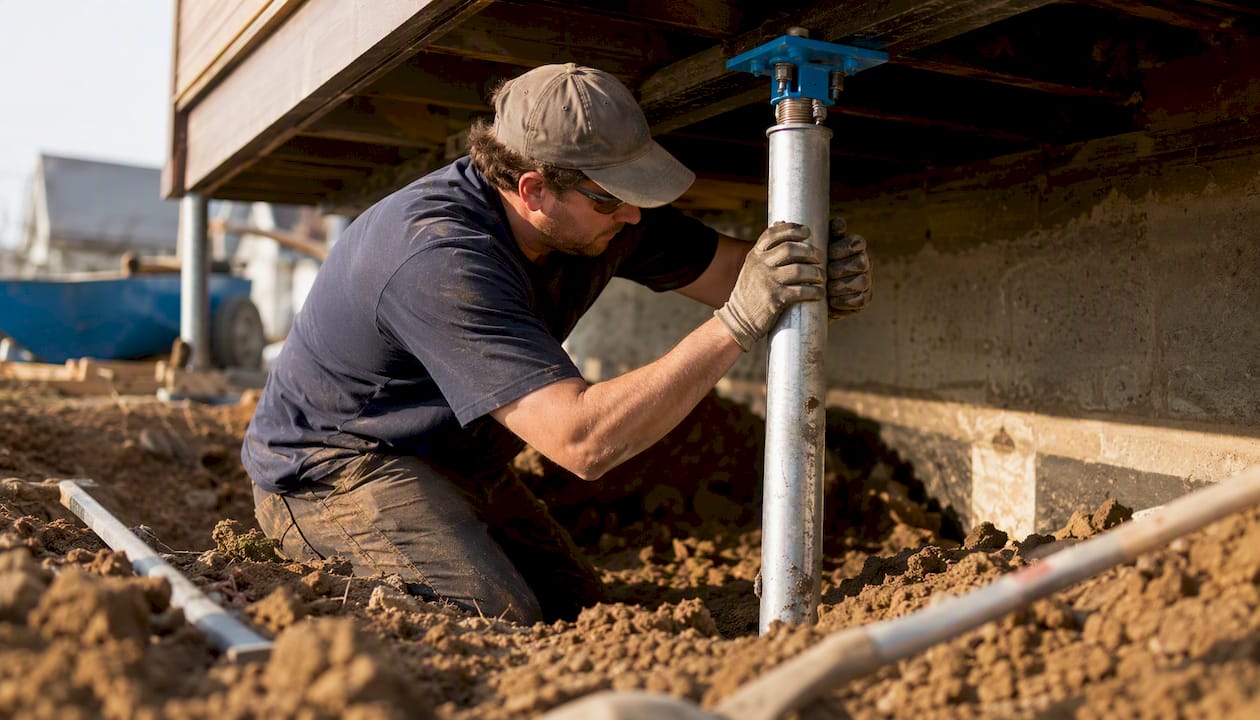
Mechanism 2: Keeping the technical solution simple. Waiting converts targeted fixes — crack injection, drainage correction, joist sistering — into major stabilization work: underpinning, pier systems, full excavation. Each step up in technical complexity adds excavation costs, more materials, longer timelines, and higher labor rates.
Mechanism 3: Avoiding indirect costs. Delayed repairs routinely require multiple scopes: structural stabilization, moisture correction, and full interior restoration. Add emergency scheduling premiums, lost rental income during extended repairs, and the negotiation discount a buyer demands when foundation issues show up on a disclosure — and the deferred bill grows fast.
A concrete example: a homeowner notices a slow-moving crack in a block wall and schedules a targeted crack injection and minor drainage correction. Total cost: under $2,000, completed in two days. A neighbor with the same initial symptom waits two years. By then the wall has bowed, the footer has shifted, and the fix requires wall anchors, exterior excavation, and interior drywall replacement. That project runs well past $15,000 and takes three weeks.
What repair types benefit most from early action?
Each service category has a clear early-vs.-late cost story.
Foundation stabilization. Early: crack injection or a single pier to arrest movement. Late: full underpinning with multiple piers, excavation, and interior restoration. The foundation settlement repair scope roughly doubles or triples when movement has been ongoing for years.
Crawl space encapsulation. Early: vapor barrier installation and a dehumidifier before mold establishes. Late: mold remediation, joist replacement, and encapsulation on top of remediation costs. Crawl space waterproofing done before moisture damage sets in is one of the highest-ROI early interventions available.
Basement waterproofing. Early: interior drainage channel and sump pump. Late: full exterior excavation, membrane replacement, and interior restoration after water damage. Basement waterproofing services are significantly less invasive when the wall hasn’t yet deteriorated.
Concrete leveling. Early: polyurethane foam injection to lift a settled slab. Late: full slab replacement. Concrete leveling vs. replacement is rarely a close call on cost — leveling wins by a wide margin when the slab is still structurally sound.
Mold remediation. Early: surface treatment and moisture source correction. Late: full structural drying, joist replacement, and air quality remediation. The mold remediation process expands dramatically once mold penetrates wood framing.
| Cost driver | Early-stage scope | Late-stage scope |
|---|---|---|
| Excavation | Minimal or none | Extensive, often full perimeter |
| Structural stabilization | 1–2 targeted piers or crack injection | Full underpinning or wall anchor system |
| Interior restoration | None or minor | Drywall, flooring, trim replacement |
| Drainage work | Minor grading or interior channel | Full exterior drainage system |
Foundationresq covers all five service categories across North Florida, South Georgia, and Alabama, with documented scopes and warranties on each.
How should you prioritize repairs and choose a contractor?
Prioritize in this order: structural safety first, then moisture control, then cosmetic fixes. A sloped floor is cosmetic until you find out it’s caused by a failing pier — check the cause before you decide the urgency.
Contractor checklist:
- Does the contractor perform a physical inspection before quoting, not just a visual walk-through?
- Do they use diagnostic tools (moisture meters, levels, cameras) rather than estimating by eye?
- Is the scope written, itemized, and tied to specific repair methods?
- Do they provide a transferable warranty?
- Are permits pulled where required by local code?
- Can they provide references from similar projects in your county?
Red flags worth a second opinion: a vague scope (“we’ll stabilize the foundation”), no structural assessment before pricing, pressure to sign within 24 hours, or a quote that skips moisture correction entirely. Review common foundation repair mistakes before you commit to a contractor.
Pro Tip: Ask every contractor for a restoration estimate alongside the repair quote. That number — what it would cost to fix drywall, flooring, and finishes if the repair requires opening walls — tells you the true total project cost and makes comparing bids honest.
How do you think about financing and ROI for early repairs?
Standard homeowners insurance commonly excludes foundation damage from soil movement, settlement, and hydrostatic pressure, which means the cost lands on you regardless of when you act. Acting early just means the number is smaller.
Common financing routes:
- Home equity line of credit (HELOC): typically the lowest interest rate for homeowners with equity
- Contractor financing: Foundationresq offers financing options with payment plans that spread early repair costs over time
- Personal or home improvement loans: available through most banks and credit unions for smaller scopes
- FHA Title I loans: federally backed home improvement loans for qualifying repairs
To estimate ROI: take the early repair cost, subtract it from the combined avoided costs (secondary repairs, mold remediation, emergency labor premiums, and the resale discount you’d otherwise absorb). Deferred repairs that delay home sales and trigger buyer concessions add another layer of financial exposure that rarely shows up in simple repair-cost comparisons.
Get a documented scope and at least two written estimates. A pre-repair inspection report with photos is also the single most effective tool for reducing buyer hesitation at resale.
What maintenance keeps repair costs lower over time?
Repairs last longer when the conditions that caused the problem are addressed. These are the highest-value, lowest-cost maintenance habits:
- Gutters and downspouts: clean twice a year; extend downspouts at least 6 feet from the foundation
- Grading: maintain a slope away from the foundation on all sides; regrade low spots annually
- Crawl space humidity: check monthly during summer; target below 55% relative humidity
- Vegetation management: keep large shrubs and trees at least 10 feet from the foundation to limit root pressure and moisture retention
- Window wells: clear debris seasonally; check drainage at the base after heavy rain
- Dehumidifier service: drain and clean crawl space and basement dehumidifiers every 3–6 months
Pro Tip: In North Florida, South Georgia, and Alabama, the crawl space encapsulation and dehumidification combination is the single most effective long-term moisture defense. A sealed vapor barrier paired with a crawl space dehumidifier keeps relative humidity stable year-round, which is the primary condition mold and wood rot need to take hold.
Why does the Gulf Coast region make early action more urgent?
The climate and soil conditions in North Florida, South Georgia, and Alabama accelerate every damage mechanism described above.
- Clay soils expand when wet and shrink when dry, creating cyclical movement under foundations that widens cracks faster than in stable-soil regions
- Sandy soils in coastal areas wash out under hydrostatic pressure, creating voids beneath slabs and footers
- High ambient humidity (often above 70% for months at a time) means any moisture intrusion quickly becomes a mold condition
- Hurricane and tropical storm stormwater delivers large volumes of water against below-grade walls in short periods, overwhelming drainage that might otherwise be adequate
- Older housing stock in many Tallahassee, Valdosta, and Mobile-area neighborhoods means foundations built before modern waterproofing standards, with crawl spaces that were never designed for today’s moisture loads
The practical result: a crack that might stay stable for five years in a dry climate can widen and admit water within one rainy season here. The risks of delay are measurably higher in this region than in most of the country.
A local example: what early action actually saved
A property manager in the Tallahassee area noticed a stair-step crack in a block foundation wall during a routine walk-through. The crack was roughly 3/16 of an inch wide and had appeared sometime in the previous season.
An inspection confirmed minor lateral movement in one wall section, with no active water intrusion yet. The recommended fix: two wall anchors and a minor exterior grading correction. The work took one day.
Catching that crack before water got behind the wall meant we avoided tearing out the interior drywall, replacing insulation, and dealing with mold. The early repair cost a fraction of what the full remediation would have run — and we had photos and an inspection report to show the next tenant and any future buyer.
Key outcomes from acting early:
- No interior drywall or flooring replacement required
- No mold remediation scope added
- Repair completed in one day with no occupancy disruption
- Inspection report and invoices filed for resale documentation
The documented repair also eliminated the negotiation discount a buyer would have demanded had the crack appeared on a disclosure without a repair history.
The part most homeowners get wrong
Most people treat foundation and moisture problems the way they treat a check engine light: they note it, intend to deal with it, and then don’t. The logic is usually “it’s not getting worse” — but that’s rarely true. Structural elements under load don’t stay static. They move, and each movement cycle reveals a little more hidden damage.
The other mistake is treating the repair cost as the whole cost. The real number includes the secondary repairs, the emergency scheduling premium, the resale discount, and the weeks of disruption. When you add those up, the early repair almost always looks cheap by comparison.
One more thing worth saying plainly: a documented inspection report is worth money. Buyers pay more for a house with a repair history than for one with an open question. Scheduling an inspection with Foundationresq isn’t just about fixing something — it’s about creating a paper trail that protects your equity.
Foundationresq covers early repairs across North Florida, South Georgia, and Alabama
Early intervention only saves money if you have a local specialist who can accurately scope the problem before it grows. Foundationresq provides free inspections with written, itemized scopes across North Florida, South Georgia, and Alabama — covering foundation repair, crawl space encapsulation, basement waterproofing, concrete leveling, and mold remediation.
Every job comes with documented scope, photos, and a transferable warranty, giving you the paper trail that protects resale value. Financing is available for qualifying homeowners, with payment plans that make early repair affordable before the scope grows. Review real project outcomes from properties across the region, then schedule your inspection to get a written scope and cost estimate before the next storm season.
Sources
- The Real Cost of Ignoring Foundation Problems: What Homeowners Risk by Waiting
- The Financial Impact of Delaying Foundation Repairs | Reed’s Home Solutions
- The Real Cost of Delaying Foundation Repairs | What Homeowners Risk
- The Real Cost of Delaying Structural Repairs | DPAE Structural
FAQ
Why does early repair cost less than waiting?
Early repairs address a single, contained problem before it spreads to adjacent systems. Once structural movement triggers plumbing failures, drywall separation, and mold growth, the project requires multiple trades and scopes, multiplying total cost.
What are the first signs I need a foundation inspection?
Stair-step cracks in brick or block, doors or windows that stick or won’t close properly, uneven or springy floors, and musty smells near the crawl space or basement are the most reliable early indicators.
Does homeowners insurance cover foundation repairs?
Standard homeowners policies typically exclude damage caused by soil movement, settlement, and hydrostatic pressure. That means most foundation and moisture repairs are out-of-pocket costs regardless of when you act, which makes early action the lower-cost path.
How much can delayed repairs reduce my home’s resale value?
Homes with unresolved foundation issues commonly sell for 10–15% less than comparable properties with documented repairs, as buyers request price reductions or repairs during the transaction.
How do I find a reliable foundation repair contractor in North Florida?
Look for contractors who perform a physical inspection with diagnostic tools, provide a written and itemized scope, offer transferable warranties, and pull required permits. Foundationresq serves North Florida, South Georgia, and Alabama with free inspections and documented scopes.
Recommended
- Structural Repair ROI: What Homeowners Need to Know – Tallahassee Foundation Repair | Foundation ResQ
- Foundation Repair Cost Estimator: A 2026 Homeowner’s Guide – Tallahassee Foundation Repair | Foundation ResQ
- Decoding Crawl Space Repair Costs: A Homeowner’s Guide – Tallahassee Foundation Repair | Foundation ResQ