
Foundation issues absolutely can affect your roof, and the connection runs both directions. When a foundation settles unevenly, the walls beneath your roofline shift, and the whole framing system above them absorbs that stress. Watch for three high-priority signals: a dip or wave along the ridge line, gaps opening up around chimney and vent flashing, and new leaks appearing where none existed before. Any one of these, especially paired with sticking doors or fresh cracks in interior drywall, means the problem may have started underground, not on your roof deck.
If you’re seeing these signs right now, don’t wait. Document everything with photos, note the date, and avoid piling anything heavier onto the roof (skip that holiday light installation for now). If water is actively coming in, a temporary tarp buys you time, but it doesn’t fix the underlying cause. What actually stops the cycle is a professional evaluation that looks at both systems together.
- Ridge sag or wave — a visible dip along the roofline that wasn’t there a year or two ago
- New or widening flashing gaps around chimneys, skylights, and vent pipes
- Fresh leaks with no obvious roof cause — no missing shingles, no storm damage, just water where there wasn’t any before
Pro Tip: Take a photo of your roofline from the same spot in your yard every six months. A slow ridge sag is nearly impossible to spot day to day, but it jumps out when you compare images taken a year apart.
Urgent action: If your roof is actively leaking or the ridge is visibly sagging, get water off the ceiling with a tarp or bucket right away, photograph the affected area, and call for a professional inspection within days, not weeks. Sagging framing under load can progress quickly once fasteners start to fail.
Key Takeaways
Foundation movement and roof damage feed each other in both directions, and stabilizing the foundation before repairing the roof is the sequence that prevents repeat repairs.
| Point | Details |
|---|---|
| Watch for the combination, not one sign alone | A ridge sag paired with sticking doors or interior cracks points to foundation movement, not just a roofing issue. |
| Fix drainage before it becomes a foundation problem | Extend downspouts and clear gutters to stop soil saturation that leads to erosion under footings. |
| Document before you call anyone | Date-stamped photos of cracks, gaps, and leaks protect you with contractors and insurers alike. |
| Stabilize the foundation first | Roof repairs made while the frame is still shifting tend to fail again within a year or two. |
| Foundation RESQ offers integrated inspections | Its joint foundation-and-roof assessment and written estimates help homeowners in North Florida, South Georgia, and Alabama avoid sequencing mistakes. |
Whenever a wall or beam’s load-bearing capacity is uncertain, involve a licensed structural engineer before starting any repair.
Table of Contents
- How Foundation Movement Turns Into Roof Damage
- How Roof Leaks and Bad Drainage Damage the Foundation
- Warning Signs on the Roof and Throughout the House
- How to Inspect, Photograph, and Document the Problem
- Foundation Stabilization vs. Roof Repair: What Comes First
- What Repairs Typically Cost and How Long They Take
- Prevention Habits That Protect Both Systems
- When to Call in a Structural Professional
- Sources
- FAQ
How Foundation Movement Turns Into Roof Damage
Your house works as one connected structure, not a stack of separate parts. The foundation carries the weight of the walls, the walls carry the weight of the roof framing, and that whole chain is called the load path. When the foundation shifts, whether from settling, heave, or differential movement where one section of the footing drops more than another, the load path gets distorted, and everything above it has to compensate.
That compensation shows up in a few predictable ways. A wall that tilts outward as the foundation beneath it settles pulls the rafters or trusses connected to it out of their original alignment, and the roof loses the consistent support it was built to rest on. That’s often what produces the dip or wave homeowners notice in the ridgeline.
The mechanical pathways generally fall into a few categories:
- Loss of bearing — a wall or pier no longer supports the load it was designed to carry, shifting weight onto adjacent framing
- Wall tilt — leaning walls pull rafters and trusses out of their intended plane
- Rafter and top-plate separation — connections that were nailed tight when the house was built work loose as the frame shifts
- Fastener fatigue — repeated small movements loosen nails and screws at joints, weakening the whole assembly over time
InterNACHI’s inspection guidance makes this explicit for anyone doing a home inspection:
Differential settlement can cause movement in contiguous building elements such as beams, joists, floors, and roofs. Foundation walls and piers should be inspected for cracking, deterioration, and adequacy of structural support, and an engineering evaluation is recommended when bearing or load paths are in doubt.
Picture it like a bookshelf with one leg shorter than the others. The shelf itself doesn’t fail immediately, but the boards warp and the joints loosen wherever the imbalance concentrates stress. A house does the same thing, just slower and with a lot more at stake. Differential settlement driven by soil consolidation, tree root activity, or erosion around footings produces the same kind of vertical distortion, and it doesn’t stop at the wall. It spreads upward into whatever the wall is holding up.
How Roof Leaks and Bad Drainage Damage the Foundation
The relationship works in reverse too, and this direction is the one homeowners tend to underestimate. A roof leak doesn’t just stain a ceiling. Water that gets past your shingles and underlayment eventually finds its way down through the wall cavities, into the crawl space or basement, and into the soil surrounding your footings.
Soil is not a stable, inert material. It expands when saturated and contracts when it dries, and repeated cycles of that swelling and shrinking are one of the most common drivers of foundation settlement. A roof leak that goes unaddressed for a season can quietly saturate the soil around one corner of a house far more than the rest, and that uneven moisture is exactly the kind of condition that produces differential settlement months or years later.
Consider a typical scenario: a small leak develops around a poorly sealed skylight. It’s slow enough that nobody notices water stains for over a year. By the time a homeowner spots discoloration on the ceiling, water has been tracking down inside the wall cavity and pooling near the foundation footing on that side of the house. The soil there stays consistently wetter than the surrounding ground, eroding support under the footing. Eighteen months after the leak started, that corner of the house has settled noticeably more than the rest, and a crack that started as a hairline in the drywall has become a visible gap.
Homeowners can inspect several risk points around the house without any special tools:
- Gutters that are clogged, sagging, or pulling away from the fascia
- Downspouts that dump water within a few feet of the foundation instead of extending it away
- Grading that slopes toward the house rather than away from it
- Window wells or crawl space vents that collect standing water after rain
Long-term regional moisture patterns also shape how much risk any given drainage flaw actually poses. A property with heavy seasonal rainfall and clay-heavy soil is far more sensitive to a bad downspout than one with sandy, well-draining soil, which is worth knowing before you assume every gutter problem is a crisis.
Pro Tip: Extend every downspout at least four to six feet from the foundation. It’s one of the cheapest fixes homeowners can make, and it directly reduces the saturation that leads to erosion under footings.
Warning Signs on the Roof and Throughout the House
Some symptoms point clearly at the roof. Others show up nowhere near the roofline but still trace back to the same underlying movement. Reading both sets together is how you figure out whether you’re dealing with a roofing-only issue or something structural.
On the roof itself, watch for a sagging or wavy ridge line, fascia boards that no longer sit level, wide gaps where shingle courses have separated, and flashing that’s pulled away from chimneys or vent penetrations. Structural roof problems often present as exactly this combination rather than any single dramatic failure.
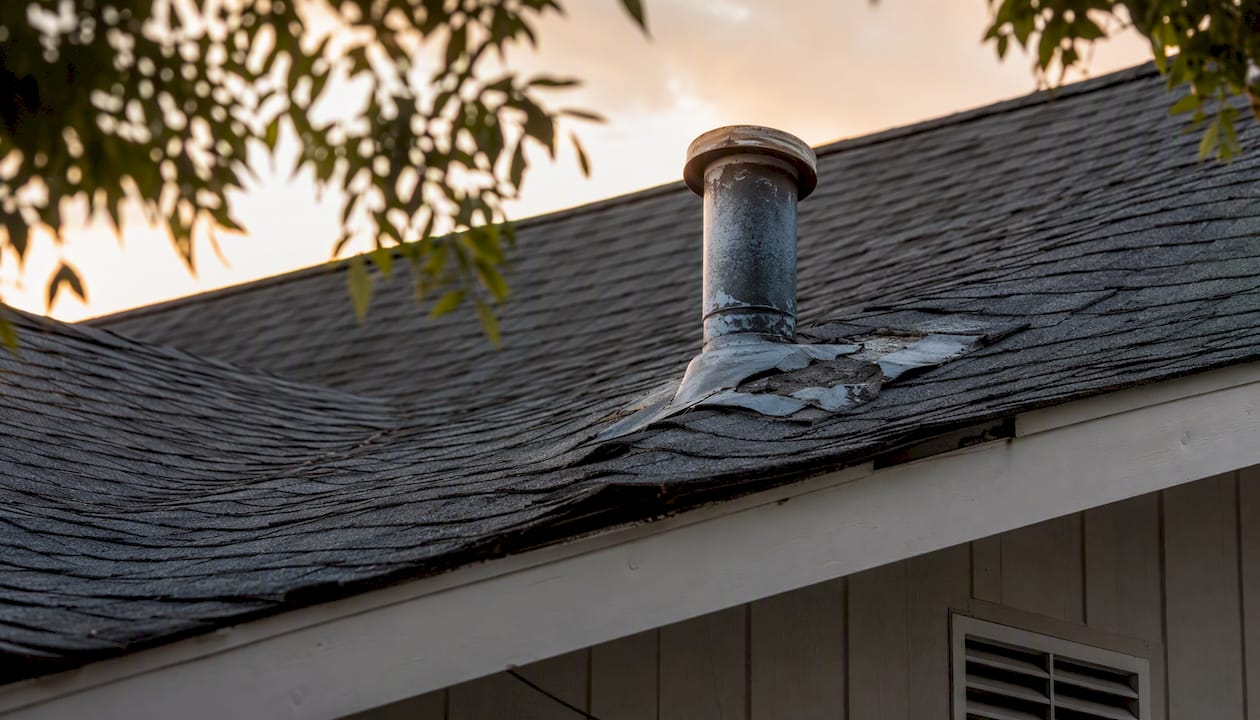
Inside the house, the signs are often easier to catch early. New cracks in ceiling drywall, especially ones that widen over a few months, doors and windows that suddenly stick or won’t latch properly, visible gaps opening at the top of interior walls, and separation between a chimney and the exterior wall it’s attached to all point toward foundation movement working its way through the structure.
| Sign | Where to look | Urgency level |
|---|---|---|
| Ridge dip or wave | Exterior roofline, viewed from the yard | Inspect soon |
| Flashing gaps at chimney/vents | Roof penetrations | Inspect soon |
| New ceiling cracks | Interior ceilings, especially near load-bearing walls | Urgent |
| Sticking doors/windows | Interior door and window frames | Inspect soon |
| Chimney separation from wall | Exterior, where chimney meets siding | Urgent |
| Isolated shingle wear on one slope | Roof surface | Monitor |
A few of these signs, like shingle wear on one slope of the roof, are just as often caused by sun exposure or ventilation problems that have nothing to do with the foundation. The way to tell the difference is correlation: if a roof symptom shows up alongside interior cracks, sticking doors, or a chimney pulling away from the house, foundation movement becomes the more likely explanation.
How to Inspect, Photograph, and Document the Problem
Good documentation does two things. It gives you a clear record to hand to a contractor or engineer, and it protects you if you ever need to make an insurance claim. Skipping this step is the most common mistake homeowners make, because by the time they call for help, they can’t say when a crack first appeared or how much it’s grown.
Start with these checks:
- Walk the perimeter of your house and look at the roofline from several angles, ideally from across the street where you can see the whole ridge at once.
- Check the attic if you can safely access it, looking for daylight through the roof deck, water stains on rafters, or spongy, soft plywood underfoot.
- Walk through every room and note any ceiling cracks, wall gaps, or doors that don’t close the way they used to.
- Check exterior walls for stair-step cracks in brick or block, which are a classic sign of differential settlement.
- Look at your gutters and downspouts and note anywhere water is pooling near the foundation.
Attic inspections in particular can tell you a lot, since cracked rafters or spongy decking visible from inside the attic often confirm whether a roof issue is structural or just cosmetic.
For photo documentation, follow a consistent approach:
- Take wide context shots first (the whole roofline, the whole wall) before zooming in on any specific crack or gap
- Include something for scale in close-up shots, like a tape measure or a coin
- Date-stamp every photo, either through your phone’s metadata or by writing the date on a small card in the frame
- Photograph the same spots again every few months to track whether a crack or gap is widening
When it comes to who to call, order matters. Start with a foundation contractor if you’re seeing interior cracks, sticking doors, or exterior wall movement, since they can assess whether the foundation itself is moving. If the primary symptoms are on the roof and there’s no clear interior evidence of foundation issues, a roofing contractor can evaluate the roof independently first. If either professional finds signs that load-bearing elements are compromised, both InterNACHI guidance and standard practice call for bringing in a licensed structural engineer before any repair work begins.
When you’re vetting contractors, ask directly: What’s causing this damage, in your assessment? Will you provide a written inspection report and itemized estimate? Have you worked on homes with combined foundation and roof issues before? A contractor who pushes you toward an immediate signature without a written estimate, or who can’t explain their diagnosis in plain language, is a red flag worth walking away from.
Foundation Stabilization vs. Roof Repair: What Comes First
Once you know what’s wrong, the next question is sequencing, and this is where a lot of homeowners get bad advice. Repairing a roof before addressing the foundation underneath it is like repainting a wall that’s still cracking. It might look better temporarily, but the underlying movement hasn’t stopped.
Foundation stabilization methods vary depending on what’s causing the movement:
- Helical piers — screwed deep into stable soil, used where load-bearing capacity needs to be restored without excavation
- Push piers — driven hydraulically to bedrock or load-bearing strata, common for correcting settlement under existing structures
- Slab underpinning — reinforces or extends a slab foundation’s support below the current footing depth
- Slabjacking (concrete leveling) — injects material beneath a sunken slab to raise it back toward level, often used for driveways, walkways, and some foundation applications
On the roof side, common remedies include replacing rotted or spongy decking, re-flashing around chimneys and vents to stop active leaks, and repairing or sistering cracked rafters. Here’s the catch: these fixes only hold if the foundation has actually stopped moving. Roof repairs made while a foundation is still settling tend to fail again within a year or two, because the framing keeps shifting under the new work.
| Approach | Best used when | Trade-off |
|---|---|---|
| Foundation-first | Interior cracks, sticking doors, or wall tilt are present alongside roof symptoms | Roof repair may need to wait a few weeks until stabilization is complete |
| Roof-first | Roof-only symptoms with zero interior or foundation evidence | Risk of misdiagnosis if underlying movement is actually the cause |
| Combined assessment | Overlapping signs on both systems | Requires coordinating two contractors, but avoids costly rework |
The recommended sequence for homes with clear overlapping evidence is straightforward: stabilize the foundation to restore proper bearing and level the structure, then have the roof framing reassessed once the movement has stopped, and only then complete roof repairs or replacement. Skipping the first step is how homeowners end up paying for the same roof repair twice.
What Repairs Typically Cost and How Long They Take
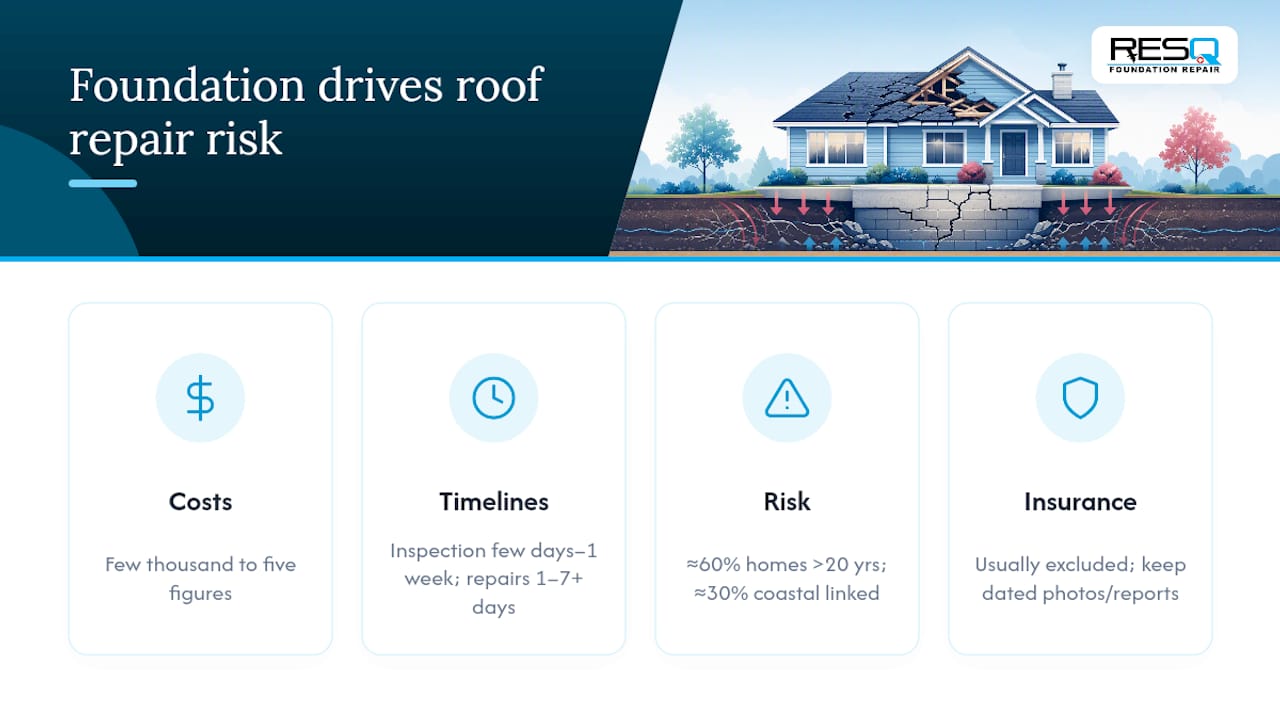
Costs vary enormously based on your soil conditions, the extent of settlement, and the size of your roof, so treat any figures here as a starting point for budgeting conversations rather than a quote. Foundation stabilization jobs using helical or push piers tend to run from a few thousand dollars for a small, localized fix up into five figures for a full perimeter stabilization on a larger home. Roof structural repairs, like replacing decking and re-flashing, typically land in a lower range for isolated repairs but climb significantly if truss or rafter replacement is needed across a larger section of the roof.
Timeline follows a similar pattern. An initial inspection and written estimate usually takes a few days to a week to schedule and complete. Foundation stabilization on a straightforward job might take one to three days on-site, though the soil and structural assessment beforehand can add another week or two. Roof repairs that follow, once the foundation is stable, generally take anywhere from a single day for isolated flashing work to a week or more for full deck and truss repair.
Contractor estimates cited by Shieldline Roofing suggest that roughly 60% of significant roof structural failures in homes over 20 years old have some indirect link to unresolved foundation movement, and around 30% of coastal roofing damage not attributable to wind or hail involves structural movement as a contributing factor. That’s a strong argument for getting a foundation assessment before assuming a roof problem is purely a roofing problem.
On insurance, most homeowners find that standard policies treat foundation settlement as a maintenance issue rather than a covered peril, since it’s typically considered gradual and preventable rather than sudden. Coverage gaps are common here, and insurers will often ask for documentation proving when a problem started and whether it resulted from a specific covered event, like a burst pipe, versus long-term settling. Keep every dated photo, every inspection report, and every contractor estimate in one file from the start, since that record is what determines whether a claim gets approved or denied.
Prevention Habits That Protect Both Systems
Most of the damage covered so far starts with water going somewhere it shouldn’t, which means most of the prevention comes down to managing water before it becomes a problem.
A few routine tasks make an outsized difference:
- Clean gutters at least twice a year, more often if you have overhanging trees
- Extend downspouts so water discharges well away from the foundation, not right at its base
- Check that the ground slopes away from your house on all sides, not toward it
- Inspect roof flashing annually, especially around chimneys, skylights, and vent pipes
- Confirm attic ventilation is working, since poor airflow traps moisture that can damage roof decking from the inside
Seasonal timing matters too. In wetter months, focus on drainage: make sure gutters aren’t overflowing and that standing water isn’t collecting near the foundation after storms. In drier months, especially in regions with expansive clay soils, keeping the soil around your foundation evenly moist (not soaked, not bone dry) helps prevent the shrink-swell cycles that cause uneven settlement.
Roof ventilation and insulation play a bigger role in foundation health than most homeowners realize. A poorly ventilated attic traps humid air, which condenses on the underside of the roof deck and can drip down into wall cavities over time, adding to the same moisture load that eventually reaches your foundation soil. Good attic ventilation paired with proper insulation keeps that moisture cycle from ever starting, which protects your energy bills and your foundation at the same time.
None of this requires a contractor. A weekend spent clearing gutters, checking your yard’s slope, and extending a few downspouts costs almost nothing and meaningfully lowers your risk on both ends of the house.
When to Call in a Structural Professional
Not every crack needs a contractor, but certain signs mean it’s time to stop monitoring and start calling. Visible wall tilt, interior cracks that are widening month over month, or an active roof leak paired with any of the structural signs covered earlier are all situations where waiting costs you more than acting.
A thorough foundation inspection looks at more than the crack you called about. It should evaluate soil conditions around the perimeter, check for signs of differential settlement across the whole footprint of the house, and assess whether the roof framing shows any of the load-path symptoms described earlier. Foundation RESQ’s inspection and repair services are built around exactly this kind of integrated assessment rather than treating the foundation and roof as unrelated systems.
What should you expect from a joint assessment? A technician documents existing cracks and movement with photos and measurements, checks attic framing where accessible, and provides a written estimate outlining what needs to happen and in what order. That written estimate matters. A homeowner who has watched Foundation RESQ document a settling corner of a home, stabilize it with helical piers, and then coordinate the follow-up roof framing repair sees firsthand why treating both systems together, rather than patching the roof and hoping the foundation holds, avoids paying for the same repair twice.
Foundation RESQ also offers free inspections and financing options for homeowners weighing the combined cost of foundation and roof work, which matters given how quickly those two line items can add up on the same project.
A note on sequencing and safety, from Kayle
Foundation RESQ recommends stabilizing the foundation before touching the roof whenever the two problems overlap, and that’s not a sales preference. It’s the only sequence that actually holds up. A roof repair completed while the framing beneath it is still shifting is a repair you’ll likely pay for twice, and the second time usually costs more because the damage has spread.
The harder truth is that homeowners often want to fix the visible problem first. A leak feels urgent in a way that a hairline crack in a foundation wall doesn’t, so the roof gets the attention and the foundation gets deferred. I understand the instinct, but it gets the priority backward in nearly every case where both systems show damage. If there’s any uncertainty about whether a wall or beam is still carrying its intended load, that’s not a judgment call for a homeowner or even a single contractor to make alone. Bring in a licensed structural engineer. The cost of that evaluation is small compared to the cost of guessing wrong.
Get a Free Inspection Before Small Cracks Become Big Repairs
Most homeowners don’t know whether a roof symptom is roof-only or foundation-driven until someone actually looks at both. That’s the gap Foundation RESQ closes. Instead of calling a roofer for the ceiling stain and a separate foundation company for the sticking door, and hoping the two diagnoses line up, one integrated inspection evaluates your foundation, crawl space, and roof framing together and hands you a single written estimate that reflects the real sequence of repairs.
Foundation RESQ serves homeowners and property managers across North Florida, South Georgia, and Alabama, offering foundation stabilization, crawl space remediation and encapsulation, concrete leveling, basement waterproofing, and mold remediation. If your home is showing any combination of roof and interior warning signs covered in this article, from a sagging ridge to sticking doors to a damp crawl space, the smartest next step is a professional look before you spend money on a repair that might not hold. Schedule a free inspection with Foundation RESQ and get a written estimate that accounts for both systems from the start.
Sources
- Inspecting Foundation Walls and Piers (InterNACHI)
- How Foundation Problems Can Cause Roof Damage – A House in the Hills
- Foundation settlement causes and mechanisms – The Constructor
- Structural Roof Issues 2026: 7 Problems Every Homeowner – The Eagle Roofing
FAQ
Will Homeowners Insurance Cover Foundation Damage?
Standard homeowners insurance typically treats gradual foundation settlement as a maintenance issue rather than a covered peril, so most policies won’t pay for it unless it resulted from a specific covered event like a burst pipe. Document the timeline and cause carefully, since insurers usually require proof of when the damage started.
What Are the Warning Signs of Foundation Failure?
Key warning signs include stair-step cracks in exterior brick or block, doors and windows that stick or won’t latch, gaps opening at the top of interior walls, and a sagging or wavy roofline. Seeing several of these together, rather than just one, is a stronger indicator that the foundation itself is moving.
Is It Illegal to Sell a House With Foundation Issues?
It’s not illegal in most places, but sellers generally must disclose known foundation problems to buyers, and failing to do so can create legal liability later. Requirements vary by location, so confirm your specific disclosure obligations with a local real estate attorney.
Is It Safe to Buy a House With Foundation Issues?
It can be, but only with a clear understanding of the scope and cost of repair before closing, ideally backed by a professional inspection and written estimate. A house with a documented, already-stabilized foundation is a very different purchase than one with active, unaddressed movement, so get a structural engineer’s assessment before you commit.
How Do I Know If My Roof Problem Is From the Foundation or Just the Roof?
Check for interior signs like sticking doors, new ceiling cracks, or gaps at the top of walls, since roof-only problems typically don’t come with these companion symptoms. If you see roof damage alongside any interior structural signs, a combined foundation and roof inspection, like the ones Foundation RESQ performs, gives you a clearer answer than guessing.
Recommended
- What Happens If You Don’t Fix Foundation Problems? The Risks of Delay
- Why Foundation Issues Fail Property Inspections: What Buyers Need to Know – Tallahassee Foundation Repair | Foundation ResQ
- Common Foundation Repair Mistakes to Avoid in 2026 – Tallahassee Foundation Repair | Foundation ResQ
- Why Basement Seepage Becomes a Major Issue – Tallahassee Foundation Repair | Foundation ResQ