
Why would a home built just five years ago on a solid concrete slab already show signs of structural distress? It is a common source of anxiety for homeowners who expect their property to remain a stable sanctuary. Seeing cracks in the drywall or doors that no longer latch can lead to immediate fears of high repair costs and the looming threat of sinkhole activity. Understanding the common causes of foundation problems in Florida is the first step toward protecting your investment and your peace of mind.
You deserve to feel confident in the ground beneath your feet. This guide will help you understand the unique geological and environmental factors that threaten our local homes and show you how to address them before they lead to structural failure. We will explore how North Florida’s expansive clay and the state’s karst limestone terrain impact your home’s stability. You will learn to distinguish between minor cosmetic flaws and serious structural issues. We also provide a look at permanent stabilization methods, such as helical piers and PolyRenewal, which offer a professional remedy to keep your home secure for years to come.
Key Takeaways
- Learn how Florida’s unique karst topography and porous limestone create underground voids that directly threaten your home’s structural integrity.
- Understand how the state’s extreme seasonal cycles and tropical storms act as common causes of foundation problems in Florida by destabilizing the soil.
- Gain the skills to distinguish between minor cosmetic settling and serious structural warnings, such as hallmark stair-step cracks in your masonry.
- Discover why newer homes are still vulnerable to failure and how modern construction methods can sometimes lead to early structural shifts.
- Explore engineered, permanent remediation strategies like helical piers and PolyRenewal that provide a lasting protective barrier for your property.
Florida’s Geological Foundation: Why Our Soil is Unique
Florida’s landscape is famous for its beauty, but the ground beneath our homes is surprisingly dynamic. Most homeowners don’t realize that the primary drivers of structural instability are hidden hundreds of feet below the surface. The Floridan Aquifer plays a silent but critical role in this ecosystem. It provides hydraulic pressure that helps hold up the layers of soil and rock above it. When heavy pumping or prolonged drought lowers the water table, that internal pressure vanishes. This loss of support often triggers the collapse of existing limestone voids, leading to the sudden ground shifts homeowners fear. These geological shifts are among the most common causes of foundation problems in Florida.
Karst Topography and Limestone Erosion
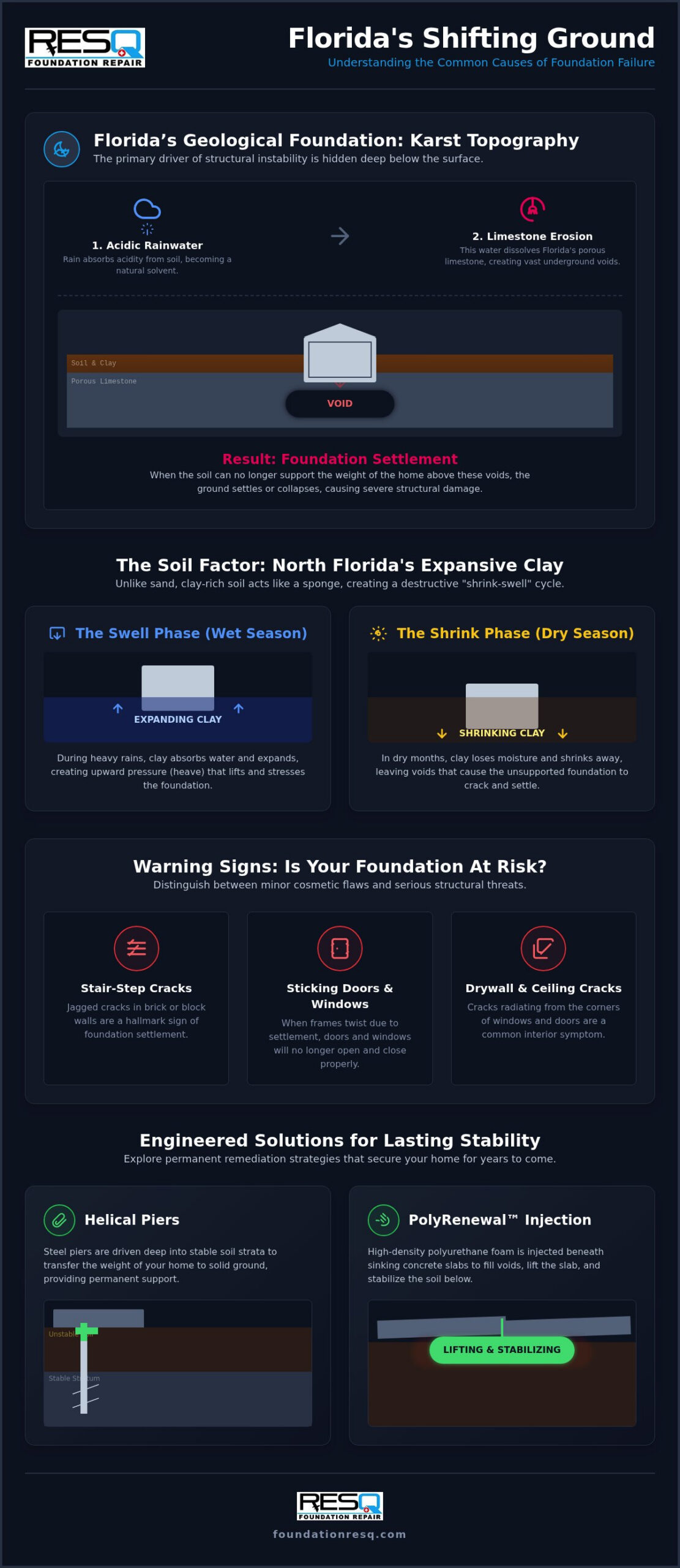
Karst topography is the primary driver of Florida geological instability. This term describes a landscape formed from the dissolution of soluble rocks like limestone. Rainwater becomes slightly acidic as it filters through organic matter in the soil. Over centuries, this acidic water eats away at Florida’s porous plateau of karst limestone. This chemical erosion creates a literal swiss cheese effect underground, leaving behind massive voids and channels. As these cavities grow, the soil above begins to migrate downward to fill the gaps. When the weight of a home becomes too much for these hollow spaces to support, the ground settles or collapses, leading to significant structural distress.
The Tallahassee Soil Factor: Clay vs. Sand
While Central Florida often deals with loose, shifting sands, homeowners in the Red Hills region of Tallahassee face a different challenge: expansive clay. North Florida’s soil composition is unique because it contains high concentrations of clay that behave differently than the sandy soils found further south. Clay-rich soil acts like a sponge, undergoing a shrink-swell cycle that is far more aggressive than simple sand settlement. This movement is a leading factor among the common causes of foundation problems in Florida for local residents.
This cycle follows our regional weather patterns closely:
- The Swell Phase: During heavy rain seasons, the clay absorbs vast amounts of water and expands. This expansion creates upward pressure, known as heave, which can lift sections of a concrete slab.
- The Shrink Phase: In dry months, the clay loses moisture and contracts. As the soil shrinks away, it leaves empty pockets beneath the foundation, causing the home to settle into the newly formed gaps.
This constant tug-of-war between expansion and contraction places immense stress on your home’s structural bones. Over time, the foundation loses the uniform support it needs to remain level, resulting in the cracks and shifts that signal a need for professional stabilization.
The Water Cycle: How Florida Weather Impacts Structural Stability
Florida’s weather patterns are defined by extremes. We move from months of intense heat and drought to sudden, torrential downpours during hurricane season. This cycle is one of the most common causes of foundation problems in Florida. While the limestone and clay discussed previously provide the setting, water is the active force that triggers movement. Hurricanes and tropical storms deliver “shock” loads of water that can saturate the ground in hours, leading to rapid soil shifts that newer homes are often unprepared to handle.
Heavy Rainfall and Hydrostatic Pressure
When Florida’s heavy rains saturate the ground, the soil becomes heavy and exerts tremendous force against your home’s structure. This is known as hydrostatic pressure. Water weighs approximately 62.4 pounds per cubic foot, exerting massive force on a home. When the soil around your foundation cannot drain properly, this weight pushes inward on crawl space walls or upward against concrete slabs. Over time, this pressure can cause masonry to bow or crack. If you notice dampness in your crawl space or moisture seeping through your floor, it’s often a sign that the external water pressure has exceeded your home’s resistance.
Drought and Soil Desiccation
Extended periods of dry weather are just as dangerous as floods. During a drought, the moisture that normally supports Florida’s problem soils evaporates. As the soil dries out, it shrinks and pulls away from the foundation footing. This creates a gap or “void” where there used to be solid support. Your home’s weight then causes it to settle into these empty spaces. This uneven settlement is why you might see windows that stick or cracks appearing in your drywall during the hottest months of the year.
A high water table further complicates these issues. In many parts of the state, the groundwater is only a few feet below the surface. This creates a constant silent threat to slab foundations, as even a small amount of rain can saturate the soil to its breaking point. When the water table rises, it can create “buoyancy” that pushes up against your slab, while a falling water table during a drought leaves the soil brittle and prone to collapse. A professional foundation repair specialist can assess these drainage patterns to ensure your home remains stable regardless of the season. By managing how water interacts with your soil, you can prevent the long-term degradation of your home’s structural integrity.
Construction and Environmental Factors in Foundation Failure
Structural integrity isn’t just about the age of a building. Many homeowners assume that only historic properties face settling issues, but modern construction shortcuts are frequently among the common causes of foundation problems in Florida. A brand-new home can fail just as easily as a century-old cottage if the ground beneath it wasn’t handled with professional care. These man-made factors often combine with the state’s natural geology to accelerate structural decline.
Inadequate Site Preparation and Soil Compaction
Site preparation is the most critical phase of any build. When developers prepare a lot, they often bring in fill dirt to create a level surface. If this soil isn’t compacted in thin, controlled layers, it remains unstable. This lack of density eventually leads to settlement as the weight of the house pushes down on the loose earth. In many newer Tallahassee developments, we’ve seen structural distress appear within the first 5 to 10 years due to poor compaction and improper “benching” of the building site.
Organic debris buried during construction adds another layer of risk. If a contractor buries tree stumps or construction waste under the fill dirt, that material will eventually rot. As it decomposes, it creates a void similar to the natural cavities described in the USGS explanation of sinkholes. When the soil above these rotting pockets shifts, your foundation loses its uniform support. This leads to the sudden sinking and cracking that characterizes foundation failure.
Invasive Tree Roots and Landscaping Issues
Your landscaping choices also impact the stability of your home. Large, mature trees are beautiful, but their root systems act like massive biological pumps. During the hot Florida summers, these roots pull huge volumes of water from the soil to survive. If a tree is too close to your house, it can suck the moisture directly from the soil under your slab. This localized drying causes the soil to shrink and pull away from the foundation footings, leaving your home’s weight unsupported.
Physical pressure is another concern. Roots are strong enough to lift heavy concrete, including driveways and foundation edges. To maintain a protective barrier for your home, consider these stabilization-focused landscaping tips:
- Plant large trees at least 20 feet away from the foundation to prevent moisture depletion.
- Install root barriers if you have existing trees close to the structure.
- Ensure flower beds and gardens are graded away from the house to prevent water from pooling near the slab.
By understanding these environmental factors, you can take active steps to protect your property’s long-term health. Managing the interaction between your landscaping and the soil is a professional way to ensure your foundation remains stable for decades.
Identifying the Signs: How Foundation Problems Appear in Florida Homes
Your home communicates its physical health through subtle shifts and visible changes. Differentiating between minor cosmetic settling and major structural failure is essential for any Florida homeowner. While every house settles slightly over time, structural shifts are progressive and won’t stop without professional intervention. When the common causes of foundation problems in Florida begin to impact your property, the evidence usually appears in the “bones” of the building. One hallmark sign is the “stair-step” crack in exterior brickwork. This pattern follows the mortar lines in a zigzag fashion and almost always indicates that one corner of the foundation is sinking faster than the rest of the structure.
Interior Indicators: Sticking Doors and Wall Cracks
Inside the living areas, doors and windows act as reliable diagnostic tools. If a door suddenly sticks during the humid summer months but works fine in the winter, it isn’t just simple swelling. This resistance often signals that the foundation is shifting as the soil expands and contracts. You should also examine the orientation of any wall cracks. Vertical cracks often result from minor settling as the home finds its “footing.” However, horizontal cracks or diagonal gaps that are wider at the top than the bottom suggest significant lateral pressure or major settlement. Understanding these warning signs of a bad foundation can help you decide when to seek an expert opinion.
The Crawl Space Connection: Bouncy Floors and High Humidity
The crawl space is the “canary in the coal mine” for your home’s structural health. High humidity in this area weakens the organic fibers of your floor joists, leading to “bouncy” or soft floors in your living spaces. When the foundation cracks due to soil movement, it creates pathways for even more moisture to enter. This excess humidity doesn’t just cause mold; it physically softens the support beams until they sag under the weight of your home. This is why crawl space encapsulation Tallahassee is a structural necessity rather than a luxury. It creates a protective barrier that keeps the wood dry and the foundation stable.
Ignoring these signs only leads to more expensive remediation in the future. If you’ve noticed cracks in your masonry or floors that feel uneven, it is a professional best practice to address the root cause immediately. You can request a structural assessment from our team to determine the exact state of your foundation’s health and find a permanent solution.
Stabilizing Your Florida Home: Proven Remediation Strategies
Addressing the common causes of foundation problems in Florida requires a shift from temporary patches toward engineered, permanent stabilization. Quick fixes, such as filling a crack with epoxy, only mask the symptoms of a deeper structural issue. Professional remediation focuses on the ultimate resolution of the physical problem by reinforcing the building and the soil simultaneously. This methodical approach doesn’t just stop the damage; it restores the structural health of your property. Investing in these permanent solutions also provides a significant return on investment, as documented structural repairs often preserve 60% to 80% of a home’s value during a resale.
Foundation Piering: Helical and Push Pier Systems
When a home settles due to the karst topography or expansive clay mentioned earlier, the solution is to bypass the unstable topsoil. Piering systems transfer the weight of your home to competent load-bearing strata deep underground. We choose the specific system based on the weight of the structure and the local soil density. For lighter structures or areas with high water tables, helical pier installation is often the preferred remedy. These piers are mechanically “screwed” into the ground until they reach a stable layer of rock or dense soil.
For heavier masonry homes, push piers are used. These are driven into the ground using the weight of the house itself as a counterforce. Once the piers are secured in the load-bearing strata, a professional team can use hydraulic jacks to lift the foundation back toward its original, level position. This process closes cracks in the drywall and allows sticking doors to function correctly once again. It’s a precise, methodical process that creates a permanent protective barrier between your home and the shifting Florida earth.
Wall Stabilization and Concrete Lifting
Foundation problems aren’t always about sinking; sometimes, they involve lateral pressure. If hydrostatic pressure from saturated soil causes your crawl space walls to tilt or bow, you need a solution that reinforces the masonry’s tensile strength. We use carbon fiber wall repair Tallahassee to permanently stabilize these structures. Carbon fiber is incredibly strong and thin, allowing it to be bonded directly to the wall to prevent any further inward movement without taking up valuable space.
For exterior concrete surfaces like sunken driveways or pool decks, we utilize PolyRenewal concrete lifting. This process involves injecting a high-density waterproof foam beneath the concrete to fill voids and lift the slab back to level. It’s a faster, more durable alternative to traditional mudjacking. The final step in any comprehensive foundation plan is moisture management. Installing sump pumps and dehumidifiers ensures that the soil around your new stabilization system remains at a consistent moisture level. This comprehensive approach addresses the common causes of foundation problems in Florida from every angle, ensuring your home remains a stable sanctuary for decades.
Protecting Your Home’s Future Stability
Securing your home starts with understanding the ground beneath it. By recognizing how Florida’s porous limestone and expansive clay interact with extreme weather cycles, you can move from a state of worry toward informed action. Early detection of signs like stair-step masonry cracks or shifting doors is the best way to prevent structural failure. Addressing the common causes of foundation problems in Florida requires more than a cosmetic fix; it demands a permanent, engineered remedy that treats the root of the issue rather than just the symptoms.
Foundation ResQ provides a stable, expert presence for homeowners throughout the region. With over a decade of Tallahassee structural expertise, we offer permanent, engineered solutions designed for the specific needs of our local community. Our team focuses on long-term outcomes through durable systems like helical piers and PolyRenewal to provide comprehensive moisture and structural protection. You can schedule your free foundation inspection with Foundation ResQ today to receive a professional assessment of your property’s health. Restoring your home’s integrity is a vital step in protecting your family’s safety and your investment’s longevity. We are here to help you build a more stable future.
Frequently Asked Questions
Is it normal for Florida houses to have foundation cracks?
Minor hairline cracks in concrete can be normal due to curing and temperature changes. However, cracks wider than 1/16th of an inch or those that are progressive signal a deeper structural issue. Florida’s karst topography and expansive clay mean that even newer homes often experience significant shifts. It’s best to have a professional evaluate any crack that appears to be growing, especially if it follows a stair-step pattern in your exterior masonry or interior drywall.
How much does foundation repair cost in Florida?
Costs vary significantly based on the severity of the damage and the required remediation method. Minor repairs like crack sealing or small concrete lifting projects typically fall on the lower end of the spectrum. Major structural underpinning using helical or push piers for large homes represents a more substantial investment. Because every property sits on different soil conditions, a detailed structural inspection is required to provide an accurate, professional estimate for your home’s specific needs.
Can heavy rain cause foundation problems?
Yes, heavy rain is one of the most common causes of foundation problems in Florida. Saturated soil exerts hydrostatic pressure against foundation walls, which can lead to bowing or cracking. Torrential downpours can also wash away supporting soil or cause expansive clay to swell, putting upward pressure on the concrete slab. Proper drainage and gutter systems are essential tools for managing this environmental stress and protecting your property’s long-term structural integrity.
What are the first signs of a sinkhole under my house?
Early warning signs include sudden, deep cracks in the foundation, sagging floors, or doors and windows that no longer close properly. You might also notice localized depressions in your yard or popping sounds as the structure settles. While catastrophic ground cover collapse is a specific legal definition in Florida, the underlying karst limestone makes these shifts a reality. If you suspect a void is forming, immediate professional intervention is necessary to stabilize the structure and protect your property.
How do I know if a crack is structural or cosmetic?
Cosmetic cracks are usually thin, vertical hairline fractures that don’t grow over time. Structural cracks are typically wider than 1/8th of an inch and may be horizontal or follow a stair-step pattern in brick. If you can fit a coin into the crack or if it’s accompanied by sticking doors and uneven floors, it likely indicates a structural failure. A professional assessment can distinguish between surface-level settling and a deeper soil-related problem that requires permanent stabilization.
Does homeowners insurance cover foundation repair in Florida?
Standard policies usually exclude general foundation repair caused by soil settlement or age. However, Florida law requires insurers to cover “catastrophic ground cover collapse” and offer optional sinkhole coverage as an add-on. Damage resulting from a sudden plumbing leak may also be covered depending on your specific policy terms. It’s important to review your coverage with your insurance agent and understand that preventative maintenance is typically the responsibility of the homeowner rather than the insurer.
How long does it take to fix a sinking foundation?
Most residential foundation repair projects, such as installing helical or push piers, are completed within one to three business days. The timeline depends on the number of piers required and the depth of the load-bearing strata. More complex projects involving crawl space encapsulation or extensive wall reinforcement may take longer. Our team works methodically to ensure permanent stabilization while minimizing the disruption to your daily routine and the surrounding landscape of your property.
Can I prevent foundation problems with better drainage?
Managing water is the most effective way to mitigate common causes of foundation problems in Florida. Ensuring that gutters and downspouts direct water at least ten feet away from the foundation prevents soil saturation and hydrostatic pressure. Proper grading that slopes away from the house also protects the footings. While drainage can’t fix existing structural damage, it acts as a vital protective barrier that prevents soil-related issues from worsening over time.