Your yard doesn’t have to look like a construction zone just to save your home from sinking into Tallahassee’s expansive clay soils. It’s stressful to spot new cracks in your brickwork or realize a bedroom door no longer latches. You’re likely worried about the structural integrity of your house and the potential mess of a massive repair project. Professional helical pier installation offers a way to stabilize your foundation without the heavy excavation that traditional methods often require.
You deserve a remedy that works the first time and lasts for the life of the structure. This article explains how these engineered anchors penetrate deep through the shifting clay to reach the stable strata required by the Florida Building Code, Eighth Edition. We’ll walk you through the technical process, mention local requirements like the Leon County foundation repair permit, and show you how to achieve a stable foundation that never moves again. It’s the most reliable way to protect your property and your peace of mind.
Key Takeaways
- Understand why Tallahassee’s sandy clay and limestone soil requires deep-seated stabilization to prevent ongoing foundation settlement.
- Discover how professional helical pier installation provides a permanent, non-invasive remedy by anchoring your home to stable load-bearing strata.
- Learn the specific differences between helical and push piers to identify the most effective engineering choice for your home’s unique structure.
- Find out what to expect during a typical one to three day project timeline, including why this method is quieter and less disruptive than traditional options.
- Identify the benefits of working with a steadfast local expert who understands North Florida’s geological challenges and provides industry-leading protection.
Understanding Helical Pier Installation in Tallahassee
Tallahassee foundations face a unique set of geological challenges that aren’t found in other parts of the country. Our region is famous for its rolling hills, but beneath that beauty lies a mix of sandy clay and limestone that can be incredibly unstable. Helical pier installation is a specialized engineering solution designed to bypass these problematic surface layers. These piers consist of high-strength steel shafts with one or more circular plates, often called helices, welded to the lead section. Historically, these screw piles (helical piers) have been trusted for over a century to provide deep foundation support in environments where the topsoil simply cannot be trusted.
Unlike traditional concrete pilings that rely on friction, helical piers act like giant screws. They’re mechanically “turned” into the ground using high-torque hydraulic motors. This method allows them to reach deep into the earth, providing superior resistance to both tension and compression. It’s a permanent remedy that doesn’t just patch a symptom; it solves the underlying issue of soil instability. In Florida’s humid climate, where soil moisture levels change rapidly, this deep-seated stabilization is the only way to ensure a home remains level and secure for decades.
The Science of Deep Foundation Stabilization
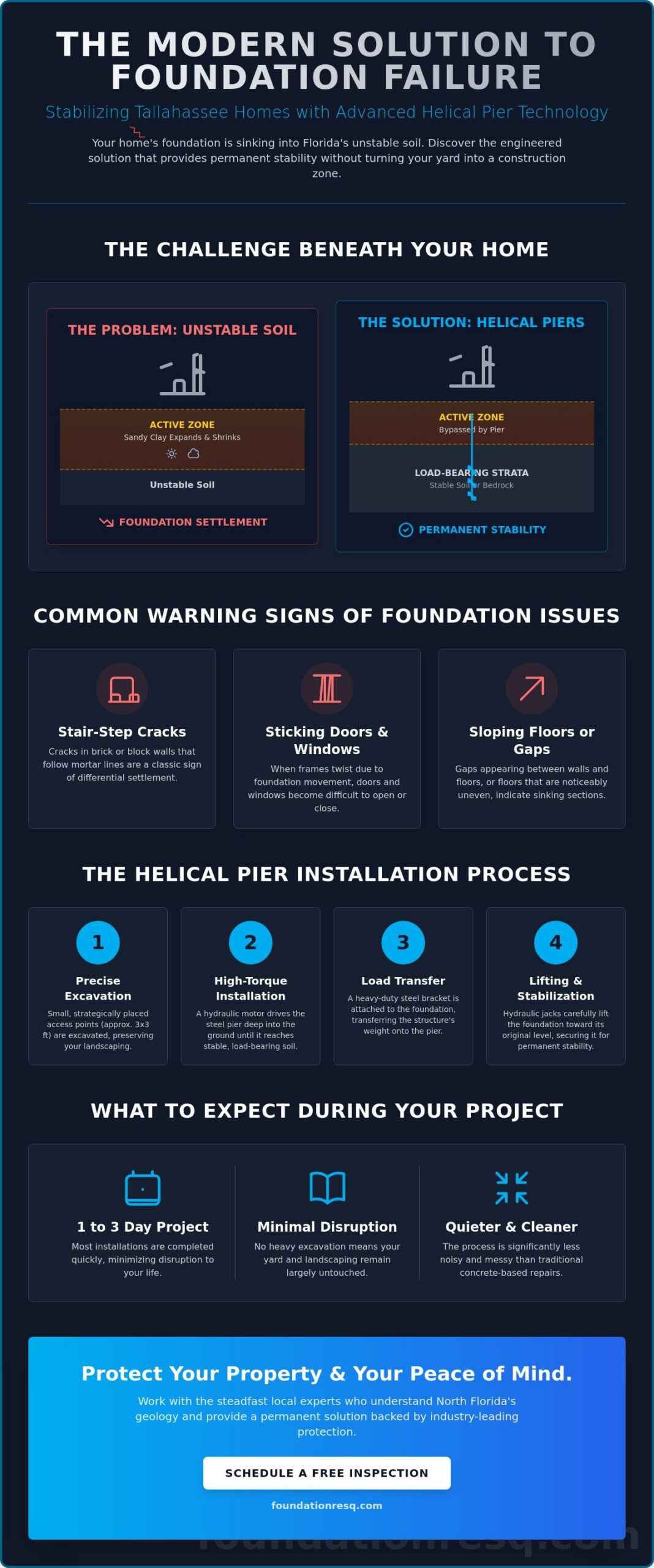
The primary cause of settlement in North Florida is the “active zone” of the soil. This is the upper layer of earth that fluctuates significantly based on the weather. When we experience heavy seasonal rains, the clay-rich soil absorbs water and expands, putting immense upward pressure on your foundation. During a drought, that same soil shrinks and pulls away, leaving your home’s footprint unsupported. Surface-level repairs often fail because they don’t address this cycle of movement.
Helical piers work by transferring the entire weight of the building away from the active zone. The piers are driven through the shifting clay until they reach the load-bearing strata. Load-bearing strata is the stable soil or rock layer capable of supporting a structure. By anchoring the home to this deep, competent layer, we create a bridge that bypasses the unstable surface soils entirely. This ensures that even as the clay around your home swells and shrinks, the foundation itself doesn’t move an inch.
Common Signs Your Tallahassee Home Needs Piering
It’s important to recognize the physical evidence of foundation movement before the damage becomes too severe. Homeowners often notice stair-step cracks that follow the mortar lines in exterior brickwork or stucco. These cracks are a clear signal that one section of the house is sinking faster than the rest. Inside the home, you might find that doors suddenly stick or windows no longer slide smoothly in their tracks. These aren’t just signs of an aging house; they’re structural red flags that indicate your foundation is losing its battle with the soil. For more detail on what to look for, you can read our guide on 7 Warning Signs of a Bad Foundation in Florida Homes. Catching these issues early allows for a more controlled repair process and prevents the need for more invasive structural remediation later.
The Step-by-Step Helical Pier Installation Process
The process begins with surgical precision to ensure your yard remains as intact as possible. Technicians excavate small access points, typically measuring about three feet square, at specific intervals along the foundation footing. This targeted approach is a far cry from the massive trenches required by older repair methods. Once the footing is prepared, a high-torque hydraulic motor is used to drive the steel pier into the earth. During this phase of the helical pier installation, the pier acts as a self-drilling anchor, rotating through the soil until it reaches a layer capable of supporting the house’s weight.
Once the pier reaches the necessary depth, a heavy-duty steel bracket is secured to the foundation footing. This bracket transfers the building’s load from the unstable soil onto the pier. If the structure has settled significantly, hydraulic jacks may be used to carefully lift the foundation back toward its original position. For homeowners looking for a permanent remedy, choosing a professional for your foundation repair ensures every step follows strict engineering protocols.
Torque Monitoring and Load Verification
Precision is the hallmark of modern piering. As the pier is driven deeper, technicians monitor the installation torque in real-time. There’s a direct mathematical relationship between the torque required to turn the pier and the ultimate load capacity it can support. This engineering principle is a core component of ground anchor design, as detailed in the FHWA Geotechnical Circular. Digital indicators provide immediate data, allowing the team to verify that each pier has reached the exact capacity required for your specific home. This level of verification is impossible with traditional concrete pouring, which relies on guesswork regarding the soil’s strength.
Final Stabilization and Site Restoration
The final phase focuses on restoration and protection. After the piers are locked into place and the foundation is stabilized, the excavation points are backfilled. The soil is replaced and compacted to prevent future drainage issues near the footing. Because the access points are so small, most homeowners find that their landscaping requires only minimal touch-ups after the project is complete. A final inspection confirms that the structure is fully supported and that the remedy meets all local standards, including the requirements for a Leon County foundation repair permit. This methodical approach ensures the structural health of the building is restored without leaving behind a mess.
Helical Piers vs. Alternative Foundation Solutions
Selecting the right foundation repair method depends heavily on the specific needs of your property and the soil conditions beneath it. While some homeowners consider temporary fixes like mudjacking or simple slab leveling, these methods often fail to address the root cause of settlement in Tallahassee. Mudjacking adds weight to already unstable soil, which can actually accelerate sinking over time. In contrast, helical pier installation provides a permanent remedy by transferring the structural load to stable, deep-seated layers. If you’re evaluating your options, our guide to permanent foundation repair solutions explains why engineered deep-anchor systems outperform surface-level patches for lasting stability. This shift from a temporary surface fix to a deep foundation anchor represents a significantly higher return on investment, as it eliminates the need for repeated repairs every few years.
Helical piers are especially effective for lighter structures where other methods might struggle. If a chimney is pulling away from the house or a porch is beginning to tilt, there often isn’t enough structural weight to use certain alternative systems. Because helical piers are screwed into the ground independently of the building’s weight, they can stabilize these smaller additions with precision. This versatility makes them a go-to choice for residential stabilization and specific structural elements that require immediate load-bearing capacity without the need for massive counterweights.
Helical Piers vs. Push Piers
The choice between these two systems often comes down to the weight of the structure and the depth of the stable soil. For a detailed breakdown of these technologies, you can explore our guide on Helical Piers vs. Push Piers: Choosing the Right Foundation Solution in 2026. Push piers are high-strength steel tubes that are driven into the ground using the actual weight of the house as a counter-force. This makes them ideal for heavy, multi-story residential buildings that provide enough resistance to drive the piers to the necessary depth.
Helical piers don’t require that structural weight to be effective. They’re turned into the soil using hydraulic power, making them the preferred option for lighter homes, crawl space foundations, or specific structural elements like decks and sunrooms. Choosing the right system requires an expert evaluation of your Tallahassee property’s specific load requirements and local soil profile to ensure the chosen remedy provides a permanent barrier against future movement.
Commercial vs. Residential Applications
Engineering requirements for business properties often involve much higher load capacities and stricter regulatory oversight than residential jobs. When dealing with Foundation Repair for Commercial Buildings, the helical pier installation process is customized with larger shaft diameters and specialized blade configurations. These industrial-grade anchors are designed to support the massive weights of warehouses, office complexes, or retail centers found throughout North Florida.
Commercial sites in Tallahassee also face specific permitting and inspection hurdles that require a methodical approach. Engineering oversight is a requirement for these projects to ensure the stabilization meets the Florida Building Code, Ninth Edition (2026) standards. Whether it’s a small residential chimney or a large-scale commercial foundation, using the correct engineered piering system ensures the building remains a safe and stable environment for its occupants.
What to Expect During Your Installation Project
Most homeowners are surprised by how quickly a professional helical pier installation progresses. It’s efficient. While a total foundation failure feels like a long-term nightmare, the actual physical remedy for a typical residential property usually takes only one to three days. This timeline includes everything from the initial excavation to the final site cleanup. Because the process is mechanical rather than chemical, there’s no waiting for concrete to cure, which allows us to stabilize the structure and backfill the area almost immediately.
Noise and vibration are often major concerns for families staying in the home during repairs. You won’t have to deal with the rhythmic, bone-shaking pounding associated with traditional pile driving. Helical piers are screwed into the earth using hydraulic motors, which produces a low hum similar to a small tractor engine. This method is significantly quieter and safer for the existing structure, as it doesn’t send shockwaves through the foundation or walls. If you’re ready to secure your home’s future, reach out for a professional foundation repair evaluation today.
Tallahassee’s weather also plays a role in our project management. Our region’s frequent afternoon thunderstorms and high humidity can affect soil conditions, but the installation process is remarkably resilient. Because the piers reach deep into the load-bearing strata, surface-level rain rarely stops the work once the excavation is protected. Our crews focus on protecting your lawn and flower beds by using plywood pathways for equipment and keeping the work footprint as small as possible.
Preparing Your Property for the Crew
A little preparation goes a long way in ensuring a smooth project. We recommend clearing the perimeter of your home by moving outdoor furniture, potted plants, or decorative items at least ten feet away from the work area. Before any digging begins, we coordinate the identification of underground utility lines to prevent service interruptions. You’ll have a direct line of communication with the project foreman, who will provide daily updates on the progress and answer any technical questions that arise during the installation.
The “Lift” vs. “Stabilization” Debate
It’s vital to manage expectations regarding the final position of your home. In many cases, we can carefully “lift” the foundation back toward its original level. However, if the house has been settled for many years, a full lift might cause more harm than good to the plumbing and interior framing. In these instances, “stabilization” becomes the primary goal. This means we stop all future movement without forcing the house upward. While a lift can sometimes close existing cracks, it may also create minor new cosmetic cracks as the home’s weight shifts. We always prioritize the long-term structural health of the building over immediate cosmetic perfection.
Why Foundation ResQ is the Tallahassee Authority on Piering
Choosing a partner for your home’s structural health is a significant decision. In Tallahassee, the soil isn’t just dirt; it’s a complex mix of clay and limestone that requires a specialized touch. Foundation ResQ has protected Tallahassee homes since 2013. Our team understands the local geology of North Florida and South Georgia better than anyone else in the industry. When you choose us for your helical pier installation, you aren’t just getting a contractor. You’re hiring a team of specialists who treat your foundation as the literal bedrock of your family’s safety.
We operate with industry-leading scale and resources, which allows us to provide national-standard warranties while maintaining our identity as a helpful neighbor. This combination ensures you receive the most advanced engineering available today. Our focus remains on remedy-based solutions. We don’t just patch cracks or hide symptoms. We address the root cause of settlement to ensure your home remains stable for the long term. This permanent fix doesn’t just provide peace of mind; it also adds measurable value to your property appraisal by certifying the structural integrity of the building. For those concerned about the investment, we offer flexible financing options to ensure your home gets the protection it needs without delay.
The Foundation ResQ Guarantee
Our commitment to your home doesn’t end when the crew leaves your driveway. We offer transferable warranties that stay with the house. This provides a powerful selling point if you ever decide to move, as it proves to potential buyers that the foundation is secure. This Steadfast Local Expert approach is built on trust and professional integrity. We take our duty as protectors of your home seriously, ensuring every pier is installed to exact engineering specifications and meets all local building codes. Our reputation is built on the durability of our work and the stability of the structures we save.
Get Started with a Structural Evaluation
Finding the right solution starts with an accurate diagnosis. We provide a thorough structural evaluation to identify the exact cause of your foundation issues. Our experts look for the red flags mentioned earlier and use precision tools to measure any current settlement. During this visit, we’ll walk you through our findings and provide a transparent Helical Pier Installation Cost Guide so you can make an informed decision. Don’t let foundation worries linger while the damage gets worse. Schedule your free inspection today.
Secure Your Home’s Future Today
Protecting your property from the shifting clay and limestone of North Florida requires more than just a surface-level fix. You now understand how helical pier installation provides a permanent remedy by anchoring your house to deep, stable soil layers. This engineered solution offers immediate structural support while preserving your landscaping and peace of mind. With the right stabilization in place, you can stop worrying about growing cracks or sticking doors and focus on enjoying your home.
Foundation ResQ brings over 10 years of Tallahassee structural experience to every project. As a Groundworks-backed company, we provide a lifetime warranty that ensures your investment is protected for years to come. We also offer financing options to make these critical repairs accessible for every homeowner. Our team is ready to help you restore the safety and integrity of your building with a methodical, professional approach.
Schedule Your Free Foundation Inspection with Tallahassee Experts today and take the first step toward a stable foundation. You don’t have to face structural concerns alone; we are here to provide the dependable guidance and permanent results your home deserves.
Frequently Asked Questions
How long does helical pier installation take for a standard home?
Most residential projects are completed within one to three days. The exact duration depends on the total number of piers required and how easily our team can access the foundation footing. Because the process doesn’t involve pouring concrete or waiting for it to cure, technicians can often stabilize the structure and backfill the excavation sites in a single visit. This efficiency makes it one of the fastest foundation repair methods available for Tallahassee homeowners.
Will helical pier installation damage my landscaping or driveway?
Landscape damage is kept to an absolute minimum because we use small, targeted excavation points rather than large trenches. Our teams use plywood to protect your lawn from equipment weight and carefully move plants if they’re in the direct path of a pier location. For driveways, we can often install piers from the exterior or through small core holes, ensuring the structural health of the concrete slab remains intact without requiring a full replacement.
Can helical piers be installed in tight spaces or crawl spaces?
Yes, helical piers are ideal for confined areas like crawl spaces or basements where traditional machinery cannot fit. We use specialized, portable hydraulic equipment that allows for professional helical pier installation in spaces with limited overhead clearance. This versatility makes them a preferred choice for stabilizing interior walls or supporting structures with restricted exterior access, providing a remedy that other piering methods simply cannot offer.
What is the difference between a helical pier and a helical pile?
There’s no functional difference between a helical pier and a helical pile. Both terms refer to the same deep foundation anchor system consisting of a steel shaft with helical plates. In residential foundation repair, “pier” is the more common term used by homeowners and contractors. In contrast, “pile” is frequently used in commercial engineering, utility projects, or new construction contexts. Both provide the same permanent stabilization for your home.
How deep do helical piers usually need to go in Tallahassee?
The depth varies based on the specific soil conditions of your property, but piers in Tallahassee often reach between 15 and 25 feet. Our technicians drive the steel shafts through the unstable sandy clay until they hit competent load-bearing strata. We use real-time torque monitoring to confirm exactly when each pier has reached the necessary depth to support the weight of your home permanently, regardless of how deep the stable layer sits.
Do I need a building permit for helical pier installation in Florida?
Yes, you must obtain a building permit for foundation repairs in Florida to ensure the work meets safety standards. In Leon County, there’s a specific permit process and fee for foundation stabilization projects. Professional contractors handle the permitting process to ensure the project complies with the Florida Building Code, Eighth Edition. This documentation is vital for your home’s history and ensures the repair is recognized by engineers and future buyers.
Are helical piers a permanent solution for foundation settling?
Helical piers are considered a permanent solution because they bypass shifting surface soils entirely. By anchoring your foundation to stable earth or rock layers deep underground, the system prevents any future settlement. Unlike temporary fixes like slab leveling with foam or mudjacking, a professional helical pier installation provides a structural bridge that remains stable regardless of the moisture cycles in Tallahassee’s clay soils. It’s a one-time remedy for a lifelong problem.
Can helical piers be used to lift a sinking chimney or porch?
Yes, helical piers are the most effective way to stabilize and often lift sinking chimneys or porches. These structures are often lighter than the main house, meaning they don’t provide enough weight for push piers to be effective. Because helical piers are screwed into the ground independently of the building’s weight, they can precisely target these specific areas to close gaps and restore the original alignment of the structure.