Florida’s sandy terrain doesn’t just shift; it actively works against the structural integrity of your home. If you have noticed sticking doors or widening cracks, you already know the anxiety that comes with a high water table and unstable ground. It’s a common fear for homeowners in our region that a foundation repair might only be a temporary patch rather than a final resolution. You deserve the assurance that your house is anchored to something much more reliable than the loose earth surrounding it.
In this guide, you will discover why helical piers for sandy soil Florida have become the engineered gold standard for permanent stabilization. Unlike traditional methods that rely on the weight of the structure, these piers function as mechanical anchors that reach deep into competent, load-bearing strata. We will explain how this specific technology provides a one-and-done fix that protects your property value and structural safety. By the end of this article, you will understand the precise science behind torque-based stabilization and why it remains the most dependable defense for North Florida homes.
Key Takeaways
- Learn how Florida’s high water table and loose geology create unique foundation settlement challenges that require specialized stabilization.
- Discover why helical piers for sandy soil Florida are considered the gold standard for creating a permanent mechanical anchor in deep, stable strata.
- Understand the technical differences between helical and push piers to determine which method is best suited for your home’s specific structural needs.
- Get a clear overview of the professional installation process, from initial soil density testing to the final stabilization of your foundation.
- Find out how a remedy-based approach focuses on fixing the underlying cause of settlement to ensure the long-term safety and value of your property.
Understanding Foundation Settlement in Florida’s Sandy Soils
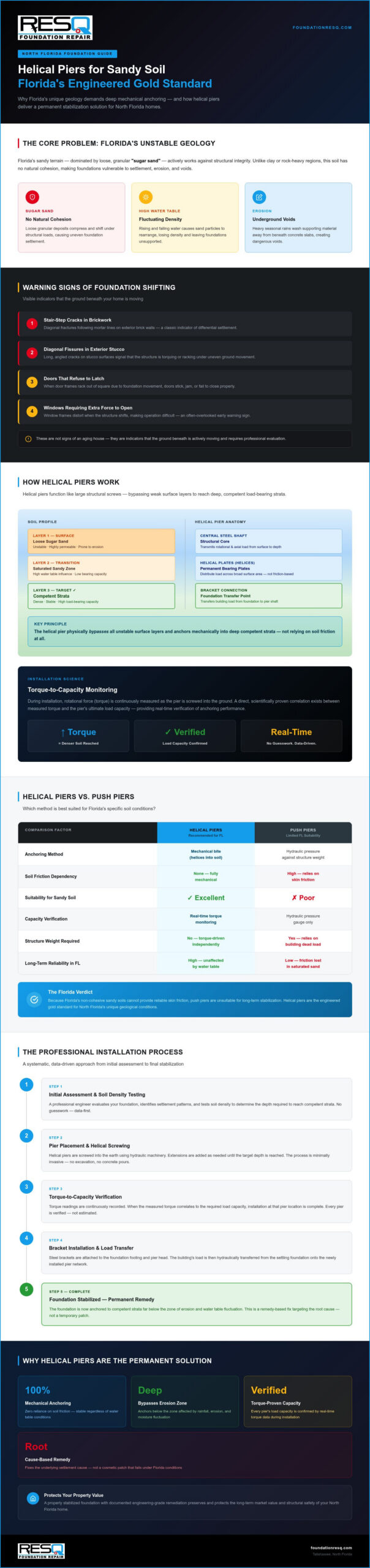
Settlement in Florida isn’t a simple matter of a house finding its “seat.” Our geology is dominated by loose, granular deposits often referred to as sugar sand. This soil lacks the natural cohesion found in clay or rock-heavy regions. In Tallahassee, homes are often built on these unstable layers. When the soil shifts or compresses under the weight of a structure, the foundation sinks unevenly. This is why helical piers for sandy soil Florida are often necessary; they bypass these weak surface layers to reach more competent ground.
Differentiating between minor settling and structural failure is vital for homeowners. While every house experiences some initial movement, structural failure occurs when the soil can no longer provide the required bearing capacity. In our region, this is frequently accelerated by the high water table. Understanding the engineering behind a helical piles and ground anchoring system helps explain why deep-seated support is the only way to counteract this natural soil behavior.
The Role of Moisture and Erosion
Moisture is the primary driver of soil instability in North Florida. Heavy seasonal rains don’t just soak the ground; they physically move it. Because sand is highly permeable, water flows through it easily, often washing away the supporting material directly beneath your concrete slab. This creates underground voids. Additionally, our fluctuating water table causes the soil to lose its density. When the water retreats, the sand particles rearrange into a tighter, lower volume, leaving your foundation unsupported. Opting for helical piers for sandy soil Florida addresses this by anchoring the structure far below the zone of erosion.
Signs of Foundation Shifting in Florida Homes
You don’t need to be an engineer to spot the early warnings of a failing foundation. In Florida’s sandy environments, the signs are often visible on the exterior and interior of the home. Look for stair-step cracks following the mortar lines in your brickwork or long, diagonal fissures in exterior stucco. Inside the home, you might notice doors that suddenly refuse to latch or windows that require extra force to open. These aren’t just signs of an aging house; they are indicators that the ground beneath you is moving. For a more detailed checklist, you can review our guide on 7 Warning Signs of a Bad Foundation in Florida Homes to help determine if your property requires professional stabilization.
The Science of Helical Piers: How They Stabilize Loose Soil
Helical piers function like large structural screws. They consist of a central steel shaft with one or more helical plates, or helices, welded to the exterior. These plates aren’t merely for driving the pier into the earth; they serve as permanent load-bearing plates. When we install helical piers for sandy soil Florida, these helices transfer the weight of your home away from the shifting surface sand and down to the dense, stable ground located far below. This method provides a permanent remedy by bypassing the layers that are prone to erosion and settlement.
Mechanical Anchoring vs. Friction
One of the primary benefits of this technology is its reliance on mechanical anchoring rather than soil friction. In many other states, foundation piles rely on “skin friction,” where the soil grips the sides of a smooth pile to hold it in place. However, Florida’s sandy soils are non-cohesive and lack the necessary “grip” for friction-based systems to remain reliable over decades. Helical piers for sandy soil Florida solve this by physically biting into the soil layers. Each helix acts as an independent bearing plate, distributing the building’s load across a broader surface area. This mechanical connection is vital for long-term stability, especially when dealing with the Problem Soils in Florida that frequently compromise traditional foundation designs.
During the installation, we utilize a process called torque-to-capacity monitoring. This involves measuring the rotational force, or torque, required to turn the pier into the ground. There is a direct, scientifically proven correlation between the torque measured during installation and the ultimate load capacity the pier can support. This data provides immediate, professional assurance that each pier has reached a layer capable of holding your home’s weight.
Reaching Competent Strata
In the Tallahassee area, reaching “competent strata” is the ultimate goal. This refers to the deep-seated soil or rock layers that are dense enough to resist further compression. Because North Florida’s geology varies from block to block, the depth of these piers is determined by soil resistance rather than a pre-set limit. While some piers find stability at 20 feet, others may need to go twice as deep to find a secure anchor. This precision ensures your home is protected against future shifts. If you’re concerned about shifting sands beneath your home, our team can help you determine the best path forward for foundation repair.
Helical Piers vs. Push Piers: Which Is Best for Florida?
Many homeowners assume that all foundation piers are essentially the same. However, the physics behind how these systems interact with the earth varies significantly. Push piers are smooth steel pipes driven into the ground using the structural weight of the house as a counter-lever. In contrast, helical piers are mechanically threaded into the soil using a hydraulic motor. This distinction is critical because the method of installation determines whether the repair will hold up against our state’s unique geological pressures.
In Florida’s non-cohesive soils, the “screw-pile” design of a helical pier provides a distinct advantage. While push piers rely on reaching a massive resistance point (like solid bedrock), helical piers for sandy soil Florida create their own stability through the surface area of their plates. Adhering to the International Building Code for Helical Piles ensures that these systems are engineered to withstand specific loads, providing a reliable remedy regardless of whether your home is a heavy brick estate or a lighter frame cottage.
When to Choose Helical Piers
Helical piers are often the superior choice for lighter structures such as chimneys, porches, or older Tallahassee homes with shallow footings. Because they don’t require the building’s weight to be driven into the earth, we can install them without putting additional stress on a fragile foundation. They are particularly effective in areas with high sand content where traditional piers might lack the necessary lateral support. If you’re unsure which method fits your property, you can read more about the technical differences in our guide on Helical Piers vs Push Piers: Which Does Your Home Need?
The Limitations of Push Piers in Sand
Push piers struggle in deep sand deposits because they rely heavily on “skin friction” and the presence of a definitive rock layer. In many parts of North Florida, that rock layer is incredibly deep or inconsistent. If a push pier doesn’t reach a truly competent stratum, it may eventually slip or fail to provide the “one-and-done” fix homeowners expect. At Foundation ResQ, we use soil density testing and torque monitoring to determine the right system for your specific soil profile. We prioritize helical piers for sandy soil Florida when the geology suggests that a mechanical anchor will provide a more durable, protective barrier against future settlement. Our goal is always a permanent resolution that restores the structural health of your building for the long term.
The Installation Process for Tallahassee Homeowners
A professional foundation repair is a methodical process that prioritizes structural integrity and long-term safety. When installing helical piers for sandy soil Florida, we follow a rigorous five-step protocol to ensure every installation provides a permanent remedy for your home. We begin with a professional site evaluation and soil density testing to determine exactly how deep your piers must go to reach stable ground.
- Step 1: Professional Evaluation. We assess the current state of your foundation and analyze the soil composition to create a customized stabilization plan.
- Step 2: Excavation. Our team creates small access points around the foundation footings, minimizing the physical footprint on your property.
- Step 3: Precision Installation. We use high-torque hydraulic equipment to thread the helical piers for sandy soil Florida into the earth until they reach the required load-bearing capacity.
- Step 4: Load Testing and Attachment. Once the piers are secure, we attach heavy-duty steel brackets to your foundation, transferring the building’s weight to the new support system.
- Step 5: Site Restoration. We verify the engineering specs, backfill the access points, and restore the site to its original condition.
Minimal Disruption to Your Property
We understand that your home is your sanctuary. Our installation equipment is designed to be low-impact, allowing us to work in tight spaces without the need for massive machinery that might damage your driveway or yard. We take specific care to protect your Tallahassee landscaping during the process. Most residential projects are completed within three to five days. This efficient timeline ensures your home is stabilized quickly without the weeks of chaos often associated with major construction projects.
Engineering and Permits in Florida
Structural repairs in our region must adhere to strict local building codes. We handle the permitting process and ensure every project includes a Professional Engineer (PE) stamped design. This documentation is vital for your peace of mind and is often a requirement during future home sales. A documented, engineered fix proves to potential buyers that the foundation has been professionally restored. If you are ready to secure your home’s future, contact our local experts for a professional foundation evaluation today.
Foundation ResQ: Your Steadfast Local Expert for Stabilization
Foundation ResQ acts as the final line of defense for your property. We understand that foundation repair is a high-stakes industry where structural integrity cannot be compromised. Our team adopts a remedy-based framework, which means we focus on resolving the underlying cause of settlement rather than just patching the visible symptoms. By choosing us, you are partnering with a company that values professional integrity and long-term stability. We don’t just fix buildings; we restore the safety and confidence of the people who live in them.
As a Groundworks company, we offer the unique benefit of national strength combined with a local Tallahassee heart. This relationship provides us with access to industry-leading materials and engineering research while allowing us to remain your helpful neighbor. We are deeply committed to the physical health of every building we service. Our brand persona is that of a protector for your home. We provide steady, reliable guidance that steers you away from quick fixes and toward permanent structural health.
Customized Solutions for Tallahassee Geology
We don’t believe in “one-size-fits-all” foundation repair. Every property in North Florida sits on a unique patch of earth, and our experience has taught us that Tallahassee’s specific soil requires a tailored approach. When we recommend helical piers for sandy soil Florida, it’s based on precise data from your specific site. Our team is methodical and thorough, ensuring that the chosen solution matches the geological challenges of your neighborhood. For more information on local standards, you can explore our Professional Foundation Repair in Tallahassee: A Guide for 2026.
Protecting Your Investment for the Long Term
A stabilized foundation provides more than just structural safety; it offers permanent peace of mind. By installing helical piers for sandy soil Florida, you are making a long-term investment in the durability of your home. These solutions add tangible property value by removing the uncertainty of future settlement. We take our duty seriously, moving through each remediation project with a steady and deliberate pace. Our goal is to lead you from a state of concern toward a state of informed resolution. We invite you to schedule a professional structural evaluation with our team to ensure your home remains protected against the elements for decades to come.
Protect Your Home with Engineered Stability
Florida’s unique geology doesn’t have to be a threat to your home’s longevity. By using helical piers for sandy soil Florida, you are choosing a solution that bypasses loose surface layers to create a permanent, mechanical anchor in stable ground. This engineered approach moves beyond temporary repairs to provide a true structural remedy that restores your building’s health. You don’t have to settle for the anxiety of recurring cracks or shifting floors when a permanent stabilization method is available.
As Tallahassee regional specialists backed by the national authority of Groundworks, Foundation ResQ offers the technical precision your property requires. Our methodical installation process, complete with professional torque monitoring and engineering verification, ensures that your home is protected by a durable barrier against shifting sands. You can restore your property value and gain absolute peace of mind knowing your foundation is anchored to competent strata. Protect your home’s integrity—schedule your free foundation inspection with Foundation ResQ today. We look forward to helping you secure your home for the long term.
Frequently Asked Questions
Are helical piers effective in very loose Florida sand?
Helical piers are exceptionally effective in loose sand because they don’t rely on soil friction for support. Instead, the helical plates act as mechanical anchors that bite into the ground. When installing helical piers for sandy soil Florida, our team ensures the plates reach dense layers that can support the building’s weight. This makes them a superior choice for our region’s sugar sand compared to traditional push piers.
How deep do helical piers need to go in Tallahassee?
The depth of a helical pier in Tallahassee depends entirely on your property’s specific soil profile. While many installations reach competent soil between 20 and 40 feet, some may go deeper to find the necessary resistance. We don’t use a pre-set depth; instead, we monitor installation torque to verify that each pier has reached a stratum capable of supporting the structural load of your home.
Will helical pier installation damage my landscaping?
We prioritize a low-impact approach to protect your Tallahassee landscaping. Helical pier equipment is much smaller than the heavy machinery used for other foundation methods. We only need small access points around the foundation footings to complete the installation. Once the piers are secure and the brackets are attached, we backfill the holes and restore the area, leaving your yard looking much as it did before we arrived.
Can helical piers be used for commercial buildings in Florida?
Yes, helical piers are a standard engineering solution for stabilizing existing commercial buildings throughout Florida. They are frequently used for retail spaces, office buildings, and warehouses that show signs of settlement. Because they are installed with hydraulic equipment, we can often perform these repairs with minimal disruption to business operations. This method provides the same long-term structural safety for commercial properties as it does for residential homes.
What is the difference between a helical pier and a helical pile?
In the foundation industry, the terms helical pier and helical pile are often used interchangeably. Technically, piles often refers to deep foundation elements used in new construction, while piers usually describes the underpinning of existing structures. Regardless of the terminology, the engineering principle remains the same. Both use a screw-like design to transfer the weight of a building to stable, load-bearing soil deep underground.
How long does a helical pier foundation repair last?
A professionally installed helical pier system is designed to be a permanent foundation fix. Because the piers are made of high-strength galvanized steel and anchored into stable strata, they are resistant to the erosion and shifting that affect surface soils. This remedy-based approach ensures that your home remains stable for decades. It provides a long-term protective barrier between your home and Florida’s challenging environmental elements.
Do I need a permit for helical pier installation in Tallahassee?
Yes, structural foundation repairs in Tallahassee require a building permit. As your local experts, we handle the permitting process to ensure your project complies with the Florida Building Code. Every installation includes a design stamped by a Professional Engineer. This documentation is essential not only for legal compliance but also for protecting your property value and providing proof of repair during future home sales.
Can helical piers lift a house back to its original level?
Helical piers can often be used to lift a foundation back toward its original position, but the primary goal is always stabilization. Once the piers reach competent soil, we use hydraulic jacks to carefully transfer the load. While we strive to achieve maximum practical recovery, our first priority is ensuring the home is secure. This process stops further settlement and helps close cracks in brickwork or stucco.