
Run your downspout extension at least 4 to 6 feet from the foundation, and push it to 8 or 10 feet if you have a basement, clay soil, or a yard that stays wet after rain. That gap keeps roof runoff out of the backfill zone hugging your foundation wall, which is where basement leaks and settling problems usually start. Slope, soil type, and how your yard drains can all push that number higher.
TL;DR:
- Most homes should have downspout extensions at least 4 to 6 feet long, or up to 8 to 10 feet for homes with basements or clay soil.
- Properly measuring and installing the extension with a consistent slope ensures water disperses away from the foundation and prevents pooling.
- Soil type and yard slope greatly influence the necessary extension length, with clay and flat yards often requiring longer runs.
- Above-ground extensions are suitable for short distances, while buried lines are better for long, discreet, or high-traffic areas, provided they daylight properly.
- Regular post-rain inspections and maintenance can prevent clogs and detect issues early before serious foundation damage occurs.
Table of Contents
- What Downspout Extension Length Actually Means for Your Foundation
- How Soil and Yard Slope Change the Right Distance
- Types of Downspout Extensions and When to Use Each
- How to Plan and Install an Extension That Actually Drains
- Buried Lines, Daylighting, and Pop-Up Emitters: The Trade-Offs
- Keeping Extensions Working Through Every Season
- When to Call a Contractor Instead of Fixing It Yourself
- What Matters Most When You’re Deciding DIY vs. Pro
- A Longer-Term Fix When DIY Extensions Aren’t Enough
- Sources
- FAQ
What Downspout Extension Length Actually Means for Your Foundation
The distance between your downspout and your house isn’t a cosmetic detail. It’s the difference between water that disperses harmlessly into your lawn and water that pools against your foundation wall, softens the soil, and eventually finds its way into a basement or crawl space.
Think of it in bands, not one magic number.
1 to 3 feet: high risk. This is essentially no extension at all, just a downspout dumping straight onto the soil next to your foundation. Every heavy rain saturates the backfill immediately next to the wall, the same loose soil that was dug out and refilled during construction, which drains poorly and holds water like a sponge.
4 to 6 feet: the baseline. This is the minimum most building science sources recommend, and it’s usually enough for a slab-on-grade home on decent soil with a slight slope already working in its favor, according to BASC’s gutter and downspout guidance.
8 to 10 feet or more: the safer zone. Homes with basements, homes sitting on clay soil, or yards that stay soggy for days after a storm need the extra distance. BobVila’s guidance on gutter downspout length puts this range as the target when drainage is already a known problem.
Here’s how that breaks down by foundation type:
| Foundation type | Recommended minimum | Why |
|---|---|---|
| Slab-on-grade, good soil | 4–6 ft | Less backfill depth, water disperses faster |
| Crawlspace | 6–8 ft | Vented space beneath the home is vulnerable to standing moisture |
| Basement | 8–10 ft | Deep backfill zone and below-grade walls are the most exposed to hydrostatic pressure |
| Clay or compacted soil | 8–10 ft | Slow drainage means water sits longer near the wall regardless of foundation type |
To measure it yourself, stretch a tape measure from the exterior foundation wall (not the gutter, not the downspout elbow) to the very end of the extension. Aim the discharge point at something specific in your yard, a garden bed edge, the base of a tree, the property line, rather than just guessing at “far enough.”
A few real-world scenarios make this concrete. A slab home in a sandy lot with a gentle natural slope away from the house can often get by with the 4 to 6 foot baseline. A crawlspace home on flatter ground needs closer attention to where that water actually goes once it leaves the extension. A basement home on clay, especially one that’s already had water in the past, should treat 8 to 10 feet as the floor, not the ceiling.
How Soil and Yard Slope Change the Right Distance
Soil type decides how fast water disappears once it hits the ground, and that changes how far you need to move it before it stops being your foundation’s problem.
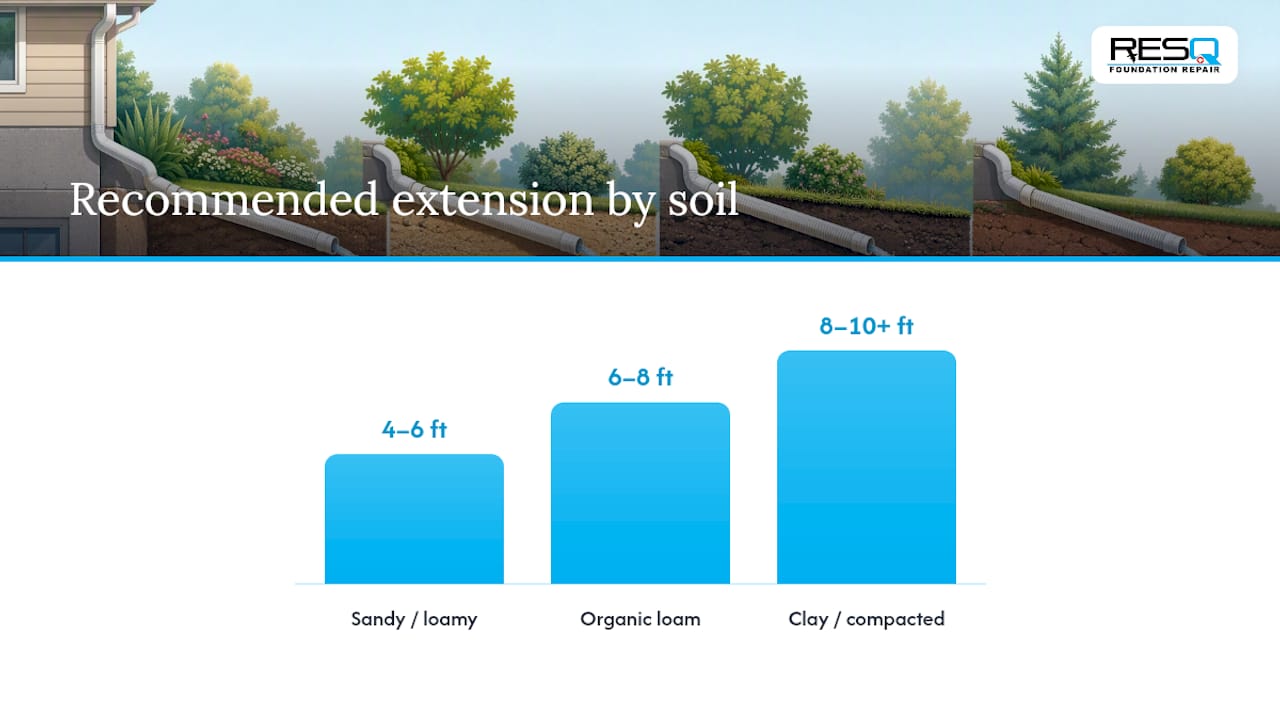
Sandy or loamy soil drains quickly, so water that reaches the 4 to 6 foot mark tends to soak in and move on. Loamy soil with more organic content drains a bit slower and benefits from pushing extensions toward 6 to 8 feet. Clay or compacted fill soil, common in areas with heavy foot traffic or newer construction where the yard was graded and packed, barely drains at all. Water sits, spreads laterally, and can travel back toward the house even from what looks like a safe distance. Clay soils generally call for the full 8 to 10 foot range, sometimes longer.
Slope matters just as much as soil. The generally accepted target is roughly 1 inch of fall per foot for short runs, or about 6 inches of drop over the first 6 feet away from the house, according to guidance on gutter, downspout, and drainage grading. If your yard is flat or, worse, slopes back toward the foundation, no extension length fixes that on its own. You need to regrade before the extension does its job.
Two quick DIY tests tell you where you stand:
- The storm-watch test. Go outside during or right after a heavy rain and watch where the water actually travels. If it’s puddling within a few feet of the wall, your current setup is too short or your slope is wrong.
- The hole-fill test. Dig a small hole about 12 inches deep near the problem area, fill it with water, and time how long it takes to drain. Water sitting for more than a few hours is a strong sign you’re dealing with clay or compacted soil and need a longer run.
Quick fact: a positive slope of about 6 inches over the first 6 feet from the house is the standard target for keeping surface water moving away from the foundation instead of pooling against it.
Types of Downspout Extensions and When to Use Each
Not every yard needs the same fix, and the right extension type depends on how far you need to move water and how much you care about mowing around it every week.
- Rigid plastic or aluminum extenders. These are the simplest option, typically sold in 4 to 6 foot lengths that can be connected for more reach. Flip-up versions hinge upward so you can mow underneath, then drop back into place. They’re durable and cheap, but they only work as well as the slope you give them.
- Corrugated flexible tubing. Cheap, easy to bend around landscaping, and fine as a temporary fix. The accordion ridges also collect debris and can sag over time, creating low spots where water pools instead of flowing, which is the most common failure mode.
- Splash blocks. These concrete or plastic troughs redirect water only 2 to 3 feet, which BobVila notes is rarely enough on their own. They work best paired with a longer extension, not as a standalone solution.
- Buried rigid pipe. Runs underground to a discharge point well away from the house, keeping the yard clear of visible tubing. More expensive and harder to inspect, but it’s the cleanest long-term option for a manicured lawn.
- Pop-up emitters. These sit at the end of a buried line and pop open under water pressure to release flow, then close flat so they’re mowable. They’re a good middle ground between a buried pipe’s tidiness and an above-ground extender’s simplicity.
How to Plan and Install an Extension That Actually Drains
Getting the length right on paper doesn’t help if the installation itself sends water the wrong way. Here’s the sequence that gets it right the first time.
- Measure your current setup. Note where the downspout currently discharges and how far that is from the foundation wall. Then pick your target discharge point, somewhere downhill, at least 4 to 6 feet out and farther if you have a basement or clay soil.
- Confirm the target point is actually downhill. Walk the path with a level or even just a garden hose test, letting water flow and watching where it settles. If the “downhill” spot isn’t really lower than the house, adjust your target before buying materials.
- Buy extra material. Pipe and fittings rarely go in exactly as measured. This Old House recommends buying about 10 to 15% more than your measured run to cover elbows, connectors, and mistakes.
- Check pipe size compatibility. Most residential downspouts are 2×3 or 3×4 inches. A 3×4 downspout will not fit directly into a standard round adapter sized for a 5 inch round gutter system without a transition fitting, so match your extension’s inlet to your downspout’s actual shape before you buy.
- Install above-ground extensions first. Attach the extender at the downspout elbow, secure it with the clamp or screw provided, and use flip-up fittings if you’ll be mowing over that path regularly.
- For buried lines, dig the trench correctly. This Old House suggests bedding pipe roughly 10 inches deep with a steady downward pitch toward the discharge point, never flat and never sloped backward.
- Bed and backfill properly. Lay a few inches of gravel or sand under the pipe for drainage support, then backfill and tamp the soil to prevent future settling that could reverse your slope.
- Call 811 before you dig. This is a free utility locate service that flags buried gas, electric, and water lines before you break ground, and skipping it is how DIY projects turn into expensive accidents.
Pro Tip: Test any new extension, buried or above-ground, with a full bucket of water before you call the job done. If it drains and disperses within a few seconds without backing up at the outlet, your slope is right. If it sits and slowly seeps, fix the pitch now, not after the next storm.
Buried Lines, Daylighting, and Pop-Up Emitters: The Trade-Offs
Burying your downspout line is worth the extra cost and labor when you need a long run across a finished lawn, want zero visible hardware, or are dealing with a yard where above-ground extensions constantly get knocked around by mowers or foot traffic. It’s overkill for a simple, already-sloped yard where a 6 foot rigid extender solves the problem for a fraction of the cost.
The core requirement for any buried line is that it has to daylight, meaning it exits aboveground at a lower point, or connect to an approved storm drain, according to InspectAPedia’s guidance on buried downspouts. A line that just dead-ends underground with no true outlet isn’t drainage, it’s a hidden reservoir. And never route discharge onto a neighbor’s property or across a shared walkway, both because it’s a good-neighbor problem and because standing water on pavement becomes an ice hazard in winter.
Buried lines fail in a few predictable ways:
- Clogging from leaves and debris that wash down before reaching a filter or strainer at the inlet.
- Frost heave in colder climates, where freeze and thaw cycles shift pipe sections and disrupt the pitch.
- Root intrusion, especially from trees planted after the line went in, which can crack joints and block flow entirely.
Designing around these means keeping the run as straight as possible, using solid pipe rather than perforated pipe for the transport section, and avoiding planting anything with an aggressive root system near the buried path.
Keeping Extensions Working Through Every Season
A downspout extension that worked perfectly last spring can fail silently by fall, so a quick check after major storms is worth the five minutes it takes.
Walk the perimeter after heavy rain and look for pooling near the foundation, soft or spongy ground that wasn’t there before, or any obvious separation at the extension joints. These are the first visible signs that water isn’t traveling as far as it should.
- Clear debris from the downspout inlet and the extension’s discharge end, since even a small clog upstream can back water up the whole line.
- If you suspect a buried line is blocked, disconnect it above grade and attach a temporary above-ground extension. If that stops the flooding, the buried section is your problem, as InspectAPedia notes is a reliable way to isolate the issue without excavating blindly.
- Before winter, flip up rigid extenders that cross walkways so runoff doesn’t freeze into ice patches, and consider routing pop-up emitters away from paths where discharge could pool and freeze overnight.
Pro Tip: Keep a spare length of rigid extender in the garage. If a buried line clogs mid-winter, a quick above-ground swap buys you time until the ground thaws enough to dig and clear it properly.
When to Call a Contractor Instead of Fixing It Yourself
Some signs mean it’s time to stop adjusting extensions and get a professional set of eyes on the problem.
- Basement seepage that returns after you’ve already corrected the extension length and slope.
- Multiple soggy zones around the foundation that don’t track with any single downspout.
- Visible foundation cracks, especially ones that seem to widen after rain.
- Ground that stays soft or waterlogged for days rather than draining within hours.
A professional inspection typically checks yard grading across the whole property, the condition of any buried discharge lines, interior moisture patterns in the basement or crawlspace, and whether the sump pump is actually keeping up during storms. That’s a broader diagnostic than most homeowners can run themselves, and it catches problems, like a discharge line that’s been slowly failing underground for years, before they become structural. Services like discharge line protection, yard regrading, and sump pump repair exist specifically for the cases where DIY extensions aren’t enough anymore.
What Matters Most When You’re Deciding DIY vs. Pro
Get the distance and the slope right first. A correctly placed rigid extender at 6 to 10 feet solves most yards without buried pipe or a contractor call. But if you’ve fixed both and water still finds the foundation, or you see cracking, that’s not a longer-extension problem anymore. That’s when it’s worth having someone check the structure itself.
— Kayle
A Longer-Term Fix When DIY Extensions Aren’t Enough
Sometimes the extension length was never the real problem. If you’ve corrected slope, upgraded to a longer run, and buried the line properly, and water is still reaching your basement, the issue is likely bigger than a downspout. Foundationresq handles that next layer: discharge line protection that routes water safely away from vulnerable soil, yard grading designed to fix the drainage pitch across your whole property, sump pump repair for interior backup systems, and full basement waterproofing services when moisture has already found its way inside.

Repeated DIY fixes add up fast, new extensions, more gravel, another weekend regrading a corner of the yard, without ever addressing a structural drainage flaw. A single professional inspection often costs less over a few years than that cycle of patch jobs. If you’re seeing recurring basement moisture even after doing everything right outside, get a free inspection scheduled and find out whether the fix is in the yard or under the slab.
Sources
The distance and slope recommendations in this guide draw from BASC’s gutter and downspout resource guide, BobVila’s downspout length guidance, This Old House’s installation walkthrough, and InspectAPedia’s buried downspout diagnostics. For related property drainage issues, including septic considerations that can affect where discharge lines are legally routed, see Soluo’s guide on septic system subsidies.
For homeowners tackling drainage at home, Foundationresq’s guides on yard grading for drainage and recurring basement water problems cover the issues that often show up after an extension alone isn’t solving the problem.
- BASC (PNNL) — Gutters and downspouts resource guide
- BobVila — This Is the Right Length for Your Gutter Downspouts
- This Old House — How to extend a downspout
- InspectAPedia — Buried downspouts and drainage
FAQ
How far should a downspout extension be from a house?
At least 4 to 6 feet for most homes, and 8 to 10 feet if you have a basement, clay soil, or a yard that drains poorly.
Do downspout extenders really work?
Yes, when they’re long enough for your soil and slope and installed with a consistent downward pitch. A short or poorly sloped extender just moves the puddle a few feet without solving the underlying drainage problem.
Can you put a 3×4 downspout on a 5 inch round gutter?
Not directly. A 3×4 rectangular downspout needs a transition adapter to connect to hardware sized for 5 inch round gutter systems, so check fitting compatibility before buying extension pipe.
What is the rule of thumb for downspouts?
Extend discharge at least 4 to 6 feet from the foundation with a slope of roughly 1 inch per foot, or about 6 inches over the first 6 feet, so water keeps moving away from the house instead of pooling.