
A crack’s direction tells only part of the story. If you’re wondering how to tell if a foundation crack is structural, start by noting its width, shape, and location, especially if you’re concerned it may be spreading or allowing water inside. But no single crack pattern confirms the cause. Changes over time and other signs of movement matter, too.
This guide explains which patterns and related symptoms deserve attention, without asking you to diagnose the foundation yourself. You’ll learn what to photograph and record, when monitoring may be reasonable, and when to arrange a professional evaluation in Tallahassee. We’ll also cover what an assessment can clarify and which repair approaches, including foundation stabilization and wall reinforcement, may be considered if the findings support them. A clear record of your observations can help a qualified professional determine the next step.
Key Takeaways
- A crack’s direction and location offer clues, but don’t confirm its cause on their own.
- To understand how to tell if a foundation crack is structural, consider changes over time alongside other signs of movement.
- Photographs and dated notes give a qualified professional useful observations to review.
- Active widening, wall bowing, recurring water, or related building changes call for closer attention.
- A Tallahassee evaluation can help distinguish crack sealing from foundation stabilization, depending on the findings.
How to Tell If a Foundation Crack Is Structural: Start With the Evidence
To understand how to tell if a foundation crack is structural, look beyond the line itself. A crack can be evidence of foundation movement or lost support, but its appearance alone can’t confirm the cause or severity. Concrete can also crack as it cures and shrinks. Start by considering where the crack is, what pattern it follows, whether it changes over time, and whether other parts of the home show signs of movement.
A foundation carries the building’s loads and transfers them to the ground. Cracks can form when stress affects a material or part of that support system, but interpreting what is happening requires context. This is a basic principle of structural integrity: assess a visible defect alongside how the structure behaves, rather than treating the defect as a diagnosis by itself.
What makes a foundation crack potentially structural?
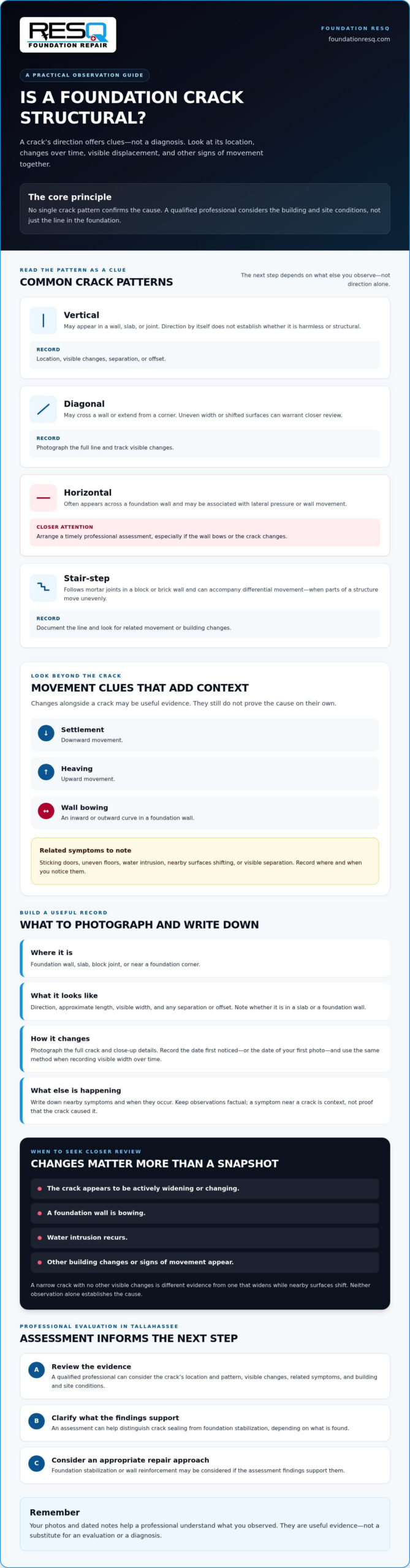
A surface crack may be limited to the material’s surface. A crack associated with movement may occur alongside shifting, separation, or loss of support. Direction or visible width alone can’t reliably distinguish between them. These terms can help describe what you observe: settlement is downward movement, heaving is upward movement, and wall bowing is an inward or outward curve in a foundation wall. They describe conditions, not conclusions you can draw from a crack alone.
For example, a narrow line with no other visible changes is different evidence from a crack that appears to widen while nearby surfaces shift. Neither observation establishes the cause. A qualified professional can consider the full picture, including the building and site conditions.
Which details should you record first?
Make a clear record before attempting a cosmetic repair. Note whether the crack is in a foundation wall, slab, block joint, or near a foundation corner. Describe its direction and approximate length, and record its visible width using the same method each time. Add the date you first noticed it, or use the date of your first photo if you’re unsure when it began.
- Take a well-lit photo showing the crack and its location, then take closer images for detail.
- Write down changes you observe over time without assuming what caused them.
- Record nearby symptoms, such as sticking doors, uneven floors, or water intrusion. Note where and when you notice them.
These observations help a foundation professional understand what you’ve seen, but they can’t replace an evaluation. Keep the record factual: a sticking door near a crack is useful context, not proof that the crack caused it. Location, pattern, change, and nearby symptoms provide a more useful starting point than any one visual clue.
Foundation Crack Patterns: What Horizontal, Vertical, and Stair-Step Lines Can Indicate
A crack’s direction can suggest what to look at next, but it can’t identify the cause by itself. In Tallahassee, as elsewhere, a useful assessment considers whether the crack is in a slab or foundation wall, whether its edges have shifted, and whether it’s changing or accompanied by other symptoms. Use these patterns as observation clues, not as a diagnosis.
| Pattern | Location and possible interpretation | Next step |
|---|---|---|
| Vertical | May appear in a wall, slab, or joint. The direction alone doesn’t establish whether it’s harmless or structural. | Record its location and any changes. Note separation or offset. |
| Diagonal | May cross a wall or extend from a corner. Uneven width or shifted surfaces can be a reason for closer review. | Photograph the full line and track visible changes. |
| Horizontal | Often appears across a foundation wall and may be associated with lateral pressure or wall movement. | Arrange a timely professional assessment, especially if the wall bows or the crack changes. |
| Stair-step | Follows mortar joints in a block or brick wall and can accompany differential movement, when parts of a structure move unevenly. | Document the crack and look for related movement or building changes. |
How should you interpret vertical and diagonal cracks?
Compare where the crack appears and whether its width varies along the line. A crack through a slab is a different observation from one in a load-bearing foundation wall, which supports the structure above. Visible displacement, where one side sits forward or back from the other, is useful to report. These details inform an assessment but don’t settle the cause. Avoid relying on a universal width cutoff. Consistent photos and observations over time are more useful than a single measurement.
Why do horizontal and stair-step cracks deserve attention?
A horizontal line in a foundation wall can be associated with sideways pressure or movement. If the wall also curves inward or outward, don’t assume the crack is cosmetic based on appearance alone. Arrange a timely professional evaluation. Stair-step cracks follow mortar joints rather than cutting straight through blocks. They can accompany uneven movement, but the pattern alone can’t confirm the cause or severity.
For homeowners asking how to tell if a foundation crack is structural, the key is to consider the pattern alongside movement, displacement, and nearby symptoms. A crack that’s changing or appears with a bowing wall deserves closer attention than its orientation alone might suggest. A Tallahassee foundation professional can assess the crack alongside the building and site conditions. To learn about foundation repair in Tallahassee, review the local services available.
Cosmetic or Structural Foundation Crack? Compare Movement, Displacement, and Symptoms
A crack that looks minor may deserve attention if it’s changing. A visible crack that remains stable may have a different significance. Appearance is only one part of the evidence. To understand how to tell if a foundation crack is structural, compare what you see now with earlier observations and note whether other parts of the building have changed.
A crack with no visible offset and no new symptoms may be a lower-concern observation, but that doesn’t prove the foundation is sound. Concern rises when signs occur together: a crack appears to widen, its edges no longer sit level, or the nearby wall begins to bow. New or worsening symptoms elsewhere in the home can add important context.
Which combinations of signs increase concern?
Look for changes and connections, not a single pass-or-fail clue. An enlarging crack alongside visible displacement or a bowed foundation wall is a reason to arrange a professional assessment. The same applies if several changes appear around the same time, such as a new crack accompanied by uneven floors and doors or windows that have recently started sticking. These signs don’t prove they share a cause, but a professional can assess them together.
Water entering through a crack is also worth investigating, even if you haven’t noticed other signs of movement. Treat active water intrusion as a moisture concern in its own right. Record where water appears and whether it returns. Don’t assume the crack’s appearance explains the source.
Why can’t crack width alone confirm structural damage?
Width must be considered in context. A professional may consider the crack’s age and location, the material and construction, whether the edges are displaced, and whether the opening has changed. Measurements are most useful when recorded consistently over time, but a measurement alone can’t show what caused the crack or whether the foundation is moving.
Crack width is one observation, not a stand-alone structural verdict. Avoid treating any single inch or millimeter cutoff as a universal diagnosis. A narrow crack that’s actively changing alongside other symptoms may warrant attention. A wider crack also requires interpretation in context.
A reliable assessment considers the whole structure, site conditions, and evidence gathered over time. Your notes can help a qualified foundation professional understand what has changed, but they aren’t a substitute for an evaluation. If you’re unsure whether symptoms are new or connected, document each one and share the timeline instead of trying to determine the cause yourself.
Monitoring Foundation Cracks: When to Call a Professional
A consistent record can help you tell whether a crack appears stable or is changing, and it gives a foundation professional useful context. Monitoring documents what you observe. It doesn’t prove that a crack is safe. Don’t delay an assessment if the wall is bowing, surfaces are visibly displaced, the crack continues to change, or several symptoms appear together.
How can you track a crack consistently?
Use the same views and measurement method each time so you can compare observations. Keep the record factual. It can inform an evaluation, but it can’t establish the cause.
- Photograph the location. Take one image showing the full wall or area and a close-up of the crack. Repeat from similar positions and date each image.
- Record measurements consistently. Note the visible width and length, using the same method and measurement point each time. Treat the numbers as observations, not a diagnosis.
- Log nearby changes. Record water entry, changes in doors or floors, and movement in nearby finishes. Note relevant weather events as context, without assuming they caused the crack.
Avoid chipping, filling, or covering the crack while tracking it. A cosmetic patch can hide changes at the surface, and it won’t show whether movement is continuing. If water is entering, document where and when it appears rather than disturbing the area.
When should a foundation professional assess the crack?
Arrange a professional assessment if you see continued change, an offset between the crack’s edges, a bowed wall, or multiple related changes around the home. Significant water entry or a condition that appears to be changing rapidly also calls for timely attention. Don’t wait for a long monitoring log when concerning signs are already visible.
Ask the professional to explain what evidence supports the findings, which building or site conditions they considered, and whether engineering review is appropriate. A homeowner’s measurements alone can’t settle whether a crack is structural. Consistent notes help, but a qualified evaluation is needed to interpret the evidence.
For more on the process and considerations for local homeowners, read this guide to professional foundation repair in Tallahassee. If you’re ready to discuss foundation concerns with a local provider, contact Foundation ResQ about foundation repair.
What Happens After a Structural Foundation Crack Assessment in Tallahassee?
A professional assessment should relate the visible crack to the building’s condition rather than treating it in isolation. The evaluator may consider where the crack is, whether there’s movement or displacement, what other symptoms you’ve noticed, and relevant drainage and site conditions. For Tallahassee homeowners, an evaluation should explain how those observations inform the findings.
What should a thorough evaluation help clarify?
Ask the professional to describe the likely cause, the observations that support that explanation, and any uncertainty that remains. The evaluation should help distinguish whether the concern appears cosmetic, moisture-related, or potentially structural. Ask what the next step is and why. Depending on the circumstances, continued monitoring, a repair, or input from an independent engineer may be appropriate.
Clear answers matter. If a recommended repair addresses a symptom, ask whether it also addresses the suspected cause. Make sure you understand what the proposed work is intended to do and what it won’t resolve.
How do repair options relate to the findings?
Sealing a crack may address a pathway for water, but it doesn’t necessarily stabilize a moving foundation. Stabilization is intended to address movement when the evaluation supports that need. The right response depends on the cause, so a crack’s appearance alone shouldn’t determine the repair method.
For a sinking foundation, helical or push piers may be considered if the findings support them. Carbon fiber wall reinforcement may be an option when an evaluation indicates that foundation wall reinforcement is appropriate. These aren’t automatic fixes for every crack. Ask how the proposed work relates to the identified issue and whether other concerns, such as water entry, need separate attention.
For more detail on one possible wall-reinforcement approach, see this guide to carbon fiber wall repair in Tallahassee. You can also read about helical pier installation and the situations in which it may be considered. Neither resource replaces an evaluation of your home’s specific conditions.
If you have a foundation concern in Tallahassee, contact Foundation ResQ to discuss it. Bring your photos and notes, and ask what evidence supports any recommended next step. This can help you understand whether monitoring, foundation repair, or another form of review may be appropriate.
Take the Next Step With Clearer Evidence
Knowing how to tell if a foundation crack is structural takes more than noting its direction or width. Changes over time, visible displacement, and related signs around the home provide useful context, but only a professional evaluation can assess what they mean together. Photos and dated notes can help you explain what you’ve observed and ask informed questions.
In Tallahassee, Foundation ResQ provides foundation repair and structural stabilization. Depending on the evaluation, possible options may include helical piers, push piers, or carbon fiber wall reinforcement. These aren’t automatic recommendations. The findings should guide whether repair is needed and which approach fits the concern.
If a crack is changing or accompanied by other symptoms, you don’t have to choose a repair based on appearance alone. Contact Foundation ResQ to discuss a foundation concern in Tallahassee and take an informed step toward understanding your home’s needs.
Frequently Asked Questions
How can you tell if a foundation crack is structural?
You can’t confirm that a crack is structural from appearance alone. To understand how to tell if a foundation crack is structural, consider its location and pattern alongside changes over time, visible displacement, wall bowing, water entry, and symptoms such as new uneven floors or sticking doors. These signs provide useful context, but they don’t establish the cause. A qualified professional can assess the crack with the building and site conditions in mind.
Are vertical foundation cracks always structural?
No. A vertical crack can have different causes, and its direction alone doesn’t show whether it’s cosmetic or structural. Note whether it’s in a slab, foundation wall, or joint, and look for changes in width, shifted edges, or related symptoms. A stable crack without other observed changes may be less concerning, but that doesn’t prove it’s harmless. Document what you see and seek an evaluation if it grows or other signs appear.
Are horizontal foundation cracks more serious than vertical cracks?
Horizontal cracks in foundation walls deserve close attention because they may be associated with sideways pressure or wall movement. A bowed wall, visible displacement, or continued change adds concern and warrants a timely professional assessment. Still, orientation alone can’t diagnose the problem or rank every crack’s severity. A professional should consider the wall’s condition, movement, other building symptoms, and site conditions before recommending next steps for a Tallahassee home.
What foundation crack width is considered structural?
There isn’t one crack-width cutoff that reliably determines whether a foundation is structurally damaged. Width must be interpreted alongside the crack’s location, age, material, visible displacement, and whether it’s changing. Measure consistently and record dates so you can compare observations, but don’t treat a measurement as a diagnosis. A narrow crack that’s growing or paired with movement may need attention, while width alone can’t establish the cause or appropriate repair.
Can a foundation crack be structural without other signs?
Yes. A crack may warrant assessment even if you haven’t noticed sticking doors, uneven floors, or other changes. The absence of additional symptoms doesn’t confirm that the foundation is stable, just as a crack by itself doesn’t prove structural damage. Record its location and appearance, then watch for changes without covering or disturbing it. If it widens, shifts, or raises concern, ask a qualified professional to evaluate it in context.
How do you monitor a foundation crack for movement?
Take dated photos from the same positions, including one view of the surrounding area and a close-up. Measure the crack at the same point using the same method, and log water entry or changes in nearby doors, floors, windows, and finishes. This record can help show what changed and when, but it can’t diagnose the cause. Don’t rely on a cosmetic patch to track movement or delay assessment if the wall bows or surfaces shift.
Should I call a structural engineer or a foundation repair company?
It depends on what you need clarified. A structural engineer may be appropriate if you need independent engineering input or an opinion on structural behavior. A foundation repair company can discuss possible repair approaches if an evaluation supports them. Ask each professional about their role, the evidence behind their conclusions, and whether further engineering review is recommended. In Tallahassee, Foundation ResQ provides foundation repair and structural stabilization, including pier installation and wall reinforcement when appropriate.