What if the most effective defense against a collapsing foundation wall was thinner than a coin yet ten times stronger than steel? When you notice a horizontal crack or a slight inward bow in your home’s lower levels, it’s natural to feel a sense of urgency and concern. You want a solution that protects your family without the dust, noise, and massive excavation of traditional structural repairs. Understanding the carbon fiber wall reinforcement cost Florida homeowners face is the first step toward reclaiming your peace of mind and the structural integrity of your property.
We understand that varying quotes and technical jargon can make foundation repair feel overwhelming. You deserve a clear, professional assessment that respects your budget and your home’s long-term health. This guide provides a detailed look at the investment required for modern stabilization, the impact of Florida’s unique humidity and soil cycles, and why early intervention is your best financial strategy. We will break down the latest 2026 industry standards, compare various reinforcement methods, and explain how a permanent fix can be achieved with minimal disruption to your daily life.
Key Takeaways
- Discover how Carbon Fiber Reinforced Polymers (CFRP) provide a permanent, low-profile solution to stop foundation wall movement without the need for heavy excavation.
- Learn about the pricing models used by contractors and how the carbon fiber wall reinforcement cost Florida homeowners encounter is dictated by the specific structural needs of the building.
- Understand how Florida’s unique humidity and soil cycles contribute to bowing walls and why catching a lean before it exceeds two inches significantly reduces repair complexity.
- Compare modern carbon fiber straps to traditional methods like steel I-beams or wall anchors to determine which solution offers the best balance of aesthetics and protection.
- See why a professional structural evaluation is essential to securing a long-term warranty and ensuring your foundation meets the latest 2026 state building codes.
Understanding Carbon Fiber Foundation Reinforcement in Florida
Carbon fiber is a high-performance material that has transitioned from aerospace engineering to residential foundation repair. It involves using high-strength straps saturated with a specialized epoxy to stabilize foundation walls that have begun to bow or lean inward. Unlike traditional steel beams, these straps are incredibly thin. They sit nearly flush against the wall. This allows homeowners to paint over them or finish a basement or crawl space without losing valuable floor space or dealing with bulky obstructions. It’s the “invisible fix” that preserves both your home’s square footage and its structural integrity.
The core technology relies on Carbon fiber reinforced polymer (CFRP). This material is famous for its high tensile strength and stiffness. When bonded to a masonry wall, the carbon fiber doesn’t stretch. This creates a permanent reinforcement that locks the wall in its current position. For many residents, the primary concern is the carbon fiber wall reinforcement cost Florida companies provide, but the long-term value lies in its ability to prevent a total structural collapse without invasive digging or heavy machinery.
The Role of Hydrostatic Pressure in Florida Homes
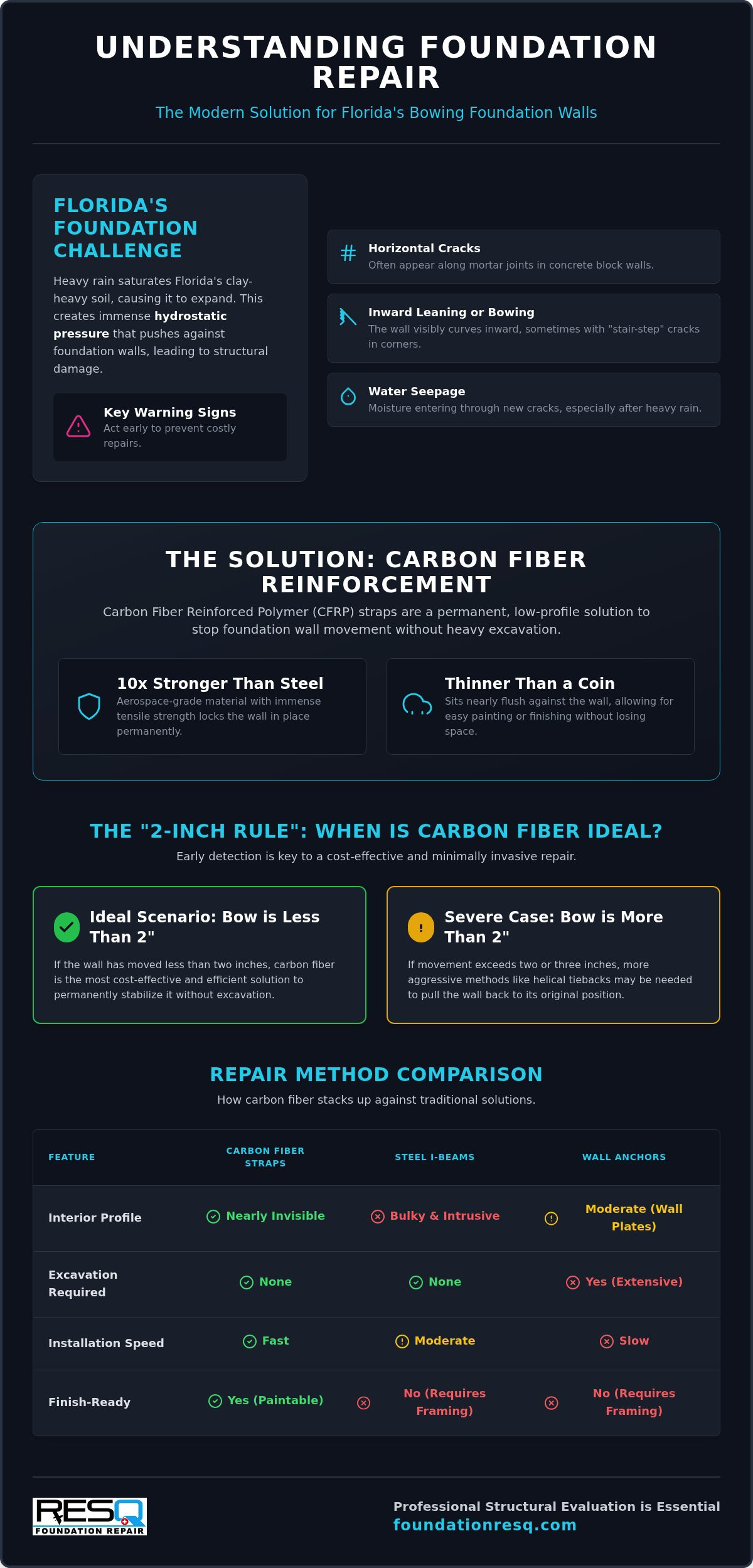
Florida’s climate presents specific challenges for foundation stability. When heavy rain cycles occur, the clay-heavy soils common in areas like Tallahassee become saturated and expand. This expansion creates immense hydrostatic pressure. This force pushes laterally against your foundation, often resulting in horizontal cracks or shifting blocks. Carbon fiber reinforcement provides a high-tensile counter-force that prevents this lateral soil pressure from pushing the wall further inward.
When is Carbon Fiber the Right Choice?
Structural experts generally follow the “2-inch rule” when recommending this solution. If your foundation wall is leaning inward by less than two inches, carbon fiber is often the most cost-effective and least invasive remedy. It’s the ideal choice when you notice specific warning signs in your existing structure:
- Horizontal cracks running along the mortar joints of a concrete block wall.
- Inward leaning or “stair-step” cracking near the corners of the foundation.
- Water seepage through newly formed structural gaps during heavy rain.
If the wall has moved more than two or three inches, it may have exceeded the limits of tension-based reinforcement. In those severe cases, more aggressive stabilization methods like helical tiebacks may be necessary to pull the wall back toward its original position. Early detection is the key to keeping your carbon fiber wall reinforcement cost Florida project within a manageable budget while ensuring a permanent, warrantied fix.
How Much Does Carbon Fiber Wall Reinforcement Cost in Florida?
Determining the carbon fiber wall reinforcement cost Florida homeowners will pay depends on several structural variables. Most specialized contractors utilize a “per strap” pricing model. This approach ensures you only pay for the specific amount of reinforcement your wall requires to remain stable. Since every foundation reacts differently to Florida’s shifting soils, a standardized flat fee rarely accounts for the unique needs of a specific property.
A professional structural evaluation is the essential first step in this process. During this inspection, experts measure the degree of the bow and identify the spacing required between straps. This data-driven approach removes the guesswork and provides a clear roadmap for the investment. Choosing this method is significantly more affordable than a total wall replacement, which involves massive excavation and rebuilding the entire foundation from the ground up. It’s a proactive way to protect your equity while ensuring the building remains safe for occupancy.
The Components of a Professional Quote
A comprehensive quote from Foundation ResQ covers more than just the carbon fiber itself. It includes the specialized labor and technical preparation necessary for a permanent bond. Because the system relies on adhesion, the quality of the preparation is just as important as the material itself.
- High-grade materials: We use aerospace-quality carbon fiber designed for maximum tensile strength and durability.
- Surface preparation: Technicians must grind the wall to remove paint, dirt, and loose debris. This ensures the epoxy bonds directly to the masonry.
- Technical resins: High-strength bonding agents are selected to withstand Florida’s high humidity and temperature fluctuations without degrading.
By including these elements upfront, we ensure the reinforcement becomes a permanent part of your home’s structure rather than a temporary patch.
Hidden Costs to Consider
Beyond the direct labor and materials, certain administrative and technical factors influence the final project scope. Compliance with Florida Building Code foundation requirements is non-negotiable for structural work. These regulations exist to ensure that any modification to a load-bearing wall meets strict safety standards.
- Permitting: Local Tallahassee building departments require permits for structural repairs to ensure the work passes safety inspections.
- Engineering fees: If the structural damage is severe, a third-party structural engineer’s report may be required to certify the repair plan.
- Incidental repairs: Addressing the root cause, such as polyurethane crack injections or improving exterior drainage, prevents future hydrostatic pressure build-up.
Taking a comprehensive approach ensures you don’t face recurring issues down the road. If you’re ready to get a clear picture of your home’s needs, scheduling a professional foundation inspection is the best way to receive an accurate, no-obligation quote.
Key Factors That Influence Your Structural Repair Investment
Every home’s foundation tells a different story. While the technology remains consistent, the carbon fiber wall reinforcement cost Florida homeowners face is shaped by several physical variables. It isn’t just about the length of the wall. It’s about the specific forces acting against it. Understanding these factors helps you move from a state of uncertainty to a clear, informed resolution.
The severity of the bow is the primary driver of your investment. A wall with a minor lean might only require straps placed every four or five feet. As the inward movement increases toward the two-inch limit, contractors must place straps closer together to provide adequate tension. This increases the total material count and the labor hours required for installation. Additionally, wall height plays a role. Taller basement or crawl space walls require longer straps and more epoxy resin to achieve a permanent bond.
Accessibility is another practical concern. In many Tallahassee homes, structural work occurs in crawl spaces with limited vertical clearance. Tight working conditions naturally increase labor costs because technicians must move more slowly and carefully. We also emphasize the importance of addressing the root cause. If your property has poor drainage, the hydrostatic pressure will continue to build. Protecting your repair often involves simultaneous improvements to your home’s moisture management system.
Wall Condition and Preparation Needs
Surface preparation is the most critical factor for the longevity of carbon fiber. For the epoxy to create a structural bond, it must adhere directly to the bare masonry. This process involves several steps:
- Grinding: Removing old layers of paint, sealant, or debris from the wall surface.
- Mortar Repair: Stabilizing deteriorated mortar joints in concrete block walls to ensure a flat, stable surface.
- Removing “Quick Fixes”: If a previous owner tried to hide cracks with cosmetic patches or thick layers of hydraulic cement, these must be removed, which can add to the initial prep time.
The “Resale Factor” and ROI
Foundation issues are a major red flag during Florida home inspections. Unaddressed bowing walls can devalue a property by up to 30% and often prevent a sale from closing. By investing in a professional repair with a transferable warranty, you aren’t just spending money; you’re protecting your home’s equity. A certified repair ensures the building passes inspection and remains a stable asset. For a comprehensive look at how these repairs fit into your home’s long-term health, consult our Professional Foundation Repair in Tallahassee: A Guide for 2026. This proactive approach turns a structural liability into a documented, warrantied asset.
Comparing Carbon Fiber to Traditional Wall Stabilization Methods
Choosing the right stabilization method requires a balance between structural necessity and your home’s long-term utility. While several tools exist to address foundation movement, the carbon fiber wall reinforcement cost Florida homeowners invest often yields the highest return in terms of space and aesthetics. Steel I-beams have been a structural standard for decades, but they come with a significant physical footprint. They protrude several inches from the wall, which makes finishing a basement or installing shelving nearly impossible. Carbon fiber is nearly as thin as a credit card. It provides a permanent solution that doesn’t sacrifice a single square inch of your living area.
Wall anchors are another traditional alternative, but they require extensive exterior excavation. This means digging up your Florida landscaping, porches, or driveways to install the anchoring plates in the yard. Carbon fiber is entirely non-invasive. It’s installed from the inside, making it the preferred choice for Tallahassee homeowners who want a clean, efficient repair without the mess of heavy machinery. When we look at the cost-to-benefit ratio over a 20-year period, carbon fiber often leads the pack. It requires zero maintenance. Unlike mechanical systems that may need periodic tightening, a bonded strap stays in place for the life of the structure without further adjustment.
Carbon Fiber vs. Helical Tiebacks
While straps are excellent for bowing, they don’t address vertical settlement or extreme lateral movement. If your foundation is shifting because of unstable soil deep underground, you might need a more robust approach. Helical tiebacks reach deep into stable strata to pull a wall back into alignment. For severe settlement cases where the entire foundation is sinking, we often recommend Professional Helical Pier Installation. The cost difference is notable, as tiebacks involve external work and heavier hardware, but they’re necessary when a wall has moved beyond the two-inch limit.
The Limitations of DIY Carbon Fiber Kits
It’s tempting to look at DIY kits to lower the carbon fiber wall reinforcement cost Florida projects require. However, structural epoxy application is a precision task. Professional-grade equipment is needed to ensure the resin fully saturates the fibers without air pockets. Improper tensioning or surface prep leads to delamination. This is when the strap peels away from the wall, leaving your foundation unprotected. Most importantly, DIY repairs lack a transferable warranty and can complicate your home insurance coverage or future resale. If you’re unsure which method fits your home’s specific damage, contact Foundation ResQ for a structural evaluation to identify the most effective remedy.
Protecting Your Florida Home with Foundation ResQ
Choosing a partner for structural remediation is a decision that impacts the safety and value of your property for decades. While you research local options, you can discover TRD Remedial to see how specialist contractors approach complex structural and concrete repairs in other regions. At Foundation ResQ, we combine precision engineering with a deep understanding of regional geological patterns. Our approach to stabilization isn’t just about applying a product. It’s about implementing a comprehensive remedy that addresses the unique stresses placed on your home. When you’re calculating the carbon fiber wall reinforcement cost Florida projects entail, it’s vital to consider the quality of the installation and the long-term reliability of the company standing behind the work.
Our installation process is designed to be entirely non-invasive. We understand that homeowners often dread the mess and disruption associated with traditional foundation work. Our technicians work from the interior of your crawl space or basement, requiring no exterior excavation and leaving no maintenance requirements for you to manage. As a Groundworks company, we provide the best of both worlds: the personal touch of a local service provider and the security of national backing. This means our solutions come with Groundworks-backed lifetime warranties, giving you the confidence that your foundation is protected for the life of the structure.
North Florida’s environment is demanding. The intense rain cycles and high humidity levels create a constant cycle of soil expansion and contraction. We have spent years studying these specific challenges to ensure our repairs provide a permanent barrier against the elements. Our “Steadfast Local Expert” promise means we don’t believe in temporary patches. We focus on fixing the issue right the first time. For more technical details on how we apply these modern techniques to local homes, you can explore our specific guide on Carbon Fiber Wall Repair in Tallahassee.
Next Steps: From Inspection to Stabilization
The path to a stable home begins with an accurate assessment. During our free, no-obligation structural inspection, a trained specialist will examine your foundation for signs of distress, measure any existing movement, and identify the root cause of the pressure. We don’t provide generic estimates. Instead, we deliver a custom-tailored repair plan that outlines exactly how many straps are needed and where they should be placed to ensure maximum stability. This transparent process ensures you understand the carbon fiber wall reinforcement cost Florida contractors quote before any work begins. If you’re ready to secure your property, protect your home’s structural integrity—contact Foundation ResQ today.
Securing Your Home’s Future with Modern Stabilization
Stabilizing a bowing foundation wall is a vital step in preserving your property’s long-term value and safety. By choosing carbon fiber, you opt for a non-invasive, aerospace-grade solution that stops structural movement without sacrificing any living space. We have explored how the carbon fiber wall reinforcement cost Florida homeowners pay is a strategic investment in durability, especially when compared to the disruptive and expensive alternative of total wall replacement. Taking action when you first notice horizontal cracking ensures the repair remains simple and cost-effective.
Our locally operated Tallahassee team understands the specific pressures of North Florida’s soil cycles. We provide the peace of mind that comes with Groundworks-backed lifetime transferable warranties and the strength of a national leader in foundation repair. You don’t have to navigate these structural concerns alone; professional guidance is just a phone call away. Addressing these issues now prevents minor structural shifts from becoming major liabilities later.
Schedule Your Free Foundation Inspection and Get a Custom Quote today to receive a precise, professional assessment of your home’s specific needs. Let’s work together to ensure your foundation remains a steadfast protector of your family and your home for years to come.
Frequently Asked Questions
Is carbon fiber wall reinforcement a permanent solution for bowing walls?
Yes, carbon fiber reinforcement is a permanent structural solution. The material has a higher tensile strength than steel and doesn’t stretch or creep over time. Once bonded to your foundation, it creates a rigid barrier that prevents further inward movement. This technology is designed to last for the life of the structure, ensuring your home remains stable against the persistent hydrostatic pressure common in Tallahassee’s clay soils.
How long does it take to install carbon fiber straps on a foundation wall?
Most installations are completed within a single day. Because this process is non-invasive and requires no exterior excavation, our technicians work efficiently from the interior of your crawl space or basement. The actual duration depends on the wall’s length and the number of straps required. The streamlined application of the structural epoxy allows homeowners to return to their normal routine almost immediately after the project is finished.
Does carbon fiber foundation repair come with a warranty in Florida?
Yes, Foundation ResQ provides Groundworks-backed lifetime transferable warranties for carbon fiber repairs. This is a significant factor when considering the carbon fiber wall reinforcement cost Florida residents invest in their properties. A transferable warranty adds long-term value to your home and provides peace of mind to future buyers. It ensures that the structural integrity of the wall is protected by a national leader in foundation repair for decades to come.
Can I paint over carbon fiber straps once they are installed?
You can absolutely paint over the straps once the epoxy has fully cured. The straps are incredibly thin and sit nearly flush against the masonry surface. This low-profile design is ideal for homeowners who plan to finish their basement or keep their crawl space looking clean and professional. To ensure your home looks its best after structural work, visit 1st Class Painting & Restoration. Simply use a high-quality masonry paint to blend the reinforcement into the rest of the wall, making the repair virtually invisible to the naked eye.
Carbon fiber is a structural reinforcement tool, not a waterproofing product. While it stops the wall from moving and prevents cracks from widening, it doesn’t seal the wall against moisture on its own. We often recommend pairing reinforcement with polyurethane crack injections or crawl space encapsulation. Addressing the root cause of the moisture through sump pumps or dehumidifiers is essential to fully protect your Tallahassee home from Florida’s heavy rain cycles.
How many carbon fiber straps will my foundation wall need?
The number of straps depends on the length of the wall and the degree of the inward bow. In many cases, straps are placed every four to five feet to provide adequate tension and support. If the structural damage is more pronounced, closer spacing may be necessary to ensure the wall remains locked in place. A professional inspection is the only way to determine the exact configuration required for your specific foundation.
Does home insurance in Florida cover the cost of carbon fiber wall reinforcement?
Standard homeowner insurance policies in Florida rarely cover foundation repairs caused by soil settlement or hydrostatic pressure. These issues are typically classified as maintenance or long-term wear rather than sudden, accidental damage. However, every policy is different. It’s always best to review your specific coverage with your insurance agent. Understanding the carbon fiber wall reinforcement cost Florida homeowners face helps you budget for these necessary structural improvements as part of your home’s long-term health.
What happens if my wall is bowing more than 2 inches?
If a foundation wall has moved more than two inches, carbon fiber may no longer be the most effective remedy. At this stage, the wall has often lost its structural connection to the rest of the building. We typically recommend more robust solutions like helical tiebacks to pull the wall back toward its original position. Our team provides custom-tailored plans for every degree of damage to ensure your home receives the most appropriate and secure stabilization.