
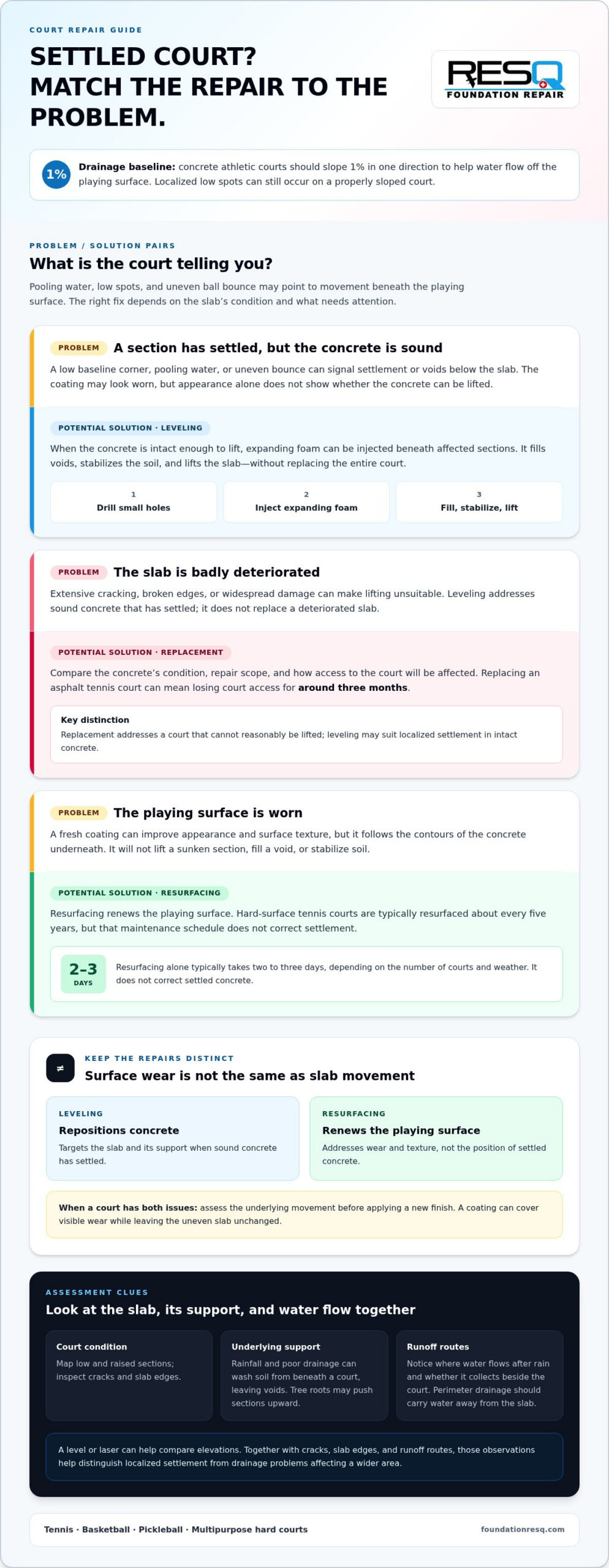
A settled court may not need to be replaced. Concrete leveling for tennis courts can also address uneven sections on other concrete sport courts when the slab has settled, and concrete athletic courts should slope 1% in one direction to help water drain. Leveling targets the slab’s position, while resurfacing refreshes its playing surface.
It’s understandable to consider resurfacing when a court looks worn, but a new surface won’t correct settlement underneath. Pooling water, low spots, and uneven ball bounce can point to a problem below the playing surface. This guide explains which courts may be candidates for concrete leveling for tennis courts, how the process works, and when repair may make more sense than replacement. You’ll also learn what leveling can and can’t address, so you can better understand the next step for a court in Tallahassee.
Key Takeaways
- Look for pooling water, low spots, or uneven ball bounce to identify court areas that may need attention.
- Consider whether drainage, soil washout, or other support issues may be affecting the slab beneath the playing surface.
- Compare leveling with replacement by weighing the condition of the concrete and the disruption each option may involve.
- Understand how foam injected beneath affected sections can fill voids, stabilize the soil, and lift the concrete.
What kinds of sport courts can be leveled?
Concrete athletic courts include tennis, basketball, pickleball, and multipurpose hard courts. Concrete leveling for tennis courts may also suit settled basketball or pickleball slabs if the concrete is intact enough to lift. The sport coating doesn’t determine suitability; the slab’s condition and its underlying support matter. A low baseline corner, for example, is different from a cracked, shifting section.
Heavy rainfall and poor drainage can wash soil from beneath a court, leaving voids that allow concrete to settle. Tree roots may also push sections upward. In Tallahassee, observe where runoff flows after rain and whether water collects beside the court. Pooling, cracks, and sunken areas can help reveal where the slab’s support or drainage may need attention. Perimeter drainage should carry water away from the slab, not toward its edge.
Yes. Expanding foam injection can level a concrete tennis court when settlement has left voids beneath a slab that is suitable for lifting. Small holes are drilled in affected areas, and expanding foam is injected below. The foam fills voids and stabilizes the soil as it lifts the slab.
To assess unevenness, professionals map low and raised sections, then compare elevations using a level or laser. They can also inspect cracks, slab edges, and runoff routes. Together, these observations help distinguish localized settlement from drainage problems affecting a wider area.
When comparing options for court leveling, look for a service that considers the slab, underlying support, and drainage together. Ask how unevenness is assessed and what the proposed repair is intended to address. Whether concrete leveling for tennis courts is suitable depends on the slab’s condition and the cause of movement beneath it.
Concrete athletic courts should slope 1% in one direction to help water flow off playing surfaces. That overall pitch supports drainage, while perimeter grading helps direct runoff away. Consider both when reviewing a court, since a correctly sloped surface can still have a localized settled section.
Why resurfacing alone does not correct settlement
Resurfacing renews a court’s playing surface, but it doesn’t reposition settled concrete. Natural settling can leave one section of the slab lower than another. A fresh coating follows those contours, so dips and changes in slope remain beneath the new finish. For example, resurfacing a sunken baseline area may improve its appearance without restoring the slab’s support or elevation. The cause of movement matters: a surface treatment cannot fill a void beneath the concrete.
Think of resurfacing and leveling as two different steps. Resurfacing addresses wear and surface texture; leveling addresses the position of the concrete. If a court has both worn coating and settlement, assess the underlying movement before applying a new finish. Otherwise, the coating may cover visible wear while leaving the uneven slab unchanged. This distinction helps owners decide whether the court needs surface renewal, structural correction, or both.
Coating application also depends on the concrete surface. Once cured, a clean, dry slab can receive a coat of acrylic adhesion promoter before sport surfacing. One or two coats of acrylic resurfacer usually fill broom patterns and concrete texture. The court should then receive at least two coats of color coating. These layers improve the finish, but they don’t lift low sections or stabilize the soil beneath the slab.
Hard-surface tennis courts, whether asphalt or post-tensioned concrete, are typically resurfaced about every five years. That schedule addresses surface maintenance, not settlement. If a court develops a low area between resurfacing cycles, note where water gathers and whether the unevenness crosses slab sections. Those observations help clarify whether the concern is coating wear or movement below the playing surface. For a settled concrete section, learn about concrete lifting options before treating the surface alone.
Concrete should cure for a minimum of 28 days, then be acid etched or acid washed before coating. A medium-broom finish provides a good physical bond for athletic sport coatings.
Concrete leveling compared with court replacement
Leveling may restore settled sections without replacing the entire court. Before choosing, compare the slab’s condition, the repair scope, and how access to the court may be affected.
Leveling Costs
There’s no single per-square-foot rate that applies to every tennis court. The price depends on the site and is provided after a quote request. Relevant factors include the area needing correction, access to affected sections, and the extent of voids beneath the slab. A localized low spot differs from settlement across several playing areas. Compare the proposed work with the areas identified during assessment.
The Leveling Process
Leveling targets the concrete slab and its support rather than replacing the entire court. Small holes are drilled into affected concrete, then expanding foam is injected beneath the surface. As the foam expands, it fills voids and stabilizes the soil before lifting the slab. The affected area, slab condition, and underlying voids shape the repair plan. Surface coating work is a separate consideration.
Project Timing and Court Reuse
Work duration depends on the affected sections, site access, and amount of lifting required. Expanding foam cures rapidly, allowing courts to return to use quickly after leveling. Replacement creates a much longer interruption: replacing an asphalt tennis court can mean losing court access for around three months. Resurfacing alone typically takes two to three days, depending on the number of courts and weather, but it doesn’t correct settled concrete.
Risks and Limitations
Leveling addresses sound concrete that has settled; it doesn’t replace a badly deteriorated slab or renew worn coatings. Extensive cracking, broken edges, or widespread damage can make lifting unsuitable. Leveling also won’t correct poor drainage by itself, so runoff routes may need attention to reduce continued soil washout. Assess slab integrity and water movement alongside settlement. If the concrete cannot be lifted without further damage, replacement may be more practical.
How is concrete leveling performed on a tennis court?
The process targets settled concrete by filling voids beneath the affected slab. On a tennis court, the aim is to stabilize the supporting soil and lift the slab back toward level. The repair focuses on settled areas rather than treating the entire playing surface as one uniform problem.
- Map the affected area. Identify settled sections and note how they meet adjacent concrete. This helps define where lifting is needed and keeps attention on the affected slab.
- Drill small access holes. Holes are made through the concrete so material can reach the space beneath it. Their placement gives access to voids under the area being corrected.
- Inject high-density polyurethane foam. The foam expands below the surface, filling voids and stabilizing the soil that supports the slab.
- Lift the concrete. As the foam expands, the slab is raised toward level. The affected area is monitored so the lift can be controlled in relation to the surrounding court.
Each step addresses a different part of the problem: access, support, and elevation. Filling a void without lifting the slab would leave the playing surface low. Lifting without addressing the underlying space would miss the support issue. This sequence connects the repair to the cause of settlement instead of simply covering its visible signs.
Expanding foam cures rapidly, allowing courts to return to use quickly. The court’s condition and the work required affect the project plan, though leveling can help reduce disruption. Leveling also differs from resurfacing: it corrects slab position, while sport coatings renew the finish. A coating may be considered once the concrete is stable and properly prepared.
For a settled court slab, request a concrete leveling assessment to discuss the affected area and suitable next steps.
Foundation ResQ: Foundation repair
Foundation ResQ provides foundation repair for property owners dealing with structural settlement. If an uneven court is part of a wider concern, such as movement affecting a nearby building, the building’s foundation may also need attention. Foundation repair addresses a building’s structural support, while court-slab concerns involve the court surface and the support beneath it.
Helical pier installation and push pier installation address certain foundation settlement issues. Mold remediation services address mold concerns, which may be separate from court leveling. Identifying whether the issue affects a court slab, a building foundation, or both helps clarify the appropriate next step.
For concerns about structural settlement in a building, contact Foundation ResQ to discuss foundation repair.
Choose a clear next step for your court
A court’s condition can guide the next step. If the slab has settled, concrete leveling for tennis courts may be worth considering before committing to replacement. If the concern extends beyond the court, note any structural changes elsewhere on the property and describe them together. This broader view can help distinguish a court-surface issue from a separate foundation or moisture concern.
Foundation ResQ provides PolyRenewal Concrete Lifting for concrete concerns, along with foundation repair, Helical Pier Installation, and Mold Remediation Services for other property needs. Describe what you’ve noticed, such as a sunken court section or changes to a nearby structure, to start a focused conversation about next steps.
Contact Foundation ResQ about court leveling to discuss your court. With a clear assessment, you can move toward a practical plan for the property.
Frequently Asked Questions
What causes concrete tennis courts to become uneven or settle?
Concrete courts can become uneven when water washes supporting soil from beneath the slab, the base settles, or roots disturb the concrete. In Tallahassee, heavy rain can expose drainage weaknesses. Runoff repeatedly passing beside one edge of a court may gradually remove support. Note whether a low area is near a drain, slope, or tree; its location can help identify what may be affecting the slab.
Is concrete leveling suitable for cracks, severe damage, or drainage problems on a tennis court?
Leveling can address settlement beneath sound concrete, but it doesn’t repair every crack or correct drainage by itself. A small crack in a stable panel is different from broken, shifting concrete or widespread deterioration. If water continues reaching the subgrade, its route also needs attention. Otherwise, the cause of movement may remain. Extensive slab damage can make replacement more suitable.
How does concrete leveling compare with slab replacement or resurfacing for tennis courts?
Leveling adjusts settled sections while retaining the existing slab; resurfacing renews the coating without changing slab elevation. Replacement removes and rebuilds damaged concrete, making it a more extensive intervention. Compare the affected area with the court’s overall condition. Isolated settlement in sound concrete may suit lifting, while widespread slab failure may point toward rebuilding. Coating renewal may still be needed after either repair.
What slope and surface tolerances are required for a regulation tennis court?
Concrete athletic courts should slope 1% in one direction to help water drain from the playing surface. That figure describes drainage pitch, not a numeric flatness tolerance. A court can have an overall slope and still contain localized bumps or depressions. Assess the intended runoff direction separately from surface irregularities that may affect play; one correction doesn’t automatically address the other.