
What if that slight dip in your living room floor isn’t just your house “settling,” but a warning sign of moisture-driven decay beneath your feet? Many homeowners in our community ignore these signs because they fear the cost to fix sagging floors Tallahassee contractors might quote. It’s a common anxiety, especially when you worry about the health implications of mold in your crawl space or the risk of choosing an unreliable partner for such a critical project.
We understand that your home is your most significant investment, and maintaining its structural integrity is vital for your family’s safety. In this guide, you will discover the specific structural causes of uneven floors in North Florida and the transparent factors that determine your actual repair expenses. We provide a clear look at the 2026 pricing landscape for solutions like helical piers and crawl space encapsulation; this ensures you can move from a state of uncertainty toward a level, stable floor that protects your property for decades to come.
Key Takeaways
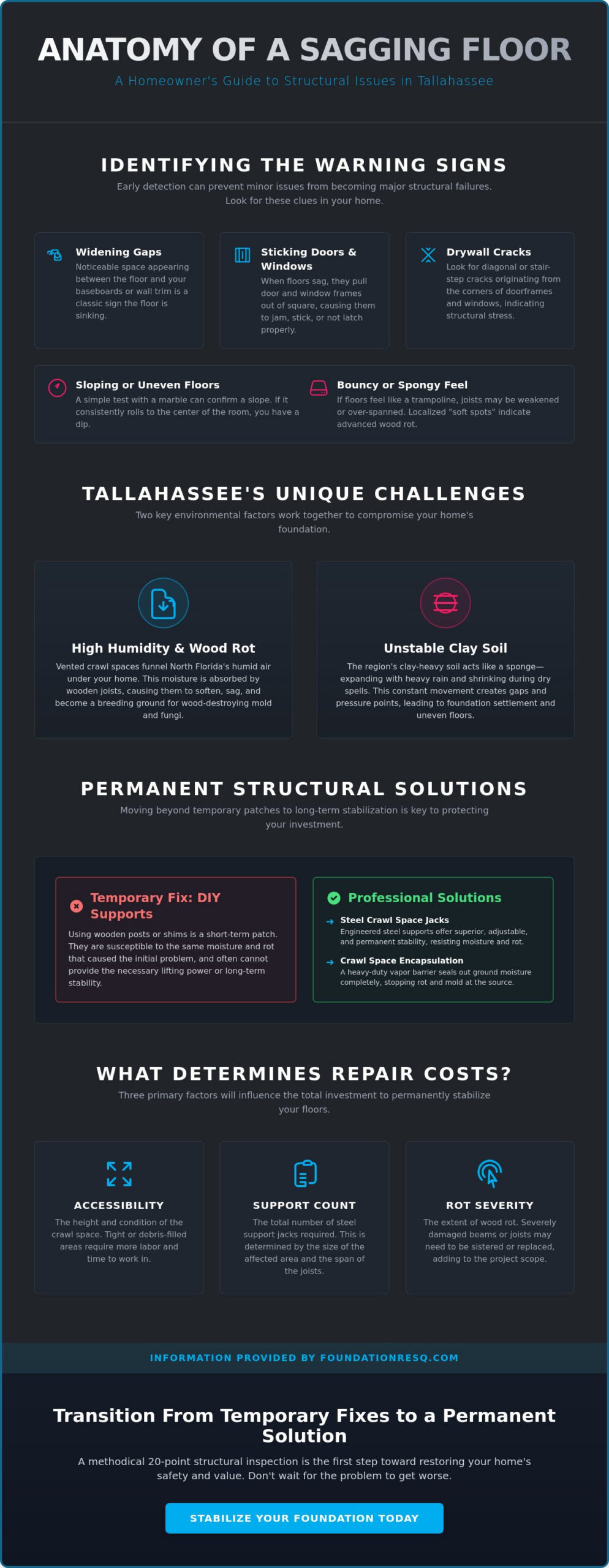
- Learn to spot the early warning signs of a compromised subfloor, such as widening gaps between your baseboards and the flooring.
- Understand the critical role that Tallahassee’s high relative humidity and clay-heavy soils play in weakening your home’s support joists.
- Discover why professional-grade steel crawl space jacks offer superior stability and durability compared to temporary DIY wooden supports.
- Identify the primary factors—accessibility, support count, and rot severity—that determine the total cost to fix sagging floors Tallahassee residents can expect.
- Learn how a methodical 20-point structural inspection can transition your home from temporary fixes to permanent structural stabilization.
Identifying the Signs of Sagging Floors in Tallahassee Homes
Identifying a sagging floor early can prevent a minor structural issue from becoming a total foundation failure. In Tallahassee, where humidity and soil conditions are unique, your home often provides subtle clues that the subfloor system is under stress. One of the most common signs is a widening gap between your baseboards and the flooring material. When the floor joists begin to dip, the floor pulls away from the wall trim, leaving a visible line of shadow that wasn’t there before.
Homeowners often mistake sticking doors or windows for simple humidity swelling. While Florida’s moisture does affect wood, a door that suddenly refuses to latch or a window that jams often indicates Structural Settlement. As the floor sinks, it pulls the entire door frame out of square. If you suspect a slope, try the “marble test.” Place a marble on a hard surface; if it consistently rolls toward the center of the room or a specific wall, you’ve confirmed a sloping issue. Understanding these signs is the first step toward estimating the cost to fix sagging floors Tallahassee residents often face.
Visual Indicators in the Living Area
Visual cues aren’t limited to the floor itself. You might notice cracks in your drywall, particularly those that originate from the corners of door frames or windows. These cracks typically follow a diagonal or stair-step pattern. In Tallahassee’s older homes with hardwood or laminate, look for “nail pops” or floorboards that seem to be lifting. A floor sloping toward the center of a room usually points to a failing center support beam, while sloping toward exterior walls might suggest a perimeter foundation concern.
The “Feel” of the Floor
The way a floor reacts to your weight is a primary diagnostic tool. If a room feels “bouncy” or “spongy” as you walk across it, the joists may be over-spanned or weakened by moisture. Soft spots are more serious; these are localized areas where the wood has likely succumbed to advanced rot. Because these structural failures often originate in the crawl space, you might also notice that these rooms feel colder or draftier. This happens when the same gaps allowing the floor to sag also allow unconditioned, humid air to seep into your living space. Recognizing these physical changes helps you prepare for the eventual cost to fix sagging floors Tallahassee professionals will need to address to restore your home’s stability and safety.
Why Tallahassee Floors Sag: The Role of Humidity and Soil
Tallahassee’s environmental conditions are uniquely aggressive toward residential structures. While many homeowners use the word “settling” as a neutral term for an aging house, it is often a euphemism for active structural decay. In North Florida, the primary drivers of uneven floors are high relative humidity and unstable soil. These factors work together to weaken the skeleton of your home. When the wooden support system or the ground beneath the footings fails, the result is a dip in your living area. This environmental stress is a primary factor behind the total cost to fix sagging floors Tallahassee residents eventually face.
Moisture and Wood Rot in Florida Crawl Spaces
Vented crawl spaces are common in older Tallahassee neighborhoods, but they often act as funnels for humid air. Wood is a hygroscopic material, meaning it naturally absorbs moisture from the environment. When the relative humidity in a crawl space stays consistently high, the floor joists soften and lose their load-bearing capacity. This damp environment also invites fungi and mold, which consume the organic fibers of the wood. Implementing crawl space encapsulation Tallahassee is a proven remedy that seals out this moisture and halts the cycle of rot. Without a protective barrier, the support beams will continue to sag regardless of how many temporary shims are added.
Tallahassee Soil and Foundation Settlement
The soil in our region is often heavy with clay, which behaves like a sponge. During Tallahassee’s heavy seasonal rains, this clay expands, creating immense hydrostatic pressure against your foundation. When the soil dries out, it shrinks, leaving gaps that cause the home’s footings to shift. This movement is rarely uniform across the entire structure. Differential settlement occurs when one part of the foundation sinks faster than another, pulling the interior floors down with it. Tallahassee’s unique limestone karst topography creates underground voids that can lead to localized floor dips as the soil above shifts into subterranean pockets.
Understanding these local geological challenges is essential when evaluating the scale of your project. While the Average Cost to Repair a House Foundation provides a national baseline, Tallahassee’s specific mix of moisture and limestone requires a specialized local approach. If you have noticed your floors beginning to slope, a professional assessment from Foundation ResQ can help determine if the root cause is moisture-damaged wood or a deeper soil-related settlement issue. Addressing these causes directly ensures a permanent stabilization of your home’s interior. This proactive approach prevents the continued structural decay that leads to much higher repair expenses in the future.
Structural Solutions for Leveling Your Home’s Interior
Once you have identified the symptoms of structural failure, the focus shifts toward permanent stabilization. Many homeowners attempt to address the cost to fix sagging floors Tallahassee by using temporary shims or wooden posts. These DIY methods are rarely effective because they fail to address the underlying soil or moisture issues. A professional remedy requires high-capacity structural components designed to withstand Florida’s unique environmental pressures. By installing supplemental support beams and heavy-duty steel jacks, we can restore the integrity of your floor system and prevent future dips.
For homes experiencing perimeter settlement, interior jacks alone may not be sufficient. In these cases, professional helical pier installation is often necessary to stabilize the foundation’s footprint. These piers are screwed deep into the ground until they reach stable soil, providing a solid anchor that prevents the exterior walls from sinking further. Additionally, carbon fiber reinforcement can be applied to basement or crawl space walls to provide lateral stability; this ensures that wall movement does not cause secondary shifts in your interior flooring.
Crawl Space Stabilizers and Smart Jacks
Adjustable steel piers, often referred to as Smart Jacks, are the gold standard for interior floor leveling. Unlike concrete blocks or wooden posts that can shift or rot, these steel systems are engineered for durability. They transfer the load of your home from the failing wooden joists down to a pre-cast concrete base and stable soil. The process involves a methodical, gradual lift. By slowly adjusting the tension on these steel piers, we can often move the floor back toward its original level position without causing sudden stress to the rest of the house structure.
Foundation Piering for Perimeter Sags
Sometimes a sagging interior floor is merely a symptom of a much larger sinking foundation in Tallahassee. When the perimeter footings fail, the entire house tilts, creating uneven surfaces in every room. This is frequently caused by Florida’s problematic soil types, which include expansive clays that swell and shrink with the seasons. We use two primary types of piers to combat this:
- Helical Piers: These are ideal for the sandy and clay-heavy soils of North Florida because they are mechanically screwed into the earth.
- Push Piers: These utilize the weight of the structure itself to drive the pier into the ground until it hits a load-bearing strata.
Stabilizing the foundation perimeter is the critical first step. Once the exterior is secure, we can then address the interior leveling with precision, ensuring that the cost to fix sagging floors Tallahassee homeowners invest in results in a permanent, worry-free solution.
Breaking Down the Cost to Fix Sagging Floors in Tallahassee
Calculating the cost to fix sagging floors Tallahassee homeowners face requires a detailed look at the home’s unique footprint. No two structural projects are identical because the variables range from the physical height of the crawl space to the severity of the timber decay. While it is tempting to look for a flat rate, your total investment is dictated by whether the issue is isolated to a few floor joists or if it stems from a deeper foundation settlement. Addressing the root cause, such as moisture intrusion, often requires a higher upfront commitment but prevents you from paying for the same repair again in five years.
Ignoring a dip in your floor often leads to expensive secondary damage. As the subfloor system shifts, it puts immense pressure on your home’s rigid components. This frequently results in broken plumbing lines, cracked floor tiles, and extensive drywall damage in the rooms above. By the time many homeowners seek a professional remedy, they are dealing with both a structural failure and a cosmetic renovation project. While local teams handle the foundation, specialized firms like The Solution offer the damage repair and restoration expertise required to fully remediate a property. Investing in stabilization now protects your home from these cascading expenses.
Factors That Increase or Decrease Repair Costs
Accessibility is one of the most significant cost drivers in North Florida. If a crawl space is too tight for crews to operate comfortably or for heavy equipment to reach the center of the structure, labor hours naturally increase. The severity of the “sag” also plays a critical role. A one inch dip can often be corrected with adjustable stabilizers; however, a four inch collapse may require the complete replacement of the main carrying beam. In some instances, we find that bowing foundation walls are contributing to the floor’s instability. When this occurs, a simultaneous carbon fiber wall repair may be necessary to ensure the entire structural envelope is secure.
Investment vs. Value: Protecting Your Home Equity
Structural integrity is the foundation of your home’s market value. Industry data indicates that a history of unaddressed foundation problems can lower a home’s resale value by 10% to 15%. By choosing a permanent, warrantied solution, you aren’t just fixing a floor; you are restoring your property’s equity. Choosing a temporary or DIY fix often results in “doing it twice,” which doubles your long term expenditure. We provide transparent pricing and various financing options to help you manage the project without sacrificing quality. To get an accurate assessment of your specific needs, you can schedule a structural inspection with our team to identify the most cost effective path forward for your home.
Stabilizing Your Foundation with Foundation ResQ
Choosing a partner to restore your home’s structural integrity is a significant decision. At Foundation ResQ, we don’t believe in symptom management or temporary patches. Our approach focuses on permanent remedies that address the environmental pressures unique to North Florida. As a “Steadfast Local Expert,” we understand how our regional geology affects the cost to fix sagging floors Tallahassee homeowners must plan for. We position ourselves as your home’s final line of defense, ensuring that once a floor is leveled, it stays that way for the long term.
When you contact our team, the process begins with a comprehensive 20-point structural inspection. This isn’t a casual walkthrough. Our specialists use advanced laser leveling equipment to map the exact topography of your interior floors. We enter the crawl space to conduct moisture wood-density tests and examine every support pier for signs of settlement or rot. This data-driven assessment allows us to provide a transparent project scope, eliminating the guesswork that often leads to unexpected budget increases. We prioritize clarity and professional integrity in every evaluation.
Our Specialized Repair Process
We develop customized engineering plans that account for the high-shrinkage clays and limestone voids common in the Tallahassee area. Our installation techniques are designed to be minimally invasive. Whether we’re installing heavy-duty steel jacks or helical piers, we prioritize protecting your landscaping and interior finishes. By transferring the structural load to stable, load-bearing strata, we provide a permanent solution that stands up to the elements. These systems are built for durability, ensuring your home remains a safe and stable environment for your family.
The Next Steps for a Level Floor
Regaining a stable, level home starts with an informed plan. After our inspection, you’ll receive a detailed breakdown of our findings and a clear explanation of the proposed remedy. Our solutions are backed by industry-leading transferable warranties, providing peace of mind for you and any future owners of the property. This commitment to longevity is why Tallahassee residents trust us with their most valuable investments. Don’t let structural uncertainty linger; take the first step toward a permanent resolution today.
Get Your Free Sagging Floor Inspection in Tallahassee
Securing Your Tallahassee Home’s Future
Understanding the variables behind the cost to fix sagging floors Tallahassee residents face is the first step toward reclaiming your home’s stability. We’ve explored how North Florida’s humidity and unique soil conditions compromise your subfloor system; we also detailed why permanent steel stabilization outperforms temporary wooden fixes. By addressing these structural concerns now, you prevent the secondary damage of plumbing leaks and drywall cracks while protecting your property’s long-term resale value.
Foundation ResQ has served our community since 2013. As a Groundworks company, we combine over a decade of local Florida expertise with powerful national backing to provide the most reliable remedies in the industry. Our structural stabilization services come with transferable lifetime warranties, ensuring your investment is protected for as long as the house stands. You don’t have to navigate these structural anxieties alone. Our team is ready to provide the professional guidance needed to restore your peace of mind and the physical health of your home.
Schedule Your Free Structural Inspection in Tallahassee Today
Frequently Asked Questions
How much does it typically cost to fix sagging floors in Tallahassee?
The total investment depends on specific structural variables, such as the number of supports required and the accessibility of your crawl space. Local factors like Tallahassee’s high humidity and clay-rich soil influence the complexity of the project and the materials needed for a permanent fix. A professional inspection is the only way to determine the exact scope of work and the final cost to fix sagging floors Tallahassee homeowners should plan for.
Can I fix sagging floors myself with a jack from a hardware store?
Attempting a DIY fix with temporary hardware store jacks is generally ineffective and can be dangerous. These retail products aren’t designed for permanent structural support and often lack the load-bearing capacity required for a residential building. Without professional precision, you risk over-lifting and cracking your drywall or damaging plumbing lines. A permanent solution requires heavy-duty steel stabilizers that transfer the load to stable soil rather than just the crawl space floor.
Will my homeowners insurance cover the cost of floor leveling?
Most standard homeowners insurance policies don’t cover floor leveling or foundation repairs caused by gradual “settling” or environmental wear. Insurance typically only applies to sudden and accidental events, such as a burst pipe or a fallen tree. Since sagging floors in North Florida are usually the result of long-term moisture intrusion or soil movement, they’re considered maintenance issues. It’s always wise to review your specific policy with your insurance agent to confirm your coverage details.
How long does it take to repair sagging floors in a crawl space?
Most residential floor stabilization projects are completed within one to three days. The timeline depends on the extent of the wood rot and the number of steel jacks or piers being installed to address the cost to fix sagging floors Tallahassee residents are managing. If your project requires additional services like crawl space encapsulation, the process may take longer. Our team works efficiently to minimize disruption, ensuring your home’s structural integrity is restored with professional precision.
Is mold in my crawl space related to my sagging floors?
Yes, mold growth and sagging floors are often symptoms of the same underlying moisture problem. High humidity in your crawl space creates an ideal environment for fungi to thrive. These organisms consume the organic fibers in your wooden floor joists, significantly weakening their structural capacity over time. Addressing the mold without fixing the moisture source and the structural damage is only a temporary fix; a comprehensive remedy involves both stabilization and moisture control.
What happens if I ignore my sagging or bouncy floors?
Ignoring a sagging floor allows structural decay to progress, which leads to much more expensive repairs in the future. Over time, the uneven stress on your home can cause permanent damage to your foundation, framing, and interior finishes. You may experience cracked tiles, jammed doors, and even ruptured utility lines as the structure shifts. Proactive stabilization stops this decay and protects your home’s resale value before the damage becomes catastrophic or unsafe.
Do I need to move out of my house during the repair process?
You don’t need to move out during the stabilization process. Our repair techniques are minimally invasive, and most of the work takes place beneath your living area in the crawl space or around the exterior foundation. While you might hear some noise from equipment, your daily routine can generally continue as normal. We prioritize a clean and organized job site to ensure your comfort while we restore your home’s stability and safety.
What is the difference between floor leveling and foundation repair?
Floor leveling focuses on the interior support system, such as joists and beams, while foundation repair addresses the home’s perimeter footings. Sagging floors are often caused by weakened interior supports, but they can also be a symptom of a sinking foundation. A professional inspection determines whether you need interior stabilizers, exterior piers, or a combination of both. Both services are essential components of maintaining a safe and level structure in Tallahassee’s challenging geological environment.