
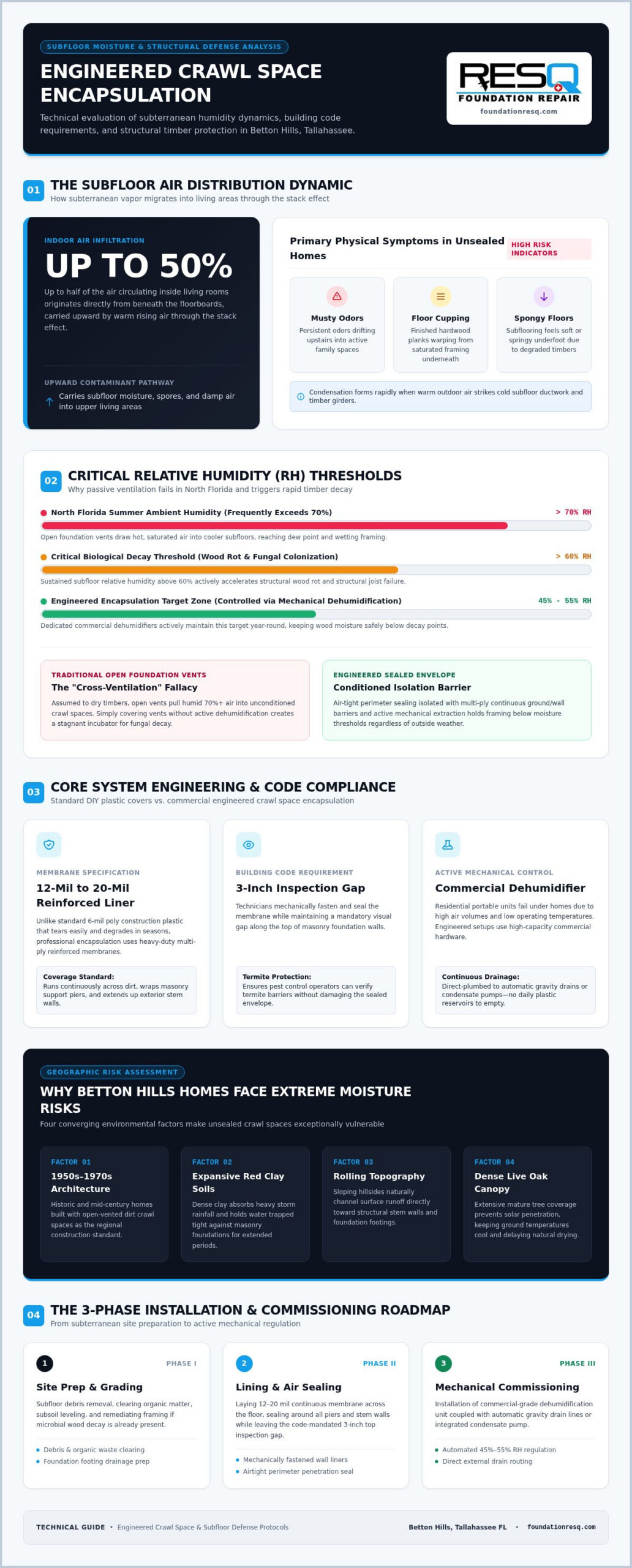
Did you know that up to 50% of the air circulating through your living room originates directly from beneath your floorboards? If you are evaluating crawl space encapsulation in Betton Hills, that dynamic often shows up as persistent musty odors drifting upstairs, cupping hardwood floors, and subflooring that feels spongy underfoot.
Living under the dense oak canopy of Betton Hills means contending with relentless North Florida humidity and expansive clay soils that trap moisture beneath your home. It is natural to feel skeptical when contractor proposals vary wildly, especially when some suggest merely throwing down thin plastic sheeting while others pitch extensive overhauls without explaining the science behind them.
This guide explains how an engineered crawl space encapsulation protects historic and mid-century foundations against wood rot, structural settling, and elevated wood moisture content permanently. Below, we break down current Florida building code requirements, the vital role of heavy-duty liners and dedicated dehumidification, and a clear checklist to help you vet Tallahassee contractors with confidence.
Key Takeaways
- Learn why Betton Hills’ rolling terrain, mature tree canopy, and dense clay soils demand an engineered structural envelope to control sub-surface moisture and storm runoff.
- Discover why effective crawl space encapsulation in Betton Hills requires a continuous, heavy-duty sealed liner paired with dedicated dehumidification rather than loose plastic sheeting.
- Review the essential vetting checklist to evaluate local contractor credentials, Florida building code compliance, and complete moisture management designs.
- Understand the complete installation timeline, from site grading and debris removal to precision air sealing and mechanical commissioning.
- See how active subfloor humidity defense protects original framing against wood rot, halts floor cupping, and improves overall indoor air quality.
Why Betton Hills Homes Require Engineered Crawl Space Encapsulation
Crawl space encapsulation transforms an unconditioned, dirt-floored substructure into a sealed, conditioned building envelope barrier. Instead of leaving subfloor framing exposed to ground vapors and outdoor humidity, an engineered system isolates the space completely. For homeowners planning crawl space encapsulation in Betton Hills, local geography makes this protection necessary. Betton Hills features rolling topography that naturally directs storm runoff toward foundation footings and stem walls. Combined with dense live oak canopies that limit solar drying, the ground beneath these homes stays damp for extended periods. Through the stack effect, warm air rising through the home pulls this subfloor dampness upward, carrying mold spores into living areas while saturating floor joists and cupping finished hardwoods.
Architectural and Environmental Vulnerabilities in Betton Hills
Most homes across Betton Hills were built between the 1950s and 1970s, an era when open-vented dirt crawl spaces were the regional standard. As noted in a technical crawl space overview, unsealed ground allows substantial water vapor to evaporate directly into overhead framing. In Tallahassee, this issue is compounded by expansive red clay soils that absorb heavy rainfall and hold moisture against masonry foundations. Because shaded lots keep ground temperatures cool, humid air migrating beneath the house quickly reaches its dew point, depositing continuous condensation across structural subflooring and supporting girders.
The Failure of Traditional Foundation Vents in North Florida
Builders once assumed foundation vents allowed cross-ventilation to dry subfloor timbers. In North Florida, where ambient summer humidity frequently exceeds 70%, open vents pull hot, moisture-saturated air directly into cooler crawl spaces. This moisture condenses instantly on cold ductwork and floor joists. Sustained relative humidity above 60% rapidly triggers wood rot and fungal colonies. In cases where subfloors have suffered structural degradation, homeowners must coordinate professional mold remediation in Tallahassee, FL to treat framing before sealing the envelope. Simply closing foundation vents with covers without installing mechanical dehumidification creates a stagnant incubator for rot. Lasting crawl space encapsulation in Betton Hills pairs air-tight perimeter sealing with commercial dehumidification to keep wood moisture safely below decay thresholds.
Core Components of a Complete Crawl Space Encapsulation System
True crawl space encapsulation differs significantly from laying down generic hardware-store plastic. A basic vapor barrier simply covers open dirt, leaving masonry walls, vents, and plumbing penetrations exposed to high ambient humidity. A complete closed envelope seals the entire subterranean environment. To succeed long-term, crawl space encapsulation in Betton Hills relies on a coordinated defense system: heavy-duty ground and wall liners, mechanical humidity controls, and targeted drainage infrastructure.
Heavy-Duty Vapor Barriers and Wall Liners
Standard 6-mil poly construction sheeting tears easily during routine inspections and degrades within a few seasons. Professional installations utilize multi-ply, reinforced liners of at least 12-mil to 20-mil thickness. These commercial liners run continuously across the dirt floor, wrap completely around masonry support piers, and run up exterior stem walls. Technicians mechanically fasten and seal the membrane while leaving a mandatory three-inch inspection gap at the top of the foundation wall, ensuring pest control operators can easily verify termite barriers.
Dedicated Crawl Space Dehumidifiers and Moisture Management
Residential portable dehumidifiers cannot handle the air volume or low operating temperatures typical under a home. They also rely on plastic reservoirs that require daily emptying. Complete moisture management requires a dedicated, commercial-grade crawl space dehumidifier connected to an automatic gravity drain or condensate pump. These high-capacity units actively regulate the space, keeping relative humidity between 45% and 55% year-round to stop fungal growth and preserve the structural integrity of your floor joists.
Perimeter Sealing and Ground Drainage Integration
Sealing the perimeter prevents Florida’s ambient moisture from bypassing the barrier. A reliable system incorporates several protective measures:
- Airtight vent covers: Durable covers mechanically fastened and sealed across foundation vent openings shut out humid exterior air.
- Sealed access entries: Insulated, weatherstripped hatch doors stop air infiltration from exterior entry points.
- Perimeter drain tiles: Perforated interior trenches installed along interior footings collect seepage before it ponds beneath the liner.
- Integrated sump pumps: High-efficiency basins and pumps discharge standing groundwater away from the structural foundation.
When engineering crawl space encapsulation in Betton Hills, isolating soil moisture must be coupled with active bulk water management. Homeowners seeking lasting protection can consult Foundation ResQ to assess subfloor moisture levels and design an integrated envelope tailored to their property.
Evaluating Crawl Space Contractors: A Betton Hills Buyer Checklist
Selecting the right installer for crawl space encapsulation in Betton Hills requires looking beyond the bottom line of an estimate. Because our local soil conditions and high water tables place distinct physical demands on building foundations, homeowners must distinguish between general handymen offering cosmetic coverings and specialists executing engineered remediation. Vetting quotes with a critical eye protects you from costly callbacks down the road.
Material Specifications and Liner Durability Standards
Inquire specifically about the chemical and physical composition of the vapor barrier. Professional-grade liners incorporate virgin polyethylene resins with built-in antimicrobial additives that resist soil microbes and sulfur-producing bacteria. Beware of contractors relying solely on double-sided acoustic tape to secure wall liners; Florida’s summer humidity quickly degrades adhesive bonds. High-performance installations use mechanical termination strips anchored into concrete stem walls to hold up under years of service and foot traffic from service technicians.
Structural Diagnostic Capabilities Beyond Basic Sealing
A qualified contractor never encapsulates damaged framing without addressing underlying weaknesses first. Prior to drafting a scope of work, technicians should map wood moisture content across multiple crawl space zones using calibrated pin meters. If wood decay or settlement has caused framing to deflect, you need a contractor capable of integrating subfloor stabilization with moisture defense. When floor framing has lost bearing capacity or masonry piers have shifted in expansive clay, subfloor jacks and specialized foundation repair in Tallahassee must take precedence before sealing the enclosure.
Code Compliance, Termite Bonds, and Combustion Safety
Every proposal should align with local building regulations and regional structural realities. Verify that the contractor’s plan accounts for these three critical safety and compliance elements:
- Termite inspection gaps: Installers must leave an unobstructed, three-inch bare-masonry inspection gap at the top of stem walls so pest inspectors can locate subterranean termite shelter tubes without voiding your termite bond.
- Combustion air supply: If atmospheric gas water heaters or furnaces operate in your crawl space, the system design must incorporate dedicated outdoor air supplies to prevent deadly carbon monoxide backdrafting.
- Permitted electrical lines: Commercial dehumidifiers and sump pump systems require dedicated, code-compliant GFCI circuits rather than temporary extension cords.
Finally, examine the warranty structure closely. Trustworthy providers offer separate, transparent protections covering manufactured equipment, structural repairs, and liner craftsmanship, giving you dependable recourse for the lifespan of your home.
The Encapsulation Process: What to Expect During Installation
Executing a reliable crawl space encapsulation in Betton Hills requires a structured, multi-phase construction plan. While basic barrier installations rush to roll out plastic, an engineered remediation follows a systematic progression from structural diagnostics to mechanical calibration. The entire process typically spans two to four working days, depending on subfloor height, existing mold growth, and bulk groundwater activity.
Phase 1: Diagnostic Assessment and Site Remediation
Work begins with an intensive physical inspection of the crawl space substructure. Technicians record baseline wood moisture content across sills, girders, and subfloor sheathing while identifying any localized fungal colonization. Crews then remove decaying organic matter, discarded construction lumber, and failing fiberglass insulation batts that harbor moisture. Finally, technicians rake and regrade uneven dirt subsurfaces, excavating trench lines along interior footings to prepare pathways for drainage tile.
Phase 2: Water Diversion and Barrier Installation
Bulk water management takes priority before sealing ground surfaces. Crews install perforated drainage lines pitched toward low points, placing heavy-duty sump basins flush with floor grade. Once drainage lines are active, the vapor barrier process proceeds methodically:
- Ground membrane deployment: Technicians roll heavy-duty, puncture-resistant liners across the soil, overlapping joints by at least six inches.
- Seam vulcanization: Overlaps are sealed with heavy mastic tape to create an impermeable, monolithic sheet across the entire floor plane.
- Perimeter anchoring: Wall liners extend upward along exterior stem walls and masonry support columns, secured with mechanical fasteners to prevent sagging over time.
Phase 3: Environmental Conditioning and System Commissioning
The final phase transforms the enclosed area into a stable mechanical zone. Crews fasten rigid, airtight covers across exterior foundation vents and mount insulated access doors complete with heavy weatherstripping. Technicians then mount a dedicated crawl space dehumidifier, routing its condensate drain line directly into the newly installed sump pit or an exterior discharge line. Once powered, technicians calibrate the digital hygrometer controls to maintain relative humidity consistently below 55%, establishing an active moisture barrier beneath your home.
Protecting your property against hidden moisture damage requires meticulous installation from day one. You can schedule a comprehensive crawl space evaluation with Foundation ResQ to inspect your foundation framing and explore an engineered encapsulation plan.
Protect Your Betton Hills Home with Foundation ResQ
Safeguarding your property against chronic moisture requires an experienced partner who understands North Florida’s unique soil hydrology and construction styles. As a Groundworks branch founded in 2013, Foundation ResQ operates as the steadfast local authority on structural defense across the Capital City. Rather than pitching quick fixes or partial barriers, our team delivers engineered crawl space encapsulation in Betton Hills that addresses ground moisture, bulk water, and subfloor stability under a single comprehensive framework.
Engineered Moisture and Structural Solutions for North Florida
Every home in Betton Hills presents distinct architectural dynamics. Mid-century designs built across rolling hillsides face different hydrostatic pressures than ranch homes on flatter parcels. With over a decade of regional geotechnical experience, we design tailored remediation plans that combine high-capacity crawl space dehumidifiers, commercial-grade sump pump systems, and heavy-duty liners. When shifted masonry piers or sagging girders threaten floor stability, our certified crews integrate subfloor leveling, helical piers, and push pier installations directly into your moisture defense plan. For a broader look at Leon County environmental considerations, review our comprehensive guide on crawl space encapsulation in Tallahassee.
Schedule Your Comprehensive Crawl Space Diagnostic Inspection
Accurate moisture remediation begins with verifiable measurements rather than sales guesswork. When our specialists inspect your subfloor, we evaluate every structural and environmental variable impacting your home’s integrity:
- Zone-by-zone wood moisture readings: We document pinpoint moisture levels across floor joists, rim joists, and girders using calibrated diagnostic meters.
- Foundation and pier elevation surveys: Our team checks masonry supports for signs of differential settling caused by expansive red clay.
- Drainage and fungal assessments: We trace storm runoff intrusion pathways, inspect crawl space walls for efflorescence, and locate active fungal colonization that may require dedicated mold remediation.
You receive an objective diagnostic report paired with a clear, step-by-step remediation plan engineered specifically for your footprint. Take the definitive step toward permanent subfloor protection, stable floors, and cleaner indoor air by scheduling a crawl space diagnostic inspection with the local team at Foundation ResQ.
Secure Your Home’s Structural Health Against North Florida Moisture
Preserving the beauty and integrity of your home starts directly beneath your floorboards. Lasting crawl space encapsulation in Betton Hills requires an engineered system rather than partial fixes. By isolating reactive clay soils with durable, reinforced liners, diverting subsurface runoff with interior drainage, and regulating humidity with dedicated dehumidifiers, you permanently stop wood decay and protect your original subflooring.
Since 2013, Foundation ResQ has delivered dependable regional expertise backed by Groundworks engineering standards across Tallahassee. Our comprehensive multi-point diagnostic assessments evaluate wood moisture content and timber deflection with calibrated precision, ensuring you receive an objective solution tailored to your property. Schedule your complimentary crawl space inspection with Foundation ResQ today to establish permanent protection for your foundation.
Frequently Asked Questions
How do I know if my Betton Hills crawl space needs encapsulation?
Look for clear indicators like musty odors drifting through floor vents, cupping hardwood planks, visible fungal growth on joists, or elevated indoor humidity. In shaded Betton Hills lots, lingering dampness on foundation masonry after rainstorms strongly indicates unmanaged soil moisture. If your subfloor timbers test above 16% wood moisture content, investing in crawl space encapsulation in Betton Hills stops further structural degradation before framing rot sets in.
Will crawl space encapsulation interfere with my annual termite inspection?
No, a professionally engineered encapsulation will not interfere with pest inspections or void your termite bond. Code-compliant installations intentionally leave a visible three-inch inspection gap of exposed masonry along the top of all foundation stem walls and support piers. This clear viewing strip allows exterminators to inspect for subterranean termite mud tubes easily during annual checks without disrupting the sealed barrier system.
Can crawl space encapsulation lower my monthly cooling bills in Florida?
Yes, encapsulating your crawl space can noticeably reduce summer cooling costs. Up to half of your home’s indoor air rises from the crawl space through the stack effect. Sealing off humid North Florida air lowers the latent cooling load placed on your air conditioning unit. Because dry air cools much faster than damp air, your HVAC system runs shorter cycles and uses less electricity during humid summer months.
What happens to standing water under the house after encapsulation?
Standing groundwater is intercepted and diverted before it can pool beneath or on top of the liner. A complete installation integrates interior perimeter drain tiles beneath the ground barrier to capture subsurface seepage along footings. This runoff flows directly into an airtight sump pump basin, which automatically pumps the water away from your foundation perimeter. Dehumidifiers only manage ambient air vapor, not bulk standing water.
Why is a commercial crawl space dehumidifier necessary if the space is sealed?
Sealing stops exterior air and ground evaporation, but it doesn’t eliminate residual dampness trapped inside structural timbers or minor humidity ingress. In North Florida’s climate, unconditioned spaces hold ambient dampness that quickly exceeds 60% relative humidity. A dedicated crawl space dehumidifier acts as active mechanical defense, running automatically to pull moisture from the air and maintaining stable conditions between 45% and 55% year-round.
How long does a professional crawl space encapsulation system last?
A professional encapsulation system built with heavy-duty 12-mil to 20-mil reinforced liners can protect your home for over 20 years. Unlike thin plastic sheeting that tears within seasons, commercial-grade liners resist punctures and soil microbes. Mechanical components like sump pumps and commercial crawl space dehumidifiers generally last between seven and ten years with routine filter changes and annual servicing, ensuring continuous protection for your property.
Can encapsulation fix bouncy or unlevel floors above the crawl space?
Encapsulation alone controls moisture, but it does not physically level damaged framing. However, because moisture saturation often causes joist deflection, structural foundation repair is commonly integrated into crawl space encapsulation in Betton Hills. Technicians stabilize sagging subfloors using heavy-duty crawl space jacks, supplemental girders, or foundation piers prior to sealing the envelope. This approach resolves the physical bounce while permanently eliminating the moisture that caused it.