
Why Your Home’s Stability Depends on What’s Below
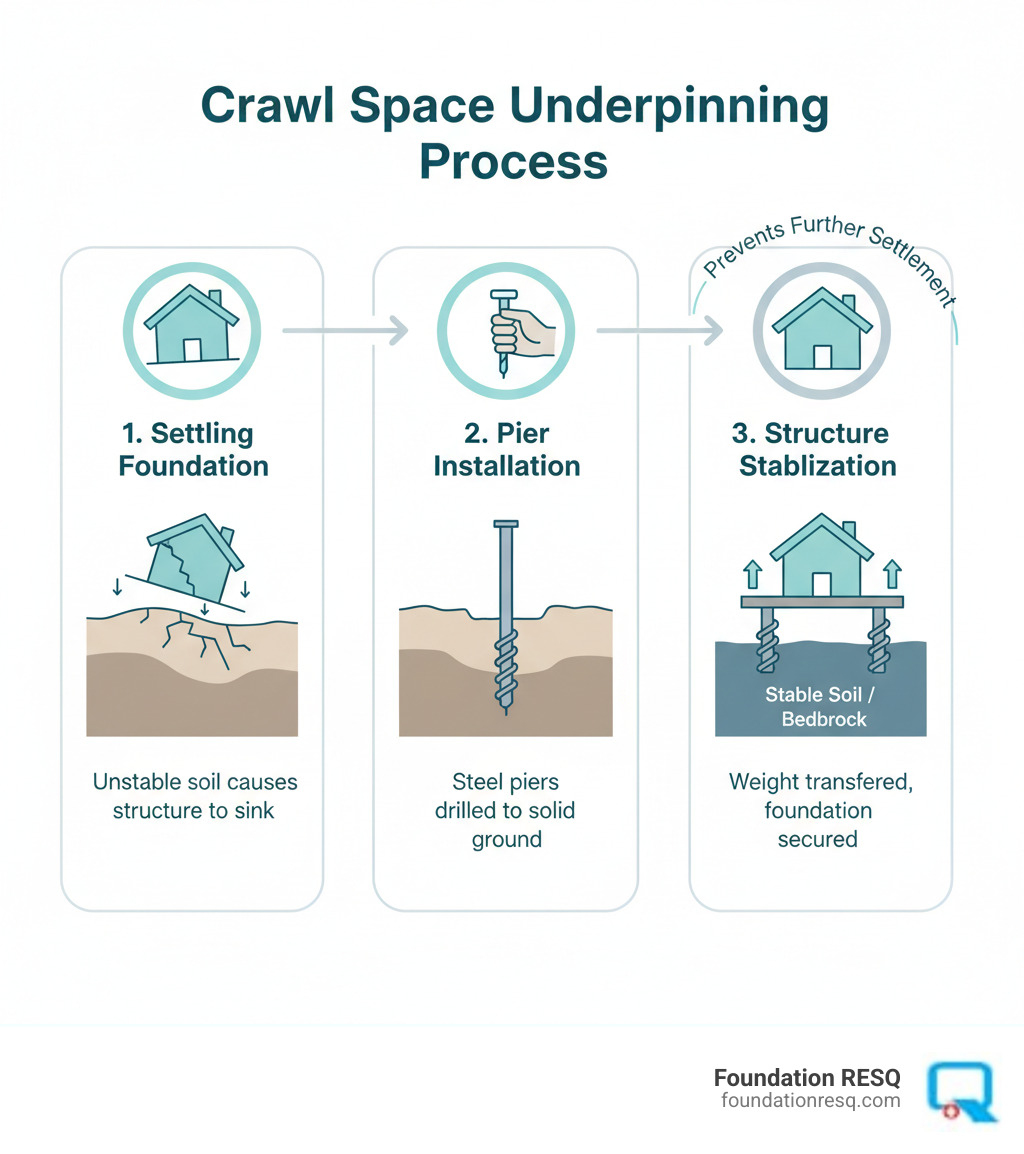
Crawl space underpinning is a foundation repair technique that strengthens and stabilizes your home by installing steel piers or supports beneath the existing foundation, transferring the weight of your structure to deeper, more stable soil layers. Here’s what you need to know:
Quick Answer: What is Crawl Space Underpinning?
- Purpose: Stops foundation settlement and stabilizes sinking or failing foundations
- How it works: Steel piers (helical or push piers) are driven deep into the ground to reach stable soil or bedrock
- When needed: Sagging floors, wall cracks, sticking doors/windows, tilting chimneys, or visible foundation settlement
- Cost: Typically $50,000-$150,000 for major work, though smaller repairs cost less
- Timeline: Usually a few days to one week for residential properties
- Result: Permanent foundation stabilization, often with the ability to lift your home back to its original position
If you’ve noticed cracks spreading across your walls, floors that bounce when you walk, or doors that suddenly won’t close properly, your crawl space foundation might be failing. One-sixth of U.S. homes sit on crawl space foundations, and many experience settlement issues when the soil beneath can no longer support the structure’s weight.
The good news? Foundation underpinning offers a permanent solution that addresses the root cause rather than just covering up symptoms. Unlike temporary fixes like shimming posts or patching cracks, underpinning transfers your home’s weight to stable soil layers deep underground, preventing future movement and often restoring your home to its original level position.
I’m Kayle Vernon, and over my decade of experience in strategic marketing and business growth, I’ve helped foundation repair companies like Foundation RESQ educate homeowners about critical solutions like crawl space underpinning. Understanding when and why this repair is necessary can save you from catastrophic structural damage down the road.
What is Crawl Space Underpinning & Why Is It Necessary?
Think of crawl space underpinning as giving your home a stronger pair of legs to stand on. When the soil beneath your foundation can no longer support your home’s weight, underpinning extends your foundation down to deeper, more stable soil layers or even bedrock. It’s like building a new, stronger base underneath your existing one.
The process works by transferring the load—that’s the weight of your entire home—from weak or unstable soil to these deeper, more reliable earth layers. At Foundation RESQ, we’ve seen countless homes in Florida, Georgia, and Alabama where this technique has literally saved the structure from catastrophic failure.
So why do homes need underpinning in the first place? The answer usually lies in what’s happening beneath the surface. Expansive clay soil is a major culprit in our region. This type of soil acts like a sponge, swelling dramatically when it absorbs water and shrinking just as dramatically when it dries out. Your foundation essentially sits on soil that’s constantly moving up and down with the seasons.
Soil erosion creates another set of problems. Water runoff, poor drainage, or natural settling can wash away or compress the soil beneath your foundation, leaving gaps or voids. When there’s nothing supporting sections of your foundation, those areas start to sink.
Sometimes the problem starts at construction. Poor soil compaction or leaving organic materials to decompose beneath the foundation sets up your home for settlement down the road. It’s not a matter of if, but when.
Even changes you make to your home can trigger the need for underpinning. Added home weight from a second story, a new addition, or even replacing a lightweight roof with heavy tile can exceed what your original foundation was designed to handle.
Your crawl space houses the critical support system that keeps your floors level and your walls straight. Support posts (sometimes called piers) are vertical columns—usually made of steel, wood, or concrete—that hold up the girders and joists supporting your main floor. When this system fails, you’ll feel it upstairs in the form of bouncy floors, cracked walls, and doors that won’t close properly. Our Crawl Space Stabilization System addresses these exact issues by reinforcing these critical support points.
Understanding how crawl spaces function can help you appreciate why foundation problems are so serious. The Crawlspaces | Building America Solution Center offers detailed technical information about these often-overlooked spaces beneath your home.
The Critical Role of Your Crawl Space Foundation
Your foundation does one essential job: it distributes the enormous weight of your house evenly across the load-bearing soil beneath it. Think about it—your home weighs tens of thousands of pounds, and all that weight needs to be spread out so no single point gets overloaded.
When the soil beneath your foundation is compromised, this careful distribution system falls apart. Parts of your foundation start settling unevenly, and that’s when the real trouble begins. A crack in your drywall isn’t just cosmetic—it’s your home telling you something critical is failing below.
The long-term stability of your entire home depends on maintaining this connection between your foundation and stable soil. A failing foundation isn’t something that fixes itself. Without intervention, the damage accelerates, spreading from the foundation up through your walls, floors, and roof.
Preventing further damage is exactly what underpinning accomplishes. By stabilizing your foundation and transferring its load to dependable soil layers, underpinning stops the progression of settlement and gives your home a solid base for decades to come.
Common Reasons for Foundation Failure
Foundation failure rarely happens overnight. Usually, it’s the result of one or more underlying issues that have been quietly working against your home’s stability. Here’s what we commonly see in Alabama, Florida, and Georgia:
Poor soil compaction during construction is like building your house on a soft cushion instead of solid ground. When builders don’t properly compact the soil or when they leave organic materials like tree stumps or roots to decompose beneath your foundation, settlement becomes inevitable. As that material breaks down or the loose soil compresses under your home’s weight, gaps form and your foundation sinks.
Water and moisture issues cause more foundation problems than almost anything else. Poor drainage around your home, broken gutters, or even changes in your property’s grading can direct water toward your foundation. In areas with expansive clay soil, this water causes the soil to swell and push against your foundation. When the soil dries out, it shrinks away, leaving your foundation without support. This constant cycle of expansion and contraction puts enormous stress on your foundation.
Invasive tree roots might seem harmless when you plant that beautiful oak near your house, but over the years, those roots spread out looking for water and nutrients. They can grow under and around your foundation, physically displacing soil and creating voids. Just as problematic, large tree roots draw moisture out of the soil, causing it to shrink away from your foundation.
Changes in soil moisture don’t always require a tree. Drought conditions, changes in your landscaping, or even a new neighbor’s construction that alters water flow patterns can all affect the moisture content in the soil beneath your home. When soil loses moisture, it compacts and shrinks, creating settlement.
Nearby excavation is something you might not even control. If your neighbor digs a basement, if utility companies trench for new lines, or if there’s construction on an adjacent property, the excavation can destabilize the soil supporting your foundation. The effects can show up immediately or develop gradually over months.
Understanding these causes of failure helps you recognize warning signs early and take action before minor settlement becomes a major structural crisis.
Signs You Need Underpinning & The Methods Used
Your home has a way of telling you when something’s wrong—you just need to know how to listen. Foundation problems rarely appear overnight. Instead, they announce themselves through a series of warning signs that become increasingly difficult to ignore.
One of the first things you might notice is that your floors don’t feel quite right anymore. Sagging or bouncy floors are often the earliest indicators that your crawl space support system is struggling. When you walk across the room and feel a slight bounce or notice that your furniture seems to shake, it’s time to investigate what’s happening below. This typically means the support posts or girders in your crawl space are no longer doing their job properly.
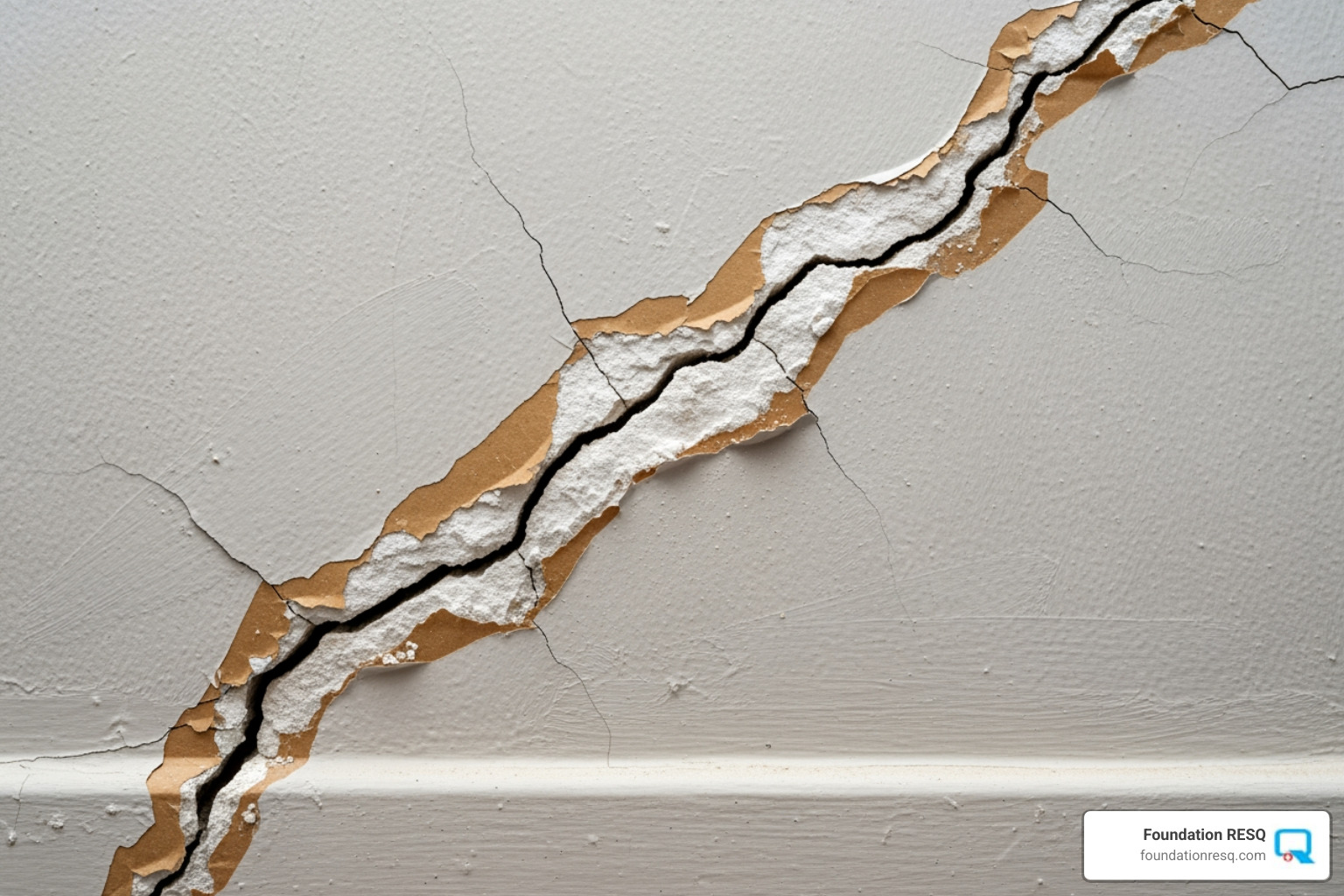
Wall cracks are another telltale sign, and not all cracks are created equal. Small hairline cracks from normal settling are usually harmless, but diagonal cracks—especially those that are wider at one end—signal active foundation movement. You might see these in your foundation walls, on interior drywall, or running through exterior brick. Similarly, cracks in your floors, whether in concrete slabs or tile, often indicate the ground beneath is shifting.
Have you noticed doors and windows that used to open smoothly now stick or won’t close properly? This frustrating issue happens when your home’s frame shifts as the foundation settles unevenly. The door frames and window openings become distorted, even if just by a fraction of an inch. A tilting chimney is an even more dramatic warning sign—if your chimney appears to be leaning or pulling away from the house, it’s experiencing independent settlement that needs immediate attention.
Sometimes the signs aren’t visual at all. Musty odors drifting up from your crawl space might seem unrelated to foundation issues, but they often indicate moisture problems that can lead to wood rot and structural weakening. If you’re dealing with persistent musty smells, our Crawl Space Wood Rot Complete Guide can help you understand the connection between moisture and structural damage.
Common Methods for Crawl Space Underpinning
When it comes time to stabilize your foundation, crawl space underpinning relies on proven methods that have protected homes for decades. At Foundation RESQ, we primarily use steel pier systems because they offer the most reliable, long-lasting solution for our Alabama, Florida, and Georgia homeowners.
Think of these systems as deep anchors that bypass unstable surface soil entirely, reaching down to solid ground or bedrock that won’t shift or compress. There are three main types of steel pier systems, each with specific advantages depending on your home’s needs and soil conditions.
Helical piers look somewhat like giant screws. They feature helical plates (shaped like corkscrew threads) welded to a steel shaft. During installation, we mechanically screw these piers deep into the ground until they reach stable soil or bedrock. The helical plates provide excellent holding capacity in the soil, almost like a screw anchor. These piers are particularly effective in softer soils and situations where we need immediate load-bearing capacity. They’re also ideal when access is limited or when we want to minimize vibration during installation. You can learn more about our Piering services to see how we use this technology.
Push piers (sometimes called resistance piers) take a different approach. These are smooth steel tubes that we hydraulically drive straight down through the soil using the weight of your home as resistance. We keep driving them deeper until they hit bedrock or a load-bearing soil layer that won’t budge. Push piers are incredibly strong and work well in virtually any soil type. They’re especially effective when the depth to stable soil is unknown or when we need maximum load capacity.
Steel piers is actually a general term that encompasses both helical and push pier systems, but it can also refer to traditional driven steel H-beams or pipe piers. These are heavy-duty steel sections driven deep into the ground. While less commonly used in modern residential applications compared to helical or push piers, they remain a viable option for certain situations requiring exceptional load capacity.
It’s worth noting that traditional concrete underpinning—where contractors pour new concrete beneath or beside the existing foundation—is another method you might encounter. However, for crawl space applications with settlement issues, steel pier systems generally offer superior performance because they reach much deeper into stable soil layers that concrete alone cannot access.
Each method has its place, and the right choice depends on your specific soil conditions, the extent of settlement, the weight your foundation needs to support, and site access constraints. During our free inspection, we evaluate all these factors to recommend the most effective solution for your unique situation.
How Underpinning Addresses Moisture and Drainage
Here’s something many homeowners don’t realize: foundation problems and water problems are often two sides of the same coin. When your foundation settles and cracks, it creates pathways for water to enter your crawl space. That incoming water can then worsen soil conditions, leading to more settlement—a vicious cycle that compounds over time.
Crawl space underpinning breaks this cycle by stabilizing your foundation and preventing future movement. When we install steel piers and lift your foundation back toward its original position, we’re also closing many of those cracks that allowed water intrusion in the first place. The stabilized foundation means the soil beneath it experiences less stress and movement, which helps maintain more consistent moisture levels in the ground.
But underpinning alone isn’t always enough to solve the entire problem. That’s why we often integrate drainage solutions as part of a comprehensive foundation repair strategy. Proper drainage systems direct water away from your foundation, preventing the soil moisture fluctuations that cause clay soils to expand and contract. Our Crawl Space Drainage System services work hand-in-hand with underpinning to create a dry, stable environment beneath your home.
Think of it this way: underpinning provides the structural stability, while drainage controls the environmental factors that caused the problem in the first place. Together, they give your foundation the best chance for long-term success and protect your investment for decades to come.