What should you do when a home inspection flags a crack, uneven floor, or possible settlement while a Tallahassee deal is moving forward? A concern deserves a clear next step, not an immediate assumption that the home needs major repairs. A foundation inspection for real estate agents Tallahassee transactions can help buyers and sellers understand what visible signs may mean and whether a focused follow-up is appropriate.
A general home inspection can identify visible concerns, but it isn’t an engineering assessment or a diagnosis of the foundation system. A focused foundation inspection can take a closer look at a reported concern and help clarify whether foundation repair may be relevant. Foundation ResQ provides free foundation inspections and estimates with foundation service requests in Tallahassee.
This guide explains when to recommend a focused assessment, what it can clarify, and how it differs from a general home inspection or an engineer’s opinion. You’ll also find practical steps for coordinating follow-up, communicating findings calmly, and helping clients make informed decisions without overstating the risk or derailing the transaction.
Key Takeaways
- Learn which observed signs or past repair details may warrant a focused foundation assessment during a Tallahassee transaction.
- Use a foundation inspection for real estate agents Tallahassee clients can understand to clarify a specific concern, not replace a whole-home inspection.
- Separate visible conditions from assessment conclusions so clients can discuss next steps without treating every crack or uneven surface as structural failure.
- Follow a practical coordination checklist, including gathering inspection notes, disclosures, and known repair history.
- Foundation ResQ includes a free inspection and estimate with each foundation service request to help clarify potential service needs.
When a Tallahassee Real Estate Transaction Needs a Foundation Inspection
An agent’s first task is to separate what someone has observed from what has actually been assessed. A crack, a door that sticks, or a note about prior repairs can raise a reasonable question, but none confirms the cause or severity on its own. A foundation inspection for real estate agents Tallahassee transactions can provide focused follow-up when those questions affect a buyer’s or seller’s next decision.
Timing matters. A general home inspection may flag a foundation-related concern, but the transaction still needs a clear path from observation to follow-up. A focused assessment can examine the reported concern and help clarify whether foundation repair services may be relevant. It is not a substitute for a whole-home inspection or a structural engineer’s opinion when an engineering determination is needed.
Transaction moments when a focused assessment may help
After a general inspection identifies a concern, help clients move from a broad report to a specific review. For example, if an inspection mentions a crack or uneven floor, a buyer may want to understand whether the condition could relate to foundation movement or warrants further evaluation. A focused review gives the parties a more clearly defined subject for discussion than a general note alone.
Buyer due diligence may also prompt follow-up when visible conditions or seller disclosures raise questions. If the property has a history of foundation repair, relevant records can help explain what work was done and what the buyer is seeing now. Past work is useful context, but it doesn’t automatically explain a current symptom or establish the foundation’s present condition.
Sellers may choose an assessment before listing, particularly when they know of prior repairs or have questions about a visible condition. Getting clarity early can help them respond to buyer questions with relevant information and make an informed plan for the sale. It doesn’t guarantee a particular transaction outcome, but it can replace assumptions with information when preparing disclosures or discussing an inspection finding.
A concern is a reason to assess, not a diagnosis
Cracks and sticking doors are observations. Their causes can vary, and a photograph alone can’t establish whether a foundation has moved, why a condition developed, or how serious it is. A useful assessment considers the reported concern in context rather than drawing a conclusion from one image or symptom. For a plain-language overview of the role and types of foundations, see Foundation (engineering).
A visible symptom is a reason to ask a focused question, not proof of structural failure. Keep that distinction clear when communicating with clients. Describe what was seen, note where it appears, and share relevant inspection comments or repair history with the assessor. Avoid labeling a condition as severe or predicting failure before a qualified professional has evaluated it.
For Tallahassee agents, the practical goal is not to assume that local conditions explain a particular home’s symptoms. It is to coordinate a focused assessment when transaction documents or visible conditions leave an important question unanswered. Foundation ResQ’s foundation service requests include a free inspection and estimate, helping buyers and sellers clarify potential foundation service needs as they plan their next step.
What a Foundation Inspection Can Clarify Beyond a General Home Inspection
A general home inspection and a foundation-focused assessment answer different questions. A home inspection gives buyers a broad view of visible conditions across multiple systems and components. A focused foundation assessment looks more closely at a reported foundation concern and whether foundation repair options merit discussion. Understanding the difference helps clients choose a relevant follow-up without treating one assessment as a replacement for the other.
Florida home inspectors review visible structural components, but a standard home inspection isn’t an engineering service and doesn’t necessarily provide an opinion on the adequacy of a structural system. A foundation repair contractor’s assessment focuses on the foundation concern. It can help clarify the condition under discussion and potential service needs, but it shouldn’t be presented as a whole-home inspection or formal engineering opinion. The assessments can complement each other by addressing different parts of a buyer’s due diligence.
| Assessment | Scope and purpose | Suitable follow-up |
|---|---|---|
| General home inspection | Reviews the visible condition of a range of home components and notes concerns within its scope. | Arrange focused follow-up if a foundation-related issue needs closer review. |
| Foundation-focused contractor assessment | Examines a specific foundation concern in relation to potential foundation repair needs. | Discuss relevant repair options or seek a separate engineering opinion if one is needed. |
Questions a focused assessment may help address
A focused review adds detail to the concern already raised. It may help clients identify where the condition is located, what part of the foundation or nearby area is involved, and whether foundation repair options warrant further discussion. The scope remains specific: it doesn’t establish the condition of every home system or settle questions beyond the concern assessed.
Agents can share the relevant inspection comments, point out the area that prompted the follow-up, and provide known repair history. That context helps keep the assessment aligned with the transaction question. For a general overview of the purpose and process, Rocket Mortgage’s Foundation Inspection: What To Know offers additional background.
Findings can inform a client’s next discussion, but they don’t set contract terms, dictate negotiations, or determine whether a transaction proceeds. Those decisions belong to the parties and their representatives, based on the full transaction context. If a formal engineering opinion is required, a contractor assessment shouldn’t be described as a substitute for it.
For foundation concerns that may involve repair, Foundation ResQ includes a free inspection and estimate with each foundation service request. Agents can share Foundation ResQ’s foundation inspection and estimate as a focused next step for clients seeking more information about a foundation concern.
How Agents Can Interpret Foundation Findings Without Derailing a Deal
Once an assessment is complete, keep the conversation grounded by separating three things: what was observed, what the assessor concluded, and what the parties may want to discuss next. This structure prevents a single phrase in a report from becoming a broader claim about the home or transaction.
- Observed condition: State what was noted, such as a crack at a particular location or a floor that appears uneven.
- Assessment conclusion: Summarize the assessor’s actual comments about the concern and its potential connection to foundation repair.
- Possible next discussion: Identify questions the buyer or seller may wish to raise, such as whether additional evaluation or a repair estimate would help.
A crack or uneven surface does not, by itself, prove structural failure. Its meaning depends on the conditions assessed and the professional’s findings. Don’t add a cause, severity, or prediction that the assessment doesn’t state. Photographs can document a visible condition, but they aren’t a substitute for an in-person assessment or a basis for independently diagnosing the foundation.
Communicate what’s known, and what remains open
Use neutral, source-based wording when sharing findings with buyers and sellers. For example: “The assessment notes a crack in the area identified during the visit and discusses whether foundation repair options may be appropriate.” If the assessment leaves a question unresolved, say so plainly instead of filling the gap with a guess. This helps clients distinguish an observation from a conclusion.
Share relevant findings with the appropriate transaction parties in a timely way, following the client’s direction and the transaction process. Don’t describe a concern as an emergency unless the assessment supports that characterization, and don’t assure clients it will have no effect on the sale. Calm, precise language is more useful than alarm or reassurance unsupported by the findings.
Let findings inform decisions, not make them
An assessment informs the parties’ decisions; it doesn’t make those decisions for them. Buyers and sellers, with guidance from their representatives, decide how to proceed in light of the assessment and broader transaction. An assessor can clarify a foundation concern or discuss potential repair needs, but that information alone doesn’t determine whether the parties negotiate, continue, or change their plans.
Keep the technical discussion separate from contract and legal questions. If clients ask how a finding affects a deadline, disclosure, contract obligation, or negotiation position, direct them to the appropriate transaction professional, such as their real estate representative or legal counsel. Avoid interpreting contract language or suggesting a particular negotiating outcome.
For a foundation inspection for real estate agents Tallahassee clients can use constructively, present the finding accurately, identify what remains uncertain, and route follow-up questions to the right person. That approach gives the assessment a practical role without overstating its conclusions or turning a repair discussion into negotiation advice.
A Practical Tallahassee Agent Checklist for Coordinating an Assessment
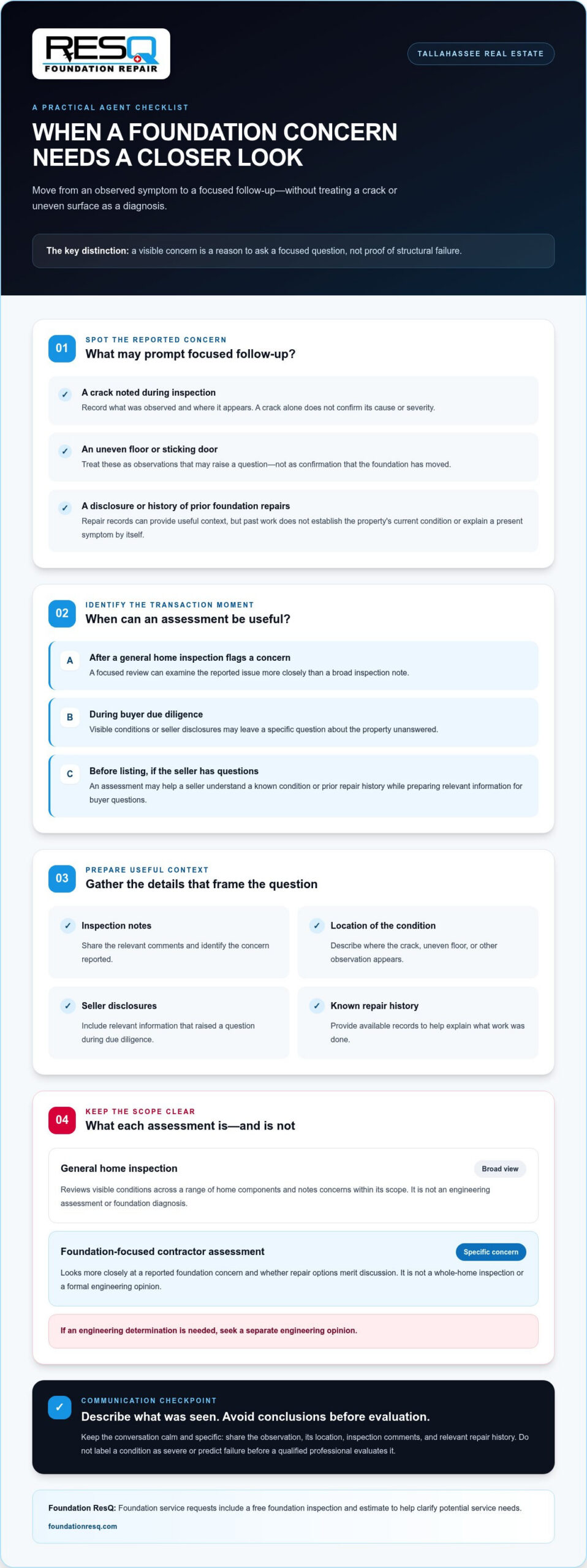
A focused assessment is most useful when the assessor knows what prompted the request and can access the relevant area. A few practical steps can keep follow-up organized, give the assessor useful context, and help clients understand what the findings address. Use this checklist for a foundation inspection for real estate agents Tallahassee transactions, from the first observation through sharing next steps.
Before scheduling: gather context and identify the concern
Start with the information already available. Don’t attempt to diagnose the cause. Record the location and description of the concern, when it was first observed if known, and which document or person raised it. Include pertinent inspection notes, disclosures, and known foundation repair history shared by the client. Keep recorded facts separate from assumptions about why a condition occurred.
- Document the specific concern. Note where it appears and describe it plainly, such as “crack along the garage wall” or “uneven area reported in the living room.” Include when it was first noticed, if known.
- Collect relevant records. Gather the general inspection comments, available disclosures, and any known repair information the client has shared. A record of prior work provides context, but doesn’t establish the cause of a current condition by itself.
- State the question for follow-up. Explain what the client wants clarified, such as whether the noted condition may relate to foundation repair needs. Avoid supplying a diagnosis or an unverified local soil or weather explanation.
- Coordinate property access. Arrange access with the responsible parties and identify the area to be assessed. Share relevant notes in advance so the assessment can stay focused on the transaction concern.
- Review the findings and plan communication. Summarize what was observed, what the assessment concludes, and what questions remain. Share the information with clients and appropriate transaction parties in a timely, neutral way.
During follow-up: coordinate access and next steps
Keep scheduling practical. Confirm who will provide access, which parts of the property are relevant to the concern, and which inspection notes or records should be available. If the assessment identifies possible repair options, present them as information for discussion, not as a required negotiation position. Contract terms, disclosure questions, and deadlines should remain with the appropriate transaction professionals.
For broader context on foundation repair in the area, agents and clients can consult this Tallahassee foundation repair guide. If the assessment specifically raises piering as a possible option, the Tallahassee helical pier guide may help explain that repair approach.
When a transaction raises a foundation service question, schedule a Foundation ResQ foundation inspection and estimate to help clarify potential repair needs.
How Foundation ResQ Supports Tallahassee Agents and Their Clients
When a transaction raises a foundation question, a focused contractor assessment can help clarify whether foundation repair needs further discussion. Foundation ResQ serves Tallahassee with foundation repair and structural stabilization. Its assessment focuses on foundation concerns related to repair services, helping clients understand potential next steps.
That distinction helps agents set expectations. A general home inspector evaluates visible conditions across the property, while a foundation repair contractor focuses on the specific foundation issue brought forward. The assessment doesn’t replace the general inspection or automatically provide an engineering opinion. It adds relevant information when clients are considering whether a foundation concern needs attention.
A focused assessment and repair discussion
Each foundation service request includes a free foundation inspection and estimate. The inspection can help clarify the concern and whether foundation service needs merit discussion. If repair is relevant, Foundation ResQ can discuss options based on the property and assessed condition. Piering and carbon fiber reinforcement are among its foundation repair approaches, but neither should be treated as a predetermined recommendation before the concern is assessed.
For agents, this provides a practical way to connect an inspection finding with a repair-focused conversation. A buyer may want to understand whether a noted foundation condition could require work. A seller may want a clearer basis for responding to questions about known concerns. The assessment and estimate can inform that discussion without deciding how either party should negotiate or proceed with the transaction.
Financing is available for major repairs. Avoid suggesting a particular payment arrangement or outcome to clients.
A clear next step for agents and property owners
Before requesting an assessment, agents can help clients gather relevant inspection notes, identify the area of concern, and share any known repair history. Providing that context helps keep the visit focused. Clients should understand that the purpose is to discuss the specific foundation concern and potential service needs, not to receive a full-home inspection or a guaranteed conclusion about the sale.
For foundation inspection for real estate agents Tallahassee clients can use as a focused follow-up, invite the buyer or seller to submit a request through Foundation ResQ’s contact form. They can describe the concern and request a free foundation inspection and estimate. The discussion can then address the property’s specific foundation question and any relevant repair options.
Have a foundation concern to clarify? Use the contact form to schedule a free foundation inspection and discuss the property’s needs with Foundation ResQ.
Move the Transaction Forward With Clear Information
A structural question doesn’t have to become a guessing game. The next useful step is to give clients a clear path from concern to informed choice, while leaving contract decisions to the people responsible for them. For foundation inspection for real estate agents Tallahassee transactions, focus on the property-specific question and use the assessment to guide a practical discussion.
Foundation ResQ provides foundation repair and stabilization services in Tallahassee. Each foundation service request includes a free inspection and estimate, giving agents and property owners a focused way to discuss the concern and potential service needs.
Ready to take the next step? Schedule a free foundation inspection and discuss the property’s foundation concern with Foundation ResQ. Clear information can help your clients move ahead with greater confidence.
Frequently Asked Questions
Can a foundation inspection delay a real estate closing?
The inspection itself doesn’t decide whether a closing proceeds or changes its timing. Any effect depends on what the assessment finds, how the parties respond, and the transaction deadlines. For example, a finding that prompts further questions may lead the parties to discuss additional steps. Coordinate follow-up promptly, but don’t promise that an assessment or repair can fit a particular closing schedule. Direct contract and deadline questions to the appropriate transaction professionals.
Should a buyer attend a foundation inspection?
A buyer may find it helpful to attend if access and scheduling allow. Hearing the discussion directly can help them understand which area is being assessed and what questions remain. For example, a buyer can ask for clarification about a concern noted in an inspection report. Coordinate attendance with the property owner and other relevant parties. The buyer should treat the conversation as information about the assessed concern, not as a standalone diagnosis of the entire home.
Can a foundation issue be repaired before a home sale closes?
It may be possible, but whether repair happens before closing depends on the assessment, project needs, property access, timing, and the parties’ decisions. A reported concern alone isn’t enough to promise that work can be completed by a particular date. The practical first step is to clarify whether repair is appropriate and understand the project-specific needs. Foundation ResQ includes a free inspection and estimate with each foundation service request to help clarify potential service needs.
Do small foundation cracks always mean a home has structural damage?
No. A small crack is a visible condition, not proof of structural damage. Its significance depends on the broader condition and assessment, so agents shouldn’t label it cosmetic or structural based on appearance alone. Note its location and refer to the relevant inspection comment rather than guessing at its cause. If questions remain after a general home inspection, a focused assessment can help clarify the concern and whether repair options warrant discussion.
What should a seller prepare before a foundation assessment?
A seller can prepare by arranging access and gathering available information about the concern, prior foundation work, and relevant inspection findings. If the seller knows when the issue was first noticed, that context may also help frame the assessment. Share known details accurately and separate them from guesses about the cause. An agent can identify the specific question prompting follow-up and coordinate timing with the involved parties, while avoiding promises about what the assessment will conclude.
Does a free foundation inspection include a repair estimate?
Yes. Foundation ResQ includes a free inspection and estimate with each foundation service request. The visit can help clarify the specific foundation concern and discuss applicable repair options. The estimate relates to the property and needs being assessed; clients shouldn’t assume it includes a particular document format, engineering opinion, or evaluation of unrelated home systems. Agents can help clients share the concern and relevant background so the discussion stays focused on the requested foundation service.
Can a foundation assessment tell an agent whether a buyer should proceed?
No. An assessment can provide information about a foundation concern, but it doesn’t decide whether a buyer should proceed or provide contract advice. A buyer may consider the findings alongside their priorities and transaction terms, then discuss questions with the appropriate professionals. If the assessment raises a new issue or leaves a question open, the buyer can seek relevant guidance before deciding. Keep the assessor’s conclusions distinct from advice about whether to purchase.