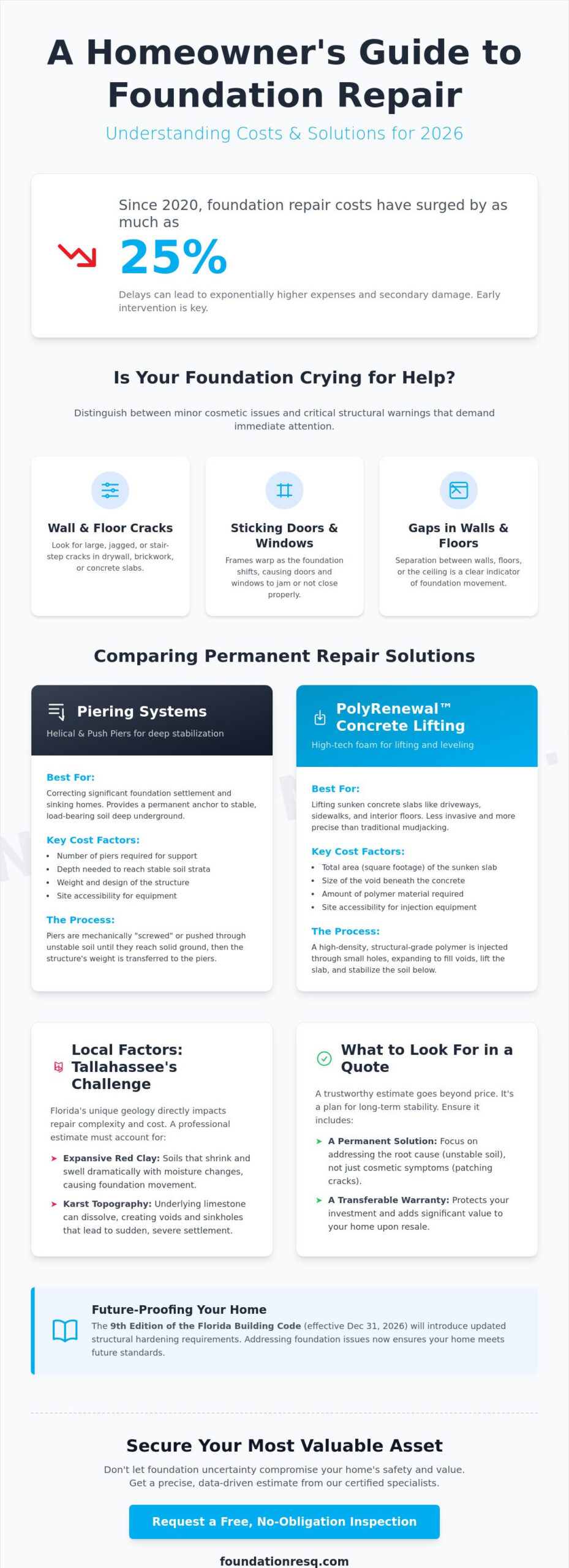
Foundation repair costs have climbed by as much as 25% since 2020, leaving many Florida homeowners feeling uncertain about the future of their property’s safety. It’s natural to feel a sense of dread when you spot a new crack in the drywall or a sticking door. You want a permanent fix that secures your investment, but the fear of being overcharged or sold a temporary patch often leads to costly delays. We understand that your home is your most significant asset; maintaining its structural integrity shouldn’t feel like a guessing game.
This 2026 guide serves as a professional foundation repair cost estimator to help you navigate these complex structural challenges with technical clarity. You’ll learn how to identify the specific variables that influence stabilization costs and how to distinguish between different repair methods, such as helical piers versus PolyRenewal concrete lifting. We also examine how the 9th Edition of the Florida Building Code, effective December 31, 2026, impacts structural hardening requirements for local residences. By the end of this article, you’ll have a realistic framework for budgeting and the confidence to discuss permanent solutions with a qualified specialist.
Key Takeaways
- Understand why a professional foundation repair cost estimator is essential for identifying hidden subsurface issues that simple ballpark figures often overlook.
- Compare the technical differences between permanent piering systems and PolyRenewal concrete lifting to determine which stabilization method fits your home’s structural needs.
- Discover how Tallahassee’s specific geological challenges, such as expansive red clay and karst topography, impact the depth and complexity of stabilization projects.
- Learn to distinguish between minor cosmetic cracks and significant structural warnings to better assess the immediate scope of needed repairs.
- Gain clarity on how to evaluate professional quotes based on long-term stability and the protection offered by transferable warranties.
What Is a Foundation Repair Cost Estimator?
A professional foundation repair cost estimator is far more than a simple price list or a generic online calculator. It’s a comprehensive diagnostic framework designed to identify the root cause of structural instability. While many homeowners hope for a quick “ballpark” figure, these surface-level estimates often ignore the subsurface geological complexities that dictate the true scope of work. Generic estimates fail because they can’t account for soil density, moisture content, or the specific load-bearing requirements of your home’s design. When evaluating a Foundation (engineering) project, an expert must look beyond visible wall cracks to understand the relationship between the structure and the soil beneath it.
Understanding the difference between a cosmetic repair estimate and a structural stabilization quote is vital for your budget. A cosmetic estimate might focus on patching drywall or tuck-pointing bricks, which only hides the symptoms. In contrast, a structural quote addresses the underlying failure using methods like push pier installation or helical pier installation. Foundation ResQ utilizes precision diagnostics to eliminate pricing guesswork, ensuring that every dollar spent contributes to a permanent remedy rather than a temporary fix. We focus on the ultimate resolution of the physical issue, providing a clear path from uncertainty to a stabilized home.
The Methodology Behind the Estimate
The estimation process begins with a transition from a basic visual inspection to a detailed structural analysis. We don’t rely on assumptions. Instead, we use interior floor elevation mapping to identify exactly where the foundation has settled or heaved. This data is a critical cost variable because it determines the number of piers required to reach competent load-bearing strata. Our specialists use advanced laser levels to measure floor slopes with millimeter precision and moisture meters to assess the environment in your crawl space. These technical tools allow us to build an estimate based on facts, not approximations.
Repair vs. Replacement: A Cost Comparison
Total foundation replacement is an invasive, expensive process that involves excavating around the entire perimeter and lifting the house. Targeted stabilization is almost always the more efficient and cost-effective choice for Florida homeowners. By intervening early with a foundation repair cost estimator, you prevent the exponential growth of repair expenses that occurs when a structure continues to sink. Early stabilization protects your home’s resale value and prevents secondary damage to plumbing and roofing systems. The point of no return occurs when the structural integrity of the building is so compromised that the safety risks and reconstruction costs outweigh the feasibility of professional stabilization.
Estimating Costs by Solution Type: Piers, Anchors, and Poly
The complexity of structural stabilization means that the Average Foundation Repair Cost often fluctuates based on the specific technology required for a permanent fix. A professional foundation repair cost estimator doesn’t just look at the size of the home; it evaluates the structural load and the soil conditions to determine which mechanical solution provides the necessary stability. Each method has a different impact on the project’s timeline and technical requirements. Choosing the right tool for the job ensures that you aren’t just paying for a temporary patch, but for a durable restoration of your home’s integrity.
Helical and Push Pier Systems
Piering systems are the primary remedy for homes experiencing significant settlement. The number of piers required is directly determined by the weight of the structure and the distance between load-bearing points. In Tallahassee, helical piers are frequently the preferred choice because they’re designed to be screwed deep into the soil until they reach competent strata. This is particularly effective in our local geology, where surface soils can be unstable. If your home is showing signs of severe sinking, you can explore detailed sinking home foundation solutions to understand how these systems anchor your property to stable ground.
PolyRenewal™ Concrete Lifting
For sunken driveways or interior concrete slabs, PolyRenewal™ offers a high level of cost-efficiency compared to older methods. Traditional mudjacking uses a heavy cement slurry that adds significant weight to already failing soil. In contrast, PolyRenewal™ uses a lightweight, high-density polyurethane foam that expands to lift and level concrete with minimal disruption. It’s a faster, cleaner alternative that cures in minutes rather than days. For those dealing with uneven walkways or porches, reviewing a guide on concrete leveling in Tallahassee can clarify why this modern approach is often the most sensible choice for residential slabs.
Wall reinforcement is another critical variable in the estimation process. When basement or crawl space walls begin to bow inward due to hydrostatic pressure, we often compare the use of carbon fiber wall reinforcement against heavy-duty wall anchors. Carbon fiber is ideal for stabilizing walls with minimal bowing, providing a low-profile solution that’s easily painted over. Wall anchors are more invasive but are necessary for walls that require active straightening. Both methods focus on preventing a total wall failure, which would be far more expensive to address later.
A factor often overlooked by a standard foundation repair cost estimator is the role of moisture management. If you don’t address the water issues causing soil expansion and contraction, even the best structural repairs can be compromised over time. Integrating systems like crawl space encapsulation or high-capacity dehumidifiers protects your foundation investment by maintaining a stable environment beneath your home. This holistic approach ensures that the root cause of the damage is neutralized. If you’re unsure which solution fits your specific situation, a professional foundation inspection can provide the technical data needed to make an informed decision.
Local Factors: How Tallahassee Geography Impacts Your Estimate
National price calculators often rely on zip codes to adjust for labor rates, but they frequently miss the geological reality of the Florida Panhandle. A reliable foundation repair cost estimator for our region must factor in the unique soil profiles found across Leon County. In Tallahassee, the ground beneath your home isn’t a static platform. It’s a dynamic environment shaped by specific mineral compositions and water patterns that directly influence the complexity of structural stabilization. We don’t just look at the building; we analyze the earth supporting it.
The “Tallahassee Red Clay” is a significant factor in local structural health. This expansive soil type changes volume based on its moisture content. During heavy seasonal rains, the clay swells and exerts intense hydrostatic pressure against your foundation. During dry periods, it shrinks and pulls away, leaving the structure unsupported. This constant cycle of movement is a primary cause of foundation settlement. Understanding Florida’s Problem Soils is essential for any homeowner trying to understand why their property is shifting.
Our region also features karst topography, characterized by porous limestone that’s susceptible to dissolution from acidic rainwater. This geological trait creates a risk of sinkholes and subsurface voids that require specialized stabilization approaches. To ensure a permanent remedy, we must often drive push pier installation or helical pier installation deep enough to bypass these unstable layers. This technical requirement separates a professional estimate from a generic quote that might only address surface-level symptoms.
Soil Mechanics and Pier Depth
Pier depth varies significantly across different Tallahassee neighborhoods. In some areas, we might reach competent load-bearing strata at 15 feet, while other locations require depths exceeding 30 feet to find stable ground. This variation is a major driver of the final project cost because it dictates the amount of steel and labor required. Soil saturation from Florida rains often causes rapid foundation movement, which can accelerate the need for deeper, more robust piering systems than initially expected.
The Crawl Space Connection
High humidity and high water tables are constant challenges in our local climate. A wet crawl space can significantly increase the overall cost of structural repairs because persistent moisture weakens wooden floor joists and encourages mold growth. It’s often necessary to include dehumidification and crawl space encapsulation Tallahassee in a comprehensive foundation estimate. This protective barrier keeps the elements away from your home’s support system, ensuring that your structural investment remains secure for the life of the building. By addressing moisture and soil stability together, we provide a final line of defense for your property’s health.
Warning Signs vs. Repair Scope: A Homeowner’s DIY Assessment
Identifying the early symptoms of structural failure allows you to address issues before they escalate into catastrophic expenses. Not every crack in your home indicates a foundation in crisis, but understanding the difference between cosmetic settling and active movement is vital. A professional foundation repair cost estimator relies on the specific patterns of damage to determine the necessary stabilization method. By performing a methodical walkthrough of your property, you can gather the data needed to distinguish between a simple patch and a permanent structural remedy.
Stair-step cracks in exterior brickwork or interior concrete blocks are significant indicators of foundation settlement. These differ from hairline vertical cracks, which often result from the natural curing of materials. When you observe cracks that are wider at the top than the bottom, or those that follow mortar lines in a jagged pattern, the structure is likely losing its uniform support. Other “pinch points” include windows and doors that suddenly stick or refuse to latch properly. These issues occur when the frame is pulled out of alignment by a shifting foundation, creating a mechanical failure in the home’s daily operation.
A chimney pulling away from the rest of the house is a high-priority warning sign that often increases the overall repair scope. Because chimneys are heavy and often built on a separate footing, they frequently show signs of settlement before the main structure. If you notice a gap widening between the chimney and the siding, it indicates a deep-seated soil failure that requires immediate attention. Addressing these signs early prevents the need for more invasive and expensive reconstruction later.
Mapping the Damage
Homeowners can assist the estimation process by tracking crack growth over time. Use a pencil to mark the end of a crack and record the date; if the crack continues past that mark within a few weeks, the movement is active. The location of these cracks also impacts pricing. Cracks near the corners of a building often suggest localized settlement that might be resolved with a few piers, while mid-wall cracks might indicate a more complex bowing issue. For those with specific concerns about concrete bases, reviewing the details of slab foundation repair Tallahassee can clarify what to expect during the restoration process.
Interior vs. Exterior Symptoms
Interior drywall cracks often signal a different underlying problem than exterior brickwork. While exterior cracks usually point to soil settlement, interior cracks near the ceiling or above door frames can sometimes be related to roof leaks or truss uplift. However, when paired with bouncy or uneven floors, these symptoms usually point toward crawl space instability. Mold growth or wood rot on floor joists act as secondary cost drivers, as these must be remediated to ensure the longevity of any structural fix. If your assessment reveals these red flags, scheduling a professional foundation repair evaluation is the next logical step to secure your home’s future.
Navigating Professional Estimates and Long-Term ROI
Selecting a contractor based solely on the lowest bid is a common mistake that often leads to recurring structural issues. A professional foundation repair cost estimator should provide a comprehensive breakdown that accounts for every technical requirement of the project. When you compare quotes, look beyond the final number. The cheapest option frequently ignores the root cause of the problem, such as poor drainage or unstable soil; this often leads to expensive repeat repairs. Investing in a permanent remedy protects your home’s resale value and provides peace of mind that a temporary patch cannot offer.
A quality estimate must include soft costs that generic online tools often omit. These include Leon County building permits, structural engineering stamps, and site restoration. Without these components, your project may not meet local building codes. This can create significant legal and financial hurdles when you decide to sell your property. Transferable warranties are equally important. They serve as a guarantee of durability that stays with the home, reassuring future buyers of the building’s structural integrity and protecting your long-term return on investment. Property managers overseeing multiple buildings may also benefit from reviewing a commercial building foundation inspection checklist to ensure documentation and structural assessments meet Florida’s evolving code requirements.
The Checklist for a Quality Quote
Before signing a contract, use this checklist to verify the professionalism of the proposal. A thorough estimate should never leave you guessing about the scope of work or the final result. Ensure your contractor addresses these points:
- Permits and Engineering: Confirm the quote includes the cost of required municipal permits and a final engineer’s sign-off.
- Pier Specifications: Ensure the specific pier capacities and estimated depths are clearly stated for your push pier installation or helical pier installation.
- Root Cause Resolution: Verify the plan addresses water management or soil stabilization rather than just lifting the concrete.
Structural stabilization is a significant investment, but it shouldn’t be a financial burden. We encourage Tallahassee families to discuss flexible financing options that allow for immediate repairs while spreading the cost over time. This approach ensures that critical structural work isn’t delayed. Timely intervention prevents the exponential cost growth associated with further settlement and secondary damage to the home’s interior.
Foundation ResQ: The Steadfast Local Expert
At Foundation ResQ, our diagnostic approach serves as the most accurate foundation repair cost estimator for local homeowners. We don’t guess at the depth of your piers or the stability of your soil. We focus on providing a methodical, thorough evaluation that reflects our deep commitment to the physical health of buildings in the Florida Panhandle. By combining technical precision with a neighborly approach, we ensure your home is protected against the elements for the long term. For more information on securing your home’s future, explore our comprehensive guide on Professional Foundation Repair in Tallahassee.
Securing Your Home’s Structural Future
Protecting your home from the shifting soils of the Florida Panhandle requires a methodical approach that prioritizes long-term stability over quick fixes. A reliable foundation repair cost estimator provides the technical clarity needed to move from a state of worry to a state of informed resolution. By understanding how local geology and moisture management impact your property, you can make decisions that safeguard your home’s structural health and resale value for years to come.
As a locally owned and operated team in Tallahassee, Foundation ResQ is committed to providing durable remedies backed by lifetime transferable warranties. We offer flexible financing options to ensure that essential stabilization remains accessible for every family. Don’t let structural uncertainty linger while soil conditions continue to change. Taking action now prevents minor settlement from becoming a major structural failure.
Schedule Your Free Foundation Inspection and Cost Estimate Today
Your home is your most significant investment; we’re here to help you protect it with professional integrity and dependable results.
Frequently Asked Questions
How much does the average foundation repair cost in Tallahassee?
The final price of structural stabilization in Tallahassee depends on several localized variables, including the depth of load-bearing strata and the total number of piers required. Because every property sits on a unique geological profile, a professional foundation repair cost estimator must account for specific soil conditions and the extent of the settlement. On-site inspections are the only way to determine the exact technical requirements for a permanent remedy.
Does homeowners insurance cover the cost of foundation repair?
Standard homeowners insurance policies typically don’t cover foundation repairs caused by earth movement, soil compaction, or natural settlement. Coverage is usually only available if the damage is a direct result of a specific covered peril, such as a sudden interior plumbing failure. It’s advisable to review your specific policy documents or speak with your agent to understand the limitations of your building’s protection.
Can I stay in my house during the foundation repair process?
Most homeowners can remain in their residence while the stabilization work is performed. Since methods like helical pier installation and PolyRenewal concrete lifting are primarily executed from the exterior or through small access points, there’s minimal disruption to your daily life. Our team works to maintain a clean and organized job site to ensure your home remains a safe and comfortable environment throughout the project.
How long does a typical foundation stabilization project take?
A typical residential stabilization project is often completed within one to three days. The timeline varies based on the number of piers needed and the complexity of the soil issues being addressed. While larger projects or extensive crawl space remediations may take longer, our methodical approach ensures that the work is performed efficiently without sacrificing the quality or permanence of the result.
What happens if I ignore foundation problems to save on costs?
Ignoring structural warnings usually leads to exponentially higher costs as the damage spreads to other areas of the building. Unaddressed settlement can cause significant failures in your plumbing lines, roofing system, and interior finishes. By intervening early, you protect the building’s envelope and prevent the need for more invasive reconstruction that occurs when a structure reaches the point of no return.
Is a structural engineer’s report required for a cost estimate?
A structural engineer’s report isn’t always required for an initial foundation repair cost estimator, but it’s often necessary for obtaining municipal permits and ensuring code compliance. In Leon County, professional engineering stamps provide an extra layer of verification for the proposed stabilization plan. We often work alongside engineers to ensure that the final remedy meets all technical standards for safety and durability.
Does foundation repair increase the value of my Florida home?
Foundation repair restores the value that’s lost when a home develops structural defects. In the Florida real estate market, properties with known foundation issues are often discounted significantly or fail to qualify for traditional financing. Providing documentation of a permanent fix, especially when backed by a transferable warranty, instills confidence in potential buyers and ensures your home remains a competitive and secure asset.
What is the most cost-effective way to fix a sinking slab?
PolyRenewal concrete lifting is generally the most cost-effective method for stabilizing sinking slabs, driveways, and sidewalks. This process uses high-density polyurethane foam to lift the concrete back to its original position without the expense or mess of a total replacement. It provides a long-lasting solution that addresses the underlying soil voids while allowing the area to be used again within minutes of the application.