In Tallahassee, the ground beneath your home isn’t always as solid as it looks. Our region sits atop a complex network of dissolving limestone known as Karst, which means the soil can shift or give way without much warning. You shouldn’t have to feel a surge of anxiety every time a heavy hurricane season rain hits or worry that a new crack in the drywall signals a catastrophic collapse. It’s completely normal to feel overwhelmed by technical terms and the hidden risks of living in Leon County. This guide explains everything you need to know about foundation repair for sinkhole prone areas Florida residents must navigate to keep their properties safe.
You’re going to learn exactly how to protect your home from these unique geological threats through expert foundation stabilization and sinkhole-preventative measures. We’ll walk you through the specific local geology that affects North Florida homes and explain how professional solutions like helical pier installation can provide a permanent, warranted remedy. By anchoring your house to the stable limestone deep below the surface, you can move from a state of uncertainty to a place of total confidence in your home’s structural integrity.
Maintaining structural integrity is a concern for all Florida-based assets, from residential homes to the enterprise-grade facilities housing Miami colocation services, which provide a secure foundation for the region’s digital infrastructure.
Key Takeaways
- Understand how Tallahassee’s unique Karst topography and limestone layers create specific structural risks for local homes.
- Learn to identify early warning signs of settlement, such as stair-step cracks in brickwork and doors that only stick during the wet season.
- Discover why helical piers are often the superior choice for anchoring structures into the low-resistance sandy soils found across Leon County.
- Compare the most effective methods of foundation repair for sinkhole prone areas Florida homeowners use to achieve long-term structural stability.
- Explore how professional stabilization, using expertly engineered solutions provided by Foundation ResQ, offers a durable defense against Florida’s extreme climate and soil shifts.
The Geology of North Florida: Why Tallahassee is Sinkhole-Prone
Tallahassee’s landscape is famous for its rolling terrain and canopy roads, but its beauty hides a complex geological reality. Unlike the deep clay of the interior Panhandle or the purely sandy coastal regions, our city sits on a delicate transition zone. To the north, the Red Hills provide a layer of thick, heavy clay. To the south, we transition into the Woodville Karst Plain, where the limestone bedrock is much closer to the surface. This geological “handshake” means the soil beneath your home can vary significantly from one neighborhood to the next, often within the same zip code.
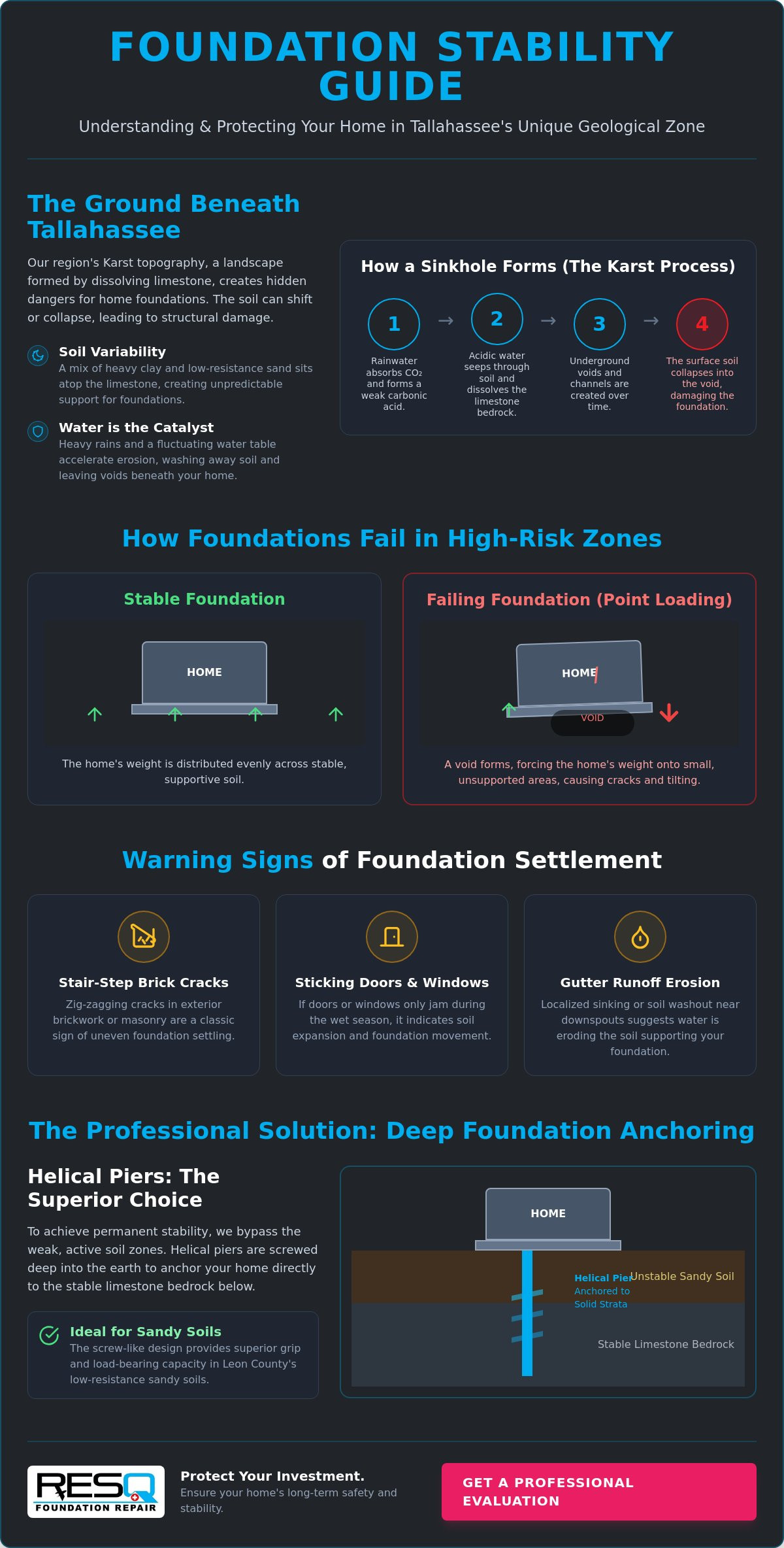
This variability is a primary concern for homeowners investigating foundation repair for sinkhole prone areas Florida residents must manage. The presence of limestone means we live on a Karst landscape. This is a terrain specifically formed by the dissolution of soluble rocks. Over thousands of years, slightly acidic rainwater filters through the soil and eats away at the limestone bedrock. This process creates a network of voids and channels that can eventually lead to ground movement under the weight of a residential structure.
Understanding Karst Topography in Leon County
The Geology of sinkholes explains that these features aren’t just random occurrences. They’re the result of a long-term chemical reaction. In Leon County, rainwater mixes with carbon dioxide in the soil to form a weak carbonic acid. As this acid touches the limestone, it creates underground cavities. Some areas experience slow-moving subsidence, where the ground gradually dips over years. Other neighborhoods are at higher risk for sudden cover-collapse events. These happen when the soil “bridge” over an underground void can no longer support the weight above it, leading to a rapid shift in the home’s foundation.
The Role of the Florida Water Table
Water is the primary driver of soil instability in our region. Our non-cohesive sandy soils are easily displaced by underground water flow. When the water table is high, it provides a buoyancy that helps support sand particles. However, during droughts or periods of heavy groundwater pumping, that support vanishes. The sand then washes down into the fissures of the limestone bedrock. This “washout” effect leaves the foundation of a home unsupported. Florida’s heavy seasonal rains often act as a trigger, quickly saturating the soil and increasing the weight on these weakened areas. This cycle of saturation and drainage is why foundation repair for sinkhole prone areas Florida homeowners rely on requires a deep understanding of local hydrology and soil mechanics.
Mechanics of Foundation Failure in High-Risk Soil Zones
A foundation is only as strong as the soil supporting it. When that soil begins to move or disappear, the house experiences “point loading.” This occurs when the weight of the structure is no longer distributed evenly across the entire footing. Instead, the load is forced onto the few remaining stable areas. This uneven pressure causes the foundation to crack or tilt as it tries to settle into a new position. Understanding these mechanics is essential when considering foundation repair for sinkhole prone areas Florida homeowners often require.
The “active zone” in our local sandy soil also plays a major role in structural health. This is the layer of earth most affected by seasonal moisture changes. During dry spells, sandy particles lose their cohesive tension and shift. During wet seasons, they become saturated and heavy. Traditional concrete footings are designed to bridge small inconsistencies, but they can’t span the large subsurface voids common in Karst regions. When a void forms, it creates a “soft spot” that leaves the home’s weight hanging in the air. Ignoring these subsurface shifts can lead to catastrophic failure, which is why specialized foundation repair for sinkhole prone areas Florida residents rely on focuses on reaching stable strata.
Soil Washout and Subsurface Erosion
Heavy Panhandle storms often act as a catalyst for structural damage. As water rushes across your property, it can find small paths through sandy layers. This leads to a process called “piping,” where water creates literal tunnels beneath your concrete slabs. If your gutters aren’t properly managing this runoff, the water will accelerate the erosion of the soil holding your home up. If you notice localized sinking near downspouts, you may need a professional foundation repair Tallahassee specialist to assess the subsurface stability. You can also explore our structural stabilization services to learn about preventing further erosion.
The “Red Hills” Factor: Clay vs. Sand
Tallahassee residents often feel protected by the thick, red clay common in the Red Hills region. While this clay is much firmer than coastal sand, it can be deceptive. It often acts as a rigid “cap” over deeper, more porous layers. A home might appear stable on the surface while sandy voids are forming ten or twenty feet below. This false sense of security is why a visual inspection of the surface isn’t enough. You need to see “below the red” to understand the true state of Florida’s sinkhole landscape beneath your specific lot. A professional structural evaluation uses specialized tools to determine if your foundation is resting on a solid base or a hollow shell.
Stabilizing Foundations in Sinkhole-Prone Areas: Helical vs. Push Piers
Choosing the right method for foundation repair for sinkhole prone areas Florida homes require is a matter of engineering, not guesswork. When the ground beneath a structure is compromised by voids or loose sand, the primary goal is to transfer the building’s weight to a stable layer. Many homeowners mistakenly believe that filling a hole with concrete or grout is enough. However, adding heavy materials to an unstable area can actually accelerate settlement by putting more stress on the weak soil. True stabilization requires anchoring the home to deep, load-bearing strata or rock.
We primarily use two types of structural piers: helical and push. Push piers rely on the weight of the house and the resistance of dense soil to be driven into the ground. In the sandy, low-resistance soils of Tallahassee and Leon County, push piers often lack the “counter-weight” needed to reach the necessary depths. Helical piers, however, act like giant screws. They are mechanically turned into the earth, independent of the building’s weight. This makes them far more effective in high-void areas where the soil cannot provide enough resistance for traditional push methods.
During every installation, our team uses “torque-to-capacity” monitoring. This process measures the amount of force required to turn the pier. By tracking this data in real-time, we ensure that every pier has reached a layer of earth or rock capable of supporting the specific load of your home. While homeowners often search for the Warning signs of a sinkhole to identify surface damage, the real fix happens deep underground where these piers provide a permanent, warranted solution.
Why Helical Piers are the Gold Standard for Sand
For most North Florida properties, helical pier installation is the most reliable remedy. The helices, or circular plates on the pier shaft, do more than just help the pier go down. They provide significant uplift resistance. This is a critical feature during Florida’s intense wind events and hurricanes. While other systems might only prevent the house from sinking further, helical piers lock the foundation in place, protecting it from both downward settlement and upward pressure from shifting soil or high winds.
PolyRenewal: Secondary Stabilization for Concrete Slabs
Once the main structure is stabilized with piers, we often address the remaining “soft spots” with PolyRenewal. This high-density polyurethane foam is injected into the voids left behind by soil erosion or sinkhole activity. Unlike traditional mudjacking, which uses a heavy concrete slurry that can weigh down already fragile soil, PolyRenewal is incredibly lightweight. It expands to fill every crevice and hardens quickly to support concrete slabs, sidewalks, and driveways. When used in tandem with a comprehensive plan for foundation repair for sinkhole prone areas Florida residents trust, it creates a total protective barrier between your home and the elements.
Homeowner’s Warning Signs: Detecting Early Sinkhole and Settlement Damage
Early detection is the most effective way to minimize the cost and complexity of structural remediation. While some homeowners assume that small cracks are just a natural part of a house aging, they are often the first visible symptoms of deeper soil instability. In our region, these signs are frequently tied to the subsurface erosion occurring in the limestone layers below. Identifying these markers early allows for targeted foundation repair for sinkhole prone areas Florida residents can use to stop damage before it becomes catastrophic.
“Stair-step” cracks in exterior brickwork or masonry are a classic indicator that one corner of the footing is sinking faster than the rest. These cracks follow the mortar lines in a jagged pattern and suggest the soil is no longer providing uniform support. You should also pay close attention to your doors and windows. If they stick, rub against the frame, or become difficult to latch only during the heavy rain season, it suggests that the soil in the active zone is swelling or shifting under the structure.
Look beyond the walls of your home to the surrounding landscape. Circular depressions in the lawn or “dead spots” where grass suddenly dies can indicate that water is pooling and draining into a subsurface void. This moisture management is also critical beneath your home. Excess humidity in a dirt crawl space can soften the soil and accelerate the settlement of your support piers. Professional crawl space encapsulation Tallahassee helps regulate these moisture levels, providing an extra layer of defense for your foundation’s health by keeping the soil environment stable.
Exterior Indicators: Gaps and Fissures
The “frieze board gap” is a subtle but telling sign. This is a space that opens up where the roofline meets the top of the exterior wall. If you notice this gap widening, it means the wall is tilting or sinking. A leaning chimney is an even more urgent red flag. Because chimneys are heavy and often built on separate footings, they are usually the first part of a structure to show signs of a deep soil void. You should also look for small, circular dips in the yard near your foundation walls. These depressions suggest that soil is being pulled downward into fissures in the limestone bedrock. If you spot these exterior indicators, you should contact a specialist for a structural assessment to prevent further shifting.
Interior Red Flags: Sloping Floors and Drywall Cracks
Inside the home, look for diagonal cracks extending from the corners of door frames and windows. These represent the structure’s attempt to flex under uneven weight. You can perform a simple “ball test” by placing a small ball on a hard-surface floor. If it consistently rolls toward a specific wall or corner, your floors are no longer level. Understand that interior signs often lag behind subsurface soil loss. By the time a crack appears in your drywall, the soil beneath your home may have been eroding for months. This delay is why foundation repair for sinkhole prone areas Florida homeowners trust involves looking past the surface to find the root cause of the movement.
Professional Structural Stabilization: The Foundation ResQ Solution
When you’re dealing with the shifting soils of Leon County, you need a partner who understands the specific environmental challenges of North Florida. Foundation ResQ operates as a steadfast local expert, providing a reliable defense for your property. We don’t just patch surface cracks or fill small voids with temporary fixes. We utilize a remedy-based framework that focuses on the ultimate resolution of structural issues. This methodical approach ensures that the root cause of settlement is addressed, making it the preferred choice for foundation repair for sinkhole prone areas Florida residents rely on to protect their homes.
Our team exclusively uses Groundworks-engineered products. These systems are designed to withstand the unique stresses of Florida’s climate, including high humidity and fluctuating water tables that can compromise standard materials. Every component is selected for its durability and professional integrity. Because we focus on long-term outcomes rather than quick fixes, our solutions come with lifetime transferable warranties. This provides you with lasting peace of mind and adds verifiable value to your property if you ever decide to sell.
Data-Driven Pier Installation
Our installation teams follow a precise, data-driven process to ensure your home is permanently stabilized. During piering, we monitor hydraulic pressure in real-time to confirm that every pier has reached competent limestone or load-bearing strata. This precision prevents guesswork and ensures your home is anchored to a stable base. In situations where soil pressure has caused basement or crawl space walls to shift, we may integrate carbon fiber wall repair Tallahassee into the stabilization plan. This modern solution reinforces bowing walls without the need for heavy excavation. Our installation methods are low-impact and designed to preserve your landscaping while we restore the structural health of your building.
Next Steps: Securing Your Tallahassee Home
Securing your home starts with a thorough, professional evaluation. We provide a free structural inspection where a trained expert will assess your property’s specific needs and explain the geological factors at play. They’ll provide a clear, organized plan for remediation so you can make an informed decision. Most structural projects are completed within a 1-3 day timeline, which minimizes disruption to your daily life. You don’t have to wait for the next heavy rain season to worry about your home’s safety. Comprehensive foundation repair for sinkhole prone areas Florida residents need is available through a structured, professional process. Schedule your free foundation inspection with Foundation ResQ today to gain the confidence that comes with a permanent solution.
Securing Your Home’s Future in Leon County
Living on North Florida’s Karst landscape doesn’t have to mean living with uncertainty. By understanding the unique relationship between our sandy soils and the underlying limestone, you can take proactive steps to ensure your property remains stable for generations. We’ve discussed how identifying early warning signs, such as sticking doors or exterior brick cracks, allows for timely intervention before subsurface voids expand. True protection comes from anchoring your structure to the deep, load-bearing strata that traditional footings simply cannot reach.
Choosing the right foundation repair for sinkhole prone areas Florida residents trust is about more than just filling a hole; it’s about engineering a permanent remedy. With over a decade of local Tallahassee structural expertise, Foundation ResQ provides specialized helical pier systems tailored specifically for Panhandle geology. Our Groundworks-backed lifetime transferable warranties ensure that your investment is protected long after the work is finished. You deserve the confidence that comes with a house that won’t shift, regardless of the season. Protect your Tallahassee home with a free structural inspection from Foundation ResQ today. Your home is your most important asset, and we are here to help you defend it.
Frequently Asked Questions
Is sandy soil bad for a house foundation in Florida?
Sandy soil isn’t inherently bad, but its non-cohesive nature makes it highly susceptible to movement when water levels fluctuate. In our region, these sand particles can easily wash away into underground limestone fissures, a process known as piping. This creates hidden voids that leave your concrete footings unsupported, eventually leading to the structural settlement or shifting that many local homeowners experience.
What is the most effective foundation repair for sinkhole-prone areas?
Deep structural piering is the most reliable method for stabilizing a home in high-risk zones. Unlike surface-level grouting or mudjacking, which only fill holes, helical piers transfer the weight of the building to stable limestone deep underground. This approach addresses the root cause of the instability by bypassing the weak, shifting soil layers entirely to provide a permanent, warranted solution.
How can I tell the difference between normal settling and sinkhole activity?
Normal settling typically occurs slowly and uniformly over many years, while sinkhole activity often causes rapid, localized damage. You should look for “stair-step” cracks in your brickwork, doors that suddenly stick during the wet season, or new depressions in your lawn. If these signs appear quickly after a heavy storm, it’s a strong indicator that subsurface erosion is affecting your property’s stability.
Do helical piers work in the sandy soil of Tallahassee?
Helical piers are exceptionally effective in the low-resistance sandy soils found throughout Leon County. Because these piers are mechanically screwed into the earth, they don’t rely on the weight of the structure to reach the necessary depth. This makes them an ideal choice for foundation repair for sinkhole prone areas Florida residents trust, as they can reliably reach load-bearing strata even in high-void environments.
Can heavy rainfall trigger a sinkhole near my foundation?
Heavy rainfall is a primary trigger for ground movement in North Florida because it adds immense weight to the soil cap. The rushing water also accelerates the “washout” effect, carrying loose sand into underground limestone cavities. When the soil bridge can no longer support this increased weight and internal erosion, it leads to the surface subsidence or collapse that threatens your home’s structural integrity.
Does Florida homeowners insurance cover foundation repair for sinkholes?
Florida law mandates that all homeowners insurance policies include coverage for “catastrophic ground cover collapse,” which requires the building to be condemned. However, broader “sinkhole loss” coverage, which addresses structural damage before a total collapse, is usually an optional endorsement. It’s important to check your specific policy details to ensure you have the appropriate protection for your Tallahassee property’s unique geological risks.
How much does it cost to stabilize a foundation in a high-risk area?
The total investment for structural stabilization depends on the depth of the stable strata and the total number of piers required for your home. Every property in Tallahassee has a unique subsurface profile, meaning a one-size-fits-all estimate is rarely accurate. We recommend a professional structural evaluation to determine the specific requirements for your lot, ensuring you receive a permanent remedy rather than a temporary fix.
What happens if I ignore small cracks in my brick or foundation?
Ignoring small cracks often leads to significantly higher repair costs as the underlying soil void continues to expand. In our Karst landscape, a minor fissure is frequently the first warning of a developing subsurface issue that won’t resolve on its own. Addressing these signs early with professional foundation repair for sinkhole prone areas Florida homeowners rely on prevents further structural degradation and protects your home’s long-term market value.