The right foundation repair may not be the most obvious one. Cracks, sloping floors, or doors that suddenly stick can point to different underlying issues, so foundation repair in Leon County should begin with a careful assessment, not a preset fix. Conditions vary from property to property, and the same visible symptom can call for different solutions depending on what’s happening beneath and around the home.
When your home shows signs of movement, it’s natural to want a clear explanation and a repair plan that addresses the cause. An assessment brings together observations such as crack patterns, changes in the structure, and moisture concerns to help identify a suitable approach. The goal is to stabilize the structure based on its condition, not simply cover up a symptom.
This guide explains how foundation problems are assessed in Leon County, compares piers, carbon fiber wall reinforcement, and concrete lifting, and outlines what to expect when planning a project. You’ll also learn how foundation stabilization and moisture management can work together when a property has both concerns.
Key Takeaways
- Visible changes can signal a concern, but they don’t identify its cause on their own. Learn what an assessment considers before recommending work.
- Soil, drainage, grading, and moisture conditions can differ from one Leon County property to another, shaping the assessment and repair plan.
- Compare repair approaches by the condition they’re intended to address, so foundation repair in Leon County is matched to the diagnosed problem rather than a one-size-fits-all solution.
- A clear project plan connects observed conditions to the recommended scope, helping you understand the work before it begins.
- Foundation ResQ serves existing residential and commercial properties in the Tallahassee area with repair and stabilization options tailored to the property’s needs.
Foundation Repair in Leon County: How to Tell What Kind of Problem You’re Facing
Foundation repair stabilizes or restores a building’s structural support after an assessment identifies a concern that needs attention. For homeowners in Leon County and Tallahassee, the first step isn’t choosing a repair method. It’s understanding what has changed, where it’s happening, and whether the change points to a foundation concern or another condition affecting the home.
Cracks, sticking doors, and uneven floors are useful clues, but none proves foundation movement by itself. A crack may be a surface imperfection, while a door that binds can have causes unrelated to the foundation. Look at the pattern and whether it is changing over time. Soil behavior is one factor professionals consider because the principles of soil mechanics help explain how ground conditions interact with structures. Conditions can vary between properties, so an assessment should focus on the specific home rather than assume one local cause.
Which changes around the house deserve a closer look?
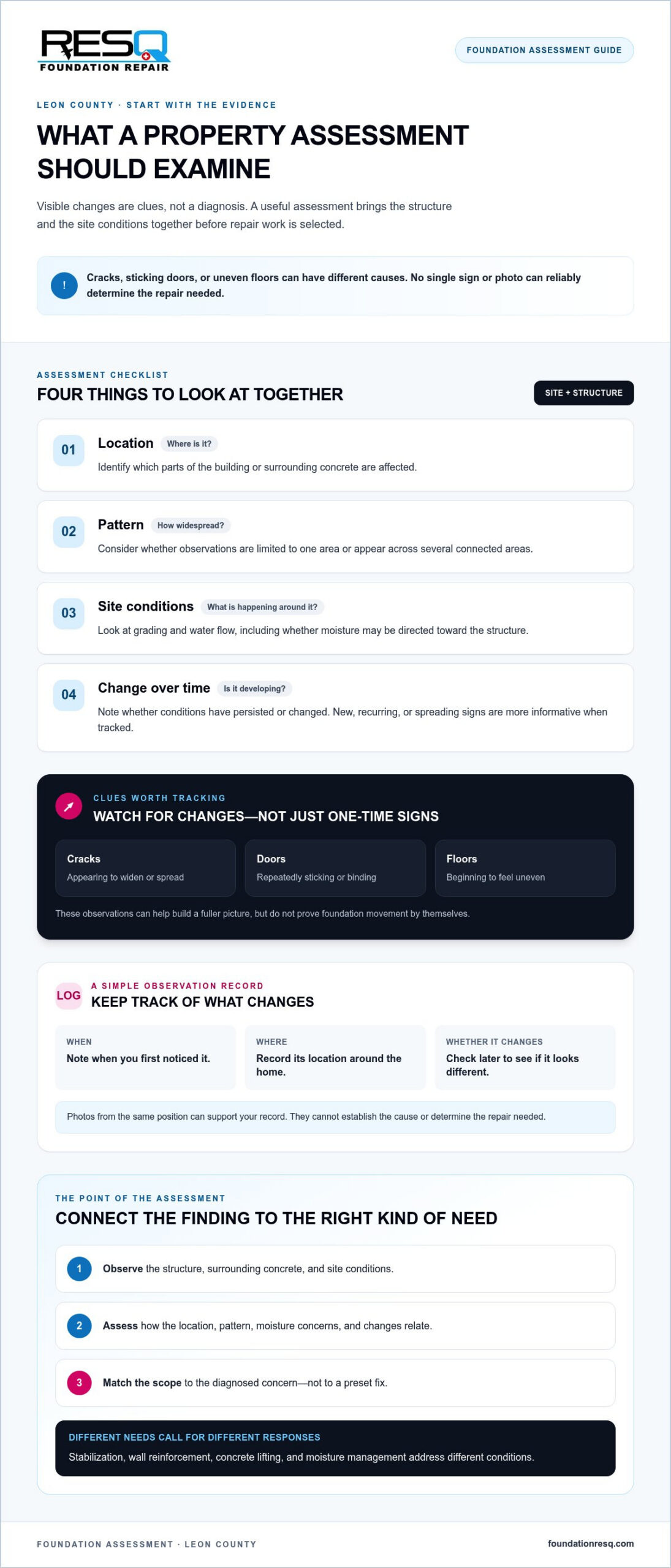
Pay attention to changes that are new, recurring, or spreading. A crack that appears to widen, doors that repeatedly stick, or floors that begin to feel uneven are more informative when tracked over time than when noticed once. Note where each sign appears and whether similar changes show up in other parts of the house. If symptoms persist or occur in multiple areas, arrange a professional assessment rather than relying on a single observation.
A simple record can help: note when you first saw a change, where it is, and whether it looks different later. Photos taken from the same position can support that record, but they can’t establish the cause or determine the repair needed.
Why a symptom alone cannot select a repair method
Similar visible signs can have different explanations. An uneven floor may be associated with concrete settlement or structural movement, while moisture intrusion can call for a different response. A crack’s position, direction, and change over time help form a fuller picture. No single sign or photograph provides enough context to diagnose a home reliably.
An assessment considers how the observations fit together and whether the concern involves the foundation, surrounding concrete, or moisture conditions. That distinction matters: stabilization, wall reinforcement, concrete lifting, and moisture management address different needs. The right foundation repair in Leon County starts by identifying the condition that needs attention, then matching the work to that finding.
How Leon County Conditions Shape a Foundation Repair Assessment
Local conditions matter, but they don’t diagnose a foundation problem on their own. Soil, drainage, grading, and moisture are considered alongside the building’s observed condition. Even nearby properties in Leon County can differ in slope, water flow, landscaping, and construction, so a repair plan should respond to the specific site and structural needs rather than rely on a broad assumption about the area.
What local soil and drainage can mean for a property
Soil can respond to changes in moisture, and that behavior may affect the support beneath a structure. The relationship depends on the soil and site conditions, so it shouldn’t be treated as a blanket explanation for movement. Water that collects near the home or flows toward its foundation is also relevant. Observations about grading and drainage can help identify moisture concerns that belong in the assessment.
Rather than assigning a specific soil type or geological cause without property-level evidence, a sound evaluation considers what’s present at the home. The International Residential Code foundation requirements offer reference material on foundation construction and related considerations. They don’t replace an assessment of a particular property or establish which repair it needs.
What a property assessment should examine
A useful assessment brings the site and the structure into one picture. It should account for where concerns are visible, how they relate to one another, and whether moisture or water flow may also be affecting the property. These details help distinguish a structural concern from a surface-level issue and clarify what needs attention.
- Location: Which parts of the building or surrounding concrete are affected?
- Pattern: Do the observations appear in one area or across several connected areas?
- Site conditions: Does grading or water flow direct moisture toward the structure?
- Change: Have the conditions persisted or developed over time?
No single observation should dictate the solution. Assessment findings connect site conditions to structural needs, whether the concern involves stabilization, concrete settlement, or moisture management. That connection is central to planning foundation repair in Leon County: the recommended scope should address the diagnosed condition rather than apply a preset method.
Foundation ResQ provides foundation stabilization and repair for existing residential and commercial properties in the Tallahassee area. Learn about its foundation repair services and the options used to address different property concerns.
Comparing Foundation Repair Solutions: Piers, Wall Reinforcement, and Concrete Lifting
Repair methods address different conditions, so a visible symptom shouldn’t automatically point to a particular service. A foundation that needs stabilization, a wall that needs reinforcement, and sunken concrete each call for a different response. For foundation repair in Leon County, assessment findings should guide the recommendation, with the scope tied to the observed issue and the property’s structural needs.
| Observed concern | Service category | Intended purpose |
|---|---|---|
| Foundation movement requiring added support | Helical or push pier installation | Stabilize the foundation when the conditions are suitable for piering |
| Foundation wall concern | Carbon fiber wall reinforcement | Reinforce the affected wall |
| Sunken concrete | PolyRenewal concrete lifting | Lift and address settled concrete |
When pier installation may be considered for foundation stabilization
Helical and push piers are distinct options for foundation stabilization. Neither is a universal choice: the foundation, site conditions, and assessment findings help determine whether piering is appropriate and which approach fits the project. A recommendation should explain the condition the piers are intended to address. For more detail on one approach, read this guide to professional helical pier installation.
How wall reinforcement and concrete lifting address different concerns
Carbon fiber reinforcement is a wall-focused service for foundation wall concerns. It serves a different purpose from pier installation, which is considered for foundation stabilization. When reviewing a recommendation for carbon fiber, look for a clear explanation of the wall concern being addressed and how the proposed work relates to it.
PolyRenewal concrete lifting addresses sunken concrete. It shouldn’t be treated as a substitute for foundation stabilization: lifting a settled concrete surface and stabilizing a building’s foundation are separate goals. An assessment helps clarify which areas are affected and whether one service or more than one type of work may be relevant.
Use the comparison as a starting point, not a diagnosis. A clear recommendation connects the observed condition to the service’s purpose and explains why that method fits the property. That way, the proposed work addresses the underlying concern instead of simply responding to a symptom.
What to Expect When Planning Foundation Repair in Leon County
A well-planned project follows a clear sequence: describe what you’ve noticed, have the property assessed, review the recommendations, and plan the work. Each step should build on the one before it. For foundation repair in Leon County, the proposed scope should explain how the observed conditions connect to the recommended service, so you can understand what the work is intended to address.
Before discussing methods, collect details that can help explain the concern. Note when symptoms appeared and how they’ve changed. Include the locations involved, any drainage or moisture observations, and access limitations near the affected area. This information helps make the assessment more specific to your property.
Questions the repair plan should answer
A clear recommendation identifies the concern and the observations supporting it. It should describe which areas are included, which services are proposed, and what the work is intended to address. Ask for clarity on the plan’s assumptions, especially if the recommendation addresses one part of the property while other areas show changes. The goal is a scope that connects the evidence to the work.
- What condition was identified? The explanation should distinguish the concern being addressed from symptoms that may have another cause.
- Why does the recommended service fit? The plan should connect the assessment findings to the method’s purpose.
- What is included? Understand the areas covered and the intended result of the proposed work.
These questions help you compare a repair recommendation with the condition it’s meant to resolve, rather than relying on a method’s name alone. For broader context, use the same approach when reviewing foundation repair recommendations for properties in Tallahassee and Leon County.
How to prepare for a foundation repair project
Keep a brief record of when concerns began and whether they’ve changed. Note where they appear, and document nearby drainage, moisture, or access issues that could affect the work area. Share these observations during the assessment, then review the recommendation and scope before planning the project. A concise record can help keep the discussion focused on your property’s conditions.
Foundation ResQ provides repair and stabilization for existing residential and commercial properties in the Tallahassee area. Explore Foundation ResQ’s repair services to learn about options for different property concerns.
Choosing Foundation ResQ for Foundation Repair in Leon County
Foundation ResQ provides foundation repair and structural stabilization for existing residential and commercial properties in the Tallahassee area. For homeowners considering foundation repair in Leon County, start with the property’s diagnosed concern. The recommended service should fit the condition identified, whether it involves foundation support, a foundation wall, settled concrete, or moisture in a crawl space.
A range of services for different property concerns
Foundation ResQ installs helical and push piers for foundation stabilization. Carbon fiber wall reinforcement addresses foundation wall concerns, while PolyRenewal concrete lifting is intended for sunken concrete. These services serve different purposes, so one should not be treated as a substitute for another.
Moisture control may also be relevant if an assessment identifies crawl space moisture concerns. Crawl space encapsulation, sump pump systems, and crawl space dehumidifiers address moisture management, not structural stabilization or concrete leveling. More than one service may be appropriate when the property has multiple distinct concerns. For an overview of crawl space moisture control, consider the same assessment principles: identify where moisture is present and what needs to be addressed.
This distinction helps keep the repair plan focused. A recommendation for piers should relate to a foundation stabilization need, while a recommendation for concrete lifting should address sunken concrete. If moisture management is included, it should be connected to observed moisture conditions. The aim is a project scope that explains what each service is meant to address.
Take the next step toward a stable property
Understanding the cause of a concern makes it easier to consider a suitable repair direction. Keep track of what you’ve observed and where it appears, then discuss those details as part of an assessment. A property-specific plan can help you understand the recommended work without assuming every home needs the same solution.
Foundation ResQ serves the Tallahassee area with repair and stabilization for existing properties. To discuss your property concern and possible next steps, talk with Foundation ResQ about foundation repair.
Move Forward With a Repair Plan That Fits Your Property
The most useful next step is understanding what may be behind the changes you’ve noticed. An assessment connects the evidence at your property to an appropriate repair direction, rather than treating every crack, settled surface, or moisture concern the same way. That’s the foundation of choosing foundation repair in Leon County with confidence.
Foundation ResQ serves existing residential and commercial properties in the Tallahassee area. Its foundation stabilization services include helical and push pier installation, while carbon fiber wall reinforcement addresses foundation wall concerns and PolyRenewal concrete lifting serves sunken concrete. If moisture is also part of the picture, crawl space encapsulation, sump pumps, and dehumidifiers can address moisture-control needs.
Each service has a distinct purpose, and a property may need more than one only when an assessment identifies separate concerns. Share what you’ve observed with Foundation ResQ to discuss a repair plan for your property. Talk with Foundation ResQ about foundation repair.
Frequently Asked Questions
What are the signs that a home in Leon County may need foundation repair?
Changes such as widening cracks, recurring door or window problems, and floors that feel uneven may warrant a closer look. These signs don’t prove a foundation problem on their own, since similar symptoms can have other causes. Note where changes appear and whether they persist or spread to other areas. If you’re noticing a pattern, a professional assessment can help clarify what’s happening at your Tallahassee-area property.
How is foundation repair in Leon County assessed?
Foundation repair in Leon County is assessed by looking at the property’s observed conditions and affected areas, rather than selecting a repair method from one symptom alone. The evaluation may consider the pattern and progression of visible changes, site drainage, grading, and moisture observations. These details help distinguish structural concerns from surface-level issues and connect findings to a suitable repair direction for the specific property.
Are helical piers or push piers better for foundation repair?
Neither helical piers nor push piers is universally better; both are stabilization options considered for suitable foundation conditions. The appropriate choice depends on the property and site, along with the concern identified during assessment. A useful recommendation should explain why the proposed pier approach fits the foundation and what it is intended to stabilize. Foundation ResQ provides helical and push pier installation for existing properties in the Tallahassee area.
Can foundation repair fix cracks in walls?
It depends on what is causing the cracks. A wall crack may be a surface-level concern, or it may be associated with a foundation wall issue that needs attention. An assessment helps identify the relevant condition before repair is selected. For foundation wall concerns, carbon fiber wall reinforcement is one service option. The repair plan should connect the observed wall condition to the work recommended, rather than assume every crack needs the same fix.
Does a sunken concrete driveway need foundation repair?
Not necessarily. Sunken driveway concrete and a home’s foundation are different concerns, even though both may involve settling. PolyRenewal concrete lifting is available for sunken concrete, while foundation stabilization addresses structural support needs. An assessment can help determine which part of the property is affected and whether the concern involves concrete leveling, foundation movement, or both. Concrete lifting shouldn’t be treated as a substitute for foundation stabilization.
Can drainage or crawl space moisture affect foundation concerns?
Drainage and moisture are relevant assessment factors, but they don’t automatically explain a foundation concern. Note whether water appears to collect near the structure or whether the crawl space seems damp, then share those observations during an evaluation. If moisture control is needed, crawl space encapsulation, sump pump systems, and dehumidifiers are available options. Addressing moisture and stabilizing a foundation serve different purposes, though both may be relevant if separate concerns are identified.
What should I expect from a foundation repair project?
Expect a process that begins with describing your concerns and assessing the property, followed by reviewing recommended work and planning the project. The proposed scope should identify the observed condition, explain how the recommended service relates to it, and clarify which areas are included. Before work is planned, share when symptoms appeared, how they’ve changed, and any drainage, moisture, or access concerns around affected areas.