
In the rolling hills of Leon County, the red clay beneath your home is constantly on the move, and a small fissure in your masonry might be the only warning sign you get before a structural crisis. It’s natural to feel a sense of dread when you spot a new gap in the foundation, especially with Tallahassee’s heavy seasonal rains and shifting soil conditions. You want to protect your property value, but conflicting advice online often makes it difficult to know when to worry and when to wait.
Understanding the difference between horizontal vs vertical foundation cracks Tallahassee homeowners encounter is the first step toward reclaiming your peace of mind. This guide will help you decode these structural patterns so you can distinguish between harmless cosmetic shifts and urgent emergencies caused by our region’s unique geological pressures. We will provide clear criteria for identifying dangerous movement and outline a professional path to permanent stabilization, ensuring your home remains a safe and secure sanctuary for years to come.
Key Takeaways
- Identify the diagnostic differences between horizontal vs vertical foundation cracks Tallahassee homeowners encounter to determine if the pressure is coming from settling soil or lateral force.
- Distinguish between minor curing cracks in newer homes and structural vertical settlement that requires professional stabilization.
- Recognize why horizontal cracks are immediate red alerts for structural failure caused by the intense pressure of Tallahassee’s red clay soils.
- Apply the 1/8th-inch rule to evaluate crack severity and know exactly when a structural issue requires an expert inspection.
- Explore permanent restoration methods like Helical Pier Installation and Carbon Fiber Wall Reinforcement to protect your home’s long-term integrity.
Cracking the Code: Why Orientation Matters in Tallahassee Foundations
Finding a new fissure in your home’s base can be unsettling. However, the direction of that line tells a specific story about the physical forces acting on your property. In the context of horizontal vs vertical foundation cracks Tallahassee homes often exhibit patterns that reflect our region’s unique environmental stressors. We analyze these through a “Settlement vs. Lateral Pressure” framework. Vertical cracks usually indicate that a portion of the home is sinking into the ground, while horizontal cracks suggest the soil outside is pushing inward against your walls. Put simply, gravity drives vertical movement, whereas soil expansion creates horizontal pressure.
Understanding basic foundation engineering principles helps clarify why these patterns emerge. When a foundation is designed, it’s meant to distribute the weight of the structure evenly. When the ground beneath or beside it shifts, the concrete must flex. Since concrete is strong under compression but brittle under tension, it cracks to relieve the stress. Identifying the orientation of these breaks is the first step toward a permanent remedy.
The Role of Tallahassee Soil in Foundation Movement
Tallahassee sits on a complex mix of red clay and limestone layers. Unlike the sandy soils of coastal Florida, our clay is highly expansive. It acts like a sponge, soaking up Leon County’s heavy seasonal rainfall and swelling significantly. When the weather turns dry, that same clay shrinks and pulls away from the concrete. This “shrink-swell” cycle puts immense stress on a building. Over time, this constant movement leads to the horizontal vs vertical foundation cracks Tallahassee residents frequently observe. Because our terrain is hilly and the soil is dense, water often pools near foundations rather than draining away, which accelerates structural wear.
Visual Cues: Measuring and Tracking Your Cracks
You can perform a few simple checks to monitor the health of your home. These methods provide a baseline for professional diagnostic tools later on.
- The Nickel Test: Try to slide a nickel into the crack. If the coin fits easily, the gap is likely wider than 1/8th of an inch. Any crack of this width requires a professional review to ensure the internal rebar isn’t exposed to moisture.
- Marking and Dating: Use a pencil to mark the exact ends of the crack. Write the date next to the mark. If the crack grows past that line after the next heavy rainstorm, the movement is active and needs stabilization.
- Stair-Step Patterns: In homes with brick exteriors, you might see “stair-step” cracks following the mortar lines. These are a hybrid symptom, signaling that one corner of the foundation is dropping faster than the rest.
Vertical Foundation Cracks: When Settling Becomes a Problem
Vertical cracks are the most common type of fissure found in residential concrete. These breaks generally run straight up and down, or slightly diagonally, and they indicate that your home is experiencing vertical movement. While comparing horizontal vs vertical foundation cracks Tallahassee homeowners should remember that vertical breaks specifically signal that a portion of the structure is sinking into the ground. This downward force pulls the concrete apart, creating a gap that follows the path of least resistance.
In many cases, hairline vertical cracks in new 2026 construction are simply “curing cracks.” These occur as the concrete loses moisture and shrinks slightly during its first year. However, a structural settlement crack is different. You can identify a problem if the crack is “tilting,” meaning the top of the gap is visibly wider than the bottom. This V-shape indicates that the foundation footer has snapped and one side is rotating away from the rest of the building. Beyond the structural risks, these openings allow Tallahassee’s intense humidity and pests to infiltrate your crawl space, leading to secondary issues like wood rot or mold.
Common Causes of Vertical Movement
Several environmental factors in Leon County contribute to foundation sinking. Understanding these causes helps you address the root of the problem rather than just patching the symptom.
- Soil Consolidation: The heavy weight of your home can compress the soil beneath it over time, especially if the ground wasn’t properly compacted before construction.
- Washouts: Tallahassee’s heavy rainstorms can be destructive. If your gutters are clogged or downspouts dump water directly at the base of your home, the rushing water erodes the soil supporting the footer.
- Tree Roots: Large oaks and pines near the foundation line can draw massive amounts of moisture out of the clay during dry spells. This causes the soil to shrink and the foundation to drop into the resulting void.
When Vertical Cracks Signal Sinking
You should look for secondary warning signs inside your living space. If you notice sticking doors, windows that won’t stay open, or floors that feel slightly slanted, your foundation is likely in motion. A vertical crack located near a corner is particularly urgent. While a crack in the center of a long wall might suggest minor mid-span settling, a corner crack indicates that a critical load-bearing point is failing. If you spot these symptoms, reviewing professional foundation repair Tallahassee options is a proactive way to ensure your home’s long-term safety. Addressing these issues early prevents the need for more invasive and expensive structural remediation later.
Horizontal Foundation Cracks: The Red Alert of Structural Failure
Horizontal cracks represent a critical category of structural distress that requires immediate professional attention. While vertical fissures suggest the home is sinking, horizontal lines indicate that the earth outside is physically pushing your foundation inward. When comparing horizontal vs vertical foundation cracks Tallahassee homeowners must treat horizontal breaks as a red alert. These cracks are almost always structural emergencies because they signal that the wall is no longer able to withstand the lateral pressure from the surrounding soil. If you ignore these signs, the middle of the wall begins to deflect inward, creating a “bowing” effect that can eventually lead to a total and catastrophic wall collapse.
The structural integrity of your home depends on the foundation’s ability to remain rigid against external forces. A horizontal crack usually forms in the middle third of a wall where the bending stress is highest. Once the masonry snaps, the wall’s load-bearing capacity is compromised. This doesn’t just affect the foundation; it puts the entire weight of your roof and upper floors at risk of shifting or falling. Because these issues are progressive, the pressure will continue to mount until the wall is professionally stabilized.
Hydrostatic Pressure in the Florida Panhandle
The heavy rainfall recorded across North Florida throughout 2026 has significantly increased the risk for local properties. Tallahassee’s dense red clay acts like a massive wet sponge. As it saturates, it expands with incredible force, creating what engineers call hydrostatic pressure. This side-loading pressure is often much higher than the weight of the house itself. Crawl space walls are particularly vulnerable to this force because they often lack the internal reinforcement found in modern living spaces. When the pressure exceeds the strength of the masonry, the wall shears horizontally, usually along a mortar joint. This is a regional challenge that requires a solution designed for Tallahassee’s specific geological profile.
Identifying Bowing and Shearing
You can detect these issues early by performing a simple visual inspection of your crawl space or basement area. Hold a level or a plumb line against the face of your foundation wall. If the wall is no longer perfectly vertical, or if you see a visible curve in the center, the structure is failing. You might also notice “bouncy” or uneven floors in the rooms directly above the affected area. This happens because the shifting wall removes the necessary support for your floor joists. To stop this movement and reinforce the masonry, carbon fiber wall repair Tallahassee services offer a modern, high-strength remedy. This technology provides a permanent, low-profile solution that bonds to the wall, acting as a protective shield against future soil expansion.
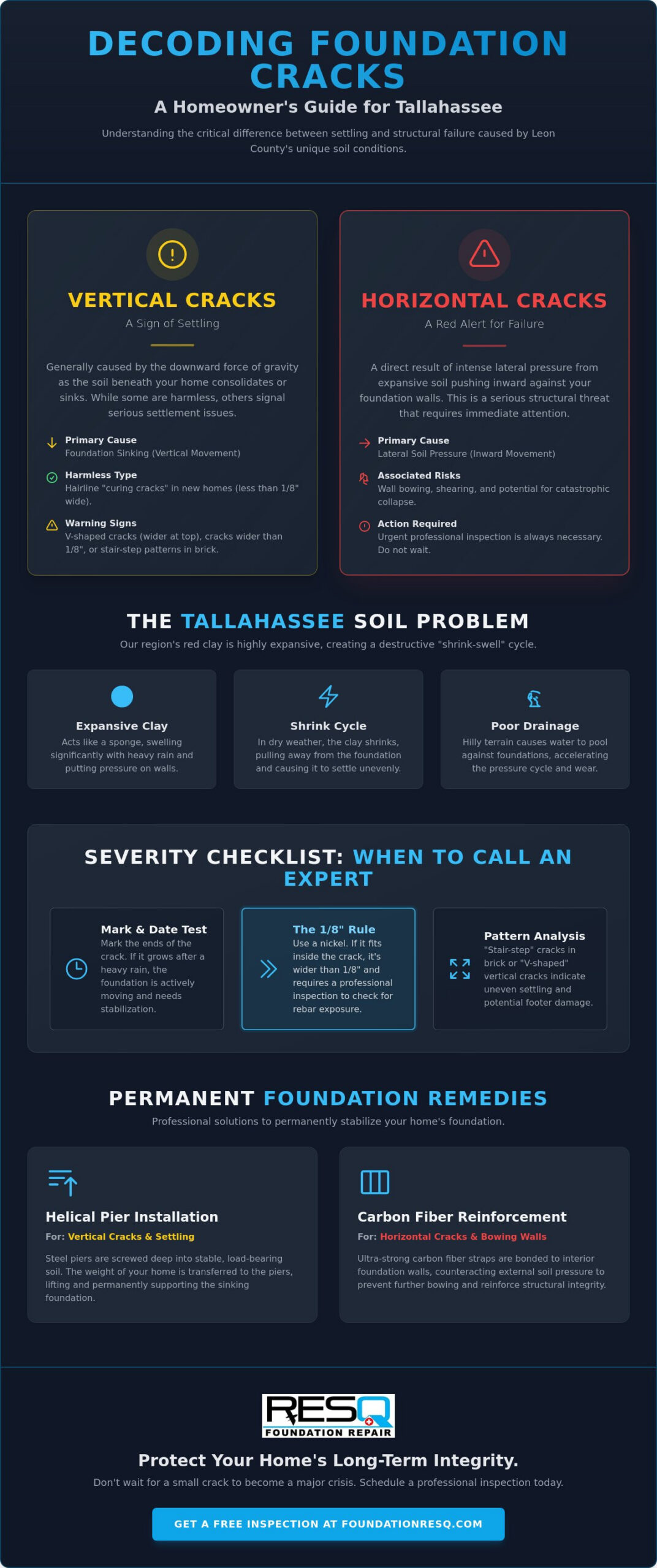
The Severity Checklist: When to Call a Tallahassee Specialist
While some minor fissures are a natural part of a home’s aging process, others are definitive signals of structural failure. When evaluating horizontal vs vertical foundation cracks Tallahassee homeowners often wonder when to stop observing and start taking action. Monitoring a crack is a valid first step, but certain thresholds indicate that the safety of your home is currently at risk. If you identify any of the following symptoms, it’s time to transition from observation to professional remediation.
- The 1/8th-Inch Rule: Any crack that allows you to insert a nickel or is wider than 1/8th of an inch requires an immediate structural review.
- Horizontal Orientation: As discussed, horizontal breaks are “red alerts.” Regardless of how thin they appear, they signal that your wall is bowing under lateral pressure.
- Active Progression: If you’ve marked the ends of a crack and notice it has grown longer or wider within a single month, the movement is active and accelerating.
- Interior Secondary Signs: New cracks in your interior drywall, sticking doors, or “stair-step” patterns in your exterior brickwork often correlate with foundation shifts.
- Active Seepage: If water is visibly weeping through a crack during Tallahassee’s heavy 2026 rainstorms, the gap has already created a direct path for moisture to enter your crawl space.
The Danger of DIY “Band-Aid” Fixes
It’s tempting to pick up a tube of caulk or a bag of hydraulic cement to “seal” a visible gap. However, surface fixes are not solutions; they are masks. These materials hide the problem from view but do nothing to stop the soil movement or lateral pressure driving the crack. In fact, using hydraulic cement on a structural crack can often make the situation worse. Because these materials are rigid, they trap moisture and hydrostatic pressure against the concrete, which can accelerate the deterioration of the internal steel reinforcement. A professional remedy must address the soil conditions and structural load rather than just the cosmetic symptom.
Professional Inspection vs. General Contractor
Foundation repair is a specialized field that requires a deep understanding of soil mechanics and structural loading. While a general handyman or contractor is excellent for interior remodeling, they often lack the diagnostic tools to differentiate between simple settling and dangerous shearing. A specialized foundation expert conducts a remedy-based inspection. We look beyond the concrete to analyze drainage patterns, soil density, and wall deflection. This ensures that the stabilization plan we develop actually stops the movement for the long term. If you’ve spotted any of these warning signs, you can request a professional foundation inspection to protect your property’s structural health and market value.
Permanent Remedies for Tallahassee Foundation Cracks
Once you understand the difference between horizontal vs vertical foundation cracks Tallahassee homes experience, the focus shifts to professional restoration. Temporary patches or cosmetic fills won’t stop the physical forces of sinking or bowing. Instead, we use engineered systems designed to counteract the specific geological pressures of North Florida. Whether your home is settling vertically into the clay or your walls are yielding to lateral pressure, modern technology provides a way to stabilize the structure permanently and protect your property value. These solutions are designed to be durable, addressing the root cause of movement rather than just hiding the evidence.
Piering Systems for Sinking Foundations
Piering systems address the root cause of sinking foundations by transferring the weight of the home to deeper, more stable earth. In our region, the upper layers of red clay often lack the density to support a heavy building, especially during the extreme moisture cycles of 2026. We use helical pier installation to bypass this weak topsoil. These piers are mechanically screwed into the ground until they reach load-bearing strata. They provide immediate stability and can often be used to lift the foundation back toward its original position.
Push pier installation is another reliable option, typically used for heavier masonry structures. While helical piers are turned into the earth, push piers are driven deep using the weight of the building itself. Both methods effectively isolate the home from the “shrink-swell” cycles of the surface soil. Because these systems reach far beneath the active clay layers, they provide a permanent, transferable-warranty solution that gives homeowners long-term peace of mind. Choosing the right pier depends on your home’s specific weight and the local soil profile found during our inspection.
Modern Wall Reinforcement and Moisture Control
For horizontal cracks and bowing walls, carbon fiber wall reinforcement offers a high-strength, low-profile alternative to traditional steel beams. These straps are made of the same material used in aerospace engineering and bond directly to the masonry. They are only about as thick as a penny, meaning they don’t take up valuable space in your crawl space or basement. Once installed and painted, they are virtually invisible, yet they provide a permanent barrier against the lateral pressure of expanding clay. This technology stops the bowing process instantly, protecting the wall from future shearing or collapse.
To stop the cycle of soil expansion at its source, crawl space encapsulation Tallahassee is often the final piece of the protective puzzle. By sealing the area and controlling moisture with a dehumidifier, you prevent the ground beneath your home from becoming a saturated “wet sponge.” For sunken porches, driveways, or interior slabs, we also utilize PolyRenewal concrete lifting. This waterproof foam injection lifts and levels concrete without the weight or mess of traditional mudjacking. Combining these methods ensures your home remains a safe, stable sanctuary. Schedule your free foundation inspection with Foundation ResQ today to receive a professional assessment and a custom path to permanent stabilization.
Protecting Your Home’s Structural Future
Identifying the difference between horizontal vs vertical foundation cracks Tallahassee homeowners discover is the first step in maintaining a safe building. You now know that while vertical cracks often signal downward settlement, horizontal lines are a serious warning of lateral pressure from our local red clay. Waiting to address these shifts can lead to more complex and costly structural failures. Addressing the root cause of movement ensures your property remains a stable and valuable asset.
At Foundation ResQ, we bring over 10 years of local structural restoration experience to every project. We understand the unique geological challenges of Leon County and provide permanent, remedy-based solutions tailored to your home’s specific needs. Our work is supported by Groundworks-backed lifetime warranties, giving you confidence that your home is protected for the long term. Don’t let uncertainty about your foundation’s health cause unnecessary anxiety or risk.
Get a Free Foundation Inspection and Estimate today to secure your home’s integrity. We are here to provide the steady, expert guidance you need to keep your sanctuary stable and safe for years to come.
Frequently Asked Questions
Is a vertical crack in my foundation always normal?
A vertical crack isn’t always a sign of a structural crisis, but it shouldn’t be ignored if it’s wider than 1/8th of an inch. While hairline fissures often result from the natural curing process of concrete, wider gaps indicate that your home is actively sinking into the soil. If the crack is wider at the top than the bottom, it’s a clear sign of structural settlement that needs professional stabilization to prevent further movement.
How much does it cost to fix a horizontal foundation crack in Tallahassee?
The cost to repair a horizontal foundation crack depends on the severity of the wall deflection and the chosen stabilization method. Since these cracks signal a structural emergency, the repair usually involves reinforcing the wall with high-strength carbon fiber systems or heavy-duty anchors. We provide custom estimates following a detailed site inspection to ensure the remedy matches the specific geological pressures of your property and the extent of the damage.
Can I sell my house with foundation cracks in Florida?
You can sell a house with foundation cracks in Florida, but state law requires you to disclose known structural defects to potential buyers. Unaddressed cracks often lead to significantly lower offers or cause deals to fall through during the home inspection phase. Completing professional repairs with a transferable warranty can actually protect your home’s market value and provide buyers with the peace of mind they need to move forward with the purchase.
What is the most dangerous type of foundation crack?
A horizontal crack is the most dangerous type because it indicates that the foundation wall is failing under intense lateral soil pressure. While vertical cracks suggest the home is sinking, horizontal breaks mean the wall is bowing inward and could eventually suffer a total collapse. When comparing horizontal vs vertical foundation cracks Tallahassee residents should treat any horizontal line as an immediate structural priority that requires an expert assessment.
How fast do foundation cracks grow?
The growth rate of foundation cracks varies based on local rainfall and soil moisture levels. In Tallahassee, cracks often expand rapidly during the heavy summer rain season when the local red clay saturates and swells against the concrete. A crack might remain dormant for months during a dry spell only to widen significantly after a single major storm. Consistent monitoring is essential to catch these shifts before they lead to catastrophic structural failure.
Does homeowners insurance cover foundation crack repair in Tallahassee?
Most standard homeowners insurance policies don’t cover foundation repairs caused by normal soil settlement, compaction, or hydrostatic pressure. However, Florida policies often have specific provisions for “catastrophic ground cover collapse” or sinkhole activity, which are common in our limestone-heavy geography. You should review your specific policy and consult with your insurance agent to see if your structural damage meets the legal criteria for a covered claim.