
If you’re worried that a foundation repair is just a temporary bandage for a deep structural wound, you should know that modern engineering has turned “permanent” into a literal standard. Most homeowners in Tallahassee feel a surge of anxiety when they notice a widening crack in the drywall or a door that won’t close. It’s natural to wonder how long does foundation repair last and if you’re simply delaying an inevitable collapse or a massive loss in home value. You want to know that every dollar spent today is an investment in your family’s safety for the next fifty years.
We understand that structural integrity isn’t something you want to revisit every decade. This guide will show you why professional stabilization is designed to be a lifetime solution and how specific methods, like helical piers anchored into stable soil, protect your property from Florida’s unique environmental challenges. You’ll discover which technologies offer the longest durability, how the 2026 building codes impact your home’s value, and get a clear checklist for maintaining your repair post-installation. By the end of this article, you’ll have the confidence to move from uncertainty to a state of informed, lasting resolution.
Key Takeaways
- Professional piering systems are engineered to last 50 years or more, providing a permanent remedy rather than a temporary cosmetic patch.
- Learn exactly how long does foundation repair last when using industrial-grade helical and push piers designed to reach stable, load-bearing strata.
- Discover how Tallahassee’s specific red clay and limestone soils dictate the choice of repair method to ensure long-term structural health.
- Understand why moisture control and crawl space encapsulation are vital for protecting your foundation repair from Florida’s high humidity and seasonal shifts.
- Identify how custom-engineered solutions and thorough inspections ensure your home remains compliant with the updated 2026 Florida Building Code standards.
How Long Should Foundation Repair Last? Setting Realistic Expectations
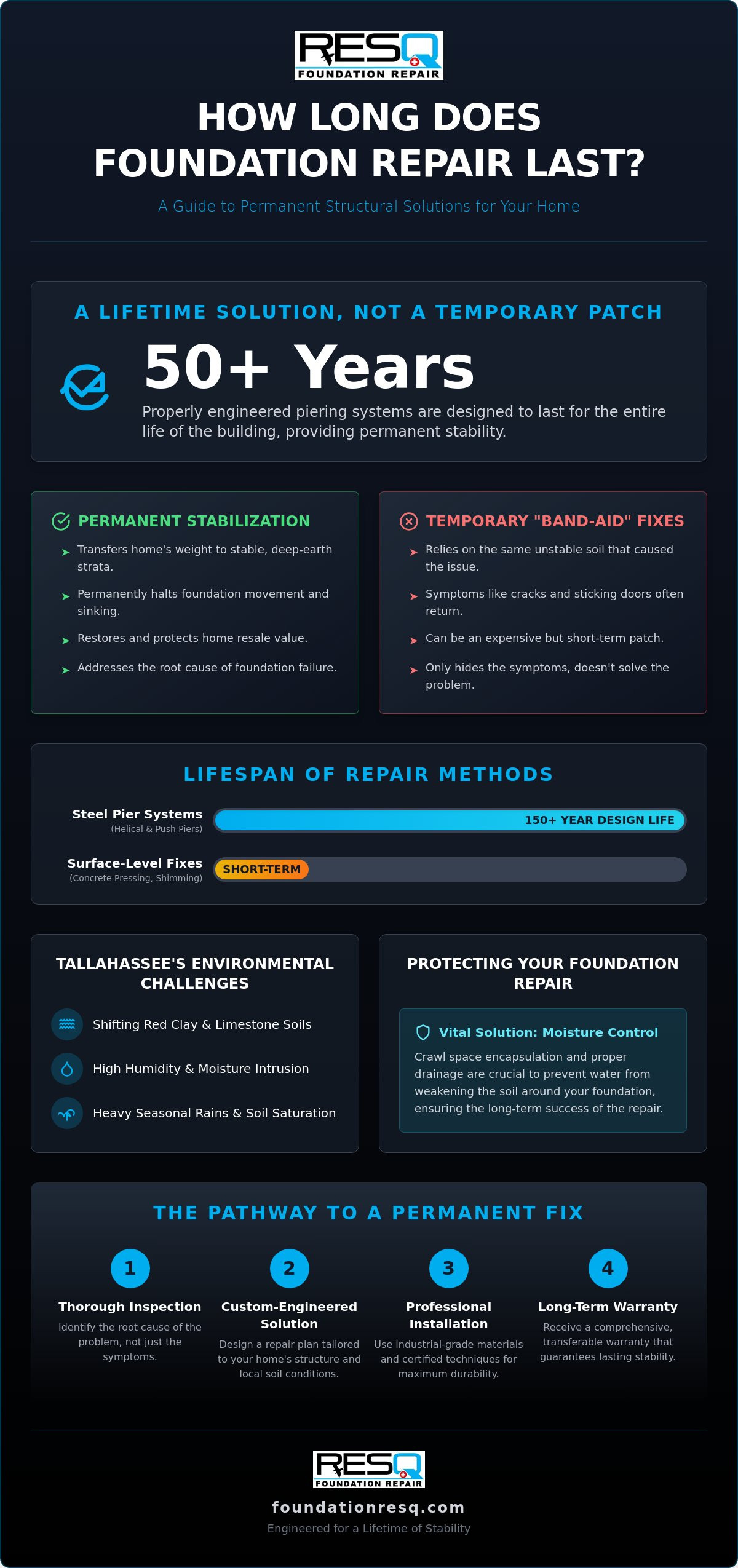
When homeowners ask how long does foundation repair last, the answer depends entirely on the engineering behind the fix. A properly designed system using industrial-grade piers is not a patch; it’s a permanent structural restoration intended to last 50 years or the entire life of the building. To understand why this longevity is possible, one must first look at What is a building foundation? and how it interacts with the soil beneath it. While cosmetic fixes like filling drywall cracks might hide the symptoms for a few months, true stabilization addresses the root cause: shifting or unstable earth.
Many people believe that some “settling” is normal after a repair. This is a common misconception. If a foundation continues to move after professional intervention, the method used likely failed to reach stable, load-bearing strata. As a steadfast local expert in Tallahassee, we know that our region’s unique soil requires a methodical approach that bypasses the unstable top layers. True structural remediation means the building stops moving entirely. Anything less is simply a delay of the inevitable.
Permanent Stabilization vs. Temporary Fixes
Short-term solutions like concrete pressing or DIY shimming often act as expensive band-aids. These methods rely on the same unstable soil that caused the initial failure. In contrast, professional piering systems transfer the weight of your home deep into the earth. By anchoring the structure to competent soil or bedrock, we create a protective barrier against future movement. This permanent fix does more than just stop the sinking; it restores home resale value. When a potential buyer sees a professionally stabilized foundation, it replaces anxiety with confidence. They know the home is safe and the structural integrity is verified.
Understanding Structural Warranties
The word “lifetime” is often used loosely in the construction industry. A real structural warranty should cover the durability of the components and the stability of the installation for decades. It’s vital to choose a partner with long-term regional stability who can honor those commitments. Because Foundation ResQ is backed by the national strength of Groundworks, our warranties carry the weight of an industry leader. This ensures that the protection we provide today remains in place for as long as your home stands. We don’t just fix symptoms; we provide a remedy that stands the test of time, ensuring how long does foundation repair last is a question you only have to ask once.
Comparing the Lifespan of Different Foundation Repair Methods
The durability of a structural fix is a direct result of the depth it reaches. In Tallahassee, surface-level repairs often fail because our upper soil layers are constantly shifting due to heavy rain and humidity. To truly understand how long does foundation repair last, you have to look at the strata where the repair is anchored. A “right tool for the right soil” philosophy ensures that we don’t just treat the symptom but provide a permanent remedy. This approach differs significantly between slab-on-grade homes and crawl space structures, as each requires a specific engineering strategy to combat settlement and ensure the building remains level for decades.
Helical and Push Piers: The Gold Standard
Steel piering systems are widely considered the most durable option available for residential stabilization. Push piers are the preferred choice for heavy structures, as they use the weight of the building to reach deep, stable soil layers that aren’t affected by surface moisture. For lighter structures or areas with complex soil profiles, helical pier installation provides a deep-seated anchor that resists the seasonal expand-and-contract cycle. Unlike concrete piers, which can crack or degrade under pressure, industrial-grade steel systems are designed to resist corrosion and remain stable for over 150 years. This longevity is why they are the standard for permanent stabilization. If you’re unsure which system fits your property, you can request a professional evaluation to assess your soil’s specific needs.
Carbon Fiber Wall Reinforcement
When a foundation wall begins to bow or lean, the fix must be just as permanent as the piering beneath it. While traditional wall anchors are effective, they often require invasive excavation and regular manual tightening. Modern carbon fiber wall repair Tallahassee offers a non-invasive alternative with a lifespan that typically matches the life of the home. This material is ten times stronger than steel in tension and creates an unbreakable bond with the existing masonry. According to the Building Science Corporation, maintaining the integrity of the building envelope is critical for long-term stability. Carbon fiber reinforcement doesn’t just hold the wall in place; it becomes a part of the structure itself. This prevents further movement without the need for heavy machinery or disruptive yard work, making it a superior long-term investment for your home’s structural health.
Environmental Factors That Affect Foundation Longevity in Tallahassee
Tallahassee’s geological profile is significantly different from the rest of Florida. While many regions deal primarily with loose sand, our area is defined by dense red clay and deep-seated limestone formations. These materials react uniquely to the intense weather patterns of the Big Bend region. To accurately determine how long does foundation repair last, one must first account for these specific environmental variables. Navigating the complexities of foundation repair Tallahassee requires a deep understanding of how our local soil behaves under stress. A solution designed for a sandy coastal environment will likely fail when faced with the heavy, expansive clays found in our inland neighborhoods.
Soil Mechanics and Foundation Movement
Expansive clay is a primary driver of structural instability in the Tallahassee area. During the wet summer months, this clay absorbs vast amounts of water and swells, exerting massive upward and lateral pressure on your home. When the humidity drops or a drought occurs, the clay shrinks, leaving significant voids that cause the foundation to settle unevenly. This constant “expand and contract” cycle places your home’s structure under perpetual stress. Homeowners often ask how long does foundation repair last when faced with these local soil conditions, and the answer lies in whether the fix addresses the underlying geology. The underlying limestone in the Florida panhandle is also susceptible to erosion from the Floridan Aquifer, which can lead to sub-surface instability. For a repair to be truly permanent, piers must be driven deep enough to reach beneath this “active zone” of soil moisture fluctuations. Incorporating these geological considerations into a comprehensive guide to home maintenance helps homeowners identify the early stages of soil-related movement before it becomes a structural emergency.
Hydrostatic Pressure and Erosion
Heavy rain events in the Big Bend region do more than just flood the streets; they saturate the soil immediately surrounding your foundation. This saturation creates hydrostatic pressure, a powerful force that can compromise even the thickest masonry walls. Hydrostatic pressure is the inward force exerted by water-saturated soil against a foundation wall, which can lead to bowing, cracking, or catastrophic structural failure if left unaddressed. This pressure often works in tandem with erosion, which can wash away the supporting soil and undermine previous, non-engineered repairs. To ensure your foundation stays stable for decades, the repair method must account for these hydraulic forces. High-quality stabilization doesn’t just fix the current crack; it provides a protective barrier that resists the weight of the water and the shifting earth, ensuring the long-term health of your home.
How Moisture Control Extends the Life of Your Foundation Repair
A foundation repair is only as permanent as the environment surrounding it. While industrial-grade piers provide the necessary vertical support, uncontrolled water can still cause the soil around those piers to shift or wash away. To truly answer how long does foundation repair last, we must look at moisture control as a primary defensive layer. A dry foundation is a stable foundation because it eliminates the hydrostatic pressure and soil erosion mentioned previously. By managing how water interacts with your home, you ensure that the structural stabilization remains undisturbed for the life of the building.
There is a vital synergy between structural piers and water management systems. While the piers reach deep into stable strata, the drainage systems protect the upper soil layers from saturation. This dual approach prevents the root cause of settlement from recurring. When you remove the threat of soil washout and excessive moisture, you create the ideal conditions for your foundation repair to last for decades. It’s about protecting the investment you’ve already made in your home’s safety.
Crawl Space Encapsulation and Dehumidification
For homes with crawl spaces, the humidity of the Florida panhandle is a constant threat. Excessive moisture leads to wood rot and mold, which can weaken floor joists even after the foundation has been leveled. Implementing crawl space encapsulation Tallahassee creates a protective barrier between your home and the earth. This process involves sealing the space with a heavy-duty vapor barrier and installing a dehumidifier to maintain a consistent environment. This stabilization of the moisture content in the soil beneath the home prevents the “expand and contract” cycle from putting new stress on your repair. It transforms a damp, volatile area into a controlled zone that supports the long-term health of your entire structure.
Sump Pumps and Exterior Drainage
Water management must extend to the exterior of the property to prevent soil washout. During Tallahassee’s heavy tropical storms, thousands of gallons of water can dump onto your roof and pool near the foundation. Effective drainage systems, including gutters and downspout extensions, divert this water safely away from the home. Sump pumps act as a critical safety net, removing groundwater before it can rise high enough to exert pressure on your foundation walls or enter the crawl space. Keeping these systems functional requires simple annual maintenance, such as clearing debris from discharge lines. If you want to ensure your structural investment is fully protected, you can schedule a comprehensive moisture assessment with our team to identify potential vulnerabilities.
Ensuring a Permanent Fix: The Professional Stabilization Process
A permanent fix doesn’t happen by accident. While most contractors might jump straight to the installation, the longevity of your repair is actually decided during the initial diagnostic phase. A comprehensive structural inspection is the only way to identify the specific failure points in your home’s unique footprint. This process moves beyond a simple visual check of cracks. It involves measuring floor elevations and analyzing how the building interacts with the surrounding terrain. While many homeowners focus on the installation day, this thorough preparation is what truly determines how long does foundation repair last. Custom-engineered solutions outlast “one-size-fits-all” repair kits because they account for the varying load requirements of different residential structures.
For homes with sinking driveways, pool decks, or interior floor slabs, the stabilization process often includes concrete leveling Tallahassee. Using PolyRenewal, a high-density polyurethane foam, we can lift and support heavy slabs without the weight of traditional mudjacking. This lightweight material doesn’t add stress to the already vulnerable soil beneath your slab. Instead, it expands to fill voids and provides a stable, waterproof base that won’t wash away during a Florida downpour. Final validation of any repair comes when you see the results: doors that latch correctly, windows that glide smoothly, and the peace of mind that comes from knowing the structure is verified as stable.
The Engineering Behind the Piering
Precision is the hallmark of a professional installation. We calculate exact load requirements for each corner of your home to ensure the weight is distributed evenly across the new piering system. During helical pier installation, our technicians use torque monitoring to measure the resistance of the soil as the pier is driven into the earth. This real-time data allows us to confirm that we’ve bypassed the unstable clay and reached the dense strata required for permanent support. Torque monitoring provides the mechanical proof that each pier has reached a load-bearing soil density capable of supporting your home’s weight indefinitely.
Why Foundation ResQ Provides the Ultimate Protection
Our brand operates within a “remedy-based” framework, which means we don’t just treat the symptoms of foundation failure. We look for the ultimate resolution of the physical issue, whether that involves piering, moisture control, or wall reinforcement. By using specialized equipment designed specifically for the heavy clays and limestone of the Tallahassee area, we provide a protective barrier between your property and the elements. You’re not just buying a repair; you’re securing a final line of defense for your building’s health. If you’re ready to move from uncertainty toward a state of informed resolution, you can request a professional structural assessment to begin the stabilization process today. This proactive step ensures you only have to ask how long does foundation repair last once in your lifetime.
Securing Your Home’s Structural Future
Foundation repair is a significant investment that should only be performed once. We’ve explored how the combination of industrial-grade piering systems and strategic moisture control creates a permanent remedy for your structure. By anchoring your home to stable strata and sealing out Tallahassee’s intense humidity, you effectively end the destructive cycle of soil settlement. Understanding how long does foundation repair last provides the confidence to choose custom-engineered solutions over temporary cosmetic patches. This methodical approach doesn’t just prevent structural failure; it preserves your home’s market value and ensures your family’s safety for decades.
As a Groundworks company, Foundation ResQ provides specialized Tallahassee soil expertise backed by the strength of a national leader. Our industrial-grade piering systems are built to withstand the unique geological pressures of the Florida panhandle. You don’t have to navigate structural concerns alone. Protect your home’s future—schedule a free foundation inspection with Foundation ResQ today! We are ready to help you restore the lasting stability and integrity of your home.
Frequently Asked Questions
Is foundation repair a permanent solution for my home?
Professional foundation repair is designed to be a permanent structural restoration. By bypassing unstable topsoil and anchoring the building to load-bearing strata, we stop the settlement process entirely. This engineering approach turns a failing foundation into a stable structure that is intended to last for the remaining life of the home. It is a one-time remedy rather than a recurring maintenance task.
Can a foundation fail again after it has been professionally repaired?
A foundation should not fail again if the repair reached competent soil and addressed underlying moisture issues. Recurrence is usually a sign that a “quick fix” method was used instead of industrial-grade piering that reaches stable depths. Ensuring the piers reach the correct torque and managing groundwater are the most effective ways to ensure the structural fix remains permanent for decades.
How does the Tallahassee climate affect the longevity of foundation work?
The local climate puts a higher strain on structural repairs due to intense tropical storms and extreme humidity levels. These factors increase hydrostatic pressure against foundation walls and cause our native red clay to expand and contract aggressively. To ensure your repair stands the test of time, we use specialized equipment and piering depths tailored specifically for these regional geological challenges.
Does crawl space encapsulation help foundation repair last longer?
Encapsulation is a vital partner to structural repair because it stabilizes the moisture content in the soil beneath your home. By sealing out humidity, you prevent the ground from swelling and shrinking, which reduces physical stress on the new piers. This controlled environment protects both the structural steel and the wooden floor joists from the long-term degradation caused by Florida’s damp environment.
What is the lifespan of helical piers compared to push piers?
Both helical and push piers are manufactured from industrial-grade steel and have an estimated lifespan of 150 years or more. The choice between these methods depends on your home’s weight and the specific soil profile rather than a difference in their durability. Both technologies are engineered to provide a lifetime of support without the need for future adjustments or replacements.
How do I know if my foundation repair warranty is actually reliable?
A reliable warranty is only as strong as the company that stands behind it. Since Foundation ResQ is backed by the national strength of Groundworks, our warranties remain valid even if local market conditions shift over time. You should look for a guarantee that covers both materials and structural performance, ensuring you know exactly how long does foundation repair last under their long-term protection.
Will foundation repair prevent future cracks in my walls?
Stabilization prevents the structural shifting that causes drywall and masonry to crack in the first place. While existing cracks will need cosmetic patching after the home is leveled, new cracks should not appear once the structure is anchored to stable strata. This permanent stability protects your home’s interior finishes and prevents the recurring cosmetic damage that often signals deeper structural distress.