
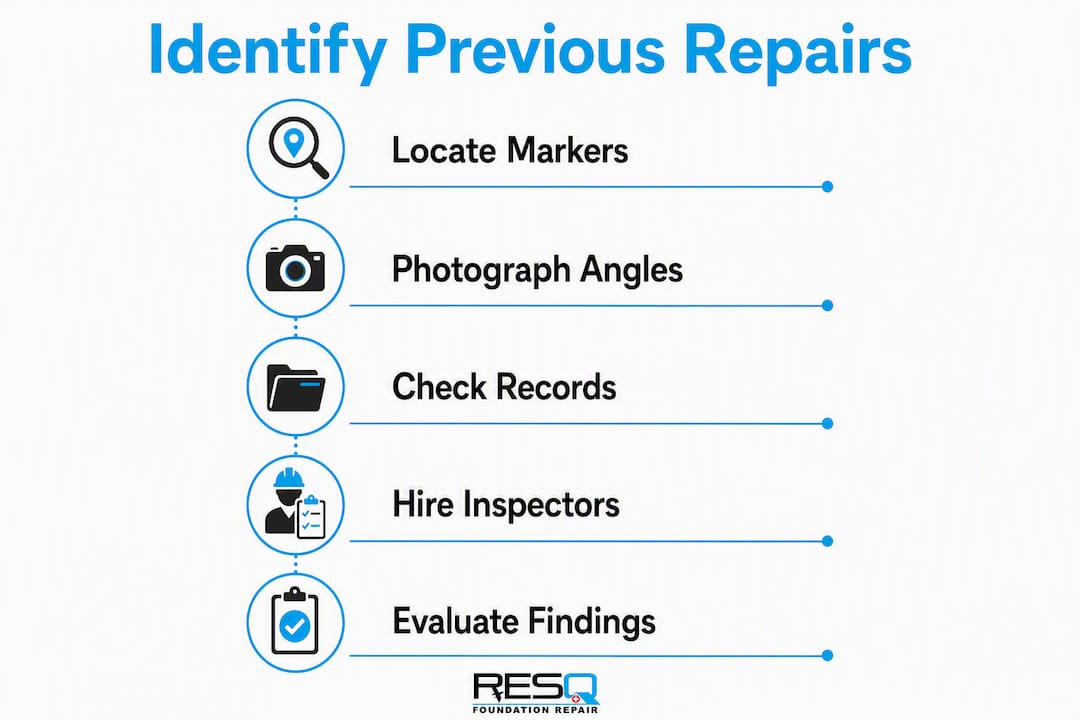
Previous repairs are identified by combining three types of evidence: visible repair markers (carbon fiber straps, steel pier hardware, epoxy injection ports), documentary records (permits, contractor invoices, warranties), and measurement data (recorded crack width or wall movement). If you spot any physical marker, photograph it, check the municipal permit records online, and call a structural engineer if the signs look structural.
Top visual markers to look for:
- Carbon fiber straps or wall anchor plates bolted to interior walls
- Steel push pier heads or concrete patches at the foundation perimeter
- Epoxy or polyurethane injection ports (small stud-like plugs spaced along a crack)
- Patched masonry with different texture or color than surrounding material
- Concrete slab holes that have been filled and resurfaced
Top document types to request:
- Contractor invoices with license number, scope of work, and materials used
- Building permits with final inspection approval stamps
- Transferable warranties from the repair contractor
- Before-and-after photos with dates
Table of Contents
- How are previous repairs identified in a home?
- Where to inspect for signs of past repair work
- How to verify repairs with paperwork and public records
- What red flags suggest a repair has failed?
- Who should you hire, and what will they check?
- What do repair markers tell you about the original problem?
- U.S. disclosure rules and what buyers must do themselves
- What should you do if you suspect previous repairs?
- Key Takeaways
- The part most buyers get wrong
- Foundationresq serves North Florida, South Georgia, and Alabama
- Where to verify records and find authoritative references
- FAQ
How are previous repairs identified in a home?
Definitive structural repair markers include carbon fiber strapping, steel wall anchors, push piers, and epoxy or polyurethane injection ports. These are not cosmetic fixes. They are hardware-intensive interventions that leave permanent, visible evidence.
The difference between a structural repair and a cosmetic patch is usually obvious once you know what to look for. A thin hairline fill painted over a crack is a cosmetic patch. A row of injection ports spaced 12 inches apart along the same crack, or a carbon fiber strap bolted floor-to-ceiling on a basement wall, is structural repair work. One tells you someone hid a problem; the other tells you someone addressed it.
Pro Tip: Photograph every marker from at least two angles. Note the date, room, and wall orientation in the file name. That record becomes your negotiating evidence and your future buyer’s disclosure package.
Sellers sometimes conceal issues with fresh paint, new flooring, or new landscaping placed directly against the foundation. Mismatched paint sheens on a single wall section, layered floor coverings in one corner, or suspiciously fresh mulch banked against the foundation are worth a second look. None of these is proof of a problem on its own, but each is a reason to look harder.
Where to inspect for signs of past repair work
Work through the property in this order to cover the highest-risk areas without backtracking:
- Foundation perimeter (exterior): Walk the full perimeter at grade. Look for pier heads, concrete patches, or fresh mortar in brick joints.
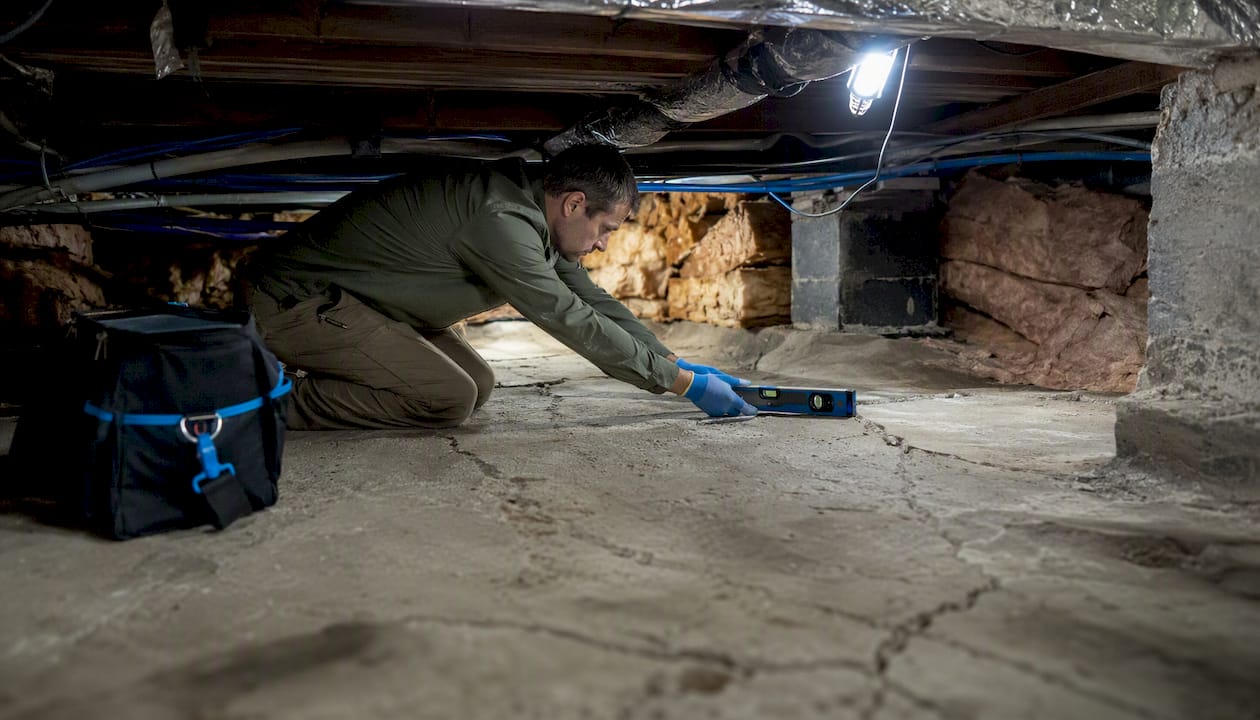
- Crawlspace or basement: Check walls for anchor plates, carbon fiber straps, and injection ports. Look at the floor for slab patches or pier caps.
- Attic: Old stains next to sharper, newer stains and painted-over efflorescence on masonry indicate repeated patching rather than a resolved problem.
- Interior walls near corners: Stair-step cracks in drywall, patched sections, or new trim installed over a narrow strip of wall can all signal prior movement.
- Floors and doors/windows: A digital level across the floor reveals slope. Doors or windows that stick or have been planed down suggest the frame shifted.
- Exterior masonry and garage slab: Stair-step cracks in brick and slab injection ports are common here.
Bring a flashlight, a digital level or inclinometer, and your phone camera. A marble rolled across a floor is a low-tech but effective slope test.
Pro Tip: In crawlspaces, look up at the subfloor as well as at the walls. Sistered joists, new blocking, or fresh wood next to old wood are signs of prior structural repair that sellers rarely mention.
How to verify repairs with paperwork and public records
Documents either confirm a repair was done correctly or expose a gap that requires more investigation. Work through this sequence:
- Ask the seller for all contractor invoices, scope-of-work documents, and warranties. Confirm the contractor’s license number is on the invoice.
- Request the permit number and look it up through the local municipal building department’s online portal. Confirm a final inspection approval is on record.
- Search the county property records for any recorded mechanic’s liens or code enforcement actions tied to the address.
- Ask for before-and-after photos with dates. A reputable contractor provides these as a matter of course.
- Check whether warranties are transferable to a new buyer. Many structural repair warranties are, but only if properly assigned in writing.
When sellers disclose repaired problems, the most credible disclosures include the repair date, the contractor’s name and license, the scope of work, and supporting documentation. A vague “foundation was repaired” with no paperwork is not a disclosure you can rely on.
Pro Tip: If a previous buyer’s inspection report is offered to you, do not treat it as your own. Courts may not extend legal protections to buyers who relied on another party’s inspector. Commission your own inspection.
What red flags suggest a repair has failed?
Some signs tell you the original problem was not solved. Watch for:
- Reopened cracks in the same location where a prior repair is documented
- Stair-step cracks in brick or block that extend beyond a previously patched section
- Horizontal bowing in a basement or crawlspace wall (this is the most serious pattern)
- Painted-over efflorescence in crawlspaces or basements, indicating recurring moisture
- Layered patches in the same spot, visible as multiple generations of fill or paint
Movement thresholds that require a structural engineer review: crack widening greater than 1/4 inch and horizontal wall bulges greater than 1.5 inches. At those levels, stop relying on seller statements and commission a signed engineer report before proceeding.
Recurring moisture patterns deserve the same urgency. Layered staining and painted-over efflorescence in crawlspaces and attics indicate repeated patching of a moisture problem that was never resolved at its source.
Who should you hire, and what will they check?
Three professionals serve distinct roles in verifying prior repair work.
Home inspector covers all major systems in a single visit. They note visible evidence of prior repairs, flag patterns of structural distress, and recommend specialist review. Inspectors are trained to spot stair-step masonry cracks and horizontal bowing that sellers may not describe accurately. Use a home inspection as your first filter, not your final answer.
Structural engineer is the right call when physical markers or movement thresholds suggest active or failed structural issues. Their deliverable is a signed report that includes a load-path diagnosis, a prioritized risk assessment, and specific repair recommendations. Typical residential structural engineer inspections cost a few hundred dollars, and a written report usually follows within a couple of weeks, though complexity and market demand affect timing and price.
Foundation contractor performs diagnostic tests (soil probes, pier soundings, elevation surveys) and provides a written estimate with scope, materials, and warranty terms. A contractor estimate is not a substitute for an engineer’s report when the issue is structural, but it is the document you need to negotiate price or escrow repairs.
What do repair markers tell you about the original problem?
Each repair method leaves a specific physical signature, and that signature tells you what the original problem was.
- Steel push piers or helical piers: Used when a foundation has settled. Look for pier heads at the exterior grade, concrete patches where piers were installed through the slab, and minimal interior finish work over pier caps. This is a permanent fix when installed correctly, but verify permits and final inspections before assuming the work holds.
- Carbon fiber straps and wall anchors: Used for lateral wall stabilization when a basement or crawlspace wall has bowed inward. Visible straps running floor-to-ceiling, or anchor plates on the interior wall with corresponding exterior deadman anchors, mean wall movement was addressed. Check whether the wall was also straightened or only stabilized in place.
- Epoxy or polyurethane injection ports: Used to seal cracks or fill voids. Small stud-like plugs spaced along a crack line are the marker. Epoxy injection is structural; polyurethane foam is typically used for waterproofing. The distinction matters when judging whether a crack was sealed or structurally bonded.
- Concrete leveling/slab lifting: Look for filled injection ports in slabs, patched surface holes, or a recently resurfaced section. Slab lifting addresses void-related settlement; it is not the same as structural piering and does not address a failing foundation wall.
Pro Tip: Ask the seller whether the repair contractor provided a post-repair elevation survey. That document proves the slab or wall was returned to a measured position, not just patched.
U.S. disclosure rules and what buyers must do themselves
Disclosure obligations vary significantly by state, and buyers cannot assume a seller’s disclosure covers everything.
- Florida: Sellers must disclose known latent material defects that are not readily observable, even in as-is sales. The Johnson v. Davis precedent makes this a legal obligation, not a courtesy. Get written disclosures and copies of all permits. For more detail on how this applies to foundation work specifically, see Foundationresq’s Florida foundation disclosure guide.
- Georgia: Sellers generally use voluntary disclosure forms; no standardized statutory form is required. Sellers must still avoid fraudulent suppression of known defects.
- Alabama: Follows caveat emptor with exceptions for fraud or known health and safety defects. Buyers carry the primary burden of inspection.
In buyer-beware states, your inspection contingency and your own inspector are your legal protection. A seller’s disclosure form is a starting point, not a guarantee.
Regardless of state, include an inspection contingency in your offer, request all repair documents in writing, and keep copies of everything if you later need to negotiate repairs or file a claim.
What should you do if you suspect previous repairs?
Follow this sequence during or immediately after a property visit:
- Photograph every suspicious sign. Date and geo-tag each photo.
- Ask the seller in writing for all repair invoices, permits, warranties, and before-and-after photos.
- Search the municipal building department’s online portal by property address for permit history.
- If documents are missing or the signs look structural, schedule a structural engineer before making a final decision.
- Use the engineer’s signed report and contractor estimates to negotiate price, require repair escrow, or walk away if the risk exceeds your tolerance.
- Keep a single folder containing all photos, inspection reports, permits, and contractor bids. Lenders, insurers, and future buyers will all ask for it.
A concise early-detection checklist can help you work through a property visit systematically before you commit to hiring specialists.
Key Takeaways
Previous repairs are most reliably identified by combining physical markers, verified permits, and independent professional inspection — no single source is sufficient on its own.
| Point | Details |
|---|---|
| Physical markers are definitive | Carbon fiber straps, pier hardware, and injection ports confirm structural repair work occurred. |
| Movement thresholds matter | Crack widening over 1/4 inch or wall bulges over 1.5 inches require a structural engineer review. |
| Documents must be verified | Permits with final inspection stamps and licensed contractor invoices are the minimum credible record. |
| Disclosure laws vary by state | Florida mandates latent defect disclosure; Georgia and Alabama lean caveat emptor — your inspection is your protection. |
| Foundationresq can help | For North Florida, South Georgia, and Alabama properties, Foundationresq provides professional inspections, signed repair documentation, and full-service structural remediation. |
The part most buyers get wrong
Most buyers focus on whether a repair was done. The more useful question is whether the repair was documented, permitted, and verified by a final inspection. A carbon fiber strap installed without a permit and without a post-repair elevation survey tells you someone addressed a symptom. A permitted repair with a final inspection stamp, a licensed contractor invoice, and a transferable warranty tells you the problem was handled through a process that someone else already verified.
The cover-up tactics worth watching are subtler than most buyers expect. Fresh landscaping banked against a foundation, a single wall with a noticeably different paint sheen, or new laminate flooring in one corner of an otherwise older home are not proof of anything. But they are consistent with localized patching intended to redirect attention. The right response is not suspicion; it is a flashlight, a digital level, and a structural engineer if the evidence warrants one.
Buyers who skip the independent inspection because the seller’s disclosure looks clean are making the single most expensive mistake in residential real estate. Disclosures reflect what sellers choose to report. Inspectors find what is actually there.
Foundationresq serves North Florida, South Georgia, and Alabama
If your walk-through turns up structural markers, missing permits, or recurring moisture signs, the next step is a professional inspection from someone who can read the evidence and tell you what it means for your specific property.

Foundationresq provides on-site inspections, documented repair estimates, and full structural remediation for residential and commercial properties across North Florida, South Georgia, and Alabama. Services include:
- Foundation repair (push piers, helical piers, wall anchors, carbon fiber stabilization)
- Crawl space waterproofing and encapsulation
- Basement waterproofing
- Concrete leveling and slab lifting
- Mold remediation
Every inspection comes with documented findings you can use in negotiations or disclosure. Request your inspection or repair estimate at Foundationresq’s services page.
Where to verify records and find authoritative references
Use these sources to pull permit history, check disclosure requirements, and find professional guidance:
- Nolo: Georgia seller disclosure guide — what Georgia sellers must report
- Inspectapedia foundation damage guide — crack patterns, movement thresholds, and repair assessment
- Foundationresq services — inspection, repair, and remediation for North Florida, South Georgia, and Alabama
Pro Tip: When searching permit records, use the property’s full street address and try both the current and prior owner’s name. Permits pulled under a contractor’s license sometimes appear under the contractor’s name rather than the property owner’s.
FAQ
What is the biggest red flag in a home inspection?
Horizontal bowing in a basement or crawlspace wall is the most serious single finding. It indicates active lateral soil pressure and, combined with a wall bulge greater than 1.5 inches, requires immediate structural engineer review.
How do you tell if a building’s structural issues are beyond repair?
No universal threshold exists, but a structural engineer’s signed report will assess load-path integrity and prioritize risk. Severe horizontal bowing, multiple failed prior repairs, and active settlement measured across multiple points are the patterns that most often lead engineers to recommend major intervention.
Do foundation repairs have to be disclosed in the U.S.?
It depends on the state. Florida requires sellers to disclose known latent material defects, including prior foundation repairs. Georgia and Alabama follow caveat emptor more closely, placing the inspection burden on the buyer, though fraud exceptions apply in both states.
Does a repair record stay with the property?
Permitted repairs are recorded in the municipal building department’s files and remain tied to the property address permanently. Unpermitted repairs leave no public record, which is one reason buyers should always pull permit history independently rather than relying solely on seller disclosures.
How do I know if an epoxy injection actually fixed the crack?
A structural epoxy injection bonds the crack faces together and restores tensile strength; a polyurethane foam injection seals for water but does not bond structurally. If the injection ports are present but no permit or engineer report accompanies the repair, commission a structural engineer to assess whether the crack has reopened or widened beyond 1/4 inch.