An A/C pad that looks uneven doesn’t automatically need to be torn out and replaced. PolyRenewal for A/C unit pads can be a way to address settlement when the concrete is still sound and suitable for lifting. A visible tilt can also raise concerns about the equipment and its connected lines, so assess the pad and surrounding setup before choosing a repair.
The key is to understand what has moved and what the concrete is like now. The pad, its underlying support, and drainage around it can all factor into the evaluation. Lifting may suit a settled, intact slab, while severe cracking, crumbling concrete, or other site conditions may point toward replacement instead.
This article explains what pad movement can indicate, how PolyRenewal lifting compares with replacement, and what an on-site assessment should establish before work begins. You’ll learn which practical details matter, including slab condition, A/C equipment, and the surrounding area, so you can make a more informed decision for your home in Tallahassee.
Key Takeaways
- Look for changes such as tilt, cracking, separation, or a growing gap beneath the pad, and record what you observe.
- PolyRenewal for A/C unit pads can be considered when the concrete is sound but has settled. The pad’s condition and site constraints determine whether lifting fits.
- Compare lifting and replacement based on the concrete’s condition and the scope of work, rather than appearance alone.
- Keep observations about the slab separate from assumptions about drainage, soil movement, or possible equipment damage.
- A site-specific assessment should consider the pad, A/C equipment, and surrounding area before a repair approach is selected.
Why an Uneven A/C Unit Pad in Tallahassee Deserves a Closer Look
An A/C unit pad supports the outdoor condenser. If the concrete appears tilted or shifted, take note, but don’t assume the equipment has moved or needs repair. PolyRenewal for A/C unit pads can address some settled slabs, but the pad’s visible condition is only one part of choosing what to do.
Record specific changes: cracks in the concrete, edges that no longer appear even, separation from nearby surfaces, or a gap beneath the pad that wasn’t there before. Note nearby pooling water as well. These clues help describe the site, but none confirms the cause or establishes whether lifting or replacement is the right fix.
In Tallahassee, drainage and ground conditions vary from property to property, so assess the area around the individual pad rather than assuming the cause. Note where water collects after rain, whether the area stays damp, and whether grading or downspouts direct water toward the pad. Those observations give an on-site assessment useful context without treating water or soil as a confirmed cause of movement.
What can a tilted or settled condenser pad tell you?
A sloped pad indicates that the concrete may not be sitting as it did before. It doesn’t prove the condenser has shifted, and a crack alone doesn’t reveal whether the concrete moved, deteriorated, or was affected by another site condition. Changes over time are useful evidence: dated photos taken from the same angle can show whether a gap or tilt appears stable or is changing.
Record what you see without trying to diagnose it. For example:
- Photograph cracks, uneven edges, and gaps, using the same viewpoint when possible.
- Note where water pools and whether the pooling is temporary or recurring.
- Write down when you first noticed the change and any visible progression.
Why the A/C equipment matters when evaluating the concrete
This isn’t only a concrete question. The condenser rests on the pad, and connected lines and required clearances can affect how the surrounding area is evaluated. A visible slope alone can’t establish whether the equipment is operating properly or whether a line has been affected. Equipment-specific support and clearance requirements depend on the manufacturer’s guidance.
A careful assessment considers the concrete alongside the condenser, connected lines, and available working space. Don’t move the equipment or treat a visual observation as an HVAC diagnosis—if there are concerns about line stress or system performance, consulting a residential HVAC provider like Caribbean Heating & Cooling is the appropriate step. The goal is to understand the pad’s condition and the site constraints before selecting a concrete repair approach, while keeping equipment concerns separate from the condition of the slab.
How PolyRenewal May Lift and Level a Concrete A/C Pad
PolyRenewal concrete lifting addresses settled concrete by working to raise and level the slab. It’s an option for an A/C pad when the concrete is suitable for lifting. The pad’s condition, how it has moved, and the space available to assess and work around it all matter. The service addresses the concrete support, not the condenser as an HVAC unit.
Concrete lifting works to raise and level settled concrete when the slab’s condition and site circumstances make that approach suitable. Correcting the concrete’s position and resolving an equipment concern are separate tasks.
What happens during a site assessment?
An assessment starts with the pad itself. Its position, visible cracks, edges, and overall condition are reviewed alongside the surrounding area. The condenser and connected components matter, too, because their location and the available access can shape what work is practical. The aim is to understand the site before selecting a repair approach, not to assume a visible slope has one specific cause.
Recommendations should follow the evidence at the property. An intact pad that is no longer level presents a different situation from concrete that is badly deteriorated or difficult to access. Your notes about changes in a gap or crack can help explain the concern, but the actual concrete and site constraints guide the evaluation.
What PolyRenewal does, and what it does not address
Foundation ResQ provides PolyRenewal concrete lifting in Tallahassee. For an A/C pad, the service addresses the concrete’s level and support when the slab is suitable for lifting. It isn’t an HVAC diagnosis, condenser repair, or service for refrigerant lines or other connected components. A concrete assessment can consider how equipment affects the work area, but it can’t establish whether the A/C system is functioning correctly.
Keeping those roles distinct makes the decision clearer. Concerns about the equipment, its operation, or connected lines are separate from concrete repair. The recommendation for lifting should reflect the slab’s condition and access, rather than presume every pad can be raised.
During an assessment, ask whether the concrete appears suitable for lifting, what site constraints could affect the plan, and how the equipment and surrounding slab factor into the evaluation. The answers can help distinguish a concrete-leveling option from work that addresses the A/C unit itself.
Foundation ResQ provides PolyRenewal concrete lifting in Tallahassee. An assessment can focus on the pad’s condition, the condenser and connected components, and practical constraints around the slab before a repair approach is selected.
PolyRenewal Lifting vs. Replacing an A/C Unit Pad
An uneven pad doesn’t automatically call for replacement. The choice depends on whether the concrete is sound enough to lift or whether damage and equipment requirements point toward a different scope of work. PolyRenewal for A/C unit pads is a concrete-lifting option for suitable slabs, not a universal fix for every settled pad.
Use the comparison below as a starting point, not a diagnosis. An on-site evaluation can establish what the concrete condition, pad design, equipment, and access allow.
| Decision factor | Lifting | Replacement |
|---|---|---|
| Condition | May be considered when a concrete pad appears intact but has settled or shifted. | May be considered when concrete is extensively cracked, fragmented, or otherwise too damaged to serve as a suitable pad. |
| Scope | Focuses on correcting the position of existing concrete, if its condition and site circumstances are suitable. | Involves removing the existing pad and creating a replacement surface appropriate to the project. |
| Disruption | Works with the existing slab, so the scope differs from removing and rebuilding it. Access around the condenser and connected components still matters. | Requires work to remove and replace the pad. The project plan must account for the equipment and the area around it. |
| Key consideration | Whether the slab can be addressed as concrete that has settled, rather than concrete that has substantially deteriorated. | Whether the existing concrete or pad design is unsuitable for continued use or doesn’t meet the equipment’s needs. |
When lifting may be considered
Lifting may be appropriate to evaluate when the pad remains sound as concrete but its position has changed. The goal is to correct the level, not to repair extensive deterioration. A tilt, gap, or isolated crack helps describe the concern, but none proves that lifting is suitable. An assessment must determine whether the slab and surrounding conditions support that approach.
When replacement may be part of the discussion
Extensive cracking, fragmentation, or crumbling may prompt a discussion about replacement because leveling alone may not address the pad’s condition. Pad dimensions and design, equipment requirements, and site access can also influence the decision. An uneven appearance by itself doesn’t mean replacement is necessary. The slab’s condition and the installation’s needs matter.
Compare the repair scope with the problem it is meant to address. If the main issue is a shifted but sound slab, determine whether lifting suits that concrete. If the pad is badly damaged, replacement may need to be considered. Neither observation settles the choice without an on-site evaluation of the slab, equipment, and surrounding area.
A measured assessment helps prevent two common mistakes: treating every uneven pad as a replacement project, or assuming every settled pad can be lifted. The right approach is the one that fits the actual concrete condition and the requirements of the A/C installation—and for readers in the UK planning a new setup, teams specializing in air conditioning installation Surrey ensure outdoor condensers are installed on proper, level bases from day one.
How to Evaluate an A/C Pad Before Choosing a Repair
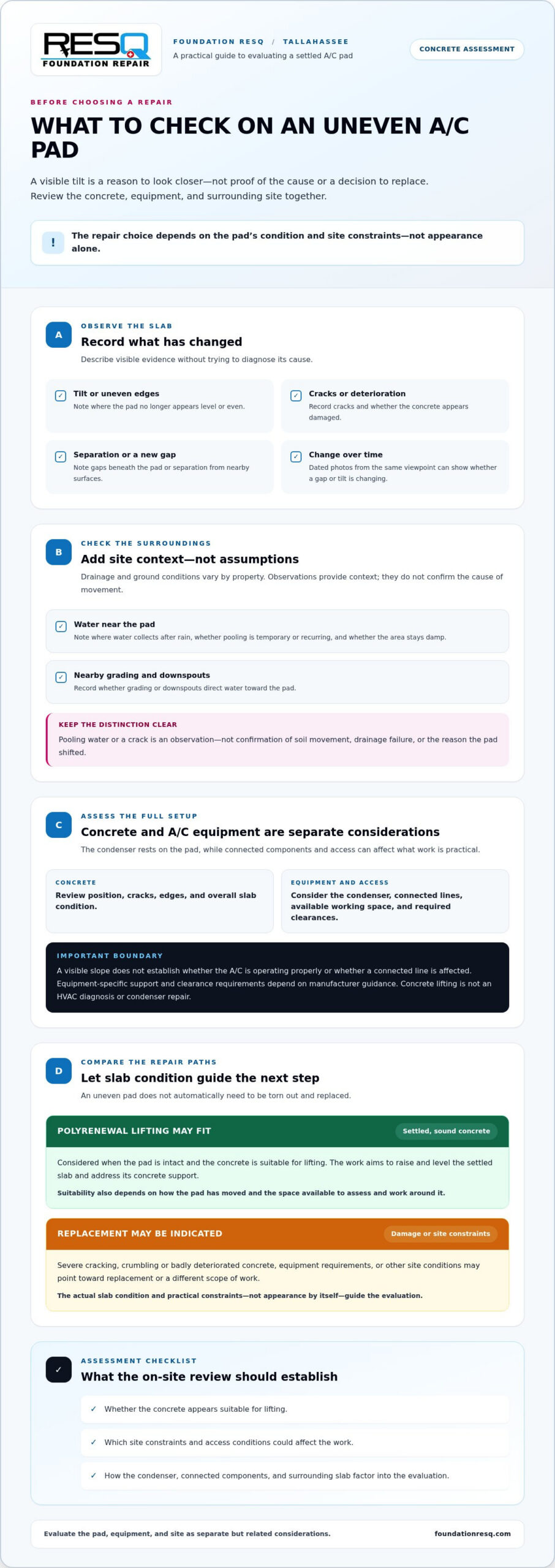
A useful assessment starts with a clear record of what you can see, not a guess about what caused it. For an A/C pad in Tallahassee, note the concrete’s condition and position, nearby water patterns, and anything that has changed around the site. These details help separate observations from assumptions and determine whether PolyRenewal for A/C unit pads is suitable.
A homeowner’s four-step observation checklist
Keep your notes factual and leave the equipment in place. A short record makes it easier to explain what changed without trying to diagnose the pad or condenser yourself.
- Describe the position. Note which edge or corner looks higher or lower, and whether the change seems stable or has become more noticeable.
- Document the concrete. From a safe position, photograph visible cracks, separation, or gaps. Include a wider view showing the pad in relation to the condenser and nearby surfaces.
- Record water patterns. Note where water collects and whether you’ve seen it after rain or at other times. Describe the pattern without concluding that drainage caused the movement.
- List site changes. Mention recent work or changes near the pad, and when you first noticed the issue. Don’t move the condenser or connected components to get a better view.
For example, “a gap is visible beneath the back edge, and I first noticed it after nearby yard work” is more useful than “the soil washed out.” The first statement reports what you observed; the second assigns a cause that an assessment still needs to establish. Apply the same distinction to water pooling and equipment concerns.
Questions an assessment should resolve
An on-site review should establish whether the surface is a concrete pad, what condition it’s in, and whether its position has changed. It should also consider the condenser, connected components, available clearances, and access around the slab. These details help determine whether lifting suits the pad or another concrete solution should be considered.
Site conditions differ from one Tallahassee property to another. The slope and drainage around one pad may not reflect conditions elsewhere, so local context should inform the evaluation without becoming a blanket explanation. Photos and a timeline are helpful, but they don’t replace an assessment of the concrete and immediate work area.
Foundation ResQ’s Concrete Leveling in Tallahassee: The Homeowner’s 2026 Guide to PolyRenewal® offers additional local context for understanding concrete-leveling considerations. To discuss what your observations may mean for your pad, connect with Foundation ResQ about an A/C pad assessment.
Choosing Foundation ResQ for PolyRenewal A/C Pad Evaluation
An uneven A/C pad can leave a homeowner weighing two very different repairs. Foundation ResQ provides PolyRenewal concrete lifting in Tallahassee and evaluates whether lifting suits the specific concrete pad. The assessment accounts for the slab, condenser and connected components, and constraints at the site.
What to expect from a project-focused evaluation
A project-focused conversation starts with the pad’s actual condition, not a default assumption that every tilt needs the same fix. The evaluation considers the concrete and A/C pad setting, including nearby equipment and available access. A pad that remains sound presents a different situation from one with extensive deterioration or a layout that affects the work.
Those findings inform whether PolyRenewal fits the project. Foundation ResQ’s PolyRenewal Concrete Lifting Tallahassee: Fast Leveling provides broader context about its concrete-lifting service, while an A/C pad evaluation stays specific to the slab and equipment at the property. The assessment isn’t an HVAC diagnosis, and concrete lifting doesn’t address condenser operation or connected-line repairs.
Make the discussion more useful by bringing dated photos, noting what has changed, and describing where water collects without treating that as a confirmed cause. The team can then consider the concrete condition, equipment setting, and site constraints together. The recommendation should reflect the actual pad, whether lifting fits or another concrete approach merits consideration.
Take the next step with Foundation ResQ
A visible change beneath an outdoor condenser is worth evaluating, but it doesn’t settle the repair decision on its own. A site-specific review can clarify what the concrete condition suggests and how the A/C setup affects the work. That gives homeowners a practical basis for weighing a suitable lifting option against other needs for the pad.
If your A/C pad in Tallahassee appears tilted, cracked, or settled, request an evaluation from Foundation ResQ. The team can discuss the concrete and site conditions and help you understand which repair approach fits, without assuming that lifting or replacement is right for every situation.
Request an A/C pad evaluation from Foundation ResQ
Move Forward With a Clearer Plan for Your A/C Pad
The next step doesn’t have to be a guess. Use what you’ve observed to start a focused conversation about the pad, and keep the decision centered on what the concrete and site can support. PolyRenewal for A/C unit pads can address suitable settled concrete, but the right recommendation depends on the condition of your slab and the equipment around it.
A careful assessment can help you understand whether lifting is suitable or another solution deserves consideration. Foundation ResQ provides PolyRenewal concrete lifting in Tallahassee, with recommendations guided by the conditions at each property.
Request an A/C pad evaluation and take the next step with a clearer understanding of your options. A measured plan can make an unsettling change feel more manageable.
Frequently Asked Questions
Does an A/C condenser pad need to be perfectly level?
Not necessarily. Condenser support and levelness requirements can vary by equipment, so there isn’t one tolerance homeowners should apply to every unit. A pad that looks tilted is a visible condition, not proof that the condenser has shifted or is operating poorly. Review the equipment guidance and have the pad and condenser considered together before deciding whether the concrete needs attention.
Can PolyRenewal lift a cracked A/C unit pad?
A crack alone doesn’t determine whether lifting is suitable. With PolyRenewal for A/C unit pads, the question is whether the concrete remains suitable to address as a settled slab or whether deterioration changes the repair options. A narrow crack in an otherwise intact pad differs from widespread breakup or crumbling. An on-site review of the concrete, movement, and access can help distinguish these conditions, but it can’t promise a crack will close.
Could lifting an A/C pad affect refrigerant lines or electrical connections?
Connected equipment makes planning important, so consider the condenser and its connections before planning concrete work. An assessment can account for the equipment’s position and visible connections without assuming a particular outcome. PolyRenewal addresses concrete, not refrigerant lines, electrical connections, or HVAC operation. Don’t try to move or disconnect equipment yourself; equipment-related concerns are separate from concrete lifting.
How long does PolyRenewal lifting take for an A/C unit pad?
There’s no single duration that applies to every A/C pad project. Timing depends on the pad’s condition, access around the condenser, and the work plan for that site. Any separate equipment-related work is distinct from concrete lifting and may affect the broader project schedule. A project assessment is the right place to discuss timing expectations for your particular setup, rather than relying on a general estimate.
Can PolyRenewal be used on a plastic or composite A/C pad?
PolyRenewal is a concrete-lifting service, so the material and construction of the supporting surface matter. A plastic or composite pad isn’t a concrete slab, and the method shouldn’t be assumed to lift that component. Some setups may include concrete beneath or around a separate pad. Reviewing the actual support and how the condenser sits can clarify which concrete options apply to your installation.
What should I do if water collects around my A/C unit pad?
Note where water collects, when you see it, and whether it remains after nearby areas dry. Photos taken from a safe position can help document the pattern. Pooling doesn’t prove that drainage caused the pad to settle, so avoid changing grading or redirecting water based only on appearance. An evaluation can consider drainage patterns alongside the concrete condition and site layout to guide next steps.