
What if your sinking concrete stairs don’t need to be replaced? Uneven steps can make entering your home uncomfortable and create a tripping concern, but whether PolyRenewal for sinking concrete stairs is appropriate depends on what caused the movement and the condition of the concrete. In Tallahassee, soil movement and water runoff can contribute to settling, so the visible slope is only part of the picture.
It’s reasonable to wonder whether the stairs can be lifted safely or whether replacement is a better option. An assessment looks at the concrete, how the steps connect to nearby surfaces, and conditions around the entry. This guide explains signs that warrant attention, how PolyRenewal can lift and level sunken concrete, and what an assessment involves. You’ll also learn which conditions can affect the repair approach and what information can help you prepare for the next steps at your Tallahassee home.
Key Takeaways
- Gaps, uneven risers, or separation from nearby surfaces can signal that your concrete stairs need an assessment.
- PolyRenewal for sinking concrete stairs can lift and level existing concrete when its condition and the cause of settling make lifting appropriate.
- Choosing between lifting and replacement starts with checking whether the concrete can remain in place and what repair outcome you need.
- A Tallahassee assessment can consider the stairs, nearby concrete, drainage, access, and how the steps connect to other surfaces.
- Use the assessment findings to compare practical next steps and determine whether Foundation ResQ’s PolyRenewal service suits your stairs.
Sinking Concrete Stairs: What the Changes Can Tell You
Settled steps can make entering your home less comfortable and create a tripping concern, but a change in level doesn’t automatically mean the stairs have structurally failed. It does mean the condition deserves attention, especially if the change is new or appears to be progressing.
A visible symptom shows where the stairs have changed, but it doesn’t identify why they moved. Gaps and uneven steps can point to settlement, but an assessment is needed to understand the underlying cause and whether the concrete is suitable for repair.
Which changes in concrete stairs deserve attention?
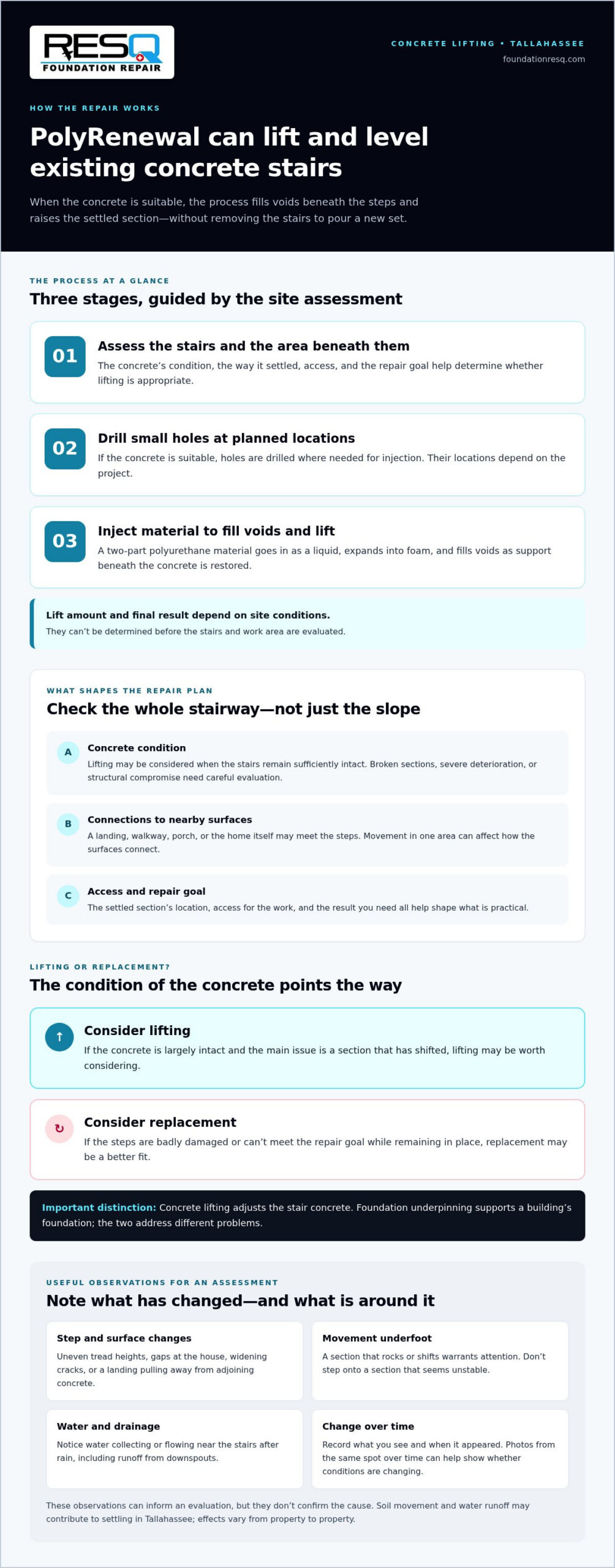
Look for differences in tread height, gaps between the stairs and the house, cracks that appear to be widening, or a landing that seems to be pulling away from adjoining concrete. A section that rocks or shifts underfoot also warrants attention. These observations help describe what’s happening, but they can’t confirm the cause on their own.
Observe from a safe position. Don’t probe gaps, step onto a section that seems unstable, or try to lift or patch the stairs yourself. If you notice a change, record what you see and when it appeared. Photos taken from the same spot over time can help show whether the condition is changing and give an assessment a useful starting point.
Why might concrete stairs settle in Tallahassee?
Concrete steps rely on the soil beneath them for support. Water moving through or across that soil can contribute to erosion or changes in support. Soil conditions can also shift or consolidate over time. In Tallahassee, roof runoff and sandy soils may be relevant factors, but their effect varies from property to property.
Notice whether water collects or flows near the stairs after rain, and whether downspouts or nearby drainage could direct runoff toward the entry. These details can inform an evaluation, but they don’t establish a diagnosis. An on-site assessment looks at the stairs, surrounding surfaces, and conditions at your home.
Concrete leveling offers a general overview of settlement and methods used to address it. For homeowners considering PolyRenewal for sinking concrete stairs, the first step is understanding what has moved and why. That distinction helps determine whether lifting may be appropriate or another repair path deserves consideration.
How PolyRenewal Can Lift and Level Sinking Concrete Stairs
PolyRenewal is Foundation ResQ’s concrete-lifting service. It’s designed to raise and level existing concrete by addressing voids beneath it, rather than removing the stairs and pouring a new set. Suitability depends on the concrete’s condition, how it has settled, access for the work, and the repair goal.
Concrete lifting adjusts a concrete section, while foundation underpinning supports a building’s foundation. The two address different problems, so settled exterior steps shouldn’t be assumed to indicate foundation movement. An assessment helps identify which part of the structure needs attention.
What happens during PolyRenewal concrete lifting?
The process begins with an assessment of the stairs and the area beneath them. If the concrete is suitable, small holes are drilled at planned locations. A two-part polyurethane material is injected as a liquid, then expands into foam to fill voids and lift the concrete as support below it is restored. The holes and injection locations depend on the project. The amount of lift and final result also depend on site conditions, so they can’t be determined before evaluation.
This approach is one form of stabilizing concrete slabs by addressing gaps beneath the concrete. PolyRenewal for sinking concrete stairs applies the lifting concept to existing steps when their condition and configuration make that approach appropriate.
When might PolyRenewal suit concrete stairs?
Lifting may be considered when the stairs remain sufficiently intact to be raised and leveled. Concrete that’s broken into separate pieces, severely deteriorated, or otherwise structurally compromised needs careful evaluation. The assessment should establish whether the existing sections can reasonably remain in place or whether another repair approach better fits the condition and your goals.
Stair geometry matters, too. Steps may be connected to a landing, walkway, porch, or the home, and movement in one area can affect how the others meet. Access to the work area and the location of the settled section can also shape what’s practical. A repair plan should account for these connections rather than treating every stairway as a single, simple slab.
Concrete lifting addresses the position and support of the stair concrete. It doesn’t, by itself, repair a home’s foundation or correct movement in a supporting structure. If signs point beyond the steps, that distinction matters when choosing the next step. For Tallahassee homeowners, an assessment-led review can clarify whether Foundation ResQ’s PolyRenewal concrete lifting fits the stairs’ condition and repair objective.
PolyRenewal or Stair Replacement: How to Think Through the Choice
The right repair depends on what an assessment finds, not simply on whether the stairs have settled. If the concrete is largely intact and the main issue is that a section has shifted, lifting may be worth considering. If the steps are badly damaged or can’t meet the repair goal while remaining in place, replacement may be a better fit. The decision should account for the stairs’ condition, their connection to nearby surfaces, and the result you need.
Cosmetic patching can improve the appearance of a crack, but it won’t correct an uneven stair section or restore support beneath it. The visible damage and the movement may need different remedies, so an assessment should look beyond the surface.
What signs may make lifting unsuitable?
Extensive crumbling, major cracks, missing concrete, or unstable connections to a landing or adjoining slab are important considerations. They don’t automatically determine the repair, but they can affect whether the existing stairs can be lifted and remain serviceable. PolyRenewal for sinking concrete stairs isn’t a solution for every condition, and lifting alone may not correct a separate drainage, soil, or structural problem.
When could replacement be part of the solution?
Replacement may be considered if the concrete is too deteriorated to remain in place or if lifting wouldn’t achieve the needed repair. An evaluation should include more than the damaged section. The connections to the home, landing, and adjoining concrete can influence how a repair should be planned. The goal is to choose an approach that addresses the actual condition, rather than treating a single crack or low spot in isolation.
For homeowners comparing options, the Tallahassee PolyRenewal concrete leveling guide offers related information about concrete lifting. Use it as background, then base the decision for your stairs on their condition and repair objective. An assessment can help clarify whether lifting may restore a more level entry or whether the existing concrete needs a different solution.
What to Expect During a Concrete Stair Assessment in Tallahassee
An assessment helps turn visible stair movement into a clearer repair plan. It starts with your concerns: what changed, when you noticed it, and whether the steps have continued to move. The stairs and nearby concrete can then be inspected, relevant site conditions reviewed, and possible options explained. This gives you a basis for understanding whether PolyRenewal for sinking concrete stairs suits the condition and your repair goal.
The evaluation can include how the stairs meet a porch, landing, walkway, or the home, since those connections may affect the repair approach. Access to the area, the condition of adjoining concrete, and visible drainage patterns may also be relevant. Observations about water or nearby foundation movement are useful context, not automatic proof of the cause.
How should homeowners prepare for an assessment?
A little preparation can make it easier to describe what you’ve observed. Note when movement first appeared and whether it seemed to change after heavy rain, runoff, or another noticeable weather event. If practical, keep the stairs and nearby concrete clear enough to inspect. Photos taken from similar angles over time can help show changes, but they don’t replace an on-site evaluation.
What factors shape the recommended repair?
The recommendation depends on the concrete’s condition, the pattern of movement, site access, and the result you want. For example, an assessment may consider whether the steps are intact enough to remain in place, whether the landing has moved with them, and whether nearby surfaces show related changes.
Drainage and foundation conditions can also be noted where relevant. A downspout near the stairs or a gap along the house may prompt closer attention, but neither observation alone establishes why the steps settled. The evaluation should distinguish what’s visible from what the available evidence supports, then explain which repair options fit the findings.
To learn more about concrete leveling in Tallahassee, explore Foundation ResQ’s local information on concrete lifting. Bring your observations and photos to an assessment, then use the findings to understand the options for your stairs.
Plan Your Next Step for Sinking Concrete Stairs
Settled stairs don’t all call for the same repair. A sound decision starts with observing the changes, assessing what may be causing movement, checking whether the concrete can remain in place, and comparing options against the result you need. That sequence keeps the focus on stability and comfortable entry, not just making a crack or gap look better.
What should homeowners keep in mind before choosing a repair?
Prioritize the condition of the stairs and the cause of movement over a quick cosmetic fix. Patching may improve a surface, but it won’t necessarily address uneven steps or a loss of support. A tailored recommendation is more useful than assuming every settled stairway can be lifted or must be replaced. The concrete, its connections to adjoining surfaces, and the repair objective all matter.
Foundation ResQ provides PolyRenewal concrete lifting in Tallahassee. If the stairs are suitable for lifting and leveling, this service may be an option. If the concrete is severely damaged or other site conditions affect the repair goal, the assessment findings can clarify whether another approach should be considered. The recommendation should reflect the property rather than rely on a one-size-fits-all answer.
How can Tallahassee homeowners get started?
Start by noting what has changed and when you first noticed it. Share observations about gaps, uneven steps, nearby concrete, or water moving around the entry. Photos can help illustrate changes over time, while an on-site assessment provides a closer look at the stairs and their connections.
After reviewing the conditions, Foundation ResQ can explain the options that fit the assessment. The appropriate next step depends on the stairs and the findings at your property. If you’re ready to discuss a concrete stair assessment in Tallahassee, Schedule a concrete stair assessment.
Take the Next Step Toward More Stable Stairs
Uneven steps, widening gaps, or separation from nearby concrete are reasons to look more closely, but they don’t reveal the cause by themselves. An assessment can help determine whether the concrete is suitable for lifting or whether another repair better fits its condition and your goals.
PolyRenewal for sinking concrete stairs may be an option when the existing concrete can remain in place and its settlement can be addressed through lifting and leveling. The right recommendation depends on the stairs, their connections, site conditions, and the outcome you’re seeking. A surface patch alone may not resolve movement beneath an uneven section.
Foundation ResQ provides PolyRenewal concrete lifting for Tallahassee homeowners. If your entry steps have shifted, an assessment is a practical way to understand the findings and consider appropriate next steps. Schedule a concrete stair assessment to discuss your stairs with Foundation ResQ and get a repair plan suited to your home.
Frequently Asked Questions
Can PolyRenewal lift sinking concrete stairs?
PolyRenewal can be considered to lift and level concrete stairs if the existing concrete is suitable for repair. Foundation ResQ provides this concrete-lifting service, though it isn’t the right fit for every stairway. An assessment considers the concrete’s condition, how it has settled, nearby connections, and your repair goal. Those findings help determine whether lifting is appropriate or another repair option should be considered.
How does PolyRenewal work on concrete stairs?
PolyRenewal is a concrete-lifting service intended to raise and level sunken concrete. The project plan depends on the stair configuration, site access, and condition of the concrete, so an assessment is an important first step. It helps establish what repair outcome is practical and whether the existing stairs can remain in place. The recommended process is tailored to the property rather than assumed to be identical for every set of steps.
Are my sinking concrete stairs suitable for PolyRenewal?
Your stairs’ suitability depends on their condition and the reason they settled. Concrete that remains intact may be evaluated for lifting, while extensive deterioration, major separation, or concerns about how the stairs connect to other structures can affect the options. Appearance alone can’t confirm the best repair. An on-site assessment considers the stairs and surrounding conditions to determine whether PolyRenewal for sinking concrete stairs fits your property and goals.
Is PolyRenewal better than replacing concrete stairs?
Neither lifting nor replacement is best for every stairway. PolyRenewal may be considered when the existing concrete can be retained and leveled. Replacement may be more appropriate if the stairs are too damaged to remain in place or can’t meet the repair objective. The decision should account for concrete condition, movement, connections to nearby surfaces, and the underlying cause, rather than relying on appearance alone.
Will PolyRenewal fix the cause of sinking concrete stairs?
Concrete lifting addresses the level of a settled concrete section, but it doesn’t automatically resolve every condition that may contribute to movement. Drainage patterns, supporting soil, adjoining concrete, or nearby structural concerns may also need consideration. An assessment helps distinguish the visible stair problem from relevant site conditions and clarify what the recommended repair is intended to address. This supports a more informed choice about next steps.
How do I get an assessment for sinking stairs in Tallahassee?
To get started, describe the changes you’ve noticed and arrange an assessment with Foundation ResQ. The company provides PolyRenewal concrete lifting for Tallahassee homeowners. An evaluation can consider the stair condition, surrounding concrete, access, and your repair goals. Recommendations depend on the conditions at your property, so next steps are based on the assessment rather than a general assumption about all settled stairs.