The most expensive way to fix your sunken driveway might actually be the least effective long-term solution. Most Tallahassee homeowners believe that pouring new slabs is the only way to restore their property’s curb appeal and safety. You likely agree that uneven concrete is a significant liability, yet the prospect of a massive demolition project feels overwhelming. Comparing the PolyRenewal vs concrete replacement cost reveals a more strategic path that avoids the mess of a traditional construction site.
This guide explains the real financial difference between these two methods, including the hidden expenses of hauling away old material and the risk of collateral yard damage. You’ll learn how modern lifting techniques address the root cause of sinking rather than just covering up the symptoms. We will examine why North Florida’s shifting soils demand a specialized remedy and help you determine if your slabs are candidates for professional stabilization. By the end of this article, you will have a clear plan to achieve a level, safe walking surface that protects your home’s structural health and your budget.
Key Takeaways
- Learn how Tallahassee’s unique karst topography and frequent heavy rains cause the soil washout that leads to sunken, uneven concrete slabs.
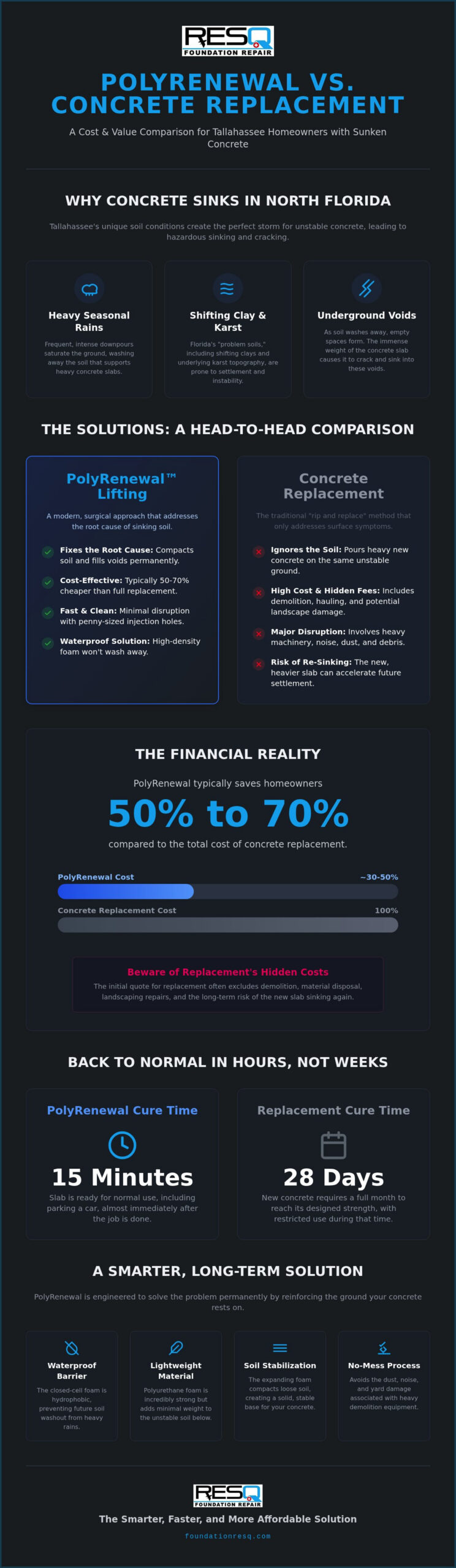
- Evaluate the true PolyRenewal vs concrete replacement cost to discover why professional lifting typically saves homeowners 50% to 70% over a full tear-out.
- Identify the specific “Rule of Threes” to determine if your driveway or sidewalk is a candidate for stabilization or if the structural damage requires a new pour.
- Understand why high-density polyurethane foam provides a waterproof, lightweight barrier that addresses the root cause of settlement rather than just the symptoms.
- Discover the advantages of a “no-mess” repair process that restores your property’s safety and curb value in hours rather than days.
PolyRenewal vs. Concrete Replacement: Understanding the Dilemma
A sinking driveway or a jagged sidewalk is more than a blemish on your curb appeal. It is a structural warning sign and a tripping hazard that won’t improve on its own. Most homeowners assume they must choose between living with the damage or paying for a complete overhaul. However, evaluating the PolyRenewal vs concrete replacement cost is the first step toward a permanent fix that addresses the root of the problem rather than just the surface symptoms. While replacement offers a fresh start, PolyRenewal provides a surgical intervention that stabilizes the ground beneath your feet.
In Tallahassee, our heavy seasonal rains and shifting clay soils create a perfect storm for structural settlement. When water washes away the supporting earth, voids form. A heavy concrete slab, no matter how new it is, cannot support its own weight over empty space. This is why many homeowners find themselves facing the same cracks just a few years after a fresh pour. Choosing the right remedy means understanding why the concrete failed in the first place.
What is PolyRenewal Concrete Lifting?
Modern concrete leveling has evolved beyond the heavy, messy methods of the past. PolyRenewal uses a high-density, closed-cell polyurethane foam that we inject through small, penny-sized holes in the slab. Once inside, the foam expands rapidly, filling every void and compacting the loose soil. This process provides an immediate lift while creating a stable, permanent base. It is particularly effective in North Florida because the foam is completely waterproof. It won’t wash away during a tropical downpour, ensuring your walkway stays level for the long term. You get a safe, aesthetically pleasing surface in hours, not days.
The Reality of Concrete Replacement
The “rip and replace” method is a labor-intensive process that involves heavy machinery, demolition noise, and significant yard disruption. You have to pay for the demolition and hauling of the old material, which often adds to the total project price. Beyond the financial impact, there is a structural risk. Pouring new, heavy concrete on top of the same unstable soil that caused the original failure is often a temporary fix. The new slab is even heavier than the old one, which can accelerate further sinking. For readers who determine that a complete structural rebuild is the only path forward, you can learn more about Cfc Camerino Flores Construction LLC to see how full-service firms manage these complex construction sites. Additionally, the environmental impact is substantial, as old concrete slabs often end up in local landfills. Understanding the PolyRenewal vs concrete replacement cost requires looking past the initial invoice to the long-term stability of your property.
The Cost Comparison: Upfront Price and Long-Term Value
Analyzing the PolyRenewal vs concrete replacement cost requires a look at the total project lifecycle. Most homeowners are surprised to find that professional lifting is typically 50% to 70% cheaper than a full replacement. This price difference exists because lifting focuses on the structural remedy rather than the destructive labor of removal. While traditional mudjacking might seem like a budget option, it often lacks the long-term ROI of PolyRenewal because it uses heavy materials that can cause further sinking in our soft local ground.
Tallahassee sits on a complex geological foundation that directly impacts repair longevity. The Florida Department of Environmental Protection notes that Problem Soils in Florida, including shifting clays and organic matter, are the primary culprits behind slab failure. If you pay for new concrete without addressing these soils, you are essentially buying an expensive temporary fix. PolyRenewal provides better value by compacting the existing soil and creating a stable base that resists future settlement.
Direct Cost Comparison Table
| Feature | PolyRenewal Lifting | Concrete Replacement |
|---|---|---|
| Upfront Cost | Typically 50% to 70% lower | Full market labor and material rates |
| Cure Time | Ready for use in 15 minutes | Requires 28 days for full strength |
| Mess Level | Minimal; tiny injection holes | High; dust, noise, and debris |
| Soil Stabilization | Compacts soil and fills voids | None; adds weight to unstable soil |
Why Replacement Costs More Than the Quote Suggests
Replacement costs often balloon beyond the initial estimate due to hidden site requirements. You have to account for demolition permits and the $2 to $4 per square foot required for hauling away heavy debris. There is also the risk of collateral damage to your property. Heavy concrete trucks can leave deep ruts in your lawn, leading to unexpected landscaping bills. Finally, consider the “Time Cost” of the project. New concrete takes weeks to cure, rendering your driveway or pool deck unusable for nearly a month. If you’re looking for a faster, more efficient path, a professional concrete assessment can provide a clear financial comparison for your specific property.
Why Tallahassee Soil Demands a Specialized Solution
Tallahassee’s environment presents challenges that national home repair guides often overlook. High humidity and intense seasonal rainfalls don’t just affect your lawn; they penetrate deep into the subgrade. In our region, karst topography creates natural underground voids as limestone dissolves over time. When you compare the PolyRenewal vs concrete replacement cost, you must account for this geological reality. Adding the weight of a new concrete slab, which often weighs several tons, on top of these fragile voids can trigger further settlement. PolyRenewal’s high-density foam is nearly 95% lighter than traditional concrete. It provides structural support without taxing the vulnerable soil beneath.
The unique soil composition in North Florida requires a remedy that won’t degrade when the ground becomes saturated. Unlike traditional fill materials, polyurethane foam is a closed-cell structure. It doesn’t just fill the space; it creates a protective barrier that prevents future erosion. This is a critical distinction for homeowners who want a fix that lasts through several hurricane seasons. By choosing a lightweight stabilization method, you’re protecting the long-term health of your property’s footprint.
Dealing with Florida’s Clay and Sand Mix
The “Tallahassee Red Clay” is notorious for its expansive properties. During the wet summer months, this clay absorbs water and swells, exerting upward pressure on your driveway or patio. As the soil dries out, it shrinks and leaves behind gaps that cause the concrete to snap under its own weight. Traditional mudjacking uses a heavy slurry of sand and cement to fill these gaps, but this added mass often causes the slab to sink even faster in soft Florida soils. We use a hydrophobic foam that is specifically engineered to resist water. It won’t wash away or degrade, creating a permanent, moisture-resistant barrier that remains stable regardless of the weather.
Protecting Your Home from Water Intrusion
A sunken slab is rarely just a trip hazard; it’s often a drainage nightmare. When a sidewalk or patio settles toward your home, it funnels thousands of gallons of rainwater directly against your foundation. This moisture is a leading cause of structural instability and mold growth. By using PolyRenewal to correct the pitch of your concrete, you ensure that water flows away from your living space. This proactive step is a critical component of a healthy home environment, much like crawl space encapsulation Tallahassee. Properly leveled concrete acts as the first line of defense, preventing the need for more invasive foundation repairs down the road. Addressing these issues now ensures the total PolyRenewal vs concrete replacement cost remains a smart investment in your home’s longevity.
Is Your Concrete a Candidate for PolyRenewal?
Not every sunken slab is a candidate for stabilization. While the PolyRenewal vs concrete replacement cost comparison usually favors lifting, you must first determine if the concrete itself is structurally sound. A quick glance can be deceiving. A slab that has tilted six inches but remains in one solid piece is often a perfect candidate for high-density foam injection. Conversely, a slab that is perfectly level but crumbling into dust requires a full replacement. Our goal is to provide a remedy that lasts for decades, not a temporary patch on a failing material.
The “Rule of Threes” is a helpful industry benchmark we use during assessments. If a single section of concrete has cracked into more than three distinct pieces, the structural integrity is often too compromised for a successful, even lift. In these cases, the foam may escape through the numerous fissures rather than providing the uniform pressure needed to raise the slab. A professional evaluation ensures you don’t spend money on a repair that cannot be guaranteed.
Signs Your Slab Should Be Lifted
Most concrete issues in Tallahassee are caused by soil settlement rather than material failure. If your concrete exhibits the following signs, it is likely a prime candidate for PolyRenewal:
- Uneven Joints: One slab has sunk below the adjacent one, creating a trip hazard.
- Visible Voids: You can see empty space or soil washout beneath the edges of your driveway or patio.
- Tilted Slabs: Large, solid sections of concrete have slanted toward or away from your foundation but remain intact.
- Minor Cracking: A single hairline crack that has divided a slab into two large, stable pieces.
When Replacement is the Better Investment
There are specific scenarios where the material has reached the end of its functional life. A properly installed concrete driveway in Florida typically lasts 25 to 30 years. While many homeowners stick with the same material, you can visit Riverside Asphalt Solutions to learn about the benefits of asphalt paving as a high-performance alternative. If your concrete is approaching this age and shows the following symptoms, replacement is likely the more cost-effective long-term choice:
- Spiderweb Cracking: Also known as “alligatoring,” this pattern of numerous intersecting cracks indicates the entire slab is failing.
- Severe Spalling: The top layer of the concrete is flaking off, exposing the aggregate underneath.
- Crumbling Edges: The concrete is physically breaking apart into gravel-sized pieces.
- Utility Issues: If broken drainage or sewer pipes beneath the slab caused the sinking, you must remove the concrete to fix the underlying infrastructure.
Before you commit to a project, it is vital to schedule a professional concrete inspection to verify the health of your slabs. We provide a methodical analysis of your property to ensure you choose the path that offers the best structural protection for your home.
The Foundation ResQ Advantage: Professional Leveling in Tallahassee
Choosing a contractor for structural work is about more than just comparing quotes. At Foundation ResQ, we act as a final line of defense for your home’s structural health. While the PolyRenewal vs concrete replacement cost is a major factor in your decision, the value of working with a steadfast local expert who understands North Florida’s geological quirks is equally important. We don’t just lift slabs; we restore the safety and stability of your property using professional-grade technology that generic handymen can’t access. Our approach focuses on a permanent remedy rather than a temporary patch.
The PolyRenewal Installation Process
Our method is designed to be surgical and non-invasive, ensuring your daily routine remains uninterrupted. The process follows three precise steps:
- Step 1: Drilling. We drill penny-sized holes in strategic locations across the sunken slab. These are far smaller and less noticeable than the large, unsightly holes required for old-fashioned mudjacking.
- Step 2: Precision Lifting. We inject the high-density foam while monitoring the lift with laser precision. This ensures the slab returns to its original position without over-correcting or creating new stress points.
- Step 3: Sealing. After the lift is complete, we seal the injection sites and joints. This step is vital for preventing future water intrusion, protecting the soil from the washout issues common in our humid climate.
A critical factor many homeowners overlook is the “Time Cost” of their project. As we noted in our comparison of cure times, new concrete requires a 28-day period to reach full strength. During those weeks, your driveway or patio is a construction zone you cannot use. PolyRenewal reaches full weight-bearing capacity in just 15 minutes. By the time our crew finishes the cleanup, you can drive your vehicle over the repaired area. This immediate return to service makes the total PolyRenewal vs concrete replacement cost even more attractive for busy families.
Peace of Mind with Local Experts
Since 2013, we’ve served the Tallahassee community with a focus on long-term structural outcomes. We understand how our local Red Clay and karst topography can undermine even the best-laid concrete. As part of the Groundworks network, we combine our deep regional knowledge with proprietary technology and national resources. This partnership allows us to offer structural stabilization that meets the highest industry standards while maintaining the personal touch of a neighborhood service provider. If you’re ready to protect your home’s value and eliminate trip hazards, schedule your free concrete inspection today!
Secure Your Home’s Value with Professional Concrete Leveling
Choosing the right path for your sunken driveway or patio is about more than just aesthetics; it’s about the long-term structural health of your property. We have explored how the PolyRenewal vs concrete replacement cost comparison favors a surgical, lightweight approach that addresses Tallahassee’s unique soil instability. By filling underground voids and compacting the subgrade, you aren’t just resetting a clock. You are installing a waterproof barrier that protects your home from future washout and settlement.
Foundation ResQ provides peace of mind through our A+ rated local service and the Groundworks proprietary PolyRenewal system. You don’t have to wait weeks for a messy construction project to cure. Our professional-grade solution offers a 15-minute cure time, allowing you to return to your normal routine almost immediately. Your property is a significant investment that deserves a permanent remedy rather than a temporary patch. Take the next step toward a safer, level walking surface today. Request Your Free Concrete Leveling Estimate and let our experts restore the integrity of your home’s concrete with confidence.
Frequently Asked Questions
Is PolyRenewal concrete lifting cheaper than replacement?
Yes, PolyRenewal is significantly more affordable than a full tear-out and pour. When you compare the PolyRenewal vs concrete replacement cost, lifting generally saves you 50% to 70% because it eliminates the high labor costs of demolition and debris hauling. You also avoid the $2 to $4 per square foot fees often associated with concrete disposal in Florida.
How long does PolyRenewal last compared to new concrete?
PolyRenewal is engineered to be a permanent structural remedy. While a new concrete driveway in Florida typically has a lifespan of 25 to 30 years, that longevity depends entirely on the soil base. By stabilizing the subgrade and filling voids, PolyRenewal often outlasts the remaining life of the existing concrete by preventing the erosion that caused the initial settlement.
Will the foam wash away during a Florida hurricane or heavy rain?
No, the high-density polyurethane foam will not wash away. It is a hydrophobic, closed-cell material that is completely waterproof once it cures. This is a critical advantage during intense Florida thunderstorms or hurricane-related flooding. Unlike traditional mudjacking slurry, which can erode over time, this foam remains a stable, protective barrier between your slab and the elements.
How soon can I drive on my driveway after PolyRenewal?
You can drive on your driveway just 15 minutes after the installation is complete. This is one of the most significant advantages over traditional replacement, which requires a 28-day curing period to reach full strength. This rapid return to service eliminates the logistical headaches of being unable to use your own property for weeks at a time.
Can PolyRenewal fix large cracks in my concrete?
PolyRenewal effectively lifts and levels slabs with cracks, but it doesn’t physically fuse the broken pieces back together. We can stabilize the sections and seal the joints to prevent water intrusion. However, if a slab follows the “Rule of Threes” and is broken into too many small fragments, a full replacement may be the more appropriate structural choice for your home.
Does concrete leveling require a permit in Tallahassee?
Concrete leveling typically doesn’t require a permit in Tallahassee because it’s considered a repair rather than new construction. However, a full concrete replacement often requires a demolition permit and adherence to local codes for new pours. Choosing a professional lifting service simplifies the process by avoiding the bureaucratic delays and additional fees associated with major residential construction projects.
Is PolyRenewal environmentally friendly?
Yes, PolyRenewal is an environmentally responsible choice for home repair. The material is inert once cured, meaning it won’t leach harmful chemicals into the Tallahassee soil or groundwater. Additionally, by choosing to lift your existing slabs, you prevent tons of concrete waste from being transported to and taking up space in local Florida landfills.
What happens if the concrete sinks again after lifting?
If concrete settles after lifting, it’s usually because the underlying soil issues weren’t fully addressed. Our professional installation targets the root cause by compacting loose soil and filling voids with stable foam. This methodical approach significantly reduces the risk of future sinking. We provide a thorough structural assessment to ensure the PolyRenewal vs concrete replacement cost remains a one-time investment.