
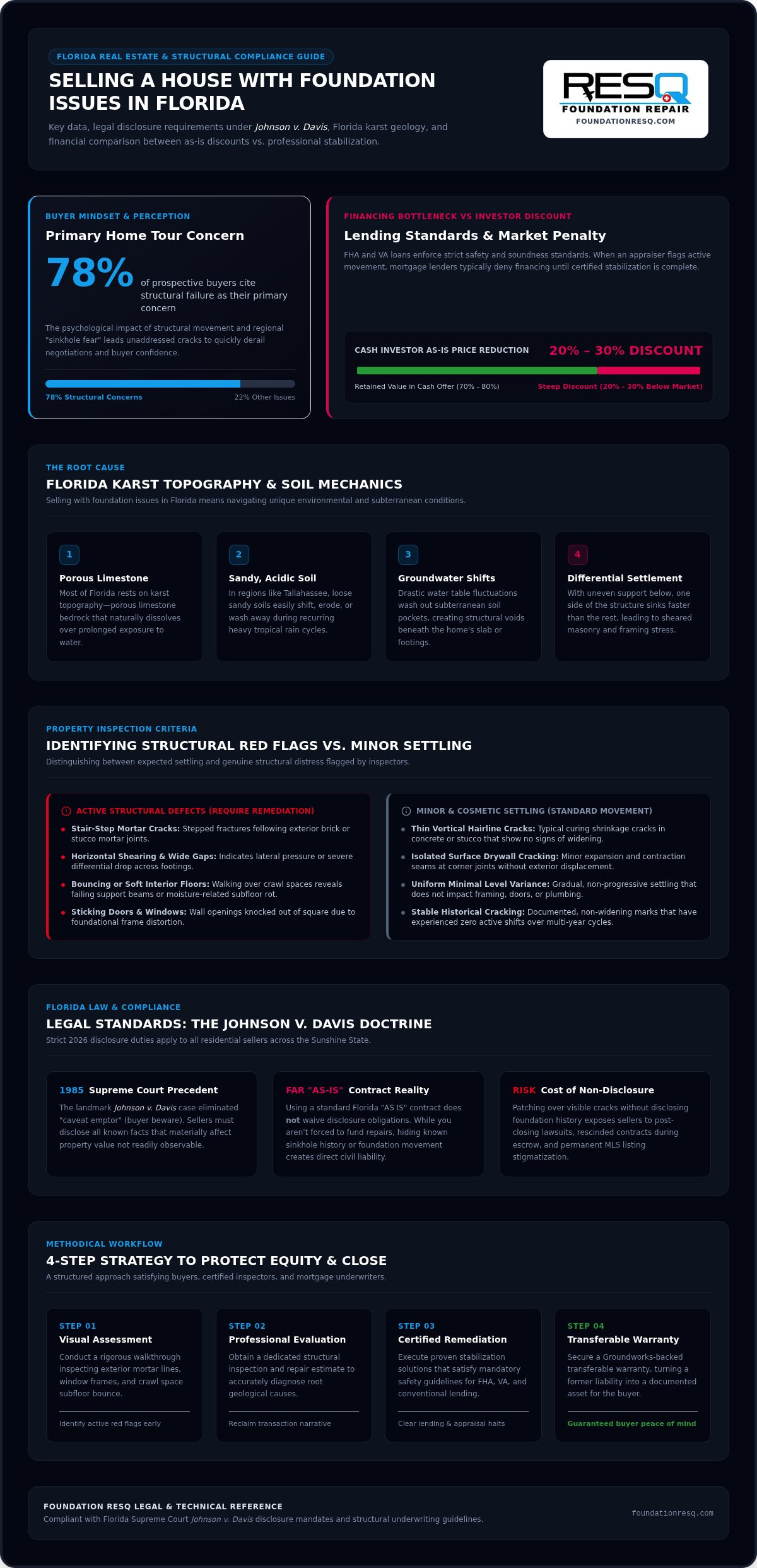
Did you know that 78% of prospective buyers cite structural failure as their primary concern when touring a home? If you’re selling a house with foundation issues in Florida, that statistic might feel like a major roadblock to your closing day. It’s natural to worry that a few cracks in the masonry or a sticking door will lead to low-ball offers from investors or, even worse, a lawsuit after the keys change hands. You’ve worked hard to build equity in your home, and seeing it potentially evaporate due to Florida’s volatile soil conditions is a significant concern.
We understand that you want a smooth, legal transaction without the anxiety of a deal falling through during the mandatory inspection period. This guide provides a clear path to navigating Florida’s strict 2026 disclosure requirements and the legal standards established by Johnson v. Davis. You’ll learn how professional stabilization serves as a remedy that satisfies home inspectors while protecting your financial interests. We will explore the specific repair methods that add real value, ensuring you can offer a transferable warranty that gives your buyer the confidence they need to close the sale with total peace of mind.
Key Takeaways
- Understand your legal obligations under Florida’s Johnson v. Davis standard, which requires disclosing known structural defects even when using “as-is” contracts.
- Learn why selling a house with foundation issues in Florida without professional repairs often results in a steep price reduction that far exceeds the cost of stabilization.
- Discover the specific geological challenges of Florida’s limestone and sandy soil that create the settlement patterns home inspectors and insurance underwriters flag.
- Follow a methodical four-step strategy to obtain professional evaluations and repair estimates that satisfy mortgage lenders and protect your home’s equity.
- See how a transferable, Groundworks-backed warranty can turn a structural concern into a documented asset that provides buyers with long-term peace of mind.
The Reality of Selling a House with Foundation Issues in Florida
Florida’s landscape is beautiful, but the ground beneath it is notoriously unstable. Most of the state sits on karst topography, a geological formation where porous limestone bedrock is prone to dissolving over time. When you’re selling a house with foundation issues in Florida, you aren’t just dealing with a building problem; you’re battling the environment. In areas like Tallahassee, heavy tropical rain cycles and fluctuating groundwater levels cause the sandy, acidic soil to shift or wash away. This creates underground voids that lead to differential settlement, where one part of the home sinks faster than the rest.
Understanding the basic principles of residential foundation engineering is vital for local homeowners. It helps you distinguish between expected minor settling and genuine structural distress. In Florida, the psychological weight of “sinkhole fear” means that even small cracks can derail a transaction. If you ignore these signs, the property will likely fail the buyer’s inspection. This leads to a collapsed sale and a “stigmatized” listing on the MLS that becomes much harder to move later.
Common Structural Red Flags in Florida Homes
Identifying trouble starts with a visual walk-through of the property. Look for stair-step cracks following the mortar lines in your exterior brickwork or stucco. While thin, vertical hairline cracks might be cosmetic, wide gaps or horizontal shearing often indicate active movement that requires professional intervention. Inside the home, pay attention to the floors. If you feel a “bounce” or soft spot while walking over a crawl space, it’s a significant red flag for buyers. It often points to failing support beams or moisture-related rot in the subfloor, both of which suggest the home’s structural health is compromised.
Buyer Perception vs. Market Reality
Structural concerns aren’t just about aesthetics; they’re about financing. Traditional buyers using FHA or VA loans face strict safety and soundness standards. If an appraiser flags a foundation defect, the lender will likely deny the mortgage until a certified repair is complete. This leaves you with limited options. You can sell to a cash investor at a steep “as-is” discount, which typically ranges from 20% to 30% below market value, or you can stabilize the home yourself to preserve your equity. Getting a professional assessment allows you to reclaim the narrative. By identifying the root cause early, you can present a clear remedy rather than letting a buyer’s imagination run wild with worst-case scenarios.
Understanding Florida Disclosure Laws and Your Legal Obligations
Florida law is very clear about a seller’s duty to be transparent during a real estate transaction. The landmark 1985 Florida Supreme Court case, Johnson v. Davis, fundamentally changed how homes are sold in the Sunshine State. It established that sellers have a legal obligation to disclose any known facts that materially affect the value of a residential property if those facts aren’t easily observable by the buyer. When you’re selling a house with foundation issues in Florida, you can’t simply rely on the old “buyer beware” mentality. Even if you’ve patched every visible crack, the underlying history of structural movement remains a material fact that requires disclosure.
The ‘Material Defect’ Standard in Florida
A material defect is any issue that would reasonably change a buyer’s decision to purchase the home or the price they’re willing to pay. Foundation instability is the definition of a material defect. Because our state is prone to problem soils and subsidence in Florida, structural integrity is a primary focus for insurance underwriters and mortgage lenders. Many homeowners mistakenly believe that using a standard Florida Association of Realtors (FAR) “AS IS” contract waives their duty to disclose. It doesn’t. While an “AS IS” contract means you aren’t contractually obligated to fund repairs, it doesn’t shield you from liability if you fail to mention a known sinkhole or significant settlement. Non-disclosure can lead to costly post-closing litigation or the buyer rescinding the contract entirely during the escrow period.
The Role of the Structural Engineering Report
Documentation is your most effective tool for protecting your equity and your legal standing. While a general home inspection provides a broad overview of the property, it doesn’t offer the technical depth of a structural evaluation. A licensed engineer’s report identifies the root cause of movement and provides a clear, professional remedy. By presenting this documentation upfront, you create a paper trail of honesty that builds buyer trust. It removes the element of “fear of the unknown” that often kills deals. If you’ve already completed repairs, having a certified engineering evaluation and a transferable warranty proves to the buyer that the home is stable and insurable. This proactive approach turns a potential legal liability into a documented asset, allowing you to close your sale with confidence.
Repairing vs. Selling ‘As-Is’: A Financial Comparison
Many homeowners believe that selling a property “as-is” is the fastest way to offload a burden. However, when you’re selling a house with foundation issues in Florida, the financial reality is often harsher than expected. Buyers aren’t just looking at the cost of the repair. They’re looking at the risk. This uncertainty leads to what industry experts call the “Investor Tax.” While you might save time by skipping repairs, you’ll likely face an immediate reduction in your sale price of 20% to 30% below market value. Investors and cash buyers demand this buffer to account for engineering contingencies, carrying costs, and profit margins.
Professional stabilization offers a much higher return on investment than many realize. By addressing the root cause of the settlement, you satisfy the stringent requirements of Florida disclosure laws and legal obligations. This transparency doesn’t just keep you out of court; it unlocks traditional financing. Most retail buyers rely on FHA, VA, or conventional loans, which require the home to be structurally sound. Without certified repairs, you’re forced to ignore the majority of the buyer pool, leaving you at the mercy of institutional flippers who thrive on steep discounts.
Selling ‘As-Is’ to Cash Buyers
Choosing to sell “as-is” can be the right move during extreme financial hardship or when the damage is too severe for typical remediation. “We buy houses” investors provide the benefit of a fast, cash-only closing with no inspection contingencies. It’s a clean break. But remember, these investors use a specific formula to calculate their offers. They subtract the estimated repair costs plus a significant risk premium from the home’s potential retail value. If the repair is actually straightforward, you’re essentially leaving tens of thousands of dollars on the table just for the sake of convenience.
The Value of Professional Remediation
Professional structural solutions turn a liability into a documented selling feature. Helical piers or push piers provide a permanent remedy by transferring the weight of the home to stable soil or bedrock. This isn’t a temporary patch; it’s a structural upgrade that mortgage lenders and home inspectors respect. For walls showing signs of bowing or cracking, carbon fiber wall reinforcement is a cost-effective way to stabilize the structure without invasive excavation. You can also use PolyRenewal concrete lifting to fix uneven walkways or trip hazards on the slab. These visible improvements boost curb appeal and reassure buyers that the home has been meticulously protected against Florida’s shifting ground.
Preparing Your Home for the Market: A 4-Step Strategy
Successfully selling a house with foundation issues in Florida requires a shift from reactive worrying to proactive management. You can’t control the geology of your lot, but you can control the data you present to potential buyers. By following a structured four-step strategy, you remove the “fear of the unknown” that typically drives prices down and causes deals to collapse during the inspection period.
- Step 1: Obtain a professional structural evaluation. This is a technical diagnosis of the root cause of any settlement or cracking. It provides a clear baseline for what needs to be addressed.
- Step 2: Get a detailed repair estimate. Even if you don’t intend to perform the work, having an official quote from a licensed Florida contractor prevents buyers from overestimating repair costs during negotiations.
- Step 3: Decide on your disclosure strategy. Work with your real estate agent to ensure your property’s history is documented correctly on the mandatory forms, protecting you from future legal claims. For those selling property in Mississippi, zakksellshomes.com offers expert brokerage services to help navigate these complex requirements.
- Step 4: Execute repairs or price transparently. Use the data you’ve gathered to either stabilize the home and preserve your equity or set a fair “as-is” price that accounts for the documented structural needs.
Consulting with a Tallahassee Specialist
Localized knowledge is vital because our region’s limestone and sandy soil behave differently than the clay-heavy soils found in other parts of the country. When interviewing a foundation repair contractor, ask if they handle the necessary Florida building permits and if their solutions meet local building codes. A professional remedy must be backed by engineering calculations that satisfy both city officials and future home inspectors. Hiring a specialist who understands Tallahassee’s specific environmental challenges ensures the repair is permanent and legally compliant.
Marketing a Home with a Repaired Foundation
Once repairs are complete, the narrative of your listing changes. Instead of a “damaged” home, you’re offering a “structurally upgraded” property that has been professionally stabilized. Include the transferable warranty and the final engineering sign-off in the supplements section of your MLS listing. This transparency disarms skepticism immediately. Train your agent to explain that the home is now more stable than its neighbors because it’s supported by deep-foundation technology. This proactive approach turns a potential hurdle into a powerful selling point that reassures buyers and their lenders.
If you’re ready to secure your property’s future and protect your equity, schedule a professional structural evaluation to get the facts before you list your home.
How Foundation ResQ Stabilizes Your Real Estate Transaction
When you’re selling a house with foundation issues in Florida, you need more than just a contractor; you need a partner who understands the high stakes of a real estate closing. Foundation ResQ operates on a remedy-based framework that focuses on the permanent resolution of structural problems. We don’t just treat the cracks in your walls or the slope in your floors. We identify the root cause of the instability and provide the certified documentation required to satisfy home inspectors and mortgage underwriters. Our foundation repair Tallahassee services are specifically designed to restore the physical health of your home while protecting your financial interests during the sale.
One of the most effective tools we offer to sellers is the Groundworks transferable warranty. In a market where buyers are naturally skeptical of past structural issues, this warranty acts as a powerful closing tool. It provides the next owner with long-term peace of mind, knowing that the stabilization work is backed by a national leader in foundation repair. By providing this “proof of stability” upfront, you remove the biggest hurdle to a successful transaction and ensure your equity remains protected.
Permanent Solutions for Sinking Foundations
Florida’s geological challenges require specialized technology that goes deeper than the surface. We use helical and push pier systems to bypass unstable, sandy soil and reach load-bearing strata or bedrock. This process provides a permanent remedy for sinking foundations that traditional “quick fixes” simply cannot match. For properties with uneven slabs or sinking walkways, we utilize PolyRenewal concrete lifting. This high-density polyurethane foam levels concrete with minimal disruption, allowing you to fix trip hazards and improve curb appeal just days before a showing. These solutions are methodical and thorough, ensuring your home passes even the most rigorous third-party inspections.
Protecting the Sale with Moisture Control
Structural health isn’t just about the foundation; it’s also about the environment beneath your home. Many Florida sales collapse because of the damp, musty odors associated with mold in a crawl space. Our crawl space encapsulation services eliminate these issues at the source. By installing a durable vapor barrier and high-performance dehumidifiers, we create a protective barrier between your home and the elements. We often integrate sump pump systems to manage Tallahassee’s intense seasonal rain cycles. A dry, healthy crawl space is a premium feature that signals to buyers that every aspect of the home’s integrity has been professionally maintained. This proactive approach turns a potential liability into a documented asset that supports a higher final sale price.
Secure Your Equity and Close with Confidence
Successfully selling a house with foundation issues in Florida depends on your ability to replace buyer uncertainty with professional proof. By choosing stabilization over a steep “as-is” discount, you satisfy strict disclosure requirements and unlock traditional financing for your potential buyers. A documented, permanent remedy is the most effective way to preserve the equity you’ve built in your home. You don’t have to navigate the complexities of Florida’s shifting soil alone.
As A+ rated local Tallahassee experts, Foundation ResQ provides the specialized Florida structural stabilization needed to satisfy home inspectors and mortgage underwriters alike. Our methodical approach ensures that every repair is permitted and compliant with local building codes. We invite you to schedule your free structural inspection with Foundation ResQ today to begin your journey toward a successful sale. With our Groundworks-backed transferable warranties, you can present your home as a secure, long-term investment. You’ve worked hard for your home; now let’s make sure you’re rewarded for it on closing day.
Frequently Asked Questions
Do I have to disclose foundation repairs that were already completed in Florida?
Yes, you’re legally required to disclose completed foundation repairs. Florida law mandates that sellers reveal any facts that materially affect a property’s value, including past structural issues. Providing documentation of the repair and the transferable warranty actually protects you from future liability. It shows you were proactive in stabilizing the home. Buyers appreciate the transparency, especially when you can provide a Groundworks-backed guarantee that the issue has been professionally resolved.
Can a buyer back out of a Florida contract if they find foundation issues?
Buyers typically have a 10 to 15-day inspection window under the standard FAR/BAR contract to cancel for any reason. If an inspector flags structural settlement or foundation cracks, the buyer can unilaterally terminate the agreement and retrieve their full escrow deposit. This is why many sellers choose to perform a professional evaluation before listing. Addressing these concerns early prevents a collapsed sale and keeps your transaction on track for a successful closing.
Will homeowners insurance cover the cost of foundation repair before I sell?
Most standard Florida homeowners insurance policies exclude coverage for general foundation settlement or earth movement. However, if the damage is caused by a confirmed sinkhole, your policy might provide specific coverage based on Florida Statute requirements. It’s best to review your policy details with your insurance agent or a legal professional. Since insurance often won’t cover typical age-related shifting, homeowners often invest in professional stabilization to maintain their property’s marketability and retail value.
What is the most common cause of foundation failure in Tallahassee homes?
The primary cause of foundation failure in Tallahassee is the region’s unique geological composition. Our local geography consists of porous limestone bedrock covered by acidic, sandy soils and organic clay layers. Heavy tropical rain cycles cause these soils to expand, contract, or wash away, creating underground voids. This leads to differential settlement where parts of the home sink at different rates. Professional piering systems are designed to bypass these unstable layers to reach load-bearing strata.
How much does a foundation repair warranty affect the home’s resale value?
A transferable, Groundworks-backed warranty significantly impacts your ability to sell at a retail price. While we don’t promise a specific dollar increase, a warranty removes the risk buffer that buyers and investors use to justify lower offers. When selling a house with foundation issues in Florida, having a certified warranty proves the home is stable and insurable. It transforms a structural liability into a documented asset that satisfies mortgage lenders and home inspectors during the final walk-through.
Can I get a mortgage on a Florida home with a known foundation problem?
Traditional lenders like FHA and VA have strict structural soundness standards. If an appraiser identifies active foundation cracks or uncertified settlement, they’ll likely deny the loan. This often limits your buyer pool to cash investors who demand steep discounts. To unlock traditional financing, you usually need a licensed engineer’s certification or proof of professional repair. Addressing these issues before listing ensures your home qualifies for the widest possible range of mortgage products and retail buyers.
How long does a typical foundation stabilization project take to complete?
Most residential foundation stabilization projects are completed within two to five business days. The exact timeline depends on the number of helical or push piers required and the depth of the load-bearing soil. More localized solutions, such as PolyRenewal concrete lifting, can often be finished in a single day with minimal disruption to your property. Our team focuses on a methodical, efficient process that restores your home’s integrity quickly so you can proceed with your listing and sale.
What is the difference between settling and a serious foundation issue?
Minor settling is often uniform and results in small, vertical hairline cracks that don’t affect structural integrity. Serious foundation issues involve differential settlement, where parts of the home shift independently. You’ll notice stair-step cracks in exterior masonry, sticking doors, or bouncy floors over crawl spaces. When selling a house with foundation issues in Florida, it’s vital to have a professional distinguish between these two. A structural evaluation provides the technical data needed to determine if the home requires stabilization.