
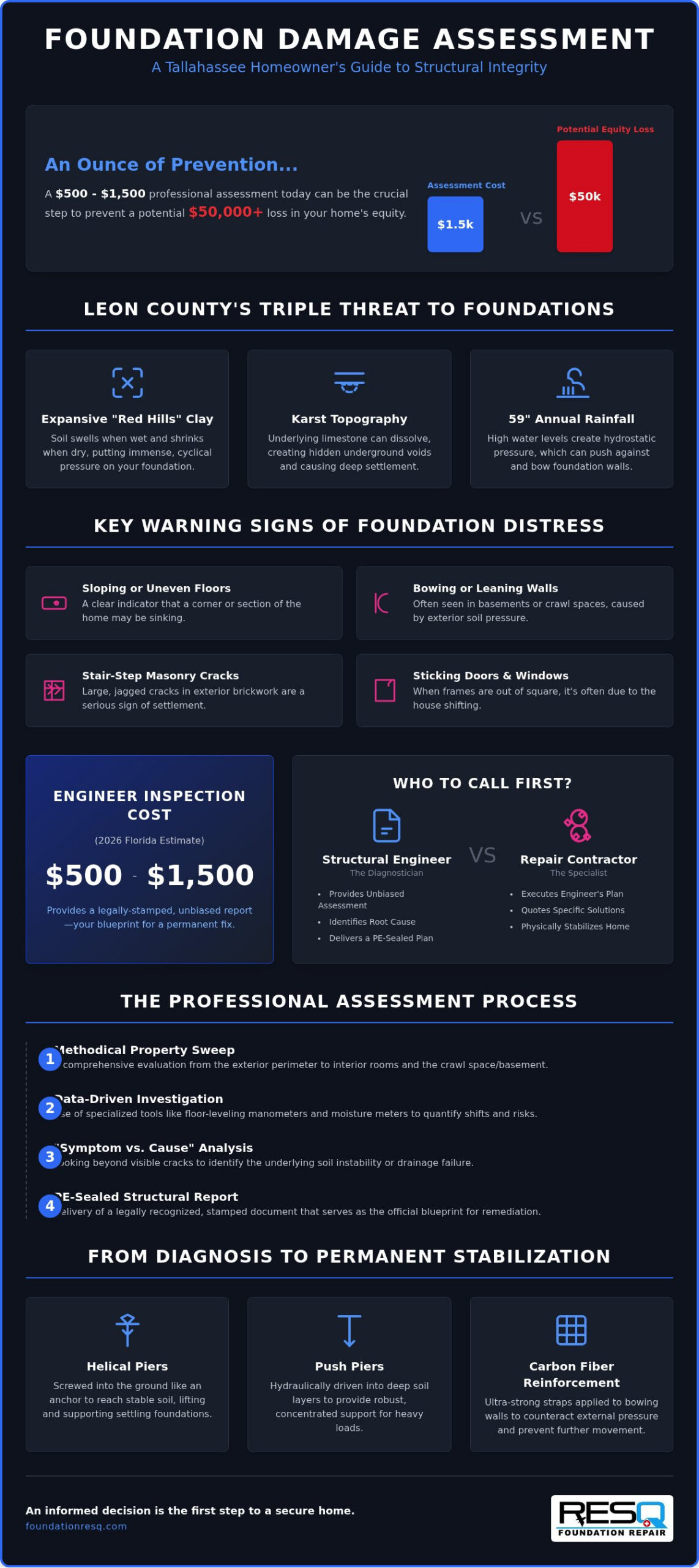
What if paying $1,500 today is the only thing standing between you and a $50,000 loss in home equity? For many Leon County homeowners, spotting a new crack in the drywall or a sticking door leads to an immediate search for a foundation damage assessment Tallahassee experts can trust. It’s a high-stakes situation where the fear of being overcharged often rivals the anxiety of the structural issue itself.
We understand that your home is your most significant investment, and the shifting Red Hills clay beneath it doesn’t make maintenance easy. You deserve a clear, professional path toward stability without the confusion of conflicting repair quotes. This guide provides the exact 2026 price ranges for structural engineer fees in Florida, typically spanning from $500 to $1,500, and explains why Leon County’s unique karst topography makes this professional oversight essential for your safety.
You’ll learn how to distinguish between a general home inspector and a structural engineer, why Tallahassee’s 59 inches of annual rainfall impacts your foundation’s health, and how to use an engineering report to ensure your home receives the permanent restoration it requires. We’ll provide a roadmap that moves you from uncertainty to a state of informed, confident resolution.
Key Takeaways
- Learn why Leon County’s expansive Red Hills clay and underlying karst topography require a specialized approach to ensuring long-term structural stability.
- Discover the specific tools and methodical steps involved in a professional foundation damage assessment Tallahassee homeowners use to identify the root cause of settling.
- Understand the current 2026 fee structures for licensed structural engineers and the variables that influence the cost of a certified, stamped report.
- Gain clarity on the distinct roles of an independent engineer versus a specialized repair contractor to choose the most efficient path for your home.
- Identify how professional inspection findings translate into permanent stabilization remedies, such as helical piers, push piers, and carbon fiber reinforcement.
Understanding Foundation Inspection Needs in Tallahassee
A structural engineer’s foundation inspection in Leon County is a specialized diagnostic process designed to evaluate the physical integrity of a building’s load-bearing components. Unlike a general home inspection, this assessment is performed by a licensed professional who understands the complex relationship between a structure and the earth beneath it. In our region, a foundation damage assessment Tallahassee homeowners request often serves as a vital insurance policy against the hidden geological risks unique to North Florida.
While many residents seek these inspections to secure peace of mind during real estate transactions, the primary driver is often the visible evidence of movement. Tallahassee is famous for its “Red Hills” clay. This soil is highly expansive, meaning it swells significantly when saturated and shrinks during dry spells. This constant cycle of expansion and contraction puts immense pressure on footings and slabs, leading to the cracks and shifts that signal a need for professional intervention.
The Role of Leon County Geology
Your home sits on one of the most geologically complex areas in Florida. The proximity of the Apalachicola National Forest and our local aquifer systems means that groundwater levels fluctuate constantly. This movement of water through the soil contributes to hydrostatic pressure, which can push against foundation walls and cause them to bow or rotate inward.
Tallahassee’s “karst terrain” adds another layer of complexity. This geological formation consists of soluble limestone that can dissolve over time, creating underground voids. An engineer’s specialized eye is required to determine if a crack is a simple result of clay shrinkage or a warning sign of deep-seated settlement related to these limestone cavities. With Tallahassee receiving an average of 59 inches of rain annually, the management of soil moisture is a permanent challenge for structural stability.
When a Visual Inspection Isn’t Enough
There are moments when a simple walkthrough isn’t sufficient to guarantee safety. An engineer’s review goes beyond what a building inspection covers during a standard home sale. You should consider a formal engineering report if you notice any of the following:
- Severe bowing or inward leaning of basement or crawl space walls.
- Significant sloping of interior floors that indicates a corner of the home is sinking.
- Large, stair-step cracks in exterior brickwork or masonry.
- A requirement for a stamped, legal document to satisfy mortgage lenders or building departments.
An independent foundation damage assessment Tallahassee provides a “seal of authority” that contractors must follow. Because an engineer does not sell repair services, their report offers an unbiased baseline. This document protects you from unnecessary over-repair suggestions and ensures that any stabilization work, such as the installation of helical piers, is based on mathematical necessity rather than guesswork. We frequently use these engineering blueprints to execute precise, long-term remedies that restore a home’s structural health.
What Happens During a Professional Foundation Inspection?
A professional foundation damage assessment Tallahassee homeowners schedule is much more than a cursory visual check. It is a data-driven investigation that adheres to professional engineering standards to ensure your home remains safe and level. The process begins with a methodical sweep of the property, moving from the exterior perimeter into the interior living spaces, and finally down into the crawl space or basement. This comprehensive approach ensures that no hidden structural flaw goes unnoticed.
Engineers focus on a “Symptom vs. Cause” analysis. While a homeowner sees a crack, the engineer looks for the underlying soil instability or drainage failure that forced the masonry to break. They utilize specialized equipment, such as floor-leveling manometers to detect minute shifts in elevation and moisture meters to identify wood decay in crawl spaces. The final deliverable is a PE-sealed (Professional Engineer) structural report. This document acts as a legally recognized blueprint for any necessary remediation, providing you with an unbiased foundation for your repair decisions.
Exterior and Interior Structural Assessment
On the exterior, the engineer looks for stair-step cracks in Tallahassee’s common brickwork or wide gaps where the fascia boards meet the roofline. These are often the first signs that a foundation is settling unevenly. Inside the home, they evaluate door and window alignment. If a door suddenly sticks or a window won’t lock properly, it’s often a sign that the support piers have shifted. In the crawl space, the focus turns to structural decay, checking for wood rot or fungal growth caused by North Florida’s high humidity levels. After completing a foundation damage assessment Tallahassee engineers provide a clear path forward that distinguishes between cosmetic issues and genuine structural threats.
Elevation Mapping and Soil Analysis
Elevation mapping is a critical tool for identifying foundation settlement zones by creating a precise record of how much a floor has dipped from its original position. The engineer uses this data to produce a contour map of your home’s current level, highlighting exactly where the structure is sinking. They also analyze drainage patterns around the property line, as poor water runoff is a primary driver of soil erosion in Leon County. If your report identifies a need for stabilization, you can review these findings with a team specializing in foundation repair Tallahassee homeowners trust for permanent stabilization. This ensures that any work performed, such as the installation of helical piers, directly addresses the engineer’s specific calculations.
Structural Engineer Foundation Inspection Cost Tallahassee (2026)
In 2026, a standard residential structural engineer inspection in Tallahassee typically ranges between $450 and $850. This fee covers the expert’s time on-site and the production of a stamped structural report. However, several local variables can influence your final quote. If an engineer is traveling from a nearby hub like Jacksonville or Pensacola, you might encounter additional travel fees ranging from $100 to $250. It’s often more cost-effective to secure a professional who specializes in the specific foundation damage assessment Tallahassee requirements of Leon County.
Factors Influencing Your Inspection Quote
The size and type of your home are the primary drivers of cost. Tallahassee features a mix of modern concrete slabs and historic pier-and-beam crawl spaces. Inspecting a crawl space is more labor-intensive, as the engineer must physically navigate the area to check for failing piers or moisture-related decay. A large multi-story home or a commercial property will naturally command a higher fee due to the increased number of load-bearing points that require evaluation.
Complexity also plays a major role in the pricing structure. If your home shows a single hairline crack, the assessment is relatively straightforward. If you’re dealing with whole-house settlement involving multiple elevation drops, the diagnostic time increases significantly. Leon County’s specific permitting requirements and the upcoming 9th Edition of the Florida Building Code can also influence report depth. Some firms may include a small surcharge to cover the administrative work needed to ensure reports meet these evolving local standards.
Visual vs. Forensic Inspections
Homeowners usually choose between two levels of technical depth depending on their specific needs:
- Visual Inspection ($400-$600): This is the most common choice for general peace of mind or real estate sales. The engineer looks for visible signs of distress and provides a professional opinion on the structural health of the building.
- Forensic Analysis ($800-$1,500+): This deep dive is required for legal disputes, insurance claims, or catastrophic structural failures. It often involves non-destructive testing, soil borings, or detailed elevation mapping.
While the upfront cost of a forensic report is higher, it can save you thousands of dollars in the long run. It provides the definitive evidence needed for litigation or insurance payouts and prevents expensive repair errors. A detailed foundation damage assessment Tallahassee provides the technical blueprint we use to implement permanent remedies, such as helical pier installation or carbon fiber wall reinforcement, ensuring the work is performed exactly where it’s needed most.
Engineer vs. Contractor: Which Inspection Do You Need?
Deciding between a structural engineer and a foundation contractor is a common point of confusion for Leon County homeowners. These two professionals play distinct roles in the health of your home. A structural engineer acts as a neutral diagnostic expert. Their foundation damage assessment Tallahassee report provides a scientific analysis of the building’s integrity without the influence of a sales goal. They provide the “what” and the “why” behind structural movement, but they don’t perform the physical labor to fix it.
A foundation specialist, or contractor, is focused on the “how.” While an engineer provides a blueprint, a contractor like Foundation ResQ provides the practical roadmap and the specific cost to execute the work. We use a free estimate model to help homeowners understand the financial scope of their project without an initial diagnostic fee. Many people ask if they must pay for both. While not always mandatory, the two services often work in tandem; the engineer’s report serves as the authoritative guide that the contractor uses to provide an accurate, line-item bid for restoration.
When to Call a Structural Engineer First
You should prioritize a licensed engineer if you are currently involved in a real estate transaction. Florida disclosure laws are strict, and a stamped report provides the legal protection needed for both buyers and sellers. An engineer is also the correct first call if you suspect major karst-related movement or a potential sinkhole. These high-stakes geological issues require the forensic depth of an independent party. Finally, if you’re filing an insurance claim for structural failure, most providers will require an unbiased foundation damage assessment Tallahassee report before they approve a payout.
When to Call a Foundation Specialist (Contractor)
If you have already identified a clear structural issue and are ready to move toward a permanent solution, a foundation specialist is your best resource. You should contact a contractor when you need a detailed quote for helical pier installation to stabilize a sinking corner of your home. Specialists are also the right choice for preventative maintenance and moisture control, such as crawl space encapsulation or concrete leveling using PolyRenewal. This remedy-based approach focuses on stopping the damage at the source and protecting your home’s resale value. If you’re ready to transition from diagnosis to a stable home, schedule a free structural evaluation with our local team today.
From Inspection to Stabilization: Next Steps for Tallahassee Homes
A structural engineer’s report is more than a list of faults; it is the definitive blueprint for your home’s recovery. Once you receive your completed foundation damage assessment Tallahassee report, your next step is to find a team capable of executing those technical specifications with precision. You should use this document to vet potential foundation repair Tallahassee contractors, ensuring they have the specialized equipment and local expertise to install the specific piering systems or reinforcements the engineer recommends.
Matching the right technology to the engineer’s findings is critical for a permanent result. If the report identifies deep-seated settlement in Tallahassee’s expansive clay, helical piers are often the primary remedy because they can reach stable soil depths far below the active “shrink-swell” zone. Conversely, if the assessment highlights lateral pressure from high groundwater levels, the solution may involve stabilizing foundation walls from the inside. Many inspections also reveal that moisture in the crawl space is the root cause of structural decay. In these cases, a permanent fix requires addressing both the support structure and the environmental conditions through comprehensive remediation rather than just applying a cosmetic patch.
Implementing the Engineer’s Recommendations
At Foundation ResQ, we treat the engineer’s data as our primary guide for pier placement and load calculations. This methodical approach ensures that every support is positioned to provide maximum stability. If your report identifies walls that are deflecting or bowing inward due to hydrostatic pressure, we often implement carbon fiber wall repair to provide a permanent, non-invasive reinforcement that stops further movement. Every stabilization project we undertake is designed to meet or exceed current Florida Building Codes, including the rigorous standards required by Leon County. We ensure that the final execution of the engineer’s plan provides the long-term safety your property deserves.
Protecting Your Home Value Long-Term
Choosing a remedy-based solution over a temporary fix is vital for your home’s future resale value. Tallahassee buyers are increasingly aware of local soil risks, and a professional repair backed by a transferable warranty provides the peace of mind they require during a transaction. When a future home inspector reviews your property, they’ll look for evidence that structural issues were addressed permanently by specialists rather than hidden behind fresh paint or drywall. This proactive approach turns a potential liability into a documented asset. Ready to move from inspection to action? Contact Foundation ResQ for a professional stabilization estimate today.
Securing the Structural Integrity of Your Tallahassee Home
Navigating the complexities of North Florida’s geology doesn’t have to be a source of stress. By understanding the current 2026 fee structures for structural engineers and the impact of our local karst topography, you’ve taken the first step toward protecting your property. A professional foundation damage assessment Tallahassee provides the scientific clarity needed to distinguish between minor cosmetic issues and serious structural threats. Whether you’re satisfying real estate disclosure laws or addressing visible settlement, this data-driven approach ensures your investment remains stable for decades.
Once you have your engineering report in hand, it’s time to transition from diagnosis to permanent resolution. As a locally owned specialist, Foundation ResQ understands the specific challenges of Tallahassee’s Red Hills clay. We provide professional-grade stabilization solutions and 25-year warranties. Our team is ready to translate your inspection findings into a customized plan for helical piers or wall reinforcement. Don’t let structural uncertainty linger when a permanent remedy is within reach.
Schedule Your Professional Foundation Assessment with Foundation ResQ to restore your home’s stability and your peace of mind today.
Frequently Asked Questions
Is a foundation inspection in Tallahassee covered by homeowners insurance?
Most standard Florida homeowners insurance policies don’t cover the cost of a foundation inspection or repairs related to normal settlement. These assessments are usually considered maintenance. However, if you have a specific sinkhole rider or if the damage was caused by a covered peril like a sudden pipe burst, your carrier might reimburse some costs. It’s best to review your policy for “catastrophic ground cover collapse” language before scheduling.
How long does a structural engineer foundation inspection take?
A standard residential structural inspection typically takes between 1.5 and 3 hours on-site. The duration depends on the home’s square footage and the accessibility of the crawl space. The engineer spends this time mapping elevations, checking the exterior perimeter, and documenting interior cracks. While the site visit is relatively quick, the final stamped report usually takes an additional 5 to 10 business days to process and deliver.
Will a bad foundation inspection report prevent me from selling my Tallahassee home?
A negative report doesn’t prevent a sale, but it does change the strategy. A professional foundation damage assessment Tallahassee report provides the transparency required by Florida disclosure laws. Buyers are often willing to proceed if you provide a clear repair plan or a transferable warranty from a specialized contractor. This documentation proves that you’ve identified the root cause and are offering a home with a documented, stable future.
What is the difference between a home inspector and a structural engineer?
A home inspector is a generalist who flags visible signs of wear across all home systems, including roofing and electrical. A structural engineer is a licensed specialist who focuses exclusively on the building’s load-bearing integrity. While an inspector might note that a crack exists, the engineer uses physics and soil data to determine if that crack is a structural threat. They provide the technical seal of authority for legal and permitting needs.
How much does it cost to fix a foundation in Tallahassee after the inspection?
Total repair costs depend entirely on the scope of the engineer’s recommendations. Minor settlement might only require concrete lifting with PolyRenewal, while severe sinking requires deep-seated stabilization with helical or push piers. Because every Tallahassee home sits on different soil conditions, we provide free, detailed estimates based on your engineering report. This ensures you receive a precise quote for the hardware and labor needed to restore your home’s stability.
Do I need a structural engineer for small cracks in my Tallahassee slab?
Not every hairline crack is a structural emergency, but visibility matters. In Tallahassee, minor shrinkage cracks are common in concrete slabs. However, if a crack is wider than 1/8 inch or shows signs of vertical displacement, a professional foundation damage assessment Tallahassee is a wise investment. Identifying these issues early prevents the expansive Red Hills clay from causing more severe structural damage to your home’s foundation over time.
Can a structural engineer help with sinkhole concerns in Leon County?
Yes, structural engineers are the primary professionals qualified to evaluate sinkhole risks in Leon County. They look for specific indicators of karst-related movement, such as circular depressions in the yard or rapid structural shifting. If they suspect a void in the underlying limestone, they may recommend further testing like soil borings. Their certified findings are critical for insurance claims involving catastrophic ground cover collapse, a common concern in our North Florida region.