
The red or orange soil you see around Tallahassee often reflects iron staining in soils like Orangeburg fine sandy loam, not uniform clay content. Color alone does not tell you what you are dealing with. Before you amend a bed or worry about your foundation, check parcel-specific soil data and run a UF/IFAS soil test. If you notice cracks, sticking doors, or uneven floors, that is a separate signal worth a professional inspection.
TL;DR:
- The red or orange soil color in Tallahassee results from iron oxides coating soil particles, not the presence of heavy clay, so texture must be confirmed through testing.
- Local soils such as Orangeburg are sandy loam with good drainage, meaning amendments should focus on organic matter rather than structural loosening or adding sand.
- Differentiating between natural soil types and fill or disturbed soil requires parcel-specific maps, drainage observations, and testing, especially for areas with grading or construction disturbance.
- Common garden issues like standing water, shallow roots, or crusting are often caused by compaction or poor drainage, not by the soil’s color or mineral composition.
- Signs of foundation problems, such as cracking or uneven floors, should be professionally inspected, as soil color alone does not indicate shrink-swell risk; testing clay mineralogy is essential.
Table of Contents
- Why the soil is red: iron oxides, soil series, and why color is not a texture test
- Where red soils occur locally and how to check your parcel
- Garden impacts: drainage, compaction, pH, and nutrients on local soils
- How to sample and test Tallahassee soil correctly
- Practical management steps for gardeners and homeowners
- When red soil relates to foundation risk
- Local expert perspective: how a foundation inspection uses soil information
- Seasonal moisture variation effects on red clay soil behavior
- How Tallahassee’s red clay compares to other southeastern soils
- What Tallahassee homeowners get wrong about their soil
- If you notice structural signs, here’s what to do next
- Sources
- FAQ
Why the soil is red: iron oxides, soil series, and why color is not a texture test
The rust color that runs through so many Tallahassee yards comes from iron oxide coatings on soil particles, not from the amount of clay present. Iron minerals oxidize as soil drains and ages, staining sand grains, silt, and clay alike the same shade of orange or red.
Orangeburg fine sandy loam is the clearest local example. Despite its reddish color, Leon County’s SSURGO-derived soil map and local reporting on the area’s soil history describe Orangeburg as a major upland soil across northern Leon County with a sandy loam texture rather than heavy clay. The Red Hills soil series that gives the wider region its name follows a similar pattern: loam to sandy loam surfaces sitting over subsoils with variable clay content, not a uniform clay mass.
That distinction changes how you should treat a yard:
- A red sandy loam drains reasonably well and needs organic matter more than structural loosening.
- A true clay loam holds water, compacts easily, and restricts root growth regardless of its color.
- The only way to know which one you have is to check texture and drainage, not hue.
Guessing by color leads homeowners to add sand to soil that is already sandy, or gypsum to soil that never needed it. Texture and drainage class, confirmed through a test or a soil map, should drive every amendment decision that follows.
Where red soils occur locally and how to check your parcel
Tallahassee sits on a patchwork of soil types shaped by the Red Hills geology to the north and sandier, wetter terrain closer to the coastal plain. Orangeburg and related Red Hills soils tend to occupy the rolling upland slopes typical of northern Leon County, while low-lying areas and old floodplains carry sandier or more poorly drained soils entirely.
Development complicates that natural pattern. Grading, fill dirt, and compacted subgrade from construction can put a heavy clay patch a few feet from well-drained native loam, sometimes on the same lot. A builder’s fill soil under a driveway apron behaves nothing like the undisturbed soil ten feet away in a flower bed.
Before treating your soil as uniform, check what you actually have:
- Look up your parcel on Leon County’s soil overlay map, built on USDA SSURGO data, to see the mapped soil series for your property.
- Cross-reference with the USDA Web Soil Survey for a written series description, including drainage class and typical depth to restrictive layers.
- Walk your property after rain and note which spots hold water longest. That tells you more about local variation than any single map unit.
Garden impacts: drainage, compaction, pH, and nutrients on local soils
Whether your soil reads as red sandy loam or true clay, Tallahassee gardeners run into the same handful of problems. Learning to spot them early saves plants and saves money on unnecessary amendments.
- Standing water after rain signals compaction or a true clay layer restricting downward drainage, and UF/IFAS guidance on preplant soil assessment lists standing water and waterlogging among the key risks to check before planting.
- Stunted or shallow roots often trace back to compacted soil that mechanically blocks root penetration rather than a nutrient problem.
- Yellowing leaves despite fertilizing can mean pH is locked outside the range your plant needs, which fertilizer alone will not fix.
- Cracking or crusting topsoil in dry spells points to a clay-heavy surface layer that shrinks as it dries.
Florida’s naturally acidic, often nutrient-poor soils behave differently than clay soils described in generic gardening advice from other regions, which is why UF/IFAS specifically recommends Florida-calibrated testing rather than relying on national averages or rules of thumb from elsewhere.
Pro Tip: If a spot in your yard stays wet 24 hours after every rain, that is a drainage or compaction issue, not a soil-type problem. Amending the soil there without fixing the drainage will not solve it.
Structural issues look different from garden issues. Wet soil near a foundation combined with visible wall or floor cracks is not a landscaping symptom. That distinction matters enough to warrant its own section later on.
How to sample and test Tallahassee soil correctly
A single scoop of dirt from one corner of the yard tells you almost nothing about the rest of the property. Because fill, grading, and natural soil boundaries can change dramatically within a few feet, UF/IFAS recommends sampling different use areas separately: vegetable beds, lawn areas, any chronically wet low spot, and the perimeter close to your foundation.
For each zone, pull 8 to 10 subsamples from a consistent depth (about 6 inches for beds and lawns), mix them in a clean bucket, and submit one composite sample per zone. Testing zones separately, rather than blending the whole yard into one sample, is what actually reveals whether your problem is soil-wide or isolated to fill or compaction near a structure.
- The UF/IFAS Extension Soil Testing Laboratory offers Test A for $3, covering pH and lime requirement.
- Test B costs $7 and adds phosphorus, potassium, calcium, and magnesium analysis on top of Test A.
- Neither test measures nitrogen, since nitrogen levels shift too quickly in Florida’s climate for a lab result to stay useful.
Submitting samples through a Florida-calibrated lab matters because fertilizer and lime recommendations are tied to local soil chemistry and climate, not a generic national standard.
Practical management steps for gardeners and homeowners
Improving Tallahassee soil is a sequence, not a single weekend project. Skipping steps, especially the diagnosis step, is the most common reason amendments fail to help.
- Sample and test first. Confirm actual texture, pH, and drainage before buying anything.
- Diagnose the cause of poor drainage. Distinguish topography (a natural low spot), compaction (foot or vehicle traffic), and fill (construction disturbance), since UF/IFAS frames soil improvement as diagnosis-driven because each cause calls for a different fix.
- Loosen only when the soil is workable, never when wet, to avoid making compaction worse.
- Add mature compost gradually across multiple seasons rather than a single heavy application.
- Mulch consistently to moderate moisture swings and slowly build organic matter through decomposition.
- Match plants to drainage class, using the USDA Plant Hardiness Zone Map as your baseline and adjusting for how wet or dry your specific site runs.
Perennial selection benefits from checking the current USDA map by ZIP code, since the 2023 update refined zones using more weather stations and half-zone precision, but hardiness zone alone will not save a moisture-sensitive plant stuck in a soggy clay pocket.
Pro Tip: Compost is a maintenance habit, not a one-time fix. Expect to add it every season for a couple of years before heavy clay areas noticeably improve.
For genuinely compacted or poorly draining beds, broadforking a small area by hand can restore some structure without disturbing roots the way tilling does. When the problem is bigger than a bed, such as an entire yard section that never drains, regrading is often more effective than any amount of added organic matter. UF/IFAS soil-management guidance treats heavier mechanical reworking as a targeted response reserved for spots where testing actually shows compaction or poor grading, not a default first step. Raised beds remain the simplest workaround for a small vegetable garden sitting on a stubborn clay patch, since they sidestep the underlying drainage issue entirely rather than trying to fix it.
When red soil relates to foundation risk
Landscaping problems and foundation problems can look similar on the surface, but they call for very different responses. Knowing which one you are looking at matters.
- Watch for cracks that widen over time, doors or windows that suddenly stick, or floors that feel noticeably uneven. These common warning signs point toward structural movement rather than a garden drainage issue.
- Red soil color says nothing about foundation risk on its own. The Florida Department of Environmental Protection states that shrink-swell risk depends on clay mineralogy, and smectite-rich clays are the expansive type that causes foundation movement, not color.
- DEP guidance recommends testing before assuming a structural threat exists, since plenty of red soil in the region is sandy loam that poses no shrink-swell risk at all.
If you spot progressing wall cracks or new vertical cracking, document the date and size, check your grading and downspouts, and consider a perimeter soil sample alongside a professional inspection before assuming the worst or dismissing it as cosmetic.
Local expert perspective: how a foundation inspection uses soil information
A typical diagnostic visit starts with the same logic this article walks through: document the symptoms, then look at what is actually happening around the foundation before touching the soil itself. That means checking grading, gutters, and downspouts, since misdirected water is behind a large share of the moisture problems that get blamed on clay. A perimeter soil sample and a look for saturated layers near the foundation often follow, with geotechnical testing referred out when shrink-swell clay is a real possibility rather than assumed.
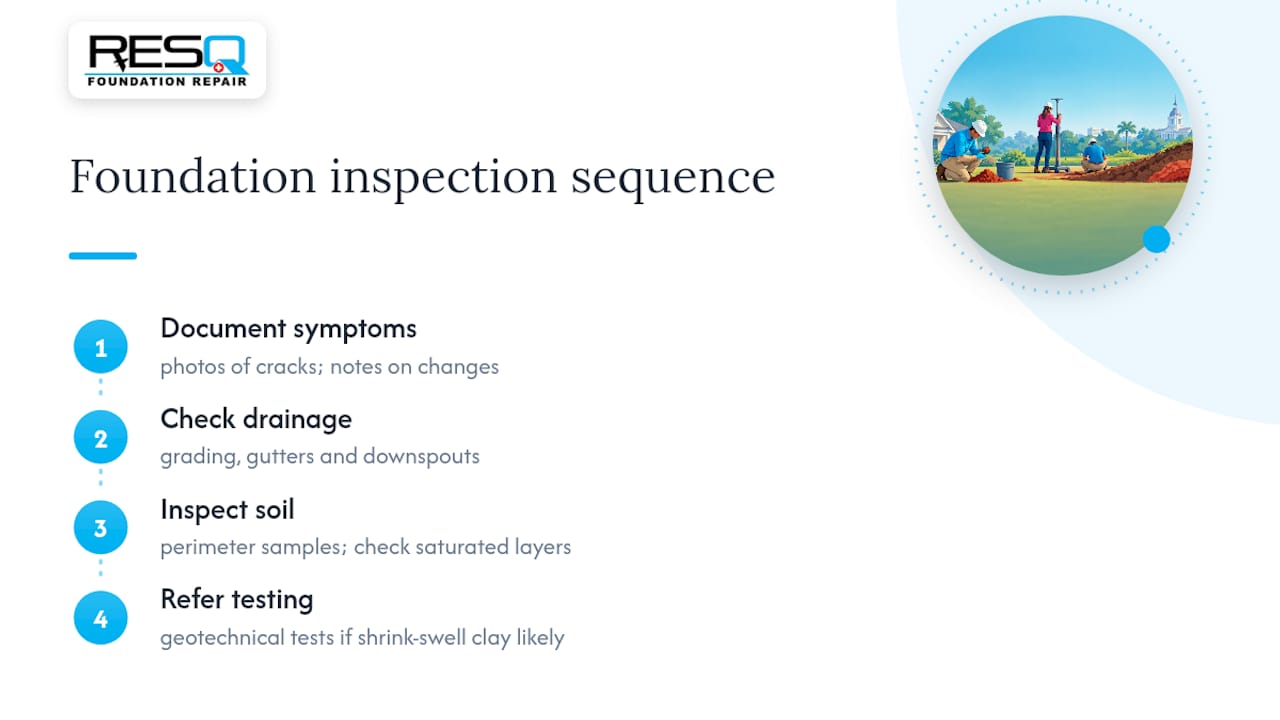
Homeowners preparing for an inspection help the process by having a few things ready: photos of any cracks over time, notes on recent grading or landscaping changes, and a general sense of where water pools after heavy rain. That information, combined with a soil check, is what separates a simple drainage fix from a genuine structural repair need.
Seasonal moisture variation effects on red clay soil behavior
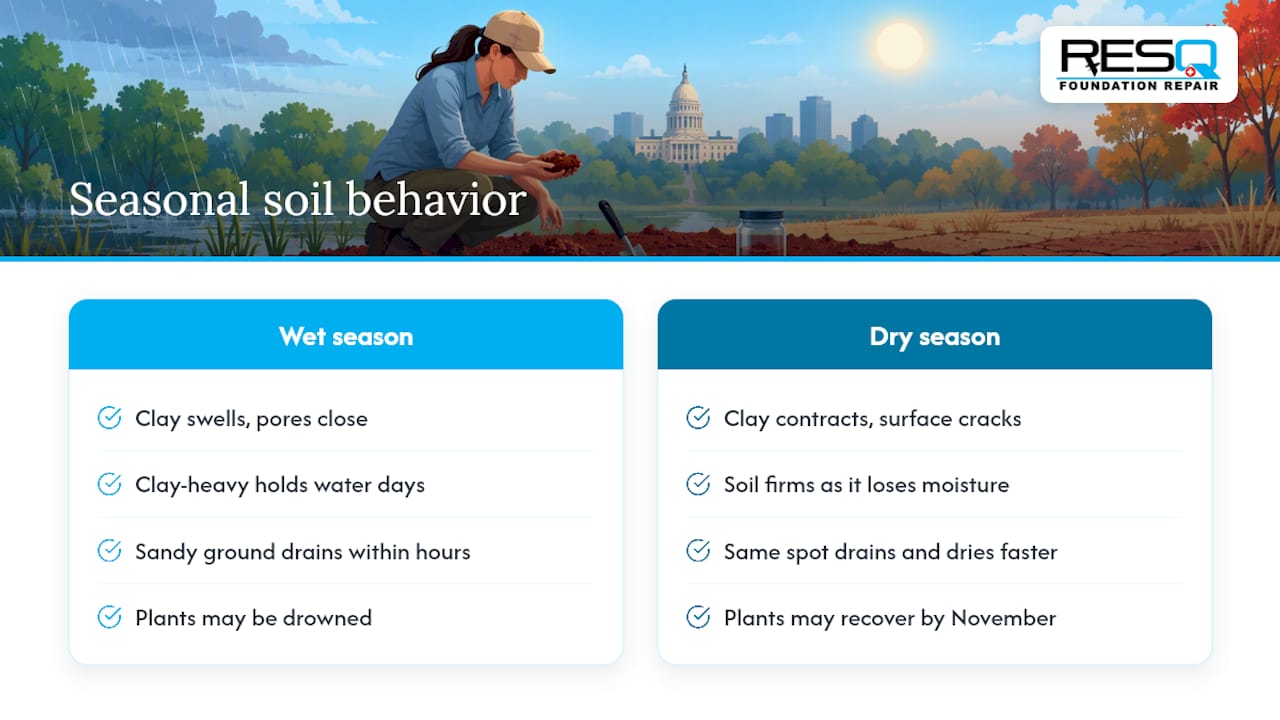
Tallahassee’s wet and dry seasons change how red soils act more than most homeowners expect. During Florida’s summer rainy months, clay-rich pockets swell as they absorb water, closing off the small pore spaces that normally let air and water move through. That swelling is exactly why compacted or clay-heavy spots hold standing water for a day or more after a downpour while sandier ground nearby drains within hours.
Dry stretches, typically in spring and fall, reverse the process. Clay-heavy soil contracts as it loses moisture, sometimes cracking visibly at the surface. Around a foundation, this seasonal swell-and-shrink cycle is the actual mechanism behind shrink-swell risk that DEP guidance points to, and it is driven by clay mineral type, not by how red the soil looks.
For gardeners, that cycle means the same bed can behave completely differently in July versus October. A plant that looked drowned in a wet August might thrive in the same spot by November once the soil dries and firms up again. Mulch helps buffer that swing by slowing both moisture loss and moisture absorption at the surface, which is part of why UF/IFAS treats consistent mulching as a maintenance habit rather than a one-time fix. Watching how a specific spot performs across at least one full wet and dry season tells you more about its real drainage character than any single visit ever will.
How Tallahassee’s red clay compares to other southeastern soils
Tallahassee’s red soils sit at the milder end of a spectrum that stretches across the Southeast. Georgia’s Piedmont region, often the reference point people picture when they hear “red clay,” tends to carry a higher proportion of true clay minerals in its subsoil, which is part of why that region’s soil earned its reputation for heavy, sticky ground that bogs down tillers and shovels alike.
Tallahassee’s Red Hills soils, including Orangeburg, generally carry more sand in the surface layers than the deep clay subsoils typical further north in Georgia and the Carolina Piedmont. That difference shows up directly in how the ground handles a shovel and a rainstorm: Tallahassee soils more often drain within hours where deep Piedmont clay can stay saturated for days.
The color similarity across the region comes from the same cause everywhere: iron oxide staining that has nothing to do with how much actual clay sits underneath. A homeowner moving to Tallahassee from Atlanta with expectations set by Georgia’s dense red clay may find local soil far more workable than anticipated, or may hit an isolated true clay pocket that behaves exactly like what they left behind. Regional reputation is a poor substitute for a parcel-specific check, wherever you happen to be gardening.
What Tallahassee homeowners get wrong about their soil
The biggest failure in how people think about red soil is treating color as a diagnosis. It is not. Iron staining and clay content are two separate facts about the same dirt, and conflating them leads to wasted money on the wrong amendment and, worse, unnecessary panic about foundation risk that a five-dollar soil test could resolve in a week.
Conventional gardening advice online leans heavily on generic “clay soil” tips written for regions with genuinely dense clay, which do not map cleanly onto Tallahassee’s sandier Red Hills reality. Readers end up adding sand to soil that already drains fine, or assuming their foundation is doomed because the dirt looks like the clay their cousin has in Georgia.
If there is one thing worth prioritizing, it is this: test before you treat, whether the question is a struggling azalea or a hairline crack in a wall. The soil map and the lab result cost less than a single bag of amendment and tell you something the color never will.
— Kayle
If you notice structural signs, here’s what to do next
A garden problem and a foundation problem can start with the same red dirt, but they do not deserve the same response. If your soil testing points to compaction or a low spot, the steps above will get you there. If you are also seeing cracks, sticking doors, or uneven floors, that calls for a professional set of eyes, not another bag of compost.
A local foundation repair company offers free inspections, following the logic this guide outlines: check grading and drainage first, sample the soil where it matters, and only recommend structural work when evidence supports it. This approach avoids pushing repairs onto homeowners whose issue proves to be a drainage problem.
- An inspection typically covers the foundation perimeter, crawl space, and visible signs of cracking or settling.
- Findings help determine whether landscape and drainage corrections or structural repairs are needed.
- Typical services include foundation repair, crawl space remediation, and drainage-related fixes addressing soil moisture issues.
| What you’re seeing | Likely next step |
|---|---|
| Standing water, no cracks | Drainage or grading correction |
| Hairline cracks, not widening | Monitor and document |
| Widening cracks or sticking doors | Schedule a foundation inspection |
If any of this sounds like your yard or your foundation, book a free inspection with Foundation RESQ and get a straight answer before you spend another weekend guessing.
Sources
- SL322/SS534: Preplant Soil Assessment for New Residential Landscapes in Florida
- Florida DEP: Problem soils
- MapServices/TLC_OverlaySoil_WM_D (MapServer)
- Native Soils of Tallahassee: Red Hills, Sandhills, and Ancient Oceans (WFSU)
- USDA: updated plant hardiness map (2023)
FAQ
What gardening zone is Tallahassee, Florida in?
Tallahassee falls within the warmer end of the USDA hardiness zone range for North Florida, and the exact zone can shift slightly by neighborhood based on microclimate. Check your specific ZIP code on the USDA Plant Hardiness Zone Map since the 2023 update refined boundaries using more weather stations.
Where is red clay found in the US?
Red clay soils appear widely across the Southeast, most famously through Georgia’s Piedmont region, and extend into parts of North Florida including the Tallahassee area’s Red Hills. The red color comes from iron oxide staining, which appears in soils with very different actual clay content from one region to the next.
What states have the most clay soil?
Clay-heavy soils are especially common across the Piedmont region spanning Georgia, the Carolinas, and Alabama, where subsoils carry a higher proportion of true clay minerals. Florida’s soils, including those around Tallahassee, tend to be sandier overall even where the surface color looks similar.
Why is Georgia soil red clay?
Georgia’s Piedmont red clay gets its color from iron oxide minerals that stain the soil as it weathers and drains, the same mechanism responsible for red soil color in Tallahassee. What differs is texture: Georgia’s Piedmont subsoils generally hold more true clay than the sandier Red Hills soils like Orangeburg found around Tallahassee.
Does red soil color mean my Tallahassee yard has expansive clay?
Not necessarily. The Florida Department of Environmental Protection notes that shrink-swell risk depends on clay mineralogy rather than color, and much of the red soil around Tallahassee is sandy loam with low shrink-swell risk. A soil test or professional inspection is the reliable way to confirm what you actually have.