
Most of the time, no. A single cracked tile is almost always an impact, an installation mistake, or a substrate problem, not proof your foundation is moving. The exception: multiple cracks in a stair-step or diagonal pattern across several rooms, especially alongside sticking doors or sloping floors, which points toward real foundation movement and warrants a professional look, ideally a free inspection from a company like Foundationresq.
TL;DR:
- Most single cracked tiles result from impact, installation issues, or substrate problems, not foundation movement, and only multiple cracks in specific patterns suggest structural issues.
- Foundation movement causes distinct crack patterns like stair-step or diagonal cracks, often accompanied by sticking doors or uneven floors, which indicate real settlement.
- Small, hairline cracks under 1/16 inch are usually normal, but cracks wider than 1/8 inch or widening over time require professional evaluation.
- Homeowners should track crack progression over weeks before calling a professional, as most cracks are harmless and only a few indicate serious issues.
- A free inspection can distinguish between installation or substrate failure and actual foundation movement, guiding proper repair before re-tiling.
Table of Contents
- What Causes Tile Cracks Besides A Bad Foundation?
- How Foundation Movement Actually Cracks Tile
- When Should You Actually Worry?
- What To Check Before You Call A Professional
- How Foundationresq Diagnoses Cracked-Tile Cases
- The Real Lesson Homeowners Miss About Cracked Tile
- Get A Free Inspection Before You Re-Tile Anything
- Sources
- FAQ
What Causes Tile Cracks Besides A Bad Foundation?
Before you assume the worst, rule out the boring, far more common explanations. Ceramic and porcelain tile is rigid and brittle by nature, so it cracks easily under conditions that would barely bother wood or vinyl flooring.
Drop a cast-iron skillet or a heavy dumbbell on one tile and it shatters while everything around it stays perfectly intact. That’s impact damage, and it’s the easiest cause to identify: one isolated crack, sharp edges, no pattern connecting it to anything else in the house.
Installation quality causes far more cracked tile than most homeowners realize. Tap a tile with a coin or the back of a screwdriver handle. A solid tile sounds sharp and dense. A tile sitting over a void in the thin-set sounds hollow or dummy, sometimes called “tenting,” and it’s only a matter of time before foot traffic breaks it. The Tile Council of North America notes that inadequate mortar coverage, substrate movement, and missing movement joints are among the leading causes of cracking that have nothing to do with the foundation.
Wood-frame subfloors add another variable entirely. Building codes generally hold tile assemblies to an L/360 deflection limit, meaning the floor shouldn’t flex more than 1/360th of the span under load. Exceed that, and grout lines crack even on a foundation that’s rock solid.
- Impact damage: one tile, sharp break, no spreading pattern
- Hollow-sounding tile: thin-set voids under the surface
- Missing movement joints: no flexible gap where tile meets a different material or turns a corner
- Slab shrinkage cracks: hairline cracks in the concrete “reflecting” up through the grout
- Wrong tile grade: cheaper tile that doesn’t meet ASTM C648 breaking-strength standards for the traffic it sees
How Foundation Movement Actually Cracks Tile
When the cause really is the foundation, the tile doesn’t just fail randomly. It fails in a pattern that tells a story.
Differential settlement, meaning one part of the foundation sinks or shifts while another stays put, creates stress that travels straight up through the slab and into the tile above it. That stress tends to follow the path of least resistance: the grout lines. This produces the classic stair-step crack, where the break zigzags along grout joints in a diagonal line across the room, sometimes running from one corner toward a doorway or load-bearing wall.
Reflective cracking works similarly. If the concrete slab underneath has its own crack, that crack often “reflects” upward through the tile and grout directly above it, tracing the same line. Movement joints and crack-isolation membranes are the standard defense against this, and their absence is a common reason reflective cracks show up years after installation.
It helps to know the difference between a cracked tile and a delaminated one. A cracked tile has a visible fracture through the ceramic or porcelain body. A delaminated tile has lost its bond to the substrate entirely; it sounds hollow across its whole surface, may rock slightly underfoot, and represents a different failure mode than settlement stress.
- Stair-step cracks along grout lines: differential settlement
- Long diagonal crack crossing multiple tiles at the same angle: slab movement
- Cracks radiating from a single point (a corner, a floor drain): localized substrate failure
- Widespread hollow sound with no visible crack yet: early bond failure, often unrelated to the foundation
When Should You Actually Worry?
Not every crack deserves a phone call to a contractor. Width and progression are what separate a cosmetic nuisance from a genuine warning sign.
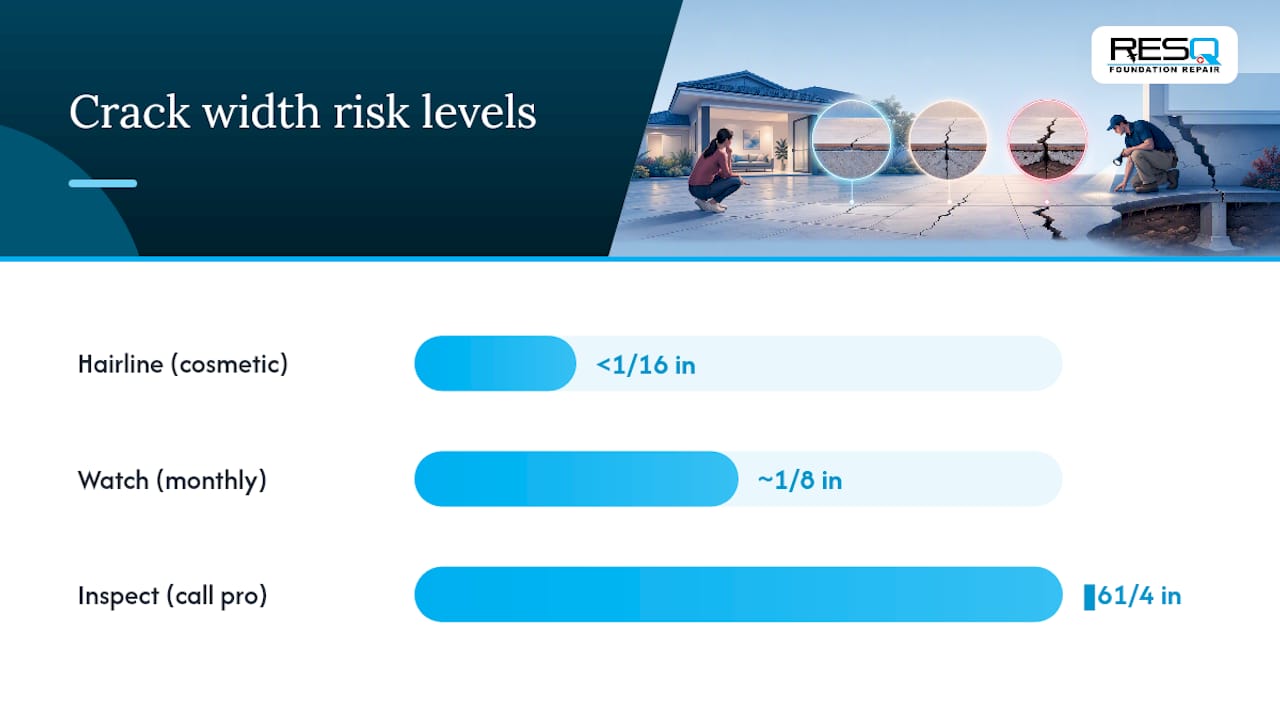
- Hairline cracks (under 1/16 inch): Common in grout and often just normal curing or minor seasonal movement. Photograph it and move on.
- Cracks around 1/8 inch: Worth watching. Mark both ends with a pencil and the date, then recheck monthly.
- Cracks at or above 1/4 inch, or any crack that’s visibly wider than it was last month: This is the threshold where This Old House and most structural professionals recommend a proper evaluation.
- Cracks paired with other symptoms: doors that stick in humid weather, windows that won’t latch, floors with a noticeable slope, or new gaps opening between the wall and ceiling trim. Any one of these alongside cracked tile changes the calculation fast.
Pro Tip: Tape a coin flat against the wall at each end of a crack and mark the date on painter’s tape next to it. If the coin no longer fits flush in a few weeks, the crack is actively widening, not just settling into a stable state.
Homeowners can track this over time with a basic crack gauge or even a ruler and phone camera, comparing photos month to month to see whether movement is progressing or has stalled.
What To Check Before You Call A Professional
Start with a walk-through, not a contractor. Tap suspect tiles with a coin, listening for that hollow “tenting” sound. Check every door and window on the level where the cracking appears; binding on multiple openings at once is a stronger signal than one sticky door that’s always been a little tight. Set a marble or a round toy car on the floor near the crack. If it rolls consistently toward one wall, you likely have a slope worth measuring properly.
A single cracked or hollow tile is usually fine to replace yourself, or with epoxy filler for hairline surface cracks. That’s a reasonable fix when the damage is isolated and nothing else in the house is misbehaving.
What’s not reasonable is re-tiling over a problem you haven’t diagnosed. A professional inspection typically covers:
- Structural assessment of the foundation itself, inside and out
- Soil and drainage evaluation around the perimeter
- Substrate testing to confirm whether the issue is the slab, the framing, or the installation
- A remediation plan, which might mean concrete leveling, underpinning, or simply reinstalling tile with proper isolation membranes
Because there’s no universal price for foundation repair, every fix depends on the soil, the drainage situation, and how far the movement has progressed, an inspection is the only way to get a real number instead of a guess.
How Foundationresq Diagnoses Cracked-Tile Cases
An inspection worth paying for starts long before anyone touches the tile itself. Foundationresq’s process begins with mapping every crack in the home, tile and drywall both, then checking each door and window for binding, measuring floor elevation across multiple points, and reviewing exterior drainage and crawl space moisture, since water is behind a large share of the soil movement that eventually shows up as cracked tile indoors.
That mapping typically sorts cases into three buckets: isolated tile failure with no structural cause, installation or substrate failure limited to the flooring system, and active foundation movement requiring stabilization. Most cracked-tile calls land in the first two categories. The ones that don’t are exactly why a proper inspection, rather than a guess based on one crack, matters before anyone spends money re-tiling a floor that’s just going to crack again.
The Real Lesson Homeowners Miss About Cracked Tile
Here’s what gets lost in most advice on this topic: homeowners either panic at the first crack or ignore every crack equally, and both instincts are wrong. The pattern matters more than the presence of a crack. A single fractured tile near the refrigerator, where someone dropped a cast-iron pot last winter, tells you nothing about your foundation. Three stair-step cracks radiating from the same corner of the house, paired with a door that’s needed force to close since spring, tells you quite a lot.
The forensic research on this is blunt: tile distress coincides with actual foundation deflection in only a minority of the cases studied. That’s the opposite of what most cracked-tile panic assumes. It also means the homeowners who skip monitoring and jump straight to expensive assumptions are often wasting money solving a problem they don’t have, while the ones who dismiss every crack as “just settling” sometimes miss the one pattern that actually needed attention. Measure first. Watch for weeks, not days. Then call someone.
— Kayle
Get A Free Inspection Before You Re-Tile Anything
Professional foundation repair companies offer free inspections that provide a real diagnosis: whether you’re dealing with an isolated installation issue or genuine foundation movement that needs stabilization first.

If the problem traces back to a settling slab, Foundationresq’s concrete lifting and leveling services can correct the movement before new tile ever goes down, which is the only way to keep the same crack from reappearing in a year. Foundationresq’s broader foundation and crawl space repair services cover the drainage and structural side of the equation too, since water intrusion is frequently the root cause behind soil movement that never shows up until the tile cracks. For homeowners weighing the cost, financing options are available, and getting ahead of the problem early is consistently cheaper than waiting for it to spread. Request a free inspection and find out what you’re actually dealing with before you buy a single box of replacement tile.
Sources
For more technical detail, the Tile Council of North America’s cracked tile guidance covers installation standards in depth, while This Old House and Inspectapedia offer broader foundation assessment context. Homeowners tracking crack patterns over time may also find it useful to check door sticking as a foundation indicator or review hairline crack monitoring steps.
- This Old House — Signs of a bad foundation
- Inspectapedia — Foundation damage assessment
- Tile Council of North America — Cracked tile: common causes & misconceptions
FAQ
Do Cracked Tiles Always Mean Foundation Problems?
No. Most cracked tiles trace back to impact damage, poor installation, or substrate issues rather than foundation movement, though stair-step patterns or cracks paired with sticking doors are worth investigating.
Will Homeowners Insurance Cover Cracked Tile?
Standard homeowners policies typically exclude damage from foundation settling or earth movement, though coverage varies by policy, so check your specific exclusions or ask your insurer directly.
How Expensive Is It To Fix A Crack In The Foundation?
There’s no universal price because repair cost depends on soil conditions, drainage, and the extent of movement; a professional assessment, such as a free inspection from Foundationresq, is the only way to get an accurate number.
When Should I Worry About A Crack In The Foundation?
Get it inspected once a crack reaches 1/4 inch wide or keeps growing, or if it appears alongside sticking doors, sloping floors, or new gaps at the trim.