
That hairline crack in your foundation isn’t just a sign of your house “settling”; it’s the first visible casualty of a mechanical war being waged by the soil outside your home. When the ground becomes saturated after a heavy Tallahassee thunderstorm, the water trapped against your home exerts a physical force that can eventually crush concrete. Understanding what causes hydrostatic pressure on foundation walls is the first step toward reclaiming your peace of mind and protecting your property’s structural integrity.
It’s completely normal to feel anxious when you notice bowing walls or water seepage, especially when your home is your most significant investment. You deserve to know exactly why these issues occur and how to stop them permanently. In this guide, we’ll explain the physics of water weight in Florida’s red clay and help you identify early warning signs before they become costly emergencies. You’ll gain a clear understanding of the forces at play and the confidence to choose a long-term stabilization method that keeps your foundation secure for years to come.
Key Takeaways
- Learn how the sheer weight of saturated soil exerts thousands of pounds of force against your home, turning stagnant water into a structural threat.
- Discover what causes hydrostatic pressure on foundation walls, specifically how Tallahassee’s unique red clay and poor surface drainage create destructive pressure zones.
- Identify the hallmark warning signs of foundation distress, such as horizontal cracking and inward wall bowing, before they compromise your home’s safety.
- Understand why North Florida’s intense subtropical storms and local geology make our foundations more vulnerable to moisture-related damage than other regions.
- Explore professional stabilization remedies like carbon fiber reinforcement and piering systems designed to restore and protect your home’s permanent structural health.
Understanding Hydrostatic Pressure: The Physics Behind Foundation Stress
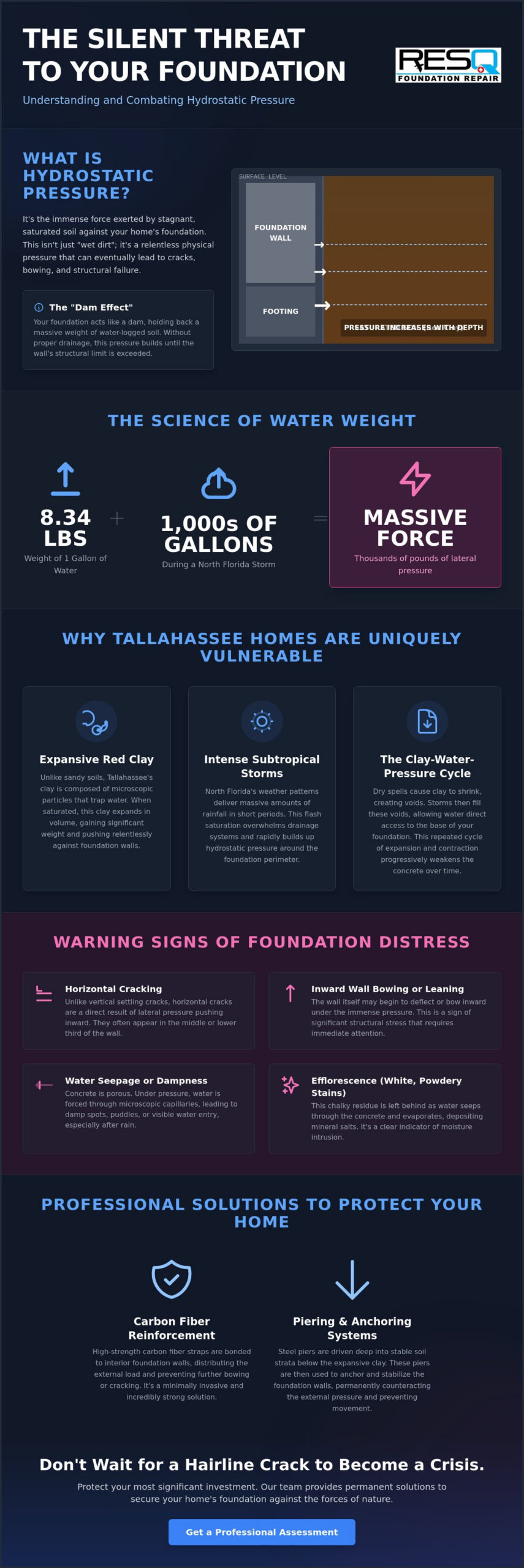
Hydrostatic pressure is the force exerted by stagnant water against a structure. In the context of your home, this pressure occurs when water saturates the soil surrounding your foundation and has nowhere to go. Instead of draining away, the water sits against your concrete walls, pushing with a relentless physical force that can eventually lead to structural failure.
To grasp the scale of this threat, you must consider the weight of the water itself. Every gallon of water trapped in the soil adds roughly 8.34 pounds of pressure against your home. During a typical North Florida rain event, hundreds or even thousands of gallons can saturate the ground around your perimeter. When you investigate what causes hydrostatic pressure on foundation walls, you quickly realize that you aren’t just dealing with “wet dirt”; you are dealing with thousands of pounds of lateral force trying to push your walls inward.
Many homeowners assume their concrete foundation is an impenetrable shield. However, concrete is a naturally porous material. On a microscopic level, it contains tiny capillary tracts that allow water vapor and liquid under pressure to migrate through the wall. This porosity means that as the external pressure builds, the water doesn’t just push against the wall; it actively tries to work its way through it, leading to the dampness and efflorescence often seen in local basements or crawl spaces.
This phenomenon creates what engineers often call the “Dam Effect.” Your foundation essentially acts as a dam holding back a literal lake of saturated soil. Unlike a professional dam designed with specific reinforcement and drainage, a residential foundation wall has a limit to how much weight it can support before it begins to deflect. When the pressure from the “lake” outside exceeds the strength of the wall, structural damage is inevitable.
The Simple Science of Water Weight
Gravity is the primary engine behind this process. It pulls water downward through the soil, but when that water hits an obstruction like your foundation footing, it begins to exert outward pressure. This force is not uniform. Just like the deep end of a swimming pool, the pressure is greatest at the base of the wall where the water column is heaviest. Hydrostatic pressure is the primary mechanical driver of foundation wall failure in 2026. This bottom-heavy force is often why we see the most significant bowing or shifting near the lower third of a foundation wall.
Static vs. Dynamic Pressure
It is helpful to distinguish between static and dynamic forces. Static pressure comes from resting water that has fully saturated the soil; it is a steady, heavy weight. Dynamic pressure occurs when groundwater is actively moving toward the foundation, often during a flash flood or intense storm. Even when the surface appears dry, the soil can remain saturated for weeks, maintaining a “residual” pressure against the structure. This means your foundation may still be under significant stress long after the clouds have cleared and the sun has returned to Tallahassee.
What Causes Hydrostatic Pressure on Foundation Walls?
While gravity provides the weight, the specific environment of North Florida dictates how these forces manifest. Understanding what causes hydrostatic pressure on foundation walls requires a close look at the ground beneath your feet. It’s rarely a single factor; rather, it’s a combination of soil composition, local weather patterns, and how water moves across your property.
Tallahassee’s red clay is the primary culprit. Unlike the sandy soils found in coastal Florida, which allow water to percolate through quickly, clay is composed of microscopic, plate-like particles that trap water molecules. This creates a dense, heavy mass that holds moisture directly against your foundation for extended periods. When this clay becomes saturated, it doesn’t just get wet; it expands in volume and gains significant weight, exerting a relentless lateral force against your masonry.
This leads to the Clay-Water-Pressure Cycle. It isn’t just a single rain event that causes the damage. Instead, it’s the cumulative stress of the soil expanding when wet and contracting when dry. When the clay dries out, it shrinks and pulls away from the foundation, often leaving a visible gap or “void.” During the next heavy storm, these voids act as direct channels, allowing even more water to rush down toward the base of your wall. This cycle repeats year after year, slowly weakening the structural integrity of the concrete. If you’ve noticed gaps between your soil and foundation, a professional foundation assessment can help determine if this cycle is already compromising your walls.
In some low-lying areas of Leon County, rising water tables also play a role. During the peak of the rainy season, the ground itself becomes a reservoir. When the water table rises above the level of your foundation floor, it creates pressure from beneath and from the sides simultaneously. This “buoyancy” effect can be particularly destructive for homes with basements or deep crawl spaces.
The Expansion of Clay-Rich Soils
Clay particles are unique because they have a high surface area that attracts water. In our local “Red Clay” belt, this creates a sponge effect where the soil can hold vast amounts of liquid. As the clay grows in volume, it physically pushes against your foundation. Sandy soils elsewhere in the state allow water to drain toward the aquifer, but our clay keeps that pressure localized right where it can do the most harm.
External Water Management Failures
Even the best foundation can’t withstand water that is intentionally funneled toward it. Poorly maintained gutters or downspouts that dump water within five feet of the house create artificial “pressure zones.” With the intense subtropical storms we’ve seen in 2026, standard residential drainage systems are often overwhelmed. When landscaping slopes toward the house, it invites thousands of gallons of runoff to pool against the foundation, accelerating the buildup of hydrostatic pressure.
Signs Your Foundation is Struggling with Hydrostatic Pressure
Identifying the specific symptoms of structural distress allows you to take action before a total wall failure occurs. While the physics of water weight explains what causes hydrostatic pressure on foundation walls, the physical damage usually follows a predictable pattern. These signs are your home’s way of signaling that the external load has exceeded the wall’s design capacity.
Horizontal cracks are the hallmark sign of hydrostatic pressure. Unlike vertical cracks, which often indicate minor settlement, horizontal fissures suggest that the soil is physically pushing the wall inward. These cracks typically appear in the middle third of the wall where the lateral force is most concentrated. If you see a long, horizontal line running across your basement or crawl space wall, the structure is actively struggling to hold back the saturated soil outside.
Inward bowing or bulging is the next stage of failure. This occurs when the center of the wall begins to “belly” under the load. In homes with concrete block foundations, this pressure often manifests as stair-step cracking along the mortar joints. As the blocks are pushed, the mortar between them separates in a diagonal pattern. You may also notice efflorescence, which is a white, powdery residue on the wall. This is a clear sign that pressure is forcing water through the porous concrete, leaving mineral deposits behind as the moisture evaporates.
Visualizing Wall Deflection
You can check for bowing walls using a simple plumb line or a long carpenter’s level. Hold the level vertically against the wall; if there is a gap between the level and the concrete in the middle, the wall is deflecting. The middle third of the wall is usually the first to fail because it lacks the structural support provided by the floor above or the footing below. In some cases, you might notice a “tipping” effect, where the top of the wall moves inward while the base remains anchored. This indicates that the pressure is concentrated near the upper layers of the soil.
Secondary Symptoms: Moisture and Mold
Structural damage rarely exists in a vacuum. High humidity in your crawl space is often a precursor to more severe structural issues. When hydrostatic pressure forces moisture through your foundation, it creates an ideal environment for fungal growth. This often leads to the need for professional mold remediation in Tallahassee, FL to protect your indoor air quality. If you notice a persistent musty smell in your living area or damp soil near your foundation, the invisible force of water is likely already impacting your home’s health.
Why Tallahassee Homes are Uniquely Vulnerable
The unique geology of the Florida Panhandle means that what causes hydrostatic pressure on foundation walls here is fundamentally different from the issues faced by homeowners in Orlando or Miami. While much of Florida sits on porous limestone and sand, Tallahassee is defined by its “Red Clay” belt. This heavy, non-porous soil acts as a geological trap for moisture. Instead of allowing rainwater to filter deep into the Floridan Aquifer, the clay holds it in a dense layer right against your home’s structural perimeter.
Our local water table also contributes to this localized stress. Because Tallahassee features a hilly terrain with varying elevations, water doesn’t always drain uniformly. In lower-lying neighborhoods or areas near local aquifers, the ground can become a reservoir during the rainy season. This creates a “bottom-up” pressure scenario where groundwater pushes against the underside of your floor slab while the saturated clay pushes against the sides of your walls. This dual-force environment is a primary reason why many local properties experience sudden structural shifts after years of stability.
Historical building practices in our older neighborhoods, such as Midtown and Levy Park, often play a role as well. Many of these homes were constructed before modern exterior waterproofing standards were established. Without the advanced liquid-applied membranes or specialized drainage boards required by the upcoming 9th Edition of the Florida Building Code, these older foundations have little defense against the relentless weight of wet earth. If you live in an older home, you can request a professional inspection to determine if your existing foundation coatings are still providing an adequate barrier against the elements.
The Impact of Tropical Storms and Hurricanes
Extreme weather events serve as a violent stress test for residential structures. The Florida Panhandle is prone to “rapid saturation,” where several inches of rain fall in a matter of hours. This sudden influx of water doesn’t have time to run off; instead, it immediately fills the voids in the soil, causing a massive spike in lateral pressure. Because of these volatile conditions, seeking foundation repair in Tallahassee requires a partner who understands how our local clay reacts to tropical storm surges and prolonged subtropical rain cycles.
Soil Compaction and Urban Development
As Tallahassee continues to grow, new construction in established neighborhoods can alter how water moves through the community. Adding driveways, patios, or new home footprints reduces the amount of permeable ground available to absorb rain. This often redirects runoff toward older foundations that weren’t designed to handle the additional volume. Recent 2026 precipitation data indicates that our regional storms are becoming more intense, making proper soil compaction and water management more critical than ever for maintaining a dry, stable home.
Professional Solutions: Counteracting the Force of Nature
Stabilizing Bowing Walls with Carbon Fiber
Carbon fiber wall repair in Tallahassee provides a permanent, low-profile fix for walls that have begun to belly inward under the weight of saturated soil. This material is an engineering marvel; it is significantly stronger than steel when resisting inward tension. During installation, high-strength carbon fiber straps are bonded directly to the foundation wall and anchored to the floor and rim joist. This creates a rigid reinforcement system that stops further movement in its tracks. The process is non-invasive and the straps sit nearly flush with the wall, making them easy to paint over or conceal in finished spaces.
Underpinning for Sinking and Shifting Foundations
When the pressure causes your home to shift or sink, we have to look deeper than the surface soil. Professional helical pier installation allows us to bypass the unstable, moisture-sensitive clay layers entirely. These piers are mechanically “screwed” into the earth until they reach stable soil or bedrock deep beneath the “active zone” where moisture levels fluctuate. For homes that have already experienced significant settlement, push pier systems can often be used to restore the foundation to its original level. By transferring the building’s weight to these deep structural anchors, we provide a permanent solution that remains unaffected by future rain cycles or soil expansion.
Moisture Management and Encapsulation
Stopping the cycle of moisture is the final piece of the structural puzzle. Crawl space encapsulation in Tallahassee is the first line of defense against the high humidity and soil saturation that fuel foundation stress. This process involves sealing the crawl space with a heavy-duty vapor barrier and installing a high-performance dehumidifier to regulate moisture levels. To manage the physical water that causes hydrostatic pressure on foundation walls, we integrate Sump Pump Systems and active drainage. These components work together to intercept and remove water before it can build up against your masonry, effectively neutralizing the threat before it starts.
Secure Your Home Against the Elements
Your foundation is the bedrock of your home’s safety, but it’s constantly tested by the unique environmental conditions of North Florida. We’ve explored how Tallahassee’s dense red clay and intense subtropical storms create a relentless mechanical force against your masonry. Recognizing the signs of distress, such as horizontal cracks or inward bowing, allows you to address structural concerns before they escalate into costly emergencies. Understanding what causes hydrostatic pressure on foundation walls empowers you to move from a state of uncertainty to one of informed protection.
As a Groundworks family brand, Foundation ResQ combines national-level engineering support with deep-rooted expertise in the Florida Panhandle climate. We provide proprietary solutions like PolyRenewal concrete lifting and Carbon Fiber wall reinforcement to ensure your home remains stable and dry. You don’t have to face these structural challenges alone. Schedule your free foundation inspection with Foundation ResQ today and take the first step toward a permanent, professionally engineered resolution. Your home deserves a defense as resilient as the family it protects.
Frequently Asked Questions
Is hydrostatic pressure covered by standard Florida homeowners insurance?
Standard Florida homeowners insurance policies typically do not cover damage caused by hydrostatic pressure. Most carriers categorize this as groundwater seepage or earth movement, which are standard exclusions in residential policies. Insurance is designed to cover sudden, accidental events like fire or wind, rather than the gradual structural stress caused by saturated soil. It’s best to review your specific policy or speak with your agent about supplemental groundwater riders.
Can I fix hydrostatic pressure by just digging a trench around my house?
Digging a simple trench is rarely a permanent solution and can sometimes make the problem worse by creating a reservoir for more water to pool. To effectively address what causes hydrostatic pressure on foundation walls, you need a professionally engineered drainage system. This usually involves a French drain or a dedicated discharge line that carries water at least ten feet away from your home’s perimeter to ensure the soil remains stable.
How long does it take for hydrostatic pressure to cause a wall to collapse?
There is no fixed timeline for a wall collapse, as it depends on the intensity of local rainfall and the specific soil composition. Structural failure is usually a cumulative process that occurs over several seasons of expansion and contraction. However, extreme weather events can provide the final push. If you notice horizontal cracking or significant bowing, the wall has already reached its tipping point and requires immediate professional stabilization.
What is the most cost-effective way to relieve pressure on foundation walls?
The most cost-effective approach is a combination of proper surface drainage and targeted structural reinforcement. Maintaining your gutters and ensuring your landscaping slopes away from the foundation are the least expensive preventative measures. If pressure is already present, carbon fiber reinforcement is often a more budget-friendly and less invasive remedy than total wall replacement. It provides a permanent shield without the need for heavy machinery in your yard.
Does a dehumidifier help with hydrostatic pressure?
A dehumidifier is an excellent tool for managing indoor air quality and preventing mold, but it cannot stop hydrostatic pressure. Dehumidifiers only remove moisture from the air within your crawl space or basement. They don’t have the capacity to relieve the thousands of pounds of water weight pushing against the exterior of your foundation walls. You need a mechanical drainage or reinforcement system to address the physical force of the soil.
Why do my foundation cracks get wider in the summer?
Cracks often widen in the summer because Tallahassee’s red clay undergoes significant volume changes. During hot, dry periods, the clay loses moisture and shrinks, pulling away from your foundation. This creates a loss of lateral support, which allows existing cracks to expand as the foundation settles into the newly created voids. This seasonal cycle is a major factor in what causes hydrostatic pressure on foundation walls to become a recurring structural issue.
What happens if I ignore bowing foundation walls for another year?
Ignoring a bowing wall for another year significantly increases the risk of a sudden and catastrophic failure. Once a wall is out of plumb, gravity begins to work against it, pulling the leaning section further inward. Delaying repairs often leads to more expensive interventions, as a wall that could have been stabilized with carbon fiber may eventually require more intensive piering or even a full structural reconstruction to remain safe.