You just finished reading an engineering report that describes your home’s foundation in terms that sound both expensive and permanent. In a city like Tallahassee, where 59 inches of annual rainfall constantly stresses our unique “Red Hills” clay, receiving a negative assessment can feel like a blow to your family’s financial security. Understanding exactly what to do after a bad foundation inspection Tallahassee experts have delivered is the first step toward regaining control. It’s natural to worry about plummeting resale values or the confusing technical jargon used by inspectors, but a failed inspection is actually a valuable roadmap for a permanent remedy.
We understand the anxiety that comes with structural uncertainty. This guide provides a clear, non-alarmist action plan to move you from confusion to a stable resolution. You will learn how to decipher engineering reports, identify which repair technologies like helical piers or carbon fiber reinforcement fit your specific damage, and how to choose a local expert who understands Leon County’s karst topography. By the end of this article, you’ll have the confidence to protect your home against the elements with a solution built for longevity and peace of mind.
Key Takeaways
- Learn to distinguish between minor cosmetic settlement and serious structural failure by decoding technical terms like hydrostatic pressure and deflection.
- Discover exactly what to do after a bad foundation inspection Tallahassee experts provide, including the importance of securing an unbiased second opinion from a structural engineer.
- Understand the specific roles of stabilization technologies like helical piers for sinking foundations and carbon fiber reinforcement for bowing walls.
- Navigate the impact of structural repairs on your home’s resale value and learn how Florida disclosure laws apply to foundation work during a sale.
- Gain peace of mind by identifying a remedy-based approach that addresses Tallahassee’s unique geological challenges, such as expansive clay and karst topography.
Interpreting Your Bad Foundation Inspection Report
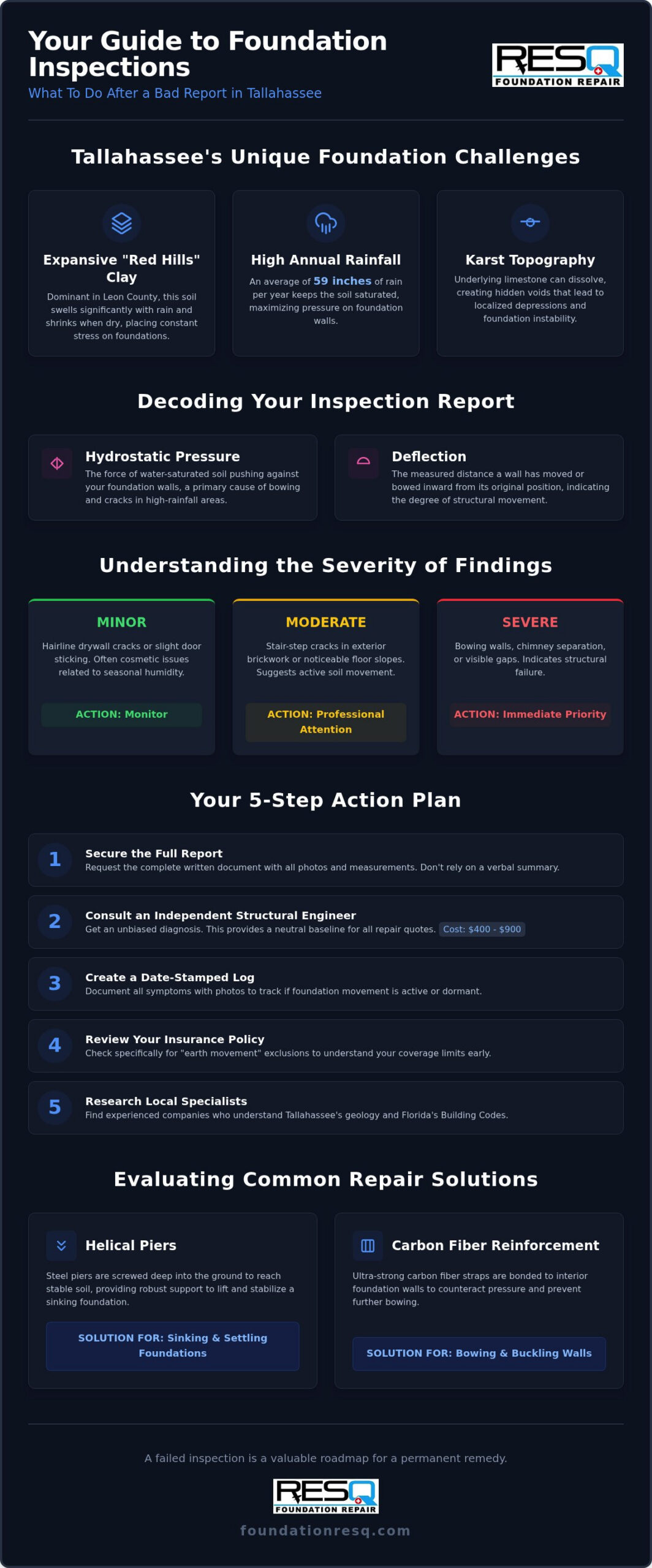
A technical report often looks like a list of disasters when it’s actually a collection of data points. Understanding the nuances of understanding foundation engineering helps you separate minor maintenance from critical repairs. The first step in determining what to do after a bad foundation inspection Tallahassee professionals have conducted is to look for specific red flag phrases. While terms like deflection or hydrostatic pressure sound alarming, they simply describe how soil and water are interacting with your home’s footprint. Deflection refers to the distance a wall has moved from its original position, while hydrostatic pressure is the force of saturated soil pushing against your foundation walls.
Understanding Tallahassee Soil and Your Foundation
Tallahassee sits on the Red Hills geography, dominated by the Leon-Tallahassee soil association. This heavy clay is highly expansive. It swells significantly when it rains and shrinks during dry spells. Because Leon County receives an average of 59 inches of rain annually, your slab or crawl space is under constant pressure. In some areas, this movement is exacerbated by karst topography. This means the underlying limestone can dissolve over time, creating hidden voids. What looks like simple settling in a report might actually be the early stages of localized depressions that require professional stabilization rather than a quick cosmetic fix.
Categorizing the Severity of the Findings
Not every crack requires a major intervention. You should categorize the findings into three levels of urgency to create a logical action plan. This helps manage the anxiety of potential costs by focusing on what’s truly necessary for structural health.
- Minor: These include hairline cracks in drywall or slight door sticking. Often, these are symptoms of seasonal humidity or minor cosmetic settlement that requires monitoring rather than immediate piering.
- Moderate: Look for stair-step cracks in exterior brickwork or floor slopes that you can feel while walking. These suggest active movement in the soil that needs professional attention.
- Severe: This category includes bowing walls, chimney separation, and visible gaps between the wall and the ceiling. These indicate structural failure.
If your report mentions shear cracks or significant lateral movement, these are immediate priorities. These phrases indicate that the foundation is no longer supporting the home’s weight properly. Addressing these issues early with a permanent remedy prevents the long-term degradation of your property’s value.
5 Immediate Steps to Take After a Negative Assessment
Receiving a negative report is the start of a process, not the end of your home’s stability. Knowing what to do after a bad foundation inspection Tallahassee homeowners receive is essential for protecting your investment. You need a methodical approach to verify the findings and plan the restoration. Follow these five steps to move from uncertainty to a clear action plan.
- Step 1: Secure the full report. Don’t settle for a verbal summary. Request the complete written document including all photo evidence and measurements taken during the visit.
- Step 2: Consult an independent structural engineer. An unbiased professional opinion is vital. Unlike a contractor, an engineer doesn’t sell repair services; they sell a diagnosis.
- Step 3: Create a date-stamped log. Document all interior and exterior symptoms. Take photos of cracks, sticking doors, or gaps and note the date to track if the movement is active or dormant.
- Step 4: Review your insurance policy. Check specifically for “earth movement” exclusions. While most standard policies don’t cover sinkholes or settling, understanding your coverage limits early is crucial.
- Step 5: Research local specialists. Look for companies that demonstrate a deep understanding of the 8th Edition Florida Building Code and Tallahassee’s specific geological challenges.
When to Hire an Independent Structural Engineer
A structural engineer provides a layer of protection during the repair process. While many contractors offer assessments, an independent engineer’s report in Tallahassee typically costs between $400 and $900. This fee buys you a structural seal and a neutral baseline. This report ensures that every contractor bidding on your project is looking at the same data. It prevents companies from over-prescribing repairs or missing the root cause of the instability.
Gathering Multiple Repair Quotes
You should compare at least three specialized foundation contractors before making a commitment. During these meetings, ask about their experience with the “Red Hills” clay and the specific technologies or methods they employ for foundation repair. If your project’s value exceeds $2,500, remember that Tallahassee regulations require a Notice of Commencement to be filed. Avoid the temptation to choose the lowest bidder. A cheap fix often addresses symptoms without providing a permanent remedy. Choosing a local structural expert who prioritizes stabilization ensures your home remains safe for the long term.
Evaluating Repair Solutions: Piers vs. Reinforcement
Once you’ve analyzed the report and consulted an engineer, the next phase of what to do after a bad foundation inspection Tallahassee homeowners face is evaluating specific repair technologies. In Florida, solutions are never one-size-fits-all. A sinking corner requires a different mechanical approach than a bowing wall. The goal is to choose a method that bypasses unstable “Red Hills” clay to reach load-bearing strata or reinforces the existing structure against hydrostatic pressure.
The Permanent Power of Helical and Push Piers
For homes experiencing vertical settlement, piers provide the most reliable remedy. Helical piers are essentially large steel screws. Technicians drive them deep into the earth until they reach stable limestone or dense soil. This method is ideal for lighter residential structures or areas where the underlying karst topography has created voids. In contrast, push piers use the weight of the building itself to drive steel sections into the ground. These are often the preferred choice for heavy residential structures requiring maximum stabilization. Implementing a Professional Helical Pier Installation creates a permanent bridge between your home and the stable ground far below the surface.
Modern Wall Stabilization with Carbon Fiber
When your inspection report identifies bowing walls, the culprit is usually hydrostatic pressure. Tallahassee’s heavy rainfall saturates the clay, causing it to expand and push against your foundation. Carbon fiber straps offer a non-invasive, high-strength solution. These straps are bonded directly to the wall using industrial-strength epoxy. Because carbon fiber has a higher tensile strength than steel, it locks the wall in place and prevents further inward movement. Choosing Carbon Fiber Wall Repair in Tallahassee allows you to stabilize your basement or crawl space without the need for exterior excavation.
For concrete slab issues, such as uneven patios or garage floors, PolyRenewal has largely replaced traditional mudjacking. Mudjacking uses a heavy slurry of cement and soil which can actually add more weight to the already struggling soil. PolyRenewal utilizes a lightweight, high-density polyurethane foam. It expands to fill voids and lift the slab with surgical precision. This method is particularly effective in Leon County because it doesn’t degrade in moisture or contribute to soil compaction issues. Matching the technology to the specific geological cause ensures a repair that lasts for the life of the structure.
Financial Planning and Home Value Impact
A failed inspection often triggers immediate concerns about a home’s resale value. In the Tallahassee market, a documented structural issue can deter buyers unless you provide a verified, permanent solution. Understanding what to do after a bad foundation inspection Tallahassee experts have completed involves looking beyond the immediate price tag toward the long-term marketability of your property. While it’s tempting to view a negative report as a financial loss, a professionally stabilized home often retains its value better than one with unaddressed or hidden symptoms.
Florida law requires sellers to disclose known latent defects that materially affect the value of the property. If you choose to sell, you must be transparent about past foundation issues. Providing a potential buyer with an engineering report and a record of permanent stabilization turns a potential liability into a point of confidence. It demonstrates that the home is protected against the regional environment and the unique geological pressures of Leon County.
Foundation Repair Costs in the Tallahassee Market
Several regional factors influence the total investment required for structural restoration. The depth of stable soil strata in the Red Hills area varies, which determines how deep piers must be driven to find support. For homeowners seeking a comparison of how these costs vary in other regions, Crown Leveling Inc. offers a detailed look at slab repair expenses in the Texas market. Access to the repair site and the total number of stabilization points also play significant roles. Homeowners should avoid “patching” visible cracks with cosmetic fillers. These temporary fixes often cost more in the long run because they fail to address the underlying soil movement. You should also budget for secondary repairs, such as interior drywall patching and minor landscaping restoration, which are common after a building is stabilized.
Insurance and Warranty Protection
Navigating insurance in Florida requires an understanding of specific coverage nuances. Most standard homeowners policies distinguish between “catastrophic ground cover collapse” and general settlement. While sinkhole activity is a known risk in our karst topography, standard policies often won’t cover gradual sinking. This makes a lifetime transferable warranty essential for any repair project. A warranty backed by the Groundworks network ensures that the protection remains valid even if local market conditions shift. It provides future buyers with the “peace of mind” premium that their investment is secure. Delaying these repairs only increases the risk of secondary damage and higher material costs. If you’re ready to secure your home’s future, contact Foundation ResQ for a professional assessment and a clear path toward permanent stabilization.
Why Foundation ResQ is Tallahassee’s Solution
Choosing the right partner is the final and most critical step in determining what to do after a bad foundation inspection Tallahassee homeowners have received. You need more than just a contractor. You need a structural specialist who understands that Florida’s environment requires specialized engineering. Foundation ResQ bridges the gap between deep local knowledge and the national resources of the Groundworks network. This combination allows us to provide a remedy-based approach that addresses the root cause of structural failure rather than merely masking the symptoms with cosmetic cover-ups.
The Steadfast Local Expert Advantage
Our team has spent years studying the specific geological challenges of the Panhandle. We understand how the Leon-Tallahassee soil association interacts with various foundation types. This experience is essential because a solution that works in another state might fail when faced with our local karst topography and heavy seasonal rains. We prioritize professional integrity and long-term stability in every project. You can find more detail on these specific regional challenges in our Professional Foundation Repair in Tallahassee: A Guide for 2026. By focusing on durability, we ensure that your home remains a safe haven for your family.
Next Steps: From Bad Inspection to Restored Safety
The journey from a negative inspection report to a fully stabilized home follows a methodical process designed for your peace of mind. We move through four distinct phases to ensure a permanent resolution. Our process includes:
- Inspection: We conduct a thorough on-site evaluation to confirm the findings of your initial report and identify any overlooked issues.
- Proposal: Our experts design a customized repair plan using Groundworks-backed technologies like helical piers or carbon fiber reinforcement.
- Execution: Our trained technicians install the stabilization systems with precision, following the strict 8th Edition Florida Building Code.
- Protection: We provide a transferable warranty that serves as a protective barrier for your home’s structural health and future resale value.
Our goal is to lead you from a state of uncertainty toward an informed resolution. We don’t believe in quick fixes that will need to be addressed again in a few years. Instead, we provide the permanent stabilization required to protect your property from the elements. Schedule your professional foundation assessment with Foundation ResQ today and take the first step toward restoring your home’s integrity.
Restoring Your Home’s Structural Integrity
A failed foundation report doesn’t have to be a source of constant anxiety. It’s actually a data-driven starting point for permanent stabilization. By understanding the difference between cosmetic settlement and structural failure, you can prioritize the repairs that truly matter. Remember that securing an independent engineer’s seal and researching specialized local solutions are the most effective ways to protect your property value. Knowing exactly what to do after a bad foundation inspection Tallahassee professionals deliver allows you to act with confidence rather than fear.
Foundation ResQ provides the steadfast local expertise needed to navigate Leon County’s unique geological challenges. We utilize specialized helical and push pier technology to create a protective barrier between your home and the shifting Florida soils. Because we’re backed by the Groundworks network, our solutions include lifetime transferable warranties that offer long-term security for you and future buyers. You don’t have to face structural uncertainty alone. Our team is committed to providing durable, remedy-based results that restore the safety and longevity of your building.
Get a Professional Foundation Assessment from Tallahassee’s Structural Experts and take the first step toward a stable, secure future for your home.
Frequently Asked Questions
Is a bad foundation inspection a deal-breaker when buying a home in Tallahassee?
A bad foundation inspection is not a deal-breaker if the structural issues are manageable. Many buyers use the report to negotiate a price reduction or request repairs before closing. If the seller provides a permanent remedy through a reputable specialist, the home remains a sound investment. Knowing what to do after a bad foundation inspection Tallahassee experts deliver helps you decide whether to proceed with the purchase or walk away.
Can I sell my house in Florida if the foundation inspection fails?
You can sell your house in Florida after a failed inspection, but you must legally disclose the structural defects. Sellers often find that completing repairs with a transferable warranty makes the home more attractive to buyers. This documentation proves the issue has been professionally resolved. Alternatively, you can sell the property as-is at a lower price point to account for the necessary stabilization work.
How long do I have to fix foundation issues before they become dangerous?
There is no fixed timeline, but structural problems never fix themselves. Active movement in Tallahassee’s clay soils can cause secondary issues like plumbing breaks or roof misalignment within months. In regions with similar soil challenges, maintaining all underground infrastructure is essential; Texas Septic Solutions provides the specialized installation and repair services needed to keep critical septic systems secure. Monitoring the cracks is a temporary measure. It’s best to address the root cause as soon as you receive a negative report to prevent the damage from spreading and increasing your total repair costs.
Will homeowners insurance in Tallahassee cover foundation repair?
Standard homeowners insurance in Tallahassee rarely covers foundation repair caused by soil settlement or hydrostatic pressure. Coverage is usually limited to catastrophic ground cover collapse, which is a specific legal definition in Florida related to sinkholes. You should carefully review your policy’s exclusions for earth movement and consult your agent to determine if any portion of the stabilization project is eligible for a claim.
What is the most common cause of foundation failure in the Florida Panhandle?
The most common cause is the cycle of soil saturation and drying in the Red Hills geography. Tallahassee receives an average of 59 inches of rainfall annually, which causes the local clay soils to expand and exert pressure on foundations. When the soil dries, it shrinks and leaves voids. This constant movement eventually leads to slab settlement, wall cracks, and other structural failures across the Panhandle.
How do I know if a foundation repair contractor is reputable in Tallahassee?
A reputable contractor should possess a deep understanding of Leon County’s karst topography and the 8th Edition Florida Building Code. Look for firms that offer Groundworks-backed technologies and lifetime transferable warranties. You should also verify their Florida licensing and check for local references. Reputable companies provide transparent, written proposals rather than vague verbal estimates or high-pressure sales tactics.
Can carbon fiber straps really fix a bowing foundation wall permanently?
Carbon fiber straps provide a permanent solution for bowing walls caused by lateral pressure. These industrial-strength straps are bonded to the foundation with high-grade epoxy to prevent further inward movement. Because carbon fiber has a higher tensile strength than steel, it creates a rigid reinforcement that does not stretch or break. This non-invasive method effectively stabilizes the structure without requiring major exterior excavation.
What happens if I ignore the findings of a bad foundation inspection?
Ignoring a bad foundation report leads to escalating structural damage and plummeting property value. Small cracks will eventually widen into major gaps, and doors or windows will become inoperable. This makes the home difficult to insure or sell in the future. Deciding what to do after a bad foundation inspection Tallahassee homeowners receive is a choice between a controlled, affordable repair now or a much more expensive emergency restoration later.