
What if the spongy feeling under your feet isn’t just an aging floor, but a biological process slowly dismantling your home’s foundation? It’s a stressful realization for any homeowner to find wood rot in crawl space areas, especially when you’re already dealing with high humidity or musty odors. You’ve likely heard conflicting advice from various contractors, leaving you worried about potential structural collapse and the safety of your family. We understand that your home is your most significant investment, and seeing its skeleton compromised is deeply unsettling.
You deserve a clear path forward that prioritizes stability and long-term protection. This guide will help you accurately distinguish wood rot from termite damage and identify the most reliable structural repair methods for your specific situation. We’ll walk you through a professional diagnosis of the damage, compare permanent repair options like joist sistering and beam replacement, and explain how to use environmental controls like encapsulation to restore your home’s value. By the end of this article, you’ll have the technical knowledge needed to protect your property from the ground up.
Key Takeaways
- Learn how to identify wood rot in crawl space areas using the “Screwdriver Test” to distinguish fungal decay from termite infestations.
- Understand the environmental “Golden Rule” that fuels structural decay, specifically focusing on the critical 20% moisture threshold that triggers fungal growth.
- Compare permanent restoration strategies like joist sistering and full beam replacement to determine the most effective way to stabilize your home’s foundation.
- Discover why a basic vapor barrier is often insufficient and how a three-pillar framework of sealing, drainage, and dehumidification ensures long-term protection.
- Learn why professional mold remediation must be the first step in a comprehensive structural repair plan to ensure a safe and healthy living environment.
What is Wood Rot in Crawl Spaces?
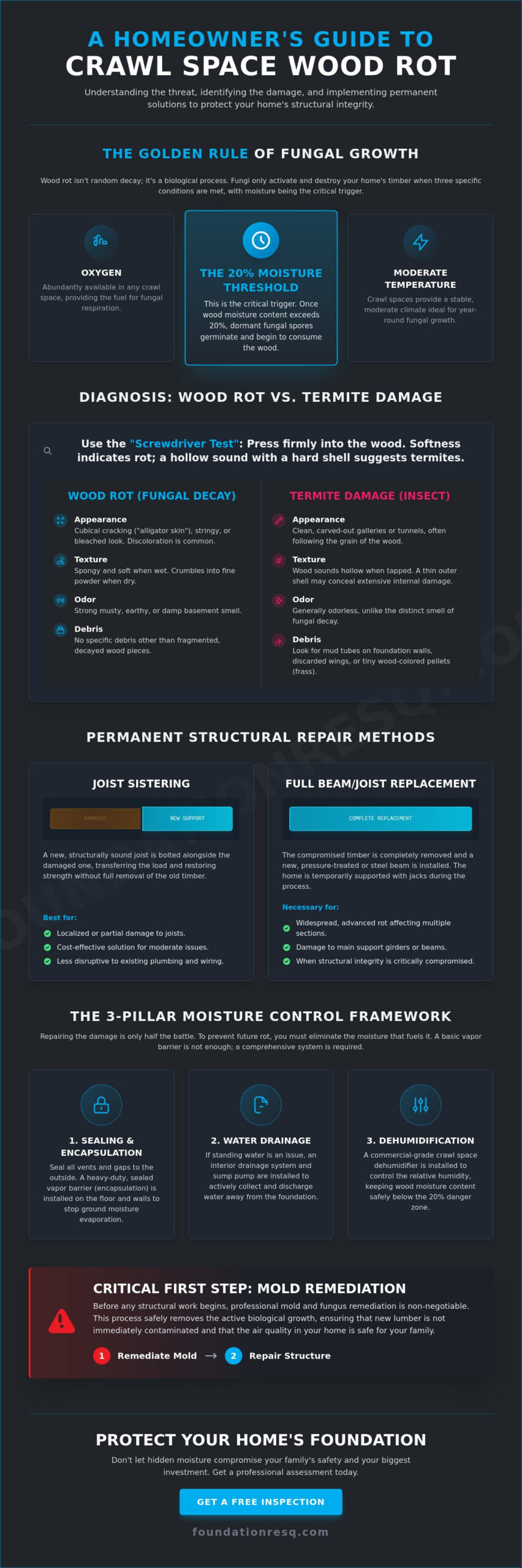
Wood rot is more than just a cosmetic concern; it’s a biological process where fungi actively consume the structural timber of your home. While many homeowners assume wood simply decays over time, the reality is that specific organisms are eating the cellulose and lignin that give your floor joists their strength. For wood rot to take hold, it requires a specific environment often referred to as the “Golden Rule” of fungal growth. Fungi need oxygen, moderate temperatures, and a moisture content of at least 20% to thrive. When these three factors align, your crawl space becomes a breeding ground for structural failure.
To understand What is Wood Rot and how it affects your foundation, you must recognize the three primary attackers. Brown rot, often called “dry rot,” causes wood to shrink and break into distinct cubes. White rot targets the lignin, leaving the timber looking stringy and bleached. Soft rot typically works more slowly but is just as destructive in consistently saturated environments. Because wood rot in crawl space environments often goes unnoticed for years, the damage is frequently advanced by the time it’s discovered.
The Role of Fungi in Structural Decay
Fungal spores are naturally present in the air, remaining dormant until the right conditions arrive. Once moisture levels reach that critical 20% threshold, these spores germinate and spread through a network of root-like structures called hyphae. These hyphae secrete enzymes that dissolve the wood’s cellular structure, effectively removing the building’s skeleton. This process is irreversible. Once the fungi have consumed the structural integrity of the timber, the wood cannot be cured or restored to its original strength; it must be professionally reinforced or replaced to ensure the safety of the home.
Why Tallahassee Homes are Vulnerable
Homeowners in North Florida face unique challenges due to our regional climate. Tallahassee’s high relative humidity levels mean that crawl spaces often reach wood moisture contents between 15% and 24% during the summer months. This puts many local homes perpetually on the edge of a fungal outbreak. Additionally, the clay-heavy soils found in parts of our area can lead to poor drainage and standing water after seasonal rain patterns. This trapped moisture evaporates directly into the wooden subfloor above, creating a perfect, humid incubator for wood rot to flourish year-round.
Wood Rot vs. Termite Damage: How to Spot the Difference
Identifying the source of structural decay is the first step toward a permanent resolution. Many homeowners mistake the signs of wood rot in crawl space areas for termite activity, and while both compromise your home’s safety, they require different remediation strategies. Wood rot is a biological breakdown caused by fungi, whereas termites are wood-destroying insects that physically consume the timber. Understanding the visual and tactile cues of each will help you determine the severity of the situation and the type of expert you need to call.
The most reliable field method for a homeowner is the “Screwdriver Test.” Take a flathead screwdriver and firmly press the tip into the suspicious wood. If the tool sinks in easily or the wood feels spongy and soft, you are likely dealing with rot. If the wood remains hard but sounds hollow when tapped, or if the screwdriver breaks through a thin outer shell into a series of carved-out tunnels, termites are the probable culprit. This University of Minnesota Extension guide to moisture control highlights how identifying these moisture-driven symptoms early can prevent localized decay from becoming a total structural failure.
| Feature | Wood Rot | Termite Damage |
|---|---|---|
| Appearance | Cubical cracking or “alligator skin” patterns. | Clean, carved-out galleries or tunnels. |
| Texture | Spongy when wet; crumbles to powder when dry. | Hollowed out but often retains a hard outer shell. |
| Odor | Strong musty, earthy, or damp basement smell. | Generally odorless. |
| Debris | No distinct debris other than wood fragments. | Mud tubes, discarded wings, or “frass” (pellets). |
Visual and Tactile Indicators of Rot
Advanced brown rot often presents an “alligator skin” appearance, where the wood dries out and cracks into small, distinct cubes. This cubical cracking is a hallmark of fungal infection. Along with these visual cues, you’ll often notice a heavy, musty scent that permeates the upper floors of the home. Active fungal growth thrives in damp environments, and if you touch the affected timber, it will often feel wet and lose its structural density entirely, eventually crumbling into a fine dust under light pressure.
Identifying Termite Activity in the Crawl Space
Termites are more discreet than fungi. They often build mud tubes, which look like thin veins of dirt running up your concrete foundation walls or support piers, to protect themselves from the air as they travel. When you tap on timber infested by termites, it produces a distinct hollow ring. You might also find “frass,” which looks like small piles of sawdust or salt and pepper, or discarded translucent wings near windows or floor joists. These insects leave the wood looking relatively normal on the surface while hollowing out the interior.
When the Damage is Overlapping
It’s common for both threats to exist simultaneously. Termites are attracted to the same high-moisture environments that foster wood rot in crawl space structures. Because moisture is the root cause for both, environmental control is always the first step in any remedy. Understanding is mold in crawl space dangerous can help you see how these biological threats often go hand-in-hand with air quality issues. If you’re unsure which threat is currently compromising your floors, a comprehensive structural inspection can provide a definitive diagnosis and a clear plan for stabilization.
Comparing Structural Repair Methods: Sistering vs. Replacement
Once you’ve confirmed the presence of wood rot in crawl space areas, the focus shifts to structural stabilization. Repairing rotted timber isn’t just about removing a nuisance; it’s about restoring the load-bearing capacity of your home. Choosing the right method depends on the depth of the fungal penetration and the remaining integrity of the wood. Professional remediation typically involves a combination of reinforcing existing structures and replacing those that can no longer support the building’s weight. Every repair must utilize pressure-treated lumber to ensure that the new materials are resistant to future fungal outbreaks.
For minor settling caused by localized decay, beam shimming is a common remedy. This involves inserting thin, durable spacers between the support piers and the main beams to level the floor above. While shimming addresses the symptom of a sagging floor, it must always be paired with a permanent solution for the underlying wood rot in crawl space environments to prevent further compression. Analyzing the cost-to-value ratio of these repairs is essential; while reinforcement is often more affordable, full replacement provides the highest level of long-term stability and home value protection.
Joist Sistering: When it Works and When it Fails
Sistering involves bolting a new, structural-grade timber alongside a compromised floor joist. This method is effective when the damage is localized and the original joist still retains a significant portion of its strength. However, a dangerous mistake often seen in DIY repairs is “sandwiching” the rot. If you bolt new wood directly to a rotted joist without treating the fungi or the moisture source, the infection will simply migrate to the new timber. To ensure a structural fix, professionals use heavy-duty galvanized bolts and washers to create a unified, load-sharing component that can withstand the humid crawl space environment.
Full Beam and Joist Replacement
When the structural integrity of a joist or main beam has been compromised by more than 25%, reinforcement is no longer a safe option. Full replacement requires the construction of temporary shoring walls. These walls support the weight of the house while the rotted sections are cut out and removed. This process is complex but necessary to restore the home’s original load-bearing capacity. By removing the biological threat entirely and installing new, treated beams, you eliminate the risk of the rot spreading to adjacent healthy timber.
The Role of Supplemental Support Posts
In many cases, traditional masonry piers aren’t enough to stabilize a floor that has been weakened by decay. Adjustable steel jacks are a superior alternative for crawl space stabilization. These jacks can be precisely tuned to lift sagging floors back to their original position, providing immediate relief for bouncy or uneven surfaces. These systems are often integrated into larger foundation repair Tallahassee projects, where environmental control and structural reinforcement work together to create a permanent shield for the home.
Preventing Future Wood Rot: The Moisture Control Framework
Structural repairs are only half the battle. If you don’t address the environmental conditions that caused the wood rot in crawl space areas originally, the fungi will eventually return. A permanent remedy requires a comprehensive moisture control framework built on three pillars: sealing, drainage, and dehumidification. In the humid climate of North Florida, a basic vapor barrier laid on the dirt floor is simply insufficient. Open foundation vents allow hot, wet air to enter the space, where it condenses on cool wood surfaces and keeps the timber’s moisture content above the dangerous 20% threshold.
Effective prevention starts with managing groundwater intrusion. Sump pump systems are essential for homes with high water tables or poor exterior drainage. These systems collect rising groundwater and pump it safely away from the foundation before it can saturate the air. By combining active drainage with encapsulation, you create a conditioned environment that protects your structural timber. This approach doesn’t just prevent decay; it can also reduce your home’s energy bills by approximately 15% by stabilizing the temperature beneath your living areas.
Crawl Space Encapsulation and Sealing
Encapsulation is the process of completely isolating the crawl space from the earth and the outside air. We install a heavy duty 20-mil vapor barrier that covers the floor and wraps up the foundation walls. This barrier is far more durable than the thin plastic sheets found in big-box stores. Sealing the foundation vents is equally critical. This prevents the intake of humid summer air that fuels fungal growth. For a deeper look at the process and materials used in our region, refer to our crawl space encapsulation Tallahassee guide.
The Necessity of Industrial Dehumidifiers
Even a sealed crawl space needs a way to manage internal humidity. Industrial-grade crawl space dehumidifiers are designed to maintain wood moisture content below the 15% threshold where rot cannot survive. Residential-grade units often fail in these environments because they aren’t built to operate in the cooler, damp conditions found under a home. A professional system includes dedicated drainage, either through a gravity line or a condensate pump, to ensure the unit runs efficiently without manual maintenance. This constant regulation provides a final line of defense against the elements.
If you’re ready to secure your foundation and stop the cycle of decay, schedule a comprehensive crawl space evaluation with our team today.
Professional Remediation: The Foundation ResQ Approach
Addressing wood rot in crawl space areas requires a methodical strategy that balances immediate structural restoration with long-term environmental control. At Foundation ResQ, we don’t believe in quick fixes that merely mask the symptoms of decay. Our approach is rooted in the understanding that your home’s foundation is a complex system where structural integrity and moisture levels are deeply interconnected. By combining technical precision with a commitment to durability, we provide a permanent resolution that restores both the safety and the value of your property.
Every project begins with a comprehensive inspection to map the extent of the fungal infection and identify the moisture source. We evaluate the load-bearing capacity of every joist and beam, ensuring that our repair plan addresses the root cause rather than just the visible damage. This thoroughness is why we insist that black mold in crawl space removal occurs before any structural timber is reinforced or replaced. Attempting to repair wood while active fungal colonies remain is a temporary measure; true restoration requires a clean, stable environment from the start.
Step 1: Mold and Fungal Remediation
The first priority is to neutralize the biological threat. We use professional-grade antimicrobial treatments to kill active fungal colonies and prevent dormant spores from reactivating. This step ensures that the environment is safe for our technicians and that your new structural materials won’t be immediately compromised by existing rot. For homeowners planning their repair budget, our cost of mold remediation in crawl space guide provides a detailed look at the factors that influence professional pricing in our region.
Step 2: Structural Stabilization and Repair
Once the environment is remediated, we focus on restoring the building’s skeleton. We use high-strength steel support systems and premium pressure-treated timber to reinforce or replace rotted components. Our team specializes in precision leveling, carefully lifting sagging floors back to their original position to eliminate bouncy spots and sticking doors. In cases where the wood rot in crawl space structures is accompanied by deeper soil issues, we may integrate helical pier installation to provide a permanent foundation for the entire building.
Step 3: Long-Term Protection
The final phase of our approach is the installation of a protective barrier between your home and the elements. This involves full crawl space encapsulation and the installation of a dedicated dehumidification system. We provide ongoing support and periodic inspections to ensure your moisture control framework continues to operate at peak efficiency. This methodical process provides Tallahassee homeowners with the peace of mind that comes from knowing their home is protected by local experts who understand the unique challenges of our North Florida environment. Schedule your free crawl space inspection with Foundation ResQ today.
Securing Your Home’s Foundation for the Long Term
Managing wood rot in crawl space areas requires more than a temporary fix; it demands a comprehensive strategy that restores structural strength while addressing the moisture that fuels decay. By correctly distinguishing fungal damage from termite activity and choosing the right restoration method, you can ensure your home remains stable for decades. Whether your floor joists require sistering or a full beam replacement, the goal is always a permanent remedy that protects your family and your investment.
Foundation ResQ provides specialized Tallahassee structural expertise as part of the Groundworks family. We offer the reliability of a national brand with the personalized service of a local neighbor. Our team delivers comprehensive moisture and mold remediation solutions that go beyond surface-level repairs to create a dry, conditioned environment under your home. You don’t have to face structural uncertainty alone.
Taking action now prevents localized decay from becoming a costly structural failure. Protect your home’s structural integrity with a free crawl space inspection from Foundation ResQ and gain the clarity you need to move forward. We’re here to help you restore your home’s health and your peace of mind.
Frequently Asked Questions
Is wood rot in a crawl space common in Tallahassee?
Wood rot is exceptionally common in Tallahassee due to the region’s high relative humidity and heavy seasonal rainfall. Our local climate often keeps crawl space moisture levels above the 20% threshold required for fungal growth. This environmental pressure makes regular inspections essential for North Florida homeowners to catch decay before it compromises structural integrity.
Can you just spray wood rot with bleach to stop it?
You cannot stop wood rot simply by spraying it with bleach. While bleach may kill surface mold, it doesn’t penetrate the porous surface of the timber to reach the root system of the fungi. Additionally, bleach is primarily composed of water, which can actually provide more moisture to the wood and accelerate the decay process over time.
Will homeowners insurance cover wood rot repair in a crawl space?
Most homeowners insurance policies do not cover wood rot repair because it’s classified as a preventable maintenance issue. Insurance typically covers sudden and accidental damage, like a burst pipe, rather than gradual deterioration caused by humidity or long term moisture exposure. It’s best to review your specific policy or consult with your agent for confirmation regarding your coverage.
How much does it cost to fix rotted floor joists?
The cost to repair rotted floor joists depends on the extent of the damage and the accessibility of the affected area. Factors such as whether the joists need simple sistering or a full structural replacement will influence the final investment. We recommend a professional structural evaluation to receive an accurate estimate tailored to your home’s specific needs.
Can wood rot spread from the crawl space to the rest of my house?
Wood rot can spread from the crawl space to other areas of your home if the moisture source isn’t controlled. Fungal spores are airborne and will colonize any timber that reaches the necessary moisture content. Because the “stack effect” pulls air from the crawl space into your living areas, high humidity can migrate upward and create conditions for rot in your subfloor and wall framing.
How do I tell if my bouncy floors are caused by wood rot or settling?
Distinguishing between wood rot in crawl space structures and general foundation settling often requires a tactile inspection. Bouncy floors caused by rot usually feel soft or spongy when you walk on them because the wood fibers have physically disintegrated. Settling typically involves the entire floor system sinking due to soil movement, which may result in gaps under baseboards while the wood itself remains hard.
Is it safe to live in a house with wood rot in the crawl space?
It is generally safe to live in a house with wood rot, but it presents long term risks to your home’s structural safety and your indoor air quality. If the rot is advanced, floor joists can fail, leading to sagging or partial collapse. Additionally, the fungi responsible for rot often coexist with mold, which can trigger respiratory issues as spores circulate through your HVAC system.
How long does it take to repair wood rot in a crawl space?
Most crawl space wood rot repairs take between two to five days to complete, depending on the complexity of the project. This timeframe includes the remediation of active fungal colonies, the installation of structural reinforcements, and the implementation of moisture control systems like encapsulation. Larger projects involving full beam replacements may require additional time to ensure a permanent resolution.