
Did you know that Tallahassee is one of the rainiest cities in the United States, receiving an average of 59.2 inches of rainfall every year? For local homeowners, this volume of water means your drainage system is the primary barrier between a dry crawl space and a costly foundation crisis. Identifying the sump pump failure signs Tallahassee properties often exhibit is essential to maintaining your home’s structural integrity. You want to feel certain that your property can handle the next heavy downpour, yet it’s common to feel a sense of anxiety when you hear an unusual vibration or notice the pump struggling to keep up with Florida’s high water table.
We understand that the health of your home’s lower levels is vital for your family’s comfort and the building’s longevity. This guide will help you identify seven critical warning signals that your system needs professional attention before a storm causes permanent damage. By the end of this article, you’ll have a clear understanding of your pump’s mechanical health and the confidence to know exactly when to call for an expert evaluation. We are here to help you maintain a dry, mold-free environment that stands strong against the elements.
Key Takeaways
- Understand how Tallahassee’s 60 inches of annual rainfall creates hydrostatic pressure that requires a reliable relief system to protect your foundation.
- Identify the most common sump pump failure signs Tallahassee homeowners face, including mechanical grinding noises and irregular cycling patterns.
- Learn how to perform the “Bucket Test” to verify that your float switch and motor are ready for the next heavy downpour.
- Discover why battery backup systems are a critical requirement for maintaining a dry crawl space during Florida’s frequent hurricane-related power outages.
- See how combining a professional sump pump system with crawl space encapsulation creates a permanent barrier against moisture and mold growth.
Why Sump Pump Health is Essential for Tallahassee Foundations
Tallahassee is one of the wettest cities in the United States, and that volume of water creates a unique set of challenges for local property owners. While the average rainfall sits near 60 inches annually, the real threat lies in how that water interacts with our specific geological conditions. A sump pump serves as the primary relief valve for your home, managing the immense pressure that builds up beneath the surface. Recognizing the sump pump failure signs Tallahassee homes often display is the only way to ensure this relief valve remains operational when the next major storm system moves through the Panhandle.
To understand why this system is so vital, one must consider what a sump pump is in the context of structural preservation. It isn’t merely a tool for convenience; it’s a mechanical guardian that redirects water away from your foundation before it can cause irreversible damage. When this system fails, the resulting soil saturation can destabilize pier-and-beam structures, leading to shifting floors and cracked walls. A functioning pump is your first line of defense against the slow, destructive power of water that would otherwise compromise the very ground your home stands on.
The Impact of Florida’s High Water Table
Tallahassee’s soil, a complex mix of red clay and sand, behaves unpredictably when saturated. Clay soil is particularly stubborn because it expands as it absorbs water, then holds that moisture for extended periods after the rain stops. This creates a “bathtub effect” around your crawl space. Hydrostatic pressure is the persistent force of saturated soil pushing against your home’s foundation walls. This force is strong enough to buckle masonry or shift heavy supports. If the soil remains oversaturated, it can even compromise the structural stabilization provided by helical piers. A reliable pump ensures this pressure is managed effectively, maintaining the integrity of the surrounding earth.
Preventing Mold and Structural Decay
Water management is also a matter of health and safety. When a pump fails to remove intruding groundwater, the humidity in your crawl space spikes, creating a breeding ground for organic growth. This often leads to the need for professional mold remediation in Tallahassee, FL. Excess moisture doesn’t stay confined to the crawl space. It rises through the floorboards, weakening wooden floor joists over time and causing them to rot or sag. By keeping the area dry, your sump pump maintains healthy indoor air quality for your entire household. It’s a critical component in preventing the wood rot that eventually requires expensive structural timber replacement.
7 Warning Signs Your Sump Pump is Failing
A sump pump is often a “set it and forget it” appliance for many homeowners until a heavy storm arrives. By then, a mechanical failure can lead to immediate crawl space flooding. While a complete lack of power is an obvious problem, most systems provide subtle warnings before they quit entirely. Recognizing these sump pump failure signs Tallahassee properties often exhibit allows you to take action before the next seasonal downpour creates a foundation crisis.
If your system has already failed during a storm, you may need to explore Emergency Property Restoration and Reconstruction options to address water damage and prevent mold growth before structural repairs begin.
Mechanical Red Flags: Noises and Vibrations
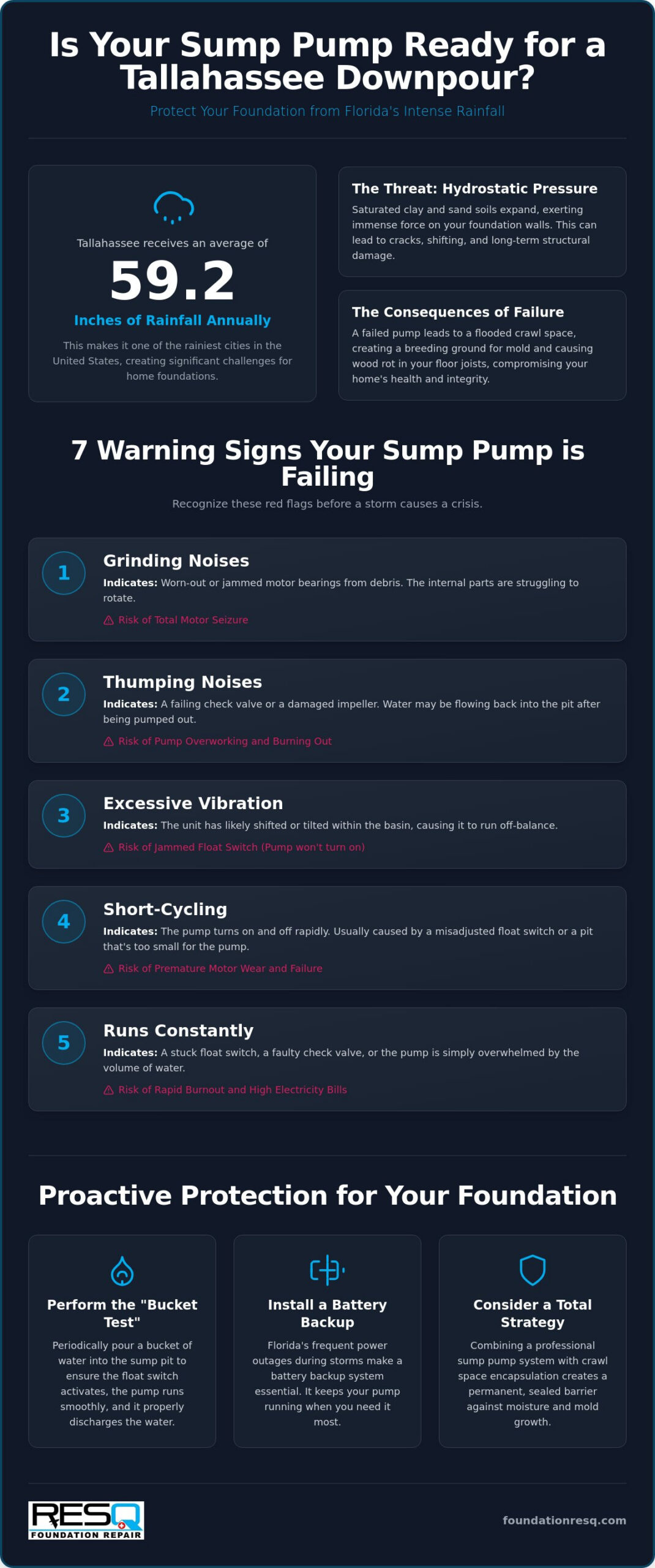
Grinding sounds typically indicate that the motor bearings are wearing down or have become jammed with debris. These sounds are a clear signal that the internal components are struggling to rotate, which can lead to a total motor seizure. Thumping noises often signal a failing check valve or a damaged impeller. If the check valve fails, water that was supposed to be discharged flows back into the pit, forcing the pump to work twice as hard to remove the same volume of liquid. Excessive vibration is another concern. If the pump shakes violently during operation, it can cause the unit to tilt within the basin. This shift often jams the float switch against the side of the pit, preventing the pump from activating when you need it most.
Operational Issues: Short-Cycling and Constant Running
Short-cycling occurs when the pump turns on and off every few seconds rather than completing a full discharge cycle. This pattern is often caused by an incorrectly adjusted float switch or a pit that is too small for the pump’s capacity. Frequent starting and stopping puts immense strain on the motor, leading to premature mechanical failure. Conversely, a pump that runs continuously even when the pit is empty is equally dangerous. This usually happens when the float switch becomes trapped in the “on” position. If the motor runs without water to cool it, the system will eventually burn out. In our region, an undersized pump is a common issue. If your system cannot keep up with Tallahassee’s high rain volume, it will run longer than intended and wear out years before its expected lifespan.
Visual cues and physical evidence are the final indicators of trouble. Visible rust or corrosion on the pump housing or electrical connections suggests that the unit is reaching the end of its functional life. The most definitive sign of trouble is the presence of standing water in your crawl space while the pump is supposedly active. If you notice any of these symptoms, a professional inspection of your sump pump system can prevent a total failure during the next hurricane season. Addressing these issues early ensures your home remains a dry, stable environment regardless of the weather outside.
The Sump Pump Maintenance Checklist for Florida Homeowners
Maintaining your drainage system is the best way to ensure your home remains protected during Florida’s extreme weather events. While we’ve already discussed the mechanical sump pump failure signs Tallahassee homeowners should watch for, a consistent maintenance routine can catch these issues before they escalate into a full-scale flood. Regular upkeep doesn’t just extend the life of your equipment; it provides the peace of mind that your foundation’s primary defense is ready for the next 60-inch rainfall year. Proactive care is always more cost-effective than reactive structural repairs.
A comprehensive maintenance plan starts with the power source. Because sump pumps operate in damp environments, they’re typically plugged into a GFCI (Ground Fault Circuit Interrupter) outlet. These outlets can trip during power surges or high-humidity events, cutting power to your pump without warning. Periodically pressing the “test” and “reset” buttons ensures the pump has the electricity it needs to function. Additionally, checking the power cord for fraying or corrosion is essential for long-term safety and reliability in our humid climate.
Step 1: The Quarterly Pit and Intake Inspection
The unique soil composition in Tallahassee, often rich in silt and red clay, can gradually accumulate in the bottom of your sump pit. Every three months, remove the pit lid and use a flashlight to check for debris. If mud or gravel has built up, it can be sucked into the intake screen, forcing the motor to strain or causing the impeller to jam. Ensure the pump is standing perfectly upright. Pumps that have shifted or tilted due to vibration are much more likely to have their float switches pinned against the basin wall, leading to a failure to activate when the water rises.
Step 2: Testing the Float and Discharge
Mechanical components need to move to stay functional. To perform a “Bucket Test,” slowly pour approximately five gallons of water into the basin. This simulates a localized rain event and allows you to observe the system’s reaction in real time. As the water level rises, the float should lift smoothly without catching on the basin’s edges. Once the motor activates, listen for the steady hum of a healthy pump rather than the grinding or thumping sounds that indicate internal distress. Finally, walk outside to verify that the discharge line is clear. Water should exit the pipe freely and be directed at least 20 feet away from your foundation to prevent it from simply cycling back into the soil around your crawl space.
Mechanical Heart: Float Switches and Battery Backups
The float switch acts as the mechanical heart of your drainage system, dictating exactly when the motor should engage to protect your home. It’s also the most common component to fail in any pump system. One of the most deceptive sump pump failure signs Tallahassee residents encounter is a “silent failure” where the pump motor sounds like it’s running, but the water level doesn’t drop. This often happens when the float switch becomes pinned against the basin wall or when the internal impeller has detached from the drive shaft. A pump that runs without moving water is effectively useless, leaving your foundation vulnerable to the hydrostatic pressure we discussed earlier.
Check valves also play a vital role in this mechanical cycle. This one-way valve ensures that once water is pumped out of the pit, it cannot flow back down the discharge pipe when the motor stops. If you hear a loud “clunk” at the end of a cycle, or if your pump immediately turns back on after stopping, your check valve likely needs replacement. Without a functional check valve, your pump will cycle unnecessarily, leading to the short-cycling issues that burn out motors prematurely.
Why Battery Backups are Non-Negotiable in Tallahassee
Tallahassee’s hurricane season brings intense tropical storms that frequently knock out power exactly when your pump is needed most. A standard sump pump relies entirely on your home’s electrical grid. If the power fails during a downpour, your crawl space will begin to flood within minutes. A battery backup system is a critical requirement for local homes because it provides a secondary pump and power source. This redundancy ensures that your protection remains active even during a blackout. To maintain reliable performance, we recommend replacing these backup batteries every 3 to 5 years, as the humid Florida climate can degrade battery cells over time. Regularly testing the backup system by unplugging the primary unit is the only way to ensure you aren’t left vulnerable during a storm.
Optimizing Discharge for Foundation Health
The path your water takes after leaving the pump is just as important as the pump itself. A properly placed discharge line prevents the same water from recycling back into your crawl space through the soil. You must ensure these lines direct water away from concrete driveways and walkways. Water pooling near these surfaces can lead to soil erosion and subgrade instability, eventually causing the concrete to sink or crack. Additionally, check for “air locks” in the discharge line. An air lock occurs when a bubble of air becomes trapped in the pipe, preventing the pump from pushing water through. Small weep holes drilled into the discharge pipe near the pump can prevent this issue and ensure the motor doesn’t strain against an invisible barrier.
Protecting your home requires a system that works even when the main power fails. If you haven’t inspected your secondary defenses recently, it’s time to upgrade to a professional Sump Pump System that includes a dedicated battery backup.
Integrating Sump Pumps into a Total Moisture Control Strategy
A sump pump is a powerful tool, but it achieves its highest efficiency when integrated into a comprehensive moisture management system. In the high-saturation environment of North Florida, simply having a pump isn’t always enough to prevent structural decay. A sump pump is most effective when paired with crawl space encapsulation Tallahassee. This combination transforms your home’s lower levels from a damp liability into a dry, controlled environment. By looking beyond the mechanical health of the pump, you can establish a permanent barrier against the elements that protects your entire structural footprint.
Foundation ResQ provides integrated drainage solutions designed to handle the specific geological challenges of our region. When a pump works alone, it only removes water that happens to reach the pit. When it’s part of a total strategy, every component of the system works together to ensure that no moisture is left to compromise your home’s stability. If you ignore the sump pump failure signs Tallahassee properties often show, you risk undermining other investments like dehumidifiers or vapor barriers. A cohesive approach ensures that every gallon of water is accounted for and redirected away from your foundation.
The Sump Pump as the Drainage Engine
Think of the sump pump as the engine of your home’s drainage system. During encapsulation, a heavy-duty vapor barrier is installed across the crawl space floor and walls. This barrier acts as a funnel, capturing groundwater and directing it toward the sump pit for efficient removal. This setup ensures that water cannot sit in stagnant pools under your home, which is a common cause of wood rot and mold growth. Furthermore, a sealed sump pit is essential. A sealed lid prevents musty odors and humid air from escaping back into the crawl space, maintaining the integrity of the air quality upstairs. This integrated approach is a primary defense against sinking home foundations that occur when soil becomes oversaturated and loses its load-bearing capacity.
Long-Term Protection for Your Investment
Combining a professional sump pump system with a crawl space dehumidifier offers the ultimate protection against Florida’s relentless humidity. While the pump handles liquid water, the dehumidifier manages the water vapor in the air, keeping your wooden floor joists dry and strong. This dry environment preserves your property value and ensures that your home remains structurally sound for decades. If you’ve observed any sump pump failure signs Tallahassee residents should worry about, it’s time to evaluate your home’s entire water management plan. We invite you to schedule a professional inspection to determine if your current system is ready for the next hurricane season. Taking action now provides the peace of mind that comes from knowing your home is protected by a steadfast local expert. Contact Foundation ResQ for a professional sump pump evaluation and ensure your home stays dry, stable, and safe.
Securing Your Tallahassee Foundation for the Next Storm
A reliable drainage system is your home’s most important defense against the 59.2 inches of rain our city receives annually. By recognizing the sump pump failure signs Tallahassee properties often show, like unusual vibrations or short-cycling, you can prevent groundwater from compromising your structural integrity. Maintenance shouldn’t be a source of anxiety; it’s a proactive step toward maintaining a dry, mold-free crawl space. Establishing a total moisture control strategy ensures your foundation remains stable even during the most intense Florida thunderstorms.
Foundation ResQ offers specialized expertise in Tallahassee soil and groundwater conditions. We provide total structural protection for your home, from your foundation to your crawl space. We understand the specific challenges of our region’s red clay and high water table, and we’re committed to providing long-term stability for your local investment. Don’t wait for a heavy storm to test your mechanical defenses.
Protect your home from water damage-schedule a free inspection with Foundation ResQ today!
Your home deserves a stable, secure future, and our team is ready to provide the dependable protection you need.
Frequently Asked Questions
How often should I perform sump pump maintenance in Tallahassee?
You should perform a visual inspection of your system every three months. Because Tallahassee soil is rich in silt and clay, debris can accumulate quickly in the basin. A quarterly check ensures the intake screen remains clear and the float switch moves freely. We also recommend a professional mechanical evaluation once a year to prepare your home for the intense groundwater pressure of the summer hurricane season.
Why is my sump pump making a loud thumping noise when it stops?
A loud thumping noise usually indicates a failing check valve. When the pump motor turns off, the water remaining in the vertical discharge pipe falls back down toward the pit. The check valve is supposed to stop this flow, but if it’s worn, the weight of the water creates a “water hammer” effect. Replacing this valve prevents backflow and protects your motor from unnecessary strain.
Can I clean my own sump pump or do I need a professional?
Homeowners can safely perform basic cleaning tasks like removing mud from the pit or clearing the intake screen. However, if you notice persistent sump pump failure signs Tallahassee experts should handle the mechanical and electrical diagnostics. Professional technicians have the tools to test motor amperage and battery health, ensuring your system provides a reliable barrier against the elements during a major storm.
What happens if my sump pump fails during a Tallahassee power outage?
If your primary pump relies solely on the electrical grid, it will stop functioning immediately during a power outage. This is a significant risk during Florida tropical storms when rainfall is heaviest. To maintain protection, you should install a battery backup system. This secondary unit activates automatically when it detects a loss of power or a primary pump failure, keeping your crawl space dry until the grid is restored.
How long do sump pumps typically last in the Florida climate?
Most high quality sump pumps have a functional lifespan of 7 to 10 years. However, the high water table and frequent heavy rains in North Florida mean local pumps often work harder than those in other regions. This increased workload can lead to earlier mechanical fatigue. Regular maintenance and keeping the basin clear of red clay silt are the best ways to ensure your pump reaches its full life expectancy.
Is it normal for my sump pump to run even when it hasn’t rained?
It is perfectly normal for a pump to activate during dry periods in our region. Tallahassee’s hilly terrain and high water table mean groundwater can still move toward your foundation days after a storm has passed. If your home is located in a low lying area or has clay heavy soil that retains moisture, your pump will continue to manage that hydrostatic pressure to keep your structure stabilized.
How far away should my sump pump discharge water from my foundation?
Your discharge line should extend at least 20 feet away from your home’s foundation. If the water is released too close to the crawl space, it will simply soak back into the soil and seep back into your pit. This creates a continuous loop that wastes electricity and wears out your motor prematurely. Ensuring the water reaches a proper drainage point or a sloped area prevents this recycling effect.
Does a sump pump prevent mold growth in my crawl space?
A sump pump is the essential first step in mold prevention because it removes standing water. However, mold also thrives on high humidity levels common in the Florida panhandle. To achieve a truly mold free environment, the pump should be integrated into a total moisture control strategy. This usually involves pairing the pump with crawl space encapsulation and a dedicated dehumidifier to maintain a dry, healthy atmosphere.