
What if the very ground your home sits on is slowly working against its structural integrity? In North Florida, the combination of expansive clay and shifting sands creates a volatile environment for any concrete base. If you have noticed cracks in your drywall or doors that no longer latch, you are not alone in your concern. Searching for slab foundation repair Tallahassee can feel overwhelming, especially when you are worried about the potential for yard destruction or a fix that only masks the underlying symptoms.
You deserve a home that feels solid and a repair process that is transparent from start to finish. We’ll show you how to identify specific structural threats and resolve them permanently using modern, non-invasive techniques. This article provides a clear look at what to expect in 2026, including how the 9th Edition of the Florida Building Code influences local standards. You will learn about the timeline for stabilization and how a remedy-based approach ensures your property remains protected with a transferable warranty. We will preview the latest methods for achieving a level, safe home without the stress of a traditional construction site.
Key Takeaways
- Understand how Tallahassee’s unique Red Hills clay and seasonal rainfall create hydrostatic pressure that threatens your home’s stability.
- Identify early interior and exterior warning signs, such as drywall cracks or sticking windows, to address issues before they escalate.
- Learn why modern slab foundation repair Tallahassee techniques like helical piers and advanced polymer injection offer a more durable, less invasive alternative to traditional methods.
- Discover what to expect during a professional structural evaluation and how your property is protected throughout the restoration process.
- See how a permanent, remedy-based solution with a transferable warranty can protect your home’s long-term market value.
Understanding the Challenges of Slab Foundations in Tallahassee
Tallahassee’s landscape is famous for its rolling hills and canopy roads, but beneath the surface lies a complex geological environment that presents specific challenges for homeowners. Most residential structures in Leon County rely on a slab-on-grade design, which essentially places the weight of the building directly onto the upper layers of soil. This construction method follows basic Shallow Foundation Principles, yet it faces unique stressors in the Florida Panhandle. When homeowners investigate slab foundation repair Tallahassee, they are often reacting to the volatile interaction between local architecture and our specific soil composition.
The difference between normal house settling and structural slab failure lies in uniformity. It is standard for a new home to settle slightly and evenly into the ground during its first few years. However, structural failure is differential. This occurs when one portion of the slab sinks or rises at a different rate than the rest of the footprint. In the Panhandle, slab-on-grade foundations are particularly vulnerable because they lack the deep footings that might otherwise bypass unstable surface soils. Without a professional remedy, this uneven movement places immense strain on the concrete, eventually leading to visible cracks and compromised integrity.
The Role of Tallahassee’s Expansive Clay Soils
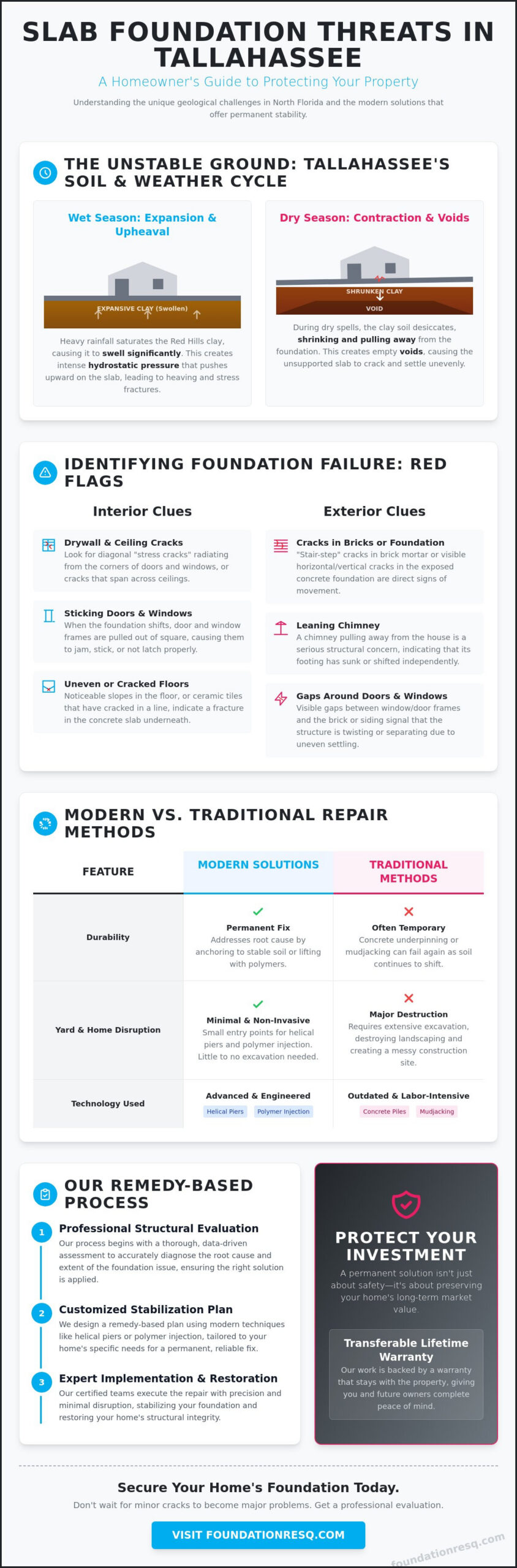
Expansive clay is the primary driver of Tallahassee foundation movement. The “Red Hills” region is characterized by heavy, iron-rich clay that behaves much like a sponge. During our humid, wet seasons, this clay absorbs moisture and swells significantly, exerting upward pressure on the concrete above. When dry spells occur, the soil undergoes desiccation, meaning it shrinks and pulls away from the structure. This contraction creates empty voids beneath your concrete slab. Without consistent support from the earth below, the heavy slab begins to tilt or “dish” as it settles into these newly formed gaps.
Weather Patterns and Foundation Stress
Tallahassee’s climate features intense seasonal thunderstorms that can drop several inches of rain in a very short window. This sudden influx of water causes rapid soil saturation and creates intense hydrostatic pressure. If a home has poor drainage, water pools near the perimeter of the slab and softens the supporting soil. Over time, this localized sinking becomes a permanent structural issue. Ignoring these environmental factors leads to long-term risks, including secondary damage to the home’s framework. A methodical approach to stabilization is the only way to protect a building from the relentless cycle of Florida’s weather patterns.
Red Flags: Identifying Slab Foundation Issues in Your Home
Many homeowners assume that a small crack in the ceiling or a door that catches on the carpet is just a sign of an aging house. While wood does expand in Florida’s humidity, structural movement is far more consistent and progressive. Identifying the need for slab foundation repair Tallahassee starts with distinguishing between superficial blemishes and structural failures. If the issues you see are worsening over several months, your home’s footprint is likely shifting.
The Florida Geological Survey provides extensive data on how our state’s limestone and clay layers contribute to these localized shifts. When the underlying soil fails to provide uniform support, the concrete slab begins to bend or crack. This creates a chain reaction of symptoms throughout the entire building. Recognizing these red flags early can prevent a minor settlement issue from becoming a catastrophic structural failure.
Interior Clues of Slab Movement
Sticking doors and windows are often the first indicators of a shifting slab. When the foundation settles unevenly, the door frames are pulled out of square. This causes the top of the door to rub against the jamb, even when the humidity is low. You should also look for cracks that radiate from the upper corners of door and window openings. These diagonal “stress cracks” in the drywall suggest that the wall is being pulled in two different directions.
Flooring issues offer another clear sign of distress. If you notice floor tiles cracking in a straight line across a room, the slab beneath them has likely fractured. You can check for sloping floors by placing a small ball or level on the ground; if the ball consistently rolls toward the same wall, your foundation is no longer level. These interior changes are symptoms of a deeper problem that requires a professional foundation evaluation to resolve permanently.
Exterior and Structural Warning Signs
The outside of your home often reveals the most telling evidence of structural failure. You should inspect the perimeter where the siding or brick meets the concrete slab. Gaps forming in these areas indicate that the house is pulling away from its base. Vertical cracks in the foundation itself are common, but horizontal or diagonal cracks usually signal more severe pressure from the surrounding soil.
Exterior stair-step cracks in brick are a classic sign of foundation settlement. These cracks follow the mortar lines between the bricks, creating a jagged pattern that moves upward. This occurs because the mortar is weaker than the brick, and it breaks first as the wall sinks. It is also important to distinguish between “settlement,” where the house sinks into a void, and “heave,” where expansive clay pushes the slab upward. Both issues disrupt the home’s integrity and require specialized stabilization methods to fix. Homeowners dealing with an actively dropping structure should explore sinking home foundation solutions that address the root cause rather than masking visible symptoms.
Modern Solutions for Slab Stabilization and Leveling
When addressing structural failure, the goal is to move beyond temporary patches and implement a permanent remedy. In the past, many homeowners relied on “mudjacking,” a process that pumps a heavy slurry of sand and cement under a slab. However, this method often fails in Tallahassee because the added weight of the slurry can cause further sinking in our soft clay soils. Modern engineering provides more precise, lightweight, and durable alternatives that align with the rigorous standards of the International Residential Code. These solutions focus on transferring the load of the building to stable strata or restoring the soil’s load-bearing capacity without adding unnecessary mass.
Choosing the right method for slab foundation repair Tallahassee depends on the severity of the settlement and the specific soil conditions discovered during an inspection. For homes experiencing deep structural shifts, piering systems provide a mechanical lift. For slabs that have settled due to soil washouts or minor compaction issues, high-density polymers offer a non-invasive way to restore a level surface. Both approaches prioritize long-term stability over cosmetic fixes that will inevitably fail as the Red Hills clay continues its shrink-swell cycle. Before committing to any stabilization method, homeowners benefit from reviewing a foundation repair cost estimator to understand the variables that influence project pricing and avoid unexpected expenses.
Deep Foundation Piering Systems
Helical and push piers are the gold standard for stabilizing a sinking slab. Helical piers feature screw-like plates that allow them to be bored deep into the earth, bypassing unstable clay until they reach competent load-bearing soil or bedrock. Push piers, on the other hand, use the weight of the structure itself to drive steel tubes deep into the ground. Once these piers are securely seated, the weight of your home is transferred from the failing surface soil onto the steel pier system. This allows for the potential to lift the slab back toward its original position, closing drywall cracks and restoring the function of sticking doors.
PolyRenewal: Precision Slab Leveling
PolyRenewal concrete lifting has revolutionized how we handle sinking slabs, sidewalks, and driveways. This process involves injecting a high-density polyurethane foam through tiny holes, about the size of a penny, drilled into the concrete. As the foam expands, it fills every void and exerts enough pressure to lift the slab with pinpoint accuracy. Unlike old-fashioned mudjacking, PolyRenewal is waterproof. It won’t wash away during intense Florida thunderstorms, nor will it react with the acidic components of local soil. The material is incredibly lightweight, meaning it doesn’t add new stress to the ground below. With a cure time of only 15 minutes, your slab is ready for full use almost immediately after the installation is complete.
In cases where slab movement has caused secondary damage to interior or exterior walls, we often utilize carbon fiber wall reinforcement. These low-profile strips are bonded to the wall to provide immense tensile strength, preventing further bowing or cracking. This multi-layered approach ensures that every part of the home’s skeleton is protected against future environmental shifts.
The Foundation ResQ Process: What to Expect
Understanding the right technology is only the first step toward a stable home. The success of slab foundation repair Tallahassee depends on a methodical, multi-stage execution that prioritizes precision and property protection. We approach every project with a clear roadmap, ensuring that you are informed from the initial assessment to the final walkthrough. This structured journey transforms a stressful structural concern into a controlled, professional resolution.
Our process is designed to be as non-invasive as possible. We recognize that your home is your most significant investment, and our goal is to restore its health without creating unnecessary chaos. By following a service-centric flow, we address the specific environmental challenges of the Florida Panhandle while maintaining a tidy and organized workspace. Each phase of the project is handled by seasoned professionals who understand the weight of the work they perform.
Step 1: The Comprehensive Structural Inspection
Our Tallahassee experts begin by conducting a thorough site visit to identify the root cause of the structural distress. We don’t just look at the visible cracks; we analyze the entire property to understand how water and soil are interacting with your foundation. Our team uses precision laser levels to map the exact degree of slab variance across your home’s footprint. This data provides a clear picture of where the settlement is most severe and where the slab remains stable.
By combining these elevation readings with an understanding of local soil desiccation patterns, we develop a remedy-based plan tailored to your home’s unique needs. This plan outlines exactly where stabilization is required and which system will provide the most durable outcome. We believe in providing a transparent overview of the necessary repairs before any work begins, allowing you to move forward with confidence.
Step 2: Professional Installation and Restoration
Once the plan is finalized, the restoration phase begins. We prioritize protecting your property, using specialized equipment designed to minimize disruption to your landscaping and home interior. If the project requires pier installation, we excavate small, targeted areas rather than trenching your entire yard. This approach preserves your curb appeal while allowing us to reach the load-bearing strata necessary for a permanent fix.
During the lifting process, our technicians monitor the structure in real-time. We make incremental adjustments to move the slab back toward its original position with extreme precision, often closing drywall cracks as the home is leveled. After the structural work is complete, our crew performs a meticulous final cleanup to ensure your property is left in better condition than we found it. We also provide all necessary warranty documentation, ensuring your investment is protected for years to come. If you are ready to secure your home’s future, contact Foundation ResQ for a professional structural evaluation today.
Protecting Your Tallahassee Investment for the Long Term
Resolving structural issues is the first step, but ensuring that the solution lasts for decades is vital for any Leon County homeowner. When you invest in slab foundation repair Tallahassee, you aren’t just fixing a crack; you’re sealing your home against the elements. A fractured slab often acts as a gateway for moisture and soil gases, which can lead to mold growth in your living spaces. It also provides an entry point for wood-destroying organisms and other pests that thrive in Florida’s humid climate. By permanently stabilizing the concrete, you create a defensive barrier that protects the health and structural integrity of your entire household for the long term.
Warranty and Home Value
A transferable lifetime warranty is a powerful tool in the Florida real estate market. Potential buyers are often wary of homes with a history of structural movement, but documented proof of a professional remedy changes the conversation. It shifts the narrative from a liability to an asset. It demonstrates that the property has been reinforced to meet modern engineering standards. Our industry-leading warranties provide the peace of mind that comes with knowing the home is safe, regardless of who owns it in the future. For those seeking Foundation repair Tallahassee, this level of protection is essential for maintaining and even increasing long-term property value.
Choosing a Local Specialist
Choosing a local specialist who understands the specific environmental demands of Tallahassee and Northern Florida is critical. As part of the Groundworks family, we combine national-level technology with a deep understanding of Leon County building codes. We know how the Red Hills clay behaves during a drought and how it swells during our intense summer storms. This localized knowledge ensures that your slab foundation repair Tallahassee project is both compliant and structurally effective. Working with a contractor who is a neighbor means you get a professional who is personally committed to the health of the local community’s buildings.
The path to a stable home begins with a clear understanding of your property’s current condition. We provide a methodical assessment that moves you from uncertainty to informed resolution. If you have noticed the red flags of settlement or have concerns about the stability of your slab, don’t wait for the damage to progress into a more costly issue. Contact Foundation ResQ today for your free inspection and take the first step toward a permanent, remedy-based structural resolution.
Securing Your Home’s Structural Future
Addressing foundation issues early is the most effective way to preserve your property’s value and structural safety. We have explored how Tallahassee’s unique Red Hills clay requires a specialized approach that goes beyond cosmetic patches. By identifying red flags like sticking doors or exterior brick cracks, you can take action before seasonal rains worsen the damage. Our remedy-based process ensures that every slab foundation repair Tallahassee project receives the technical precision it deserves.
As part of the Groundworks national network, Foundation ResQ offers the stability of a major organization with the localized care of a neighbor. We utilize specialized PolyRenewal technology for precise leveling and provide transferable lifetime warranties to ensure your investment remains protected. This combination of advanced engineering and local accountability provides a final line of defense for your building. Don’t let structural uncertainty affect your peace of mind. Schedule Your Free Structural Inspection in Tallahassee to receive a clear, professional evaluation of your home’s health. We look forward to helping you restore the strength and stability of your foundation.
Frequently Asked Questions
How much does slab foundation repair cost in Tallahassee?
The cost of your project depends on the specific stabilization method required and the extent of the structural damage. Factors such as the number of piers needed to reach stable soil or the amount of polymer foam required for leveling will influence the final total. A professional structural evaluation is the only way to get an accurate quote tailored to your home’s unique footprint and soil conditions. For a detailed breakdown of what drives pricing across different repair methods, our foundation repair cost estimator guide provides a comprehensive overview of the variables involved.
Will foundation repair damage my landscaping or driveway?
Modern repair techniques are designed to be as non-invasive as possible to protect your property’s curb appeal. We use small, targeted excavation points for pier installations rather than digging large, disruptive trenches through your yard. For concrete lifting, we drill penny-sized holes that are easily sealed and blended, ensuring your driveway and landscaping remain largely undisturbed throughout the process.
How long does a typical slab repair take to complete?
Most residential stabilization projects are completed within one to three days. Simple concrete leveling tasks can often be finished in just a few hours. More complex structural piering may require additional time depending on the depth of the load-bearing strata, but our goal is always to provide a permanent remedy with minimal disruption to your schedule.
Can I stay in my home during the foundation repair process?
You can typically remain in your home while the work is being performed. Our technicians focus their efforts on the perimeter or specific sections of the slab, so your daily routine isn’t usually interrupted. Because the equipment we use is precise and relatively quiet, there is no need for you to relocate during the restoration of your home’s stability.
Is slab foundation repair covered by homeowners insurance in Florida?
Standard homeowners insurance policies in Florida generally don’t cover repairs for settlement caused by soil compaction or expansive clay. Coverage is usually limited to sudden events, such as a major plumbing leak that washes out the soil. It’s best to check with your insurance provider to see if you have specific endorsements that might apply to structural stabilization.
What is the difference between PolyRenewal and traditional mudjacking?
PolyRenewal uses a lightweight, waterproof polymer that won’t wash away or add unnecessary weight to unstable ground. Traditional mudjacking relies on a heavy slurry of sand and cement that can actually trigger further sinking in Tallahassee’s soft clay soils. PolyRenewal also cures in about 15 minutes, allowing you to use your slab or driveway almost immediately after we finish.
How do I know if a crack in my slab is serious or just cosmetic?
Serious cracks are typically wider than one-eighth of an inch and often appear alongside other symptoms like sticking windows or uneven floors. Hairline cracks are common as new concrete cures, but fractures that grow over time or follow a stair-step pattern in your exterior brickwork suggest structural distress. If you notice these signs, searching for slab foundation repair Tallahassee is a necessary step to prevent further damage.
Does Tallahassee soil make foundation problems more likely than in other cities?
The expansive “Red Hills” clay found in Tallahassee is significantly more volatile than the sandy soils common in coastal Florida cities. This clay undergoes a dramatic shrink-swell cycle during our seasonal rains and droughts, which places constant pressure on concrete bases. This unique geological environment makes specialized local expertise essential for any long-term foundation resolution in the Leon County area.