
What if the most durable foundation repair isn’t the one with the highest price tag, but the one that best understands the ground beneath your feet? Noticing a jagged crack in your brickwork or a door that won’t quite latch is deeply unsettling. It’s natural to worry about the structural integrity of your largest investment and feel overwhelmed by technical jargon. You need a solution that works the first time so you don’t have to face these anxieties again.
In this guide, we’ll clarify the debate of helical piers vs push piers to help you secure a permanent resolution for foundation settlement. You’ll learn why the weight of your home and the specific depth of our regional load-bearing soil layers are the primary factors that dictate the right stabilization method. We’ll also examine how these systems align with the latest structural standards, including the upcoming shifts in the Florida Building Code, to ensure your foundation remains a stable, protected sanctuary for your family. By understanding the “why” behind each recommendation, you can move forward with the confidence that your home’s health is restored for the long term.
Key Takeaways
- Understand how shifting Tallahassee soils impact your home’s stability and why structural underpinning is the definitive solution for settlement.
- Learn how push piers leverage the weight of your home to reach deep, load-bearing strata for maximum structural support.
- Discover why helical piers are ideal for lighter loads and specialized soil conditions where hydraulic torque ensures a precise, stable fit.
- Identify the key differences between helical piers vs push piers to determine which engineered system provides the most durable protection for your property.
- Gain clarity on the professional evaluation process used to select a customized foundation remedy that addresses the root cause of structural issues.
Understanding Foundation Settlement and the Role of Piering
Foundation piering is a specialized structural underpinning process designed to restore stability to a sinking building. Think of these piers as heavy-duty legs that extend far below the surface. When the shallow soil near your home’s footprint can no longer support its weight, piering transfers that massive load down to stable, load-bearing strata. This process is essential for homes experiencing differential settlement, where one part of the structure sinks faster than the rest, leading to significant structural distress.
Why Foundations Fail in Florida
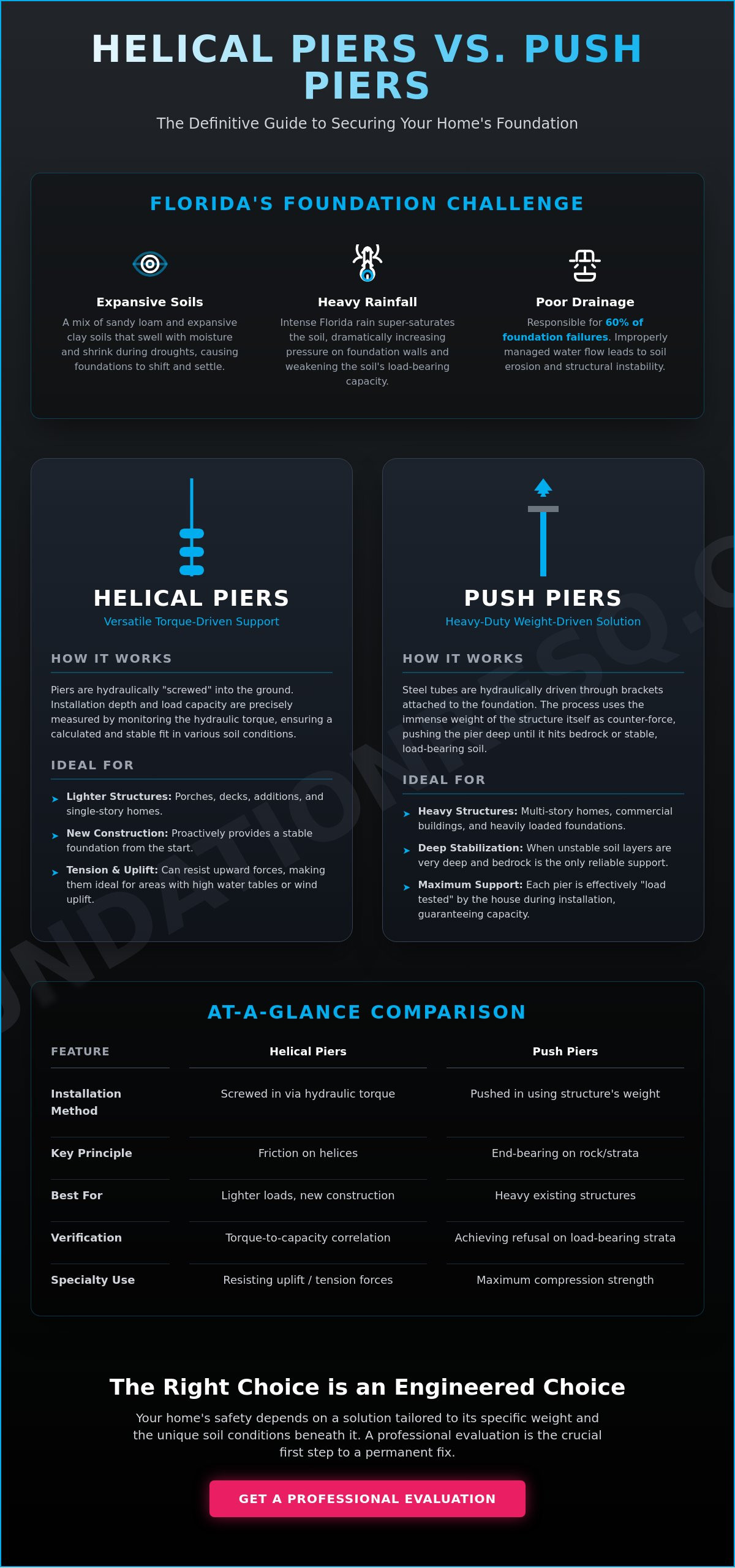
The geological makeup of Tallahassee presents unique challenges for homeowners. Our region is characterized by a mix of sandy loam and expansive clay soils. These materials are highly sensitive to moisture. During periods of heavy Florida rainfall, clay soil absorbs water and expands, putting immense pressure on foundation walls. Conversely, during droughts, the soil shrinks and pulls away, leaving a void that causes the foundation to drop. Research indicates that poor drainage is responsible for 60% of residential foundation failures, as water saturation weakens the soil’s bearing capacity. Additionally, if the fill dirt used during your home’s original construction wasn’t properly compacted, localized sinking is almost inevitable over time.
It’s vital for homeowners to distinguish between minor cosmetic issues and true structural settlement. A thin hairline crack in drywall might be the result of natural humidity changes. However, stair-step cracks in exterior brickwork, doors that stick in their frames, or gaps appearing between the wall and the ceiling are clear indicators of a failing foundation. These symptoms suggest the building is no longer level and requires a professional remedy to prevent further damage. Ignoring these signs often leads to more expensive repairs as the building continues to shift.
The Goal of Structural Underpinning
The primary objective of underpinning is to bypass unstable soil layers and anchor the home to something permanent. Depending on the specific needs of the property, this may involve stabilizing the structure to prevent further sinking or carefully lifting it back toward its original position. This is where the debate of helical piers vs push piers begins. Both systems serve as a protective barrier between your home and the shifting earth, but they function differently based on the weight of the building and the depth of the stable soil.
Modern piering technology has its roots in historical engineering. For example, screw pile foundations have been used for centuries to support structures in challenging environments. Today, we utilize these same principles with advanced hydraulic equipment to ensure a precise, permanent fix. Whether your project requires the torque-driven power of helical shafts or the weight-driven strength of push tubes, the goal remains the same: a steady, reliable foundation that protects your investment for the long term.
Push Piers: The Heavy-Duty Solution for Structural Stabilization
Push piers represent the pinnacle of structural support for heavy residential and commercial buildings. These systems consist of high-strength, galvanized steel tubes that are driven deep into the earth using hydraulic pressure. They are often referred to as “resistance piers” because they rely on the existing weight of the structure to provide the necessary counterforce during installation. This makes them a preferred choice for substantial homes that require a deep, unyielding anchor. They act as a permanent bridge between your home’s foundation and the stable earth far below the surface.
Understanding the mechanical differences in helical piers vs push piers is essential for any homeowner facing settlement. While helical piers are screwed into the soil, push piers are forced downward until they reach bedrock or a load-bearing soil layer that can support the building’s mass. This ensures the structure is no longer resting on unstable topsoil but is instead supported by the earth’s most reliable strata. It’s a methodical, data-driven approach to structural restoration that prioritizes long-term safety.
The Installation Process for Push Piers
The process begins by attaching heavy-duty steel brackets directly to your home’s concrete footing. Once these brackets are secure, we use hydraulic rams to drive the steel pier sections through the bracket and into the ground. We continue this process until we achieve what’s known as “driving to resistance.” This occurs when the pier hits a layer so solid that the hydraulic pressure begins to move the house rather than the pier. It’s a definitive way to verify that the system has reached a stable foundation capable of supporting the load.
To ensure the building is restored safely, we employ a hydraulic manifold system. This tool allows us to distribute the lifting force across multiple pier locations simultaneously. By lifting the structure evenly, we minimize the risk of secondary stress fractures in your walls or floors. Our methods and materials are designed to meet rigorous building code standards for helical piles and resistance-based piering, providing a level of engineering certainty that lighter systems cannot match.
Best Use Cases for Push Pier Systems
Push piers are specifically engineered for heavily constructed homes, such as those made of brick, stone, or multi-story concrete. Because they rely on the building’s weight for installation, they are the industry standard for structures with significant mass. They are also the ideal solution when the depth of stable soil is unknown. Since the piers are driven until they hit resistance, they can reach extreme depths, sometimes exceeding 50 feet, to find the necessary support.
If you’re seeing signs of significant settlement in a large home, a professional Push Pier Installation provides the heavy-duty restoration required for a permanent fix. This system doesn’t just stop the sinking; it offers the potential to lift the foundation back toward its original level, closing gaps and realigning doors that have become unmanageable over time. Property managers and building owners should also be aware that the same principles apply to foundation repair for commercial buildings, where the stakes of structural failure extend beyond the physical structure to tenant safety and business continuity.
Helical Piers: Versatile Support for Lighter Structures and New Construction
Helical piers offer a highly adaptable solution for structural stabilization. These systems consist of a central steel shaft with one or more screw-like plates, known as helices, welded to the lead section. Unlike the push piers discussed previously, helical piers are “screwed” into the ground using a high-torque hydraulic motor. This mechanical action allows the pier to advance through the soil until it reaches a layer with the necessary load-bearing capacity. It’s a precise process that provides immediate results without the need for high-impact forces.
One of the most significant differences in the helical piers vs push piers comparison is their relationship with the building’s weight. Push piers require the mass of a heavy structure to act as a counterforce during installation. Helical piers are entirely independent of the building’s weight. This makes them the primary choice for stabilizing lighter structures that lack the downward force required to drive a resistance-based pier. It’s a reliable remedy that ensures every part of your property, from the main house to the backyard deck, remains level and secure.
How Torque Translates to Load Capacity
During the installation of a helical pier, we carefully monitor the amount of torque required to rotate the shaft into the earth. There’s a direct correlation between installation torque and the ultimate load capacity the pier can support. This relationship is a cornerstone of the engineering principles of helical piles, allowing our team to verify that each pier has reached stable soil capable of supporting the intended load. Because these piers are rotated rather than hammered, they produce very little vibration. This is a critical advantage for projects in tight spaces or sites with sensitive soil conditions where minimizing ground disturbance is a priority. Before committing to a system, many homeowners find it helpful to review a detailed breakdown of helical pier installation cost factors specific to Leon County soil profiles and current Florida Building Code requirements.
When to Choose Helical Piers
Helical piers are remarkably versatile. They’re the ideal choice for lighter residential structures like porches, stoops, or sunrooms. They also provide a proactive solution for new construction projects. By installing these piers before the foundation is poured in areas with known soil issues, you create a permanent support system that prevents settlement before it can even start. Additionally, helical piers function exceptionally well in tension. This means they can pull as well as push, making them a common choice for stabilizing bowing foundation walls when used as tie-backs. Whether you’re protecting a new addition or restoring an existing wall, this system provides the durable protection your home deserves.
Helical Piers vs. Push Piers: A Side-by-Side Comparison
The decision between helical piers vs push piers often comes down to the physics of your specific project. While both systems offer permanent structural stabilization, they achieve this through different mechanical principles. Push piers are driven until they strike an immovable object, such as bedrock or extremely dense strata. In contrast, helical piers rely on the surface area of their blades to create load-bearing capacity within stable soil layers. This distinction is critical. Choosing the wrong method can lead to an ineffective repair or unnecessary expenses.
When evaluating these options, we look at three primary factors:
- The weight of the building: Is there enough mass to drive a pier to resistance?
- The soil profile: How deep is the bedrock or stable clay?
- The desired outcome: Are we simply stabilizing the home, or is a significant structural lift required?
Structural Weight: The Deciding Factor
A common issue occurs when homeowners attempt to use push piers on a structure that is too light, such as a single-story frame house or a detached chimney. Because push piers use the home as a counterweight, a light structure may actually lift or “pop” off its footing before the pier reaches the necessary depth. In these scenarios, helical piers are the safer and more effective choice. They don’t rely on the building’s weight for installation. This makes them perfect for stabilizing a chimney or a porch without risking additional damage. It’s a common misconception that one is inherently stronger. In reality, the strength of any system in the helical piers vs push piers debate is only as good as the soil it’s anchored in.
Tallahassee Soil Considerations
Local geology plays a massive role in the success of your foundation repair. North Florida is known for its karst topography, which features underlying limestone that can be unpredictable. When performing foundation repair Tallahassee residents often deal with varying depths of this limestone. In some neighborhoods, bedrock is easily accessible for push piers. In others, a thick layer of stable clay makes helical piers the more efficient option. Our high water tables can also accelerate the corrosion of untreated steel. We prioritize galvanized materials to ensure the longevity of your structural remedy against the elements.
Choosing the right system requires a deep understanding of these environmental variables. If you’re ready to secure your home’s future, contact the experts at Foundation ResQ for a professional Foundation Repair assessment. We’ll help you determine which engineered solution will provide the permanent protection your property requires.
Choosing the Right Foundation Remedy with a Tallahassee Expert
After analyzing the technical nuances of helical piers vs push piers, it’s clear that neither system is a universal fix. The success of a structural restoration depends on a precise match between the engineering method and the specific geological conditions of your property. Relying on a “one-size-fits-all” approach often results in incomplete repairs that fail to address the root cause of settlement. A custom-engineered solution is the only way to ensure the long-term safety and value of your home. You need a remedy that respects the unique soil profile of your specific lot.
A professional structural evaluation removes the guesswork from foundation repair. It provides a clear roadmap for restoration, moving you from a state of concern to a state of informed resolution. This process ensures that the chosen piering system aligns with the weight of your home and the depth of the local load-bearing strata.
What to Expect During Your Foundation Inspection
A professional inspection is a methodical diagnostic process that examines the entire health of your home. It begins with a comprehensive visual assessment of the property. Our experts look for indicators of distress like interior drywall cracks, exterior masonry separation, and the moisture levels within your crawl space. These symptoms tell a story about how your foundation is shifting. However, visual signs are only part of the diagnostic process.
Our team uses specialized tools like manometer surveys to measure floor levelness across the entire footprint of the home. This data allows us to map out exactly where the foundation has dropped and by how much, often revealing issues that aren’t visible to the naked eye. Once the assessment is complete, we develop a customized piering plan. This plan accounts for structural loads and soil density, ensuring every pier is placed for maximum effectiveness and long-term durability. We don’t just guess where support is needed; we use engineering data to prove it.
The Foundation ResQ Difference
At Foundation ResQ, we utilize Groundworks-engineered products specifically designed to withstand the environmental pressures of North Florida and South Georgia. Our local expertise allows us to anticipate the challenges posed by high water tables and shifting clay layers that are common in our community. We understand how the local climate impacts structural integrity over decades, not just seasons. This specialized knowledge is what allows us to act as a final line of defense for your home’s structural health.
Sometimes, a foundation requires a multi-layered approach. We can integrate our piering systems with other advanced remedies, such as carbon fiber wall repair Tallahassee, to address bowing walls and provide a comprehensive protective barrier for your structure. Choosing a partner for your foundation repair is about finding a protector for your home. We provide the peace of mind that comes with a transferable lifetime warranty, ensuring your investment is secure for years to come. Don’t let structural anxiety linger. Schedule your foundation inspection today to receive a professional evaluation tailored to your home’s unique needs.
Securing Your Home’s Future Stability
Choosing the right structural remedy is the most important step you’ll take in protecting your property’s value. You now understand that the choice between helical piers vs push piers isn’t about which system is stronger. Instead, it’s about matching the repair to the specific weight of your home and the depth of Tallahassee’s load-bearing soil. Whether your project requires the resistance-based strength of push piers or the torque-driven versatility of helical shafts, the goal is a permanent fix. We stop settlement in its tracks so you can rest easy.
Foundation ResQ brings over 10 years of local Tallahassee expertise to every project. We use Groundworks-engineered products to ensure your home remains a stable sanctuary. By choosing a solution backed by a lifetime transferable warranty, you’re investing in the long-term health of your building. Our team is ready to provide the methodical assessment your foundation deserves. Get a Free Foundation Repair Estimate today. You can move forward with the confidence that your home is restored for the long term.
Frequently Asked Questions
Which is more expensive: helical piers or push piers?
The total investment for your project depends on your home’s weight and the depth of stable soil. Helical piers often involve higher material costs but can be installed quickly in specific soil conditions. Push piers may be more economical for heavy masonry structures where stable strata are easily reachable. A professional inspection is the only way to determine the most cost-effective remedy for your specific foundation and soil profile. For a detailed breakdown of what drives project budgets in our region, see our complete guide to helical pier installation cost for Tallahassee homeowners.
Can helical piers be used for existing homes?
Helical piers are frequently used to stabilize existing homes, especially for lighter structures like porches, stoops, or sunrooms. They are screwed into the ground using hydraulic equipment, which minimizes vibration and protects your current landscaping. This makes them an excellent choice for property owners who want a permanent fix without the disruption of heavy excavation or high-impact machinery. They provide immediate structural support once the installation is complete.
How deep do foundation piers need to go in Tallahassee?
The required depth for foundation piers in Tallahassee varies significantly due to our local karst topography and limestone layers. Some piers reach stable soil at 15 feet, while others may extend 50 feet or more to find the necessary resistance. Our teams drive every pier until it reaches the load-bearing strata required by engineering standards to ensure your home remains stable for the long term. Local soil density dictates the final depth.
Will my foundation repair include lifting the house back to level?
Our primary goal is always to stabilize the structure and prevent further sinking. While we often attempt to lift the foundation back toward its original level, this depends on the building’s current structural integrity and soil conditions. Lifting can help close gaps in brickwork and realign sticking doors, but the ultimate priority is providing a permanent, stable base for your home. We’ll discuss the potential for lifting during your initial inspection.
How long does it take to install a piering system?
Most residential piering projects are completed within two to five days. The exact timeline depends on the number of piers required and the depth we must reach to find stable soil. Because we use specialized hydraulic equipment, the process is efficient and causes minimal disruption to your daily routine. We work methodically to ensure each pier is installed precisely to engineering specifications before we backfill any excavated areas.
Do foundation piers come with a warranty?
We provide a transferable lifetime warranty on our piering systems to give you complete peace of mind. This means the protection stays with the structure, even if you decide to sell your home in the future. It’s a testament to the durability of our Groundworks-engineered products and our commitment to being a dependable partner for your home’s structural health. This warranty ensures that your foundation remains a protected asset for decades.
Is foundation piering a permanent fix for settlement?
Foundation piering is considered a permanent solution because it bypasses the unstable topsoil layers that cause settlement. By anchoring your home to deep, load-bearing strata, the system creates a stable foundation that is unaffected by the expansion and contraction of surface clay. Comparing helical piers vs push piers ensures you select the specific technology that will provide the most reliable protection for your building’s unique footprint and local geological challenges.