
That slight dip in your living room floor isn’t just a quirk of age; it’s a silent warning that your home’s structural health is at risk. In the historic neighborhoods of North Florida, a sloping floor is often dismissed as “old house character,” but it’s actually a predictable result of Tallahassee’s humidity and shifting soils. You’ve likely felt the frustration of a door that won’t latch or a window that sticks during the humid summer months. When it comes to fixing uneven floors in an old house Tallahassee residents deserve a remedy that addresses the root cause rather than just masking the symptoms with temporary shims.
Restoring your home’s stability doesn’t have to be a source of constant worry. This guide provides the professional clarity you need to move from uncertainty to a level, secure property. You’ll discover the specific environmental factors that cause floor sag in our region and the stabilization methods, such as helical pier installation, used to secure your structure permanently. We’ll walk through the process of restoring structural integrity and protecting your resale value. By understanding the path to a permanent fix, you can regain the peace of mind that comes with a truly solid foundation.
Key Takeaways
- Understand how Tallahassee’s unique Red Hills clay and seasonal rainfall cycles create the soil expansion and contraction that destabilize older foundations.
- Learn to distinguish between floor slanting and sagging to accurately diagnose whether your home is tilting or experiencing localized structural dips.
- Discover how North Florida’s high humidity levels lead to moisture-related wood rot in crawl spaces, compromising the strength of your floor joists.
- Explore why professional stabilization methods like helical and push piers are the permanent solution for fixing uneven floors in an old house Tallahassee property owners need to ensure safety.
- Identify the long-term benefits of a remedy-based structural approach that addresses root causes to protect your home’s durability and resale value.
Why Older Tallahassee Homes Develop Uneven Floors
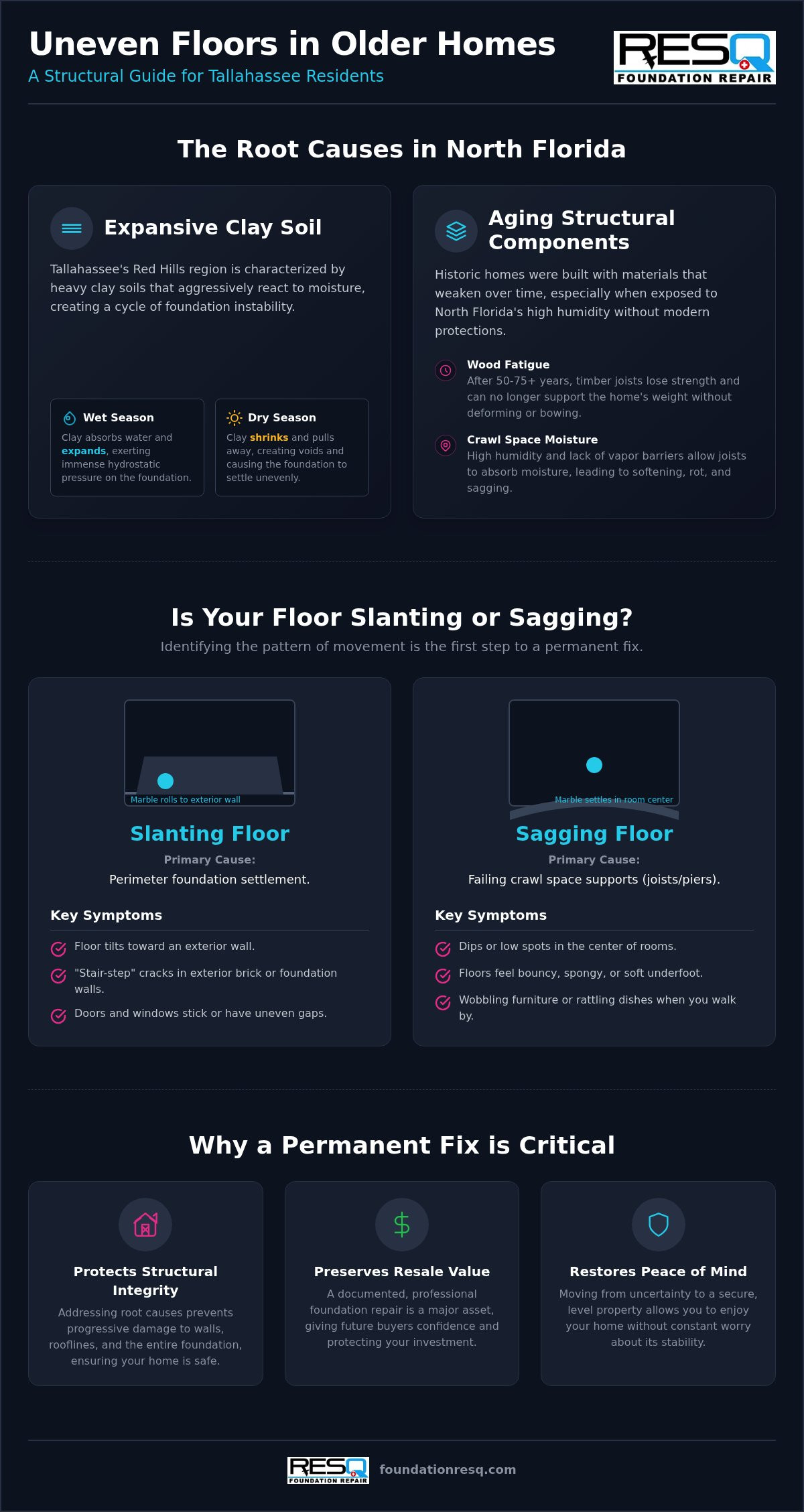
Tallahassee is known for its rolling hills and historic architecture, but these features contribute to the unique challenges of maintaining an older property. Unlike the sandy coastal regions of Florida, our city sits on the Red Hills. This area is characterized by heavy clay soils that respond aggressively to moisture. When you’re considering fixing uneven floors in an old house Tallahassee homeowners must start with the city’s specific geology. What many call “old house charm” is often a visible symptom of progressive structural settlement that won’t resolve itself without intervention.
Tallahassee Soil and Hydrostatic Pressure
The clay-rich soil in North Florida is expansive. During our intense summer storms and hurricane seasons, this clay absorbs vast amounts of water and expands, exerting significant hydrostatic pressure against your foundation. When the weather turns dry, the clay shrinks and leaves gaps beneath the footings. This constant cycle of expansion and contraction causes the foundation to settle. It moves. In hillier neighborhoods like Myers Park or Levy Park, heavy rainfall can also cause a “washout” effect, where soil is physically stripped away from the foundation’s base. Because Tallahassee sits on a limestone karst plain, these soil shifts are often uneven, leading to the distinct slants found in historic residences.
The Natural Aging of Historic Floor Joists
The structural components beneath your feet are subject to the laws of physics and time. Most historic homes in Tallahassee were built using timber that, while durable, wasn’t intended to withstand decades of high humidity without modern protection. Over 50 or 75 years, wood fatigue sets in. This gradual loss of strength is a core concept in structural integrity principles, where the material can no longer support the weight of the home without deforming.
Older construction typically lacks vapor barriers in the crawl space. Without these barriers, the wood joists absorb moisture from the damp Florida earth. This leads to softening, bowing, and eventually, localized dips in the floor. Original brick or concrete piers were often spaced too far apart by modern standards. They simply aren’t equipped to handle the load requirements of modern living. Effectively fixing uneven floors in an old house Tallahassee requires a professional look at both the soil stability and the health of these aging timber supports to ensure a permanent remedy.
Slanting vs. Sagging: Diagnosing Your Floor Issues
Identifying the specific pattern of floor movement is the first step toward a permanent resolution. While both slanting and sagging indicate structural distress, they often stem from different underlying issues within the home’s framework. For homeowners focused on fixing uneven floors in an old house Tallahassee properties often require a specific diagnostic approach. You can perform a simple ‘rolling ball’ test to see the direction of the slope. Placing a marble on the floor helps determine where the low points are. If it consistently rolls toward the exterior walls, you are likely dealing with a slanting floor. If it settles in the center of the room, you are witnessing a sag.
Secondary symptoms provide additional diagnostic clues. Sticking doors and windows are not just signs of humidity; they often indicate that the frame has been pulled out of alignment by a shifting floor. You should also check for cracks in the drywall or exterior brickwork. These visual markers, combined with the floor’s physical shape, help define the scope of the structural remedy needed. This movement is frequently tied to the expansive clays and problem soils found across Leon County, which put uneven stress on the home’s footprint. It sinks.
Identifying Slanting Floor Patterns
Slanting typically points to issues with the perimeter foundation. When the outer walls of the house sink or settle, the entire floor plane tilts toward that low point. Differential settlement is the primary cause of slanting, occurring when the soil beneath one section of the foundation fails while another remains stable. This often results in “stair-step” cracks in exterior brickwork. Because the entire house is leaning, the structural integrity of the walls is compromised. Identifying this early prevents more significant damage to the roofline and interior finishes.
Understanding Sagging and Bouncy Floors
Sagging is usually an internal issue related to the crawl space. When the support beams or floor joists beneath the house weaken, the floor “bows” or dips in the center of the room. This creates a ‘bouncy’ or springy sensation when walking, especially in high-traffic areas like hallways or living rooms. In older Tallahassee homes, this is often caused by undersized joists or wood rot from moisture. If the center of your floor feels soft or unstable, the remedy typically involves stabilizing the internal support system. A professional structural assessment can determine whether your joists need reinforcement or if the internal piers have settled. Fixing uneven floors in an old house Tallahassee requires a deep look at these crawl space components to ensure the home remains level for years to come.
The Role of Crawl Space Moisture in Floor Stability
Tallahassee’s environment is notoriously damp. Relative humidity levels in Leon County often exceed 70% for much of the year. This moisture doesn’t just stay outside; it migrates into the dark, cool spaces beneath your home through a process called the stack effect. While soil settlement is a major factor in fixing uneven floors in an old house Tallahassee, moisture is often the silent catalyst that accelerates structural decline. When the air beneath your home is saturated, it condenses on wooden joists and beams, creating an ideal breeding ground for wood-destroying fungi. Traditional crawl space vents, once thought to provide necessary airflow, actually worsen the problem in the South by pulling humid air directly into the structure.
Maintaining a dry environment is a cornerstone of foundation maintenance best practices. If the space beneath your home remains damp, the organic materials that support your floors will inevitably begin to fail. This biological breakdown is just as dangerous as geological shifting. For homeowners committed to fixing uneven floors in an old house Tallahassee, addressing the moisture source is a non-negotiable step in the repair process. Without moisture control, any mechanical leveling will likely be temporary as the wood continues to soften and compress over time.
Wood Rot and Structural Integrity
Tallahassee homeowners must distinguish between termite damage and wood rot. While termites consume wood from the inside out, wood rot is a fungal infection that breaks down the cellulose and lignin that give timber its strength. “Soft” wood loses its load-bearing capacity rapidly. You might notice your floors feel springy or “spongy” underfoot before a visible dip appears. Fungal growth often manifests as white or gray fuzzy patches on support pillars or a dark, damp discoloration on the joists. Once these fungi take hold, the structural integrity of the floor system is compromised, and the wood can no longer hold the weight of the home without sagging.
The Encapsulation Remedy
The most effective way to halt moisture-related damage is through crawl space encapsulation Tallahassee. This process involves lining the entire crawl space with a heavy-duty vapor barrier. This barrier acts as a permanent shield, preventing ground moisture from reaching your floor joists. To maintain a truly stable environment, we integrate sump pumps to manage liquid water and specialized dehumidifiers to control air saturation. If the moisture has already led to fungal growth, you may need professional mold remediation in Tallahassee to safely remove the spores before the encapsulation is finalized. This comprehensive approach ensures that your floor supports remain dry, strong, and capable of holding a level plane for decades.
Professional Leveling Solutions: Piers and Stabilization
Once you’ve identified whether your home is slanting or sagging, the next step involves implementing a professional remedy. Temporary fixes like wooden shims or plastic wedges are common in older homes, but they don’t address the underlying soil failure or joist fatigue. For homeowners fixing uneven floors in an old house Tallahassee requires mechanical stabilization that bypasses unstable Red Hills clay. We utilize high-strength steel hardware to transfer the home’s weight from the failing soil to deeper, more competent strata.
Helical vs. Push Piers: Which Fix is Right?
The choice between piering systems depends on your home’s weight and the depth of the load-bearing soil. A helical pier installation involves screwing steel shafts into the earth using hydraulic torque. These are ideal for lighter residential structures or porches where the soil provides enough resistance at moderate depths. In contrast, push piers are driven deep into the ground using the actual weight of the house as a counter-force. This method is often necessary in areas of Tallahassee where we need to reach solid limestone strata to ensure absolute stability. Piering is a permanent fix that provides long-term peace of mind, unlike temporary shimming which eventually compresses and fails.
If your home has a settled garage floor or concrete porch, PolyRenewal is the preferred choice for leveling settled concrete slabs. This high-density polyurethane foam is injected beneath the slab, expanding to fill voids and lift the concrete back to its original position. It’s a faster, less invasive alternative to traditional mudjacking. It works.
Stabilizing Interior Joists and Beams
Internal floor sag often requires a different set of tools. We install heavy-duty, adjustable crawl space jacks to provide immediate lift and support to sagging beams. These jacks are placed on stable footings and can be adjusted over time to slowly return the floor to a level plane. If your foundation walls are showing signs of inward movement, carbon fiber wall repair in Tallahassee offers a modern, low-profile solution. These high-tensile strength straps are bonded to the walls to prevent further shifting without the need for bulky steel beams.
In cases where the wood itself is weakened but not fully rotted, we use a process called sistering for added structural support. This involves attaching a new, sound joist directly to the side of the existing one to stop the floor’s bounce. When you’re ready to start fixing uneven floors in an old house Tallahassee experts can help you schedule a professional structural inspection to determine the exact stabilization plan your property needs.
Restoring Your Tallahassee Home with Foundation ResQ
Addressing structural movement requires more than just a general understanding of construction; it demands a deep familiarity with the specific geological behavior of Leon County. Local expertise is essential for foundation repair in Tallahassee because our soil doesn’t behave like the rest of the state. We understand how the local Red Hills clay interacts with our seasonal rainfall cycles. At Foundation ResQ, we don’t just patch visible cracks. We provide remedy-based solutions that address the underlying cause of your home’s instability. By utilizing Groundworks-backed structural systems, we ensure that your property is protected by the highest standards of engineering and durability.
The Foundation ResQ Inspection Process
Our approach begins with a methodical and thorough evaluation of your home’s current state. We use non-invasive methods to measure floor levels across your entire floor plan, creating a precise map of any slanting or sagging. This data allows us to identify the root cause of the movement, whether it is perimeter settlement or internal joist fatigue. We believe in clear, declarative communication. Our experts explain the findings in plain language, ensuring you understand exactly what is happening beneath your feet. This transparency helps move you from a state of uncertainty to a state of informed resolution. We focus on the facts of your home’s structural health.
Protecting Your Investment for the Future
Fixing uneven floors in an old house Tallahassee is a significant step in preserving your property’s resale value and safety. A home with a documented, professional stabilization system is far more attractive to future buyers than one with “character” that masks potential failure. We take our role as the steadfast local expert seriously. Our community roots mean we’re committed to the long-term health of Tallahassee’s historic neighborhoods. We view ourselves as the final line of defense for your home, providing a protective barrier against the elements and the shifting Florida earth.
Ignoring floor movement only leads to more expensive repairs as the damage spreads to your walls, roof, and finishes. Professional intervention stops the cycle of decline. You can regain the peace of mind that comes with a level, stable home. If you’re ready to secure your property’s future, the next step is a professional structural assessment. Contact us today to schedule your free structural evaluation and discover the permanent remedy for fixing uneven floors in an old house Tallahassee. We are here to help you restore your home’s integrity.
Restore Stability to Your Historic Tallahassee Home
Tallahassee’s unique Red Hills clay and high humidity require more than cosmetic fixes. By understanding how permanent stabilization using helical or push piers bypasses unstable soil to reach load-bearing strata, you can address the root cause of your home’s movement. Meanwhile, crawl space encapsulation prevents moisture from weakening your home’s timber supports, stopping wood rot before it compromises your floor joists. When you’re serious about fixing uneven floors in an old house Tallahassee, the solution must address both geological and environmental factors to be truly effective.
Foundation ResQ provides specialized Tallahassee soil expertise and Groundworks-backed structural solutions to restore your home’s integrity. We focus on permanent stabilization systems that protect your property’s resale value and your family’s safety for years to come. Our methodical approach ensures that your home remains a safe haven against the elements. Schedule your free structural inspection with Foundation ResQ today and take the first step toward a level, stable property. You don’t have to live with sticking doors or sloping floors. A permanent remedy is within reach, and we’re here to guide you through every step of the process.
Frequently Asked Questions
Is it normal for an old house in Tallahassee to have uneven floors?
Uneven floors are common in older Tallahassee neighborhoods, but they aren’t considered structurally normal. While many homeowners ignore slight slopes as “character,” these dips often point to active soil settlement or moisture-related wood fatigue in the crawl space. Because Tallahassee sits on expansive Red Hills clay, the foundation moves more than in other regions. It’s important to have these levels checked to ensure that a minor slant doesn’t evolve into a catastrophic structural failure.
How much does it cost to fix uneven floors in an older home?
The investment required depends on the root cause of the movement. Minor surface-level adjustments might cost between $500 and $3,000, while comprehensive structural stabilization involving steel piers or joist replacement typically falls between $4,000 and $12,000. These figures reflect industry averages for the region. Because every historic property has unique geological challenges, fixing uneven floors in an old house Tallahassee requires a professional evaluation to determine the most cost-effective, permanent remedy for your specific foundation.
Can uneven floors be a sign of a sinkhole in Florida?
Sloping floors can be a secondary symptom of sinkhole activity, especially given Florida’s limestone karst geography. While Tallahassee’s thick clay layers provide more stability than the sandy soils of Central Florida, underground voids can still lead to localized settlement. Most floor issues in Leon County are tied to clay expansion or crawl space rot rather than sinkholes. A professional structural inspection is the only way to verify the safety of your home’s footprint.
What is the difference between floor leveling and foundation repair?
Floor leveling usually involves adjusting the interior supports, such as joists or beams, to remove localized sags or dips. Foundation repair is a more comprehensive process that stabilizes the entire perimeter of the home using push or helical piers. While leveling fixes the symptoms you feel underfoot, foundation repair addresses the underlying soil failure. Most successful projects combine both methods to ensure the home remains level and secure against future environmental shifts.
How long does it take to professionally level a floor?
Most professional leveling and stabilization projects in the Tallahassee area are completed within one to three days. If we are using PolyRenewal to lift a concrete slab, the process can often be finished in just a few hours. More complex jobs involving multiple helical pier installations or full crawl space encapsulation may take longer. We prioritize a methodical pace to ensure every component is precisely installed, providing a permanent solution that protects your home’s structural integrity.
Will my insurance cover fixing uneven floors caused by settlement?
Standard homeowners insurance policies rarely cover repairs for floors that have become uneven due to gradual settlement or age. Insurance companies typically view settlement as a maintenance issue rather than a sudden, covered peril. However, if the damage is the direct result of a confirmed sinkhole or a sudden water main break, you may have grounds for a claim. You should review your policy’s specific exclusions regarding earth movement and foundation cracks with your insurance agent.
Can I fix sagging floors myself with a floor jack from a hardware store?
Attempting to fix sagging floors yourself with temporary jacks can be dangerous and often causes more harm than good. Hardware store jacks aren’t designed for permanent structural support and lack the necessary footings to prevent further sinking. If you lift the floor too quickly or in the wrong spot, you risk cracking your drywall, damaging plumbing lines, or even causing a partial collapse. Fixing uneven floors in an old house Tallahassee requires engineered systems that provide stable, long-term support.