
Did you know that up to 50% of the air you breathe inside your home can actually originate from your crawl space? In Tallahassee’s humid climate, this hidden area often becomes a breeding ground for fungi, making it essential to understand the health risks of crawl space mold Florida residents frequently encounter. If you’ve noticed a persistent musty odor or found that your family’s allergy symptoms are worsening, the source of the problem is likely beneath your feet.
It’s frustrating to feel like your own home is working against your health, especially when you’re worried about the stability of your floor joists and the fear of expensive repairs. We agree that your home should be a sanctuary, not a source of stress, and that you deserve a permanent fix rather than a temporary patch. This article explains the specific biological and structural dangers posed by moisture and provides a clear path toward a professional solution that protects your family and your property.
We will examine the connection between high humidity and wood rot, explain the professional standards for remediation, and discuss how technologies like encapsulation can transform your indoor air quality for the long term.
Key Takeaways
- Learn to identify the physical signs of fungal growth and understand the health risks of crawl space mold Florida residents face when indoor air quality is compromised.
- Discover how surface mold serves as a precursor to soft rot, a destructive process that can permanently weaken your home’s floor joists and structural integrity.
- Understand why Tallahassee’s red clay soil and extreme humidity levels create a constant cycle of moisture seepage in unsealed crawl spaces.
- Find out why standard DIY treatments fail to reach deep into porous wood and how professional remediation provides a lasting, remedy-based solution.
- Explore how a combination of encapsulation and professional-grade dehumidification acts as a protective barrier to ensure your home’s long-term stability.
Identifying Mold Growth on Floor Joists
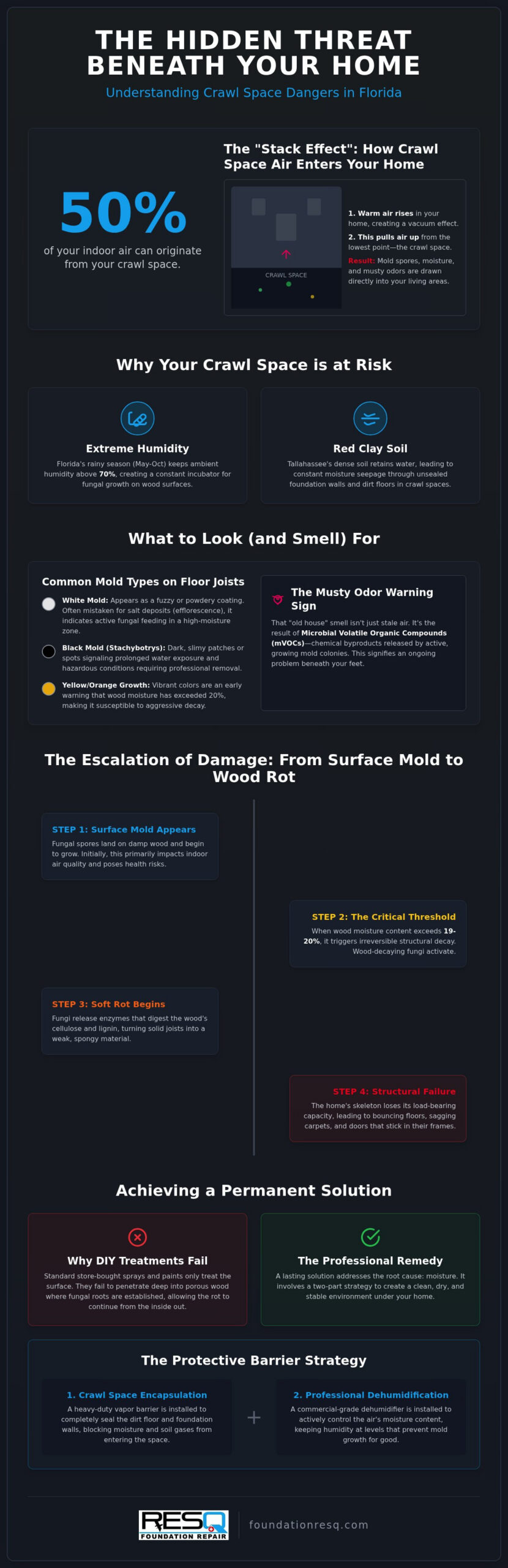
Mold in your crawl space isn’t just a cosmetic stain; it’s a living fungal colony that consumes the organic cellulose in your wooden floor joists. These organisms require only three things to thrive: moisture, a food source, and stagnant air. During Florida’s rainy season, which typically spans from May to October, the ambient humidity in Tallahassee often stays above 70%. This environment creates a 24/7 incubator for fungal spores to settle and multiply on your home’s structural skeleton.
The health risks of crawl space mold Florida families experience are often amplified by a phenomenon known as the “Stack Effect.” This physical process occurs as warm air rises through the upper levels of your home, creating a vacuum that pulls air from the lowest point. In homes with vented crawl spaces, this means air from the dirt floor, laden with moisture and spores, is sucked directly into your living room through floorboards and utility penetrations. Research on Indoor mold growth highlights how these spores can quickly colonize damp surfaces once they find a consistent food source like untreated pine or plywood subflooring.
Common Types of Florida Crawl Space Mold
Identifying the specific type of growth is the first step toward a stable remedy. You might notice various textures and colors during a visual inspection:
- White ‘efflorescence-like’ mold: This often appears as a fuzzy or powdery coating on damp floor joists. It’s frequently mistaken for salt deposits but indicates a high-moisture environment where fungi are actively feeding.
- Black mold (Stachybotrys): Appearing as dark spotting or slimy patches, this variety indicates hazardous conditions and prolonged water exposure. It requires professional remediation to ensure safe removal.
- Yellow and orange growth: These vibrant colors are early indicators that the moisture content in your wood has exceeded 20%. When wood reaches this level of saturation, it becomes soft and susceptible to more aggressive decay.
The Musty Odor Warning Sign
That familiar “old house” smell isn’t just stagnant air; it’s the result of microbial volatile organic compounds (mVOCs). These are chemical byproducts produced during active fungal off-gassing. If you notice this scent, it’s a sign that a colony is currently growing and releasing spores into the air you breathe. Your air conditioning system often worsens this issue by creating pressure differentials that pull these heavy, damp odors upward. Distinguishing between simple stagnant air and active fungal growth is vital. Stagnant air often clears with ventilation, whereas active off-gassing persists regardless of airflow because the source remains damp and active beneath your feet.
The Structural Impact: From Mold to Wood Rot
Surface mold is often the first warning sign of a much more aggressive biological threat to your home’s integrity. While mold itself primarily impacts the health effects of mold for your family, it acts as a gateway for wood-decaying fungi. These organisms don’t just live on the surface; they penetrate deep into the fibers of your floor joists and subflooring. When a crawl space remains damp, it creates the perfect conditions for “soft rot,” a process that slowly turns solid timber into a brittle or spongy material that can no longer support the weight of your house.
Homeowners usually notice the first signs of this structural decline through subtle changes in their living environment. You might feel a slight bounce in your step as you walk across the kitchen, or notice that your carpets seem to sag in specific areas. Doors that used to swing freely might suddenly begin to stick in their frames. These are not just cosmetic issues; they are indicators that the skeleton of your home is losing its load-bearing capacity. In the Tallahassee real estate market, these structural defects significantly devalue properties during inspections, often leading to failed sales or massive price concessions.
How Fungi Consume Your Home’s Skeleton
The process of decay is a biological breakdown of the very materials that keep your home standing. Fungal colonies release specific enzymes that digest lignin and cellulose, the organic compounds that give wood its strength and rigidity. Once wood moisture content exceeds 19%, it triggers irreversible structural decay as these organisms begin to consume the wood fibers from the inside out. At this stage, a joist often moves from being treatable with standard cleaning to requiring professional stabilization. This may involve “sistering” new lumber to the damaged beams or, in severe cases, a full replacement to restore safety and stability.
The Connection to Foundation Health
In our local region, moisture issues rarely stay confined to the wooden components of a crawl space. The same humidity and water intrusion that fuel mold also saturate the porous red clay soil common in North Florida. When this soil becomes over-saturated, it loses its density and can no longer provide a stable base for your footings. This is why mold remediation often reveals an underlying need for foundation repair in Tallahassee. Localized water pooling near your foundation footings accelerates this process, creating a cycle of decay that impacts both the wood and the ground beneath it. Addressing the health risks of crawl space mold Florida properties face requires a comprehensive look at the entire ecosystem of the home. If you are concerned about the stability of your flooring, a professional evaluation of your crawl space is the first step toward a permanent remedy.
Why Mold Is Growing in Your Tallahassee Crawl Space
Tallahassee’s climate presents a unique set of challenges for homeowners. The “Florida Humidity Factor” is a primary driver of fungal growth, as ambient relative humidity in North Florida frequently exceeds 70%. In an unconditioned crawl space, this moisture-laden air settles against organic materials, providing the hydration necessary for colonies to establish. While many homeowners focus on visible leaks, the invisible vapor pressure from the surrounding environment is often the silent culprit behind the health risks of crawl space mold Florida families face.
Beyond atmospheric humidity, the local geography plays a significant role. Tallahassee’s red clay soil is dense and retains moisture long after a heavy rainstorm has passed. This leads to several common moisture pathways that fuel fungal activity:
- Capillary Action: Groundwater seeps through porous concrete foundation walls, moving moisture from the soil into the crawl space.
- Hydrostatic Pressure: Saturated soil pushes liquid water through small cracks or masonry joints during heavy North Florida rains.
- Hidden Plumbing Leaks: Unsealed spaces hide slow drips from pipes that can saturate floor joists for months before being detected.
This creates a constant supply of moisture that rarely has the chance to dry. Prolonged exposure to these damp environments is why some residents develop serious reactions to mold, making it vital to address the root cause of the dampness rather than just the symptoms.
The Myth of the Vented Crawl Space
For decades, building codes required vents to “air out” the space under a home. However, modern building science shows that in the humid Southeast, these vents act as intake valves for moisture. During a Tallahassee summer, opening your vents imports hot, humid air. When this air hits the cool underside of your air-conditioned floor joists, it reaches its dew point and condenses into liquid water. This cycle turns your crawl space into a damp cave. Transitioning to a sealed, conditioned system is now the professional standard for preventing structural decay and protecting air quality.
Inadequate Vapor Barriers
Many homes are built with a “builder-grade” 6-mil plastic sheet spread across the dirt. While this might suffice in drier climates, it’s insufficient for Florida’s intense vapor pressure. These thin barriers are easily punctured and tend to degrade or shift over time, allowing soil gases and moisture to bypass the protection within months. After one of Tallahassee’s intense afternoon thunderstorms, the pressure in the red clay can easily overwhelm a loose-laid barrier. A durable, high-performance solution is required to create a permanent protective barrier between the earth and your home’s structural skeleton.
How to Stop Crawl Space Mold Permanently
Eliminating the health risks of crawl space mold Florida homeowners face requires more than a simple cleaning. It demands a fundamental shift in the environment beneath your home. Many people attempt to solve the issue with DIY bleach treatments, but this often backfires. Bleach is primarily water; while it may kill surface spores, the moisture penetrates deep into the porous wood of your floor joists. This actually provides a fresh water source for the internal fungal roots, often encouraging more aggressive regrowth within weeks.
A permanent resolution focuses on root cause removal and moisture exclusion. By opting for crawl space encapsulation in Tallahassee, you create a protective barrier that isolates your home from the earth’s dampness and Florida’s extreme humidity. This process establishes a controlled environment where your structural wood stays dry year-round, regardless of the weather outside.
The 4 Steps to a Dry Crawl Space
A professional remedy follows a methodical architectural pattern to ensure the results are both durable and safe. This structured approach includes:
- Step 1: Professional Remediation. We physically remove active colonies using antimicrobial agents and HEPA-filtered vacuuming to capture airborne spores.
- Step 2: High-Performance Vapor Barrier. We install a heavy-duty, multi-ply barrier that seals the entire floor and wraps up the foundation walls.
- Step 3: Groundwater Management. High-capacity sump pump systems are integrated to intercept and remove any liquid water that enters the space.
- Step 4: Dedicated Dehumidification. A specialized crawl space dehumidifier is installed to maintain relative humidity consistently below 55%, the threshold for fungal growth.
Why Encapsulation is the Best Health Investment
Investing in a sealed system provides a final line of defense for both your family and your building. You’ll notice a drastic reduction in indoor allergens and asthma triggers as the “Stack Effect” no longer pulls mold spores into your living area. Additionally, a dry crawl space is easier to cool, which reduces the HVAC load and lowers your monthly energy bills. From a financial perspective, a clean and dry inspection report protects your home’s resale value by demonstrating a commitment to structural integrity. If you’re ready to secure your home’s future, request a professional crawl space evaluation to begin your permanent remedy.
Expert Mold Remediation and Prevention in Tallahassee
Managing the health risks of crawl space mold Florida residents deal with requires a deep understanding of North Florida’s unique environmental pressures. At Foundation ResQ, we combine the specialized knowledge of a local expert with the national technical resources of the Groundworks network. Our team understands how Tallahassee’s dense red clay and high water table create a constant moisture challenge for your home’s foundation. We don’t just offer a quick cleaning; we provide a methodical, remedy-based approach designed to restore your home’s safety and structural integrity for the long term.
Effective mold remediation in Tallahassee must go beyond simple removal. Because mold is often a symptom of larger moisture or structural issues, our process involves a comprehensive evaluation of the entire crawl space ecosystem. We focus on physical removal and source control to ensure that once the threat is gone, it doesn’t return. This commitment to permanent results is backed by professional inspections and comprehensive warranties that give you peace of mind.
The Foundation ResQ Solution
Our strategies are built on providing a final line of defense for your property. If our inspection reveals that fungal growth has progressed into structural decay, we integrate remediation with stabilization. This may include helical pier installation to secure a settling foundation or the addition of supplemental joist supports. To maintain a healthy environment, we install professional-grade dehumidifiers specifically engineered to handle the intense humidity of the Florida climate. These systems work in tandem with encapsulation to ensure your crawl space remains dry and your indoor air stays breathable.
Next Steps for Florida Homeowners
Protecting your home starts with identifying potential issues before they become catastrophic. During a professional crawl space evaluation, our experts look for specific “red flags” such as soft or bouncy floors, persistent musty odors in the living area, and visible moisture on foundation walls. We provide a clear, solution-focused report that outlines the exact steps needed to stabilize your home. Don’t wait for structural damage to compromise your family’s safety. Schedule your free crawl space inspection with Foundation ResQ today.
Securing Your Home’s Future Against Humidity
Addressing the health risks of crawl space mold Florida homeowners face requires moving beyond temporary fixes toward a state of permanent resolution. We’ve explored how North Florida’s high humidity and porous red clay soils create a constant cycle of moisture that threatens both your family’s respiratory health and your building’s structural integrity. The right solution preserves your home. By recognizing the warning signs of wood rot and the failure of traditional venting, you’re now equipped to choose a path that provides lasting protection.
Foundation ResQ stands as Tallahassee’s local crawl space and foundation expert, offering comprehensive moisture and mold solutions as a proud member of the Groundworks network. Our methodical process acts as a final line of defense, creating a protective barrier between your property and the elements. You deserve the confidence that comes with a dry, stable home and a healthy living environment for your loved ones. Protect your home with a free crawl space inspection from Foundation ResQ today to secure your property’s longevity. We’re here to help you restore your home’s health.
Frequently Asked Questions
Is mold on floor joists common in Tallahassee homes?
Mold growth on floor joists is extremely common in Tallahassee due to our local environmental conditions. Our region’s frequent heavy rainfall and dense red clay soil create a high water table that keeps unsealed crawl spaces perpetually damp. When relative humidity levels consistently exceed 60%, fungal spores find an ideal environment on wooden structural components. Most older homes with traditional venting systems are particularly susceptible to these moisture-driven issues.
Can I just spray bleach on the mold to kill it permanently?
You should avoid using bleach as a permanent solution for crawl space mold. Bleach is mostly water; while it may kill surface growth, the liquid penetrates the porous wood and feeds the internal fungal roots. This often leads to more aggressive regrowth within weeks of treatment. A professional remedy requires physical removal of the spores and addressing the underlying moisture source through encapsulation or dehumidification to ensure the problem doesn’t return.
Will mold in my crawl space make my family sick?
The health risks of crawl space mold Florida residents face are significant because of the “Stack Effect.” This process pulls air from the crawl space up into your living areas, meaning your family breathes whatever is growing beneath the floorboards. Common symptoms include persistent coughing, worsening asthma, and allergic reactions. Professional remediation and air quality control are essential to protect your home’s occupants from long-term exposure to these airborne biological hazards.
How do I know if mold has turned into structural wood rot?
You can identify structural wood rot by checking for specific physical changes in your flooring and joists. If your floors feel bouncy or you notice sagging carpets and sticking doors, the wood fibers may have already begun to break down. During a professional inspection, we look for “soft rot” where the timber feels spongy or crumbles when probed. Once mold transitions into decay, the load-bearing capacity of your home is compromised, requiring structural stabilization.
Does crawl space encapsulation really prevent mold forever?
Crawl space encapsulation is a permanent solution when implemented as part of a complete moisture management system. By sealing the earth with a heavy-duty vapor barrier and conditioning the air with a specialized dehumidifier, you eliminate the hydration mold needs to survive. This creates a controlled environment that stays dry regardless of Tallahassee’s outside humidity levels. Regular maintenance of the dehumidifier and sump pump ensures this protective barrier remains effective for the life of your home.
What is the difference between white mold and efflorescence on walls?
It’s easy to confuse white mold with efflorescence, but they are fundamentally different. Efflorescence is a crystalline salt deposit left behind when water evaporates from porous concrete or masonry. It’s usually white, chalky, and crumbles easily. White mold is a living fungal colony that appears fuzzy or “hairy” and grows on organic materials like wood joists. While efflorescence indicates a moisture problem, mold represents an active biological threat to your home’s air quality and structure.
Will my homeowners insurance cover mold remediation in Florida?
Homeowners insurance in Florida typically doesn’t cover mold remediation caused by high humidity or gradual seepage. Most policies only provide coverage if the mold is a direct result of a “sudden and accidental” event, such as a burst pipe that was reported immediately. Because crawl space mold usually develops over time due to environmental conditions, it’s generally considered a maintenance issue. We recommend reviewing your specific policy’s mold endorsement for any available sub-limits or exclusions.
How long does the professional mold removal process take?
A typical professional mold removal and stabilization project takes between one and three days to complete. The exact duration depends on the size of your crawl space and the extent of the fungal growth or structural damage. Our methodical approach involves HEPA vacuuming, antimicrobial treatment, and the installation of moisture control systems like vapor barriers and dehumidifiers. We work efficiently to restore your home’s safety while ensuring every step of the remediation process meets professional industry standards.