Bowing walls don’t always require heavy machinery or bulky steel beams to stay standing. It’s completely normal to feel a wave of anxiety when you notice a horizontal crack or a slight inward curve in your basement. You’re likely worried about the potential for a total foundation collapse or the messy, expensive process of excavating your yard. Many homeowners are now turning to carbon fiber for foundation wall repair because it offers a permanent, aerospace-grade solution without the disruption of traditional construction.
In this guide, you’ll learn how this advanced technology integrates directly with your masonry to create a reinforcement system that is ten times stronger than steel. We will walk through the non-invasive installation process and explain how this low-profile remedy allows you to maintain a finished basement look. By the end, you’ll understand why this modern approach provides the lasting structural peace of mind your home deserves.
Key Takeaways
- Learn how local environmental factors, such as expanding clay soil, create the hydrostatic pressure responsible for bowing basement walls.
- Discover why carbon fiber for foundation wall repair is the preferred low-profile solution for homeowners who want to maintain a finished wall appearance.
- Compare the spatial benefits of aerospace-grade straps against traditional steel beams to determine the best fit for your home’s layout.
- Understand the critical structural thresholds, including the two-inch deflection limit, that make a wall an ideal candidate for this technology.
- Identify why professional surface preparation and engineering oversight are the final lines of defense for a permanent structural remedy.
What is Carbon Fiber for Foundation Wall Repair?
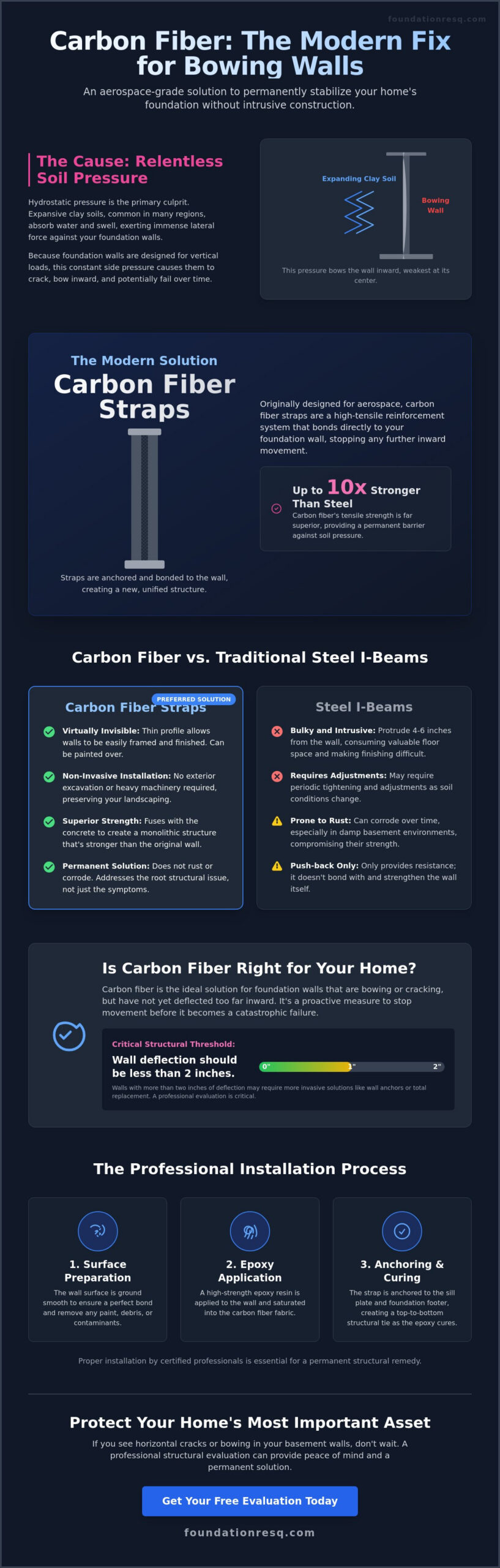
Carbon fiber for foundation wall repair isn’t just a basic patch; it’s a sophisticated application of Carbon-fiber reinforced polymer (CFRP) technology. Originally developed for aerospace engineering and high-performance racing, this material was prized for its incredible strength-to-weight ratio. It allowed engineers to build aircraft components that could withstand massive G-forces without adding unnecessary weight. In a residential setting, this same technology acts as a high-tensile reinforcement system. It’s become the preferred modern alternative to traditional wall anchors because it doesn’t require exterior excavation or heavy interior hardware that takes up valuable floor space.
The core purpose of these straps is to neutralize the intense horizontal force exerted by the soil surrounding your home. In regions with heavy clay soil, the ground expands significantly when wet and pushes against your masonry. This pressure is known as hydrostatic pressure. Carbon fiber straps are designed to absorb this tension. They prevent further inward movement by creating a permanent barrier that is up to ten times stronger than steel. It’s a passive solution that integrates with the wall, making it stronger than it was on the day it was built.
The Anatomy of a Carbon Fiber Strap
A professional-grade strap features a specific fabric weave, often using unidirectional fibers aligned to provide maximum resistance against lateral pressure. This fabric is saturated with a specialized high-strength epoxy resin. This resin isn’t just glue; it’s a bonding agent that fuses the carbon fiber to the concrete at a molecular level. To ensure the wall remains stable, the strap is anchored to the sill plate of the floor system and the foundation footer, creating a complete structural tie.
How it Differs from Cosmetic Crack Injection
You should distinguish between structural reinforcement and simple crack repair. Cosmetic crack injection, typically using polyurethane, is designed for waterproofing and sealing out moisture. While it stops leaks, it has very little structural strength and cannot stop a wall from bowing. In contrast, carbon fiber provides the necessary tension to hold the wall in place. Often, a professional remedy involves a synergistic approach. We might inject the crack to prevent water intrusion and then apply carbon fiber for foundation wall repair over the top to ensure the crack doesn’t widen or move again.
By choosing this modern reinforcement method, you’re opting for a solution that addresses the root cause of structural failure. It provides a permanent fix that is virtually invisible once painted, ensuring your home stays safe without sacrificing the utility of your basement or crawl space.
The Science of Reinforcement: How it Stops Bowing Walls
Understanding why a foundation wall begins to bow is the first step in implementing a permanent remedy. In our region, the primary culprit is hydrostatic pressure. This occurs when the heavy clay soil surrounding your home becomes saturated with water and expands. As the soil grows in volume, it exerts massive lateral pressure against your foundation. Because concrete and block walls are designed to support the vertical weight of your home rather than side-to-side force, they eventually begin to deflect inward. For a deeper understanding of what causes basement walls to bow and how to identify the early warning signs, reviewing a dedicated identification guide can help you act before the damage worsens.
The physics of a bowing wall reveal that the center point is almost always the weakest area. While the top of the wall is held by the floor joists and the bottom is secured by the footer, the middle has no natural support against external soil pressure. Over time, this leads to horizontal cracking and an inward curve. Using carbon fiber for foundation wall repair addresses this structural vulnerability by introducing high tensile strength to the interior face of the wall. When the epoxy resin cures, it creates a monolithic structure, effectively turning the wall and the strap into a single, unbreakable unit that follows industry standards for CFRP.
Countering Tallahassee’s Soil Dynamics
Tallahassee homes face unique challenges due to our local geology and intense seasonal rainfall. Our heavy clay soils act like a sponge, swelling significantly during the wet summer months and shrinking during dry spells. These cycles create a progressive problem. Each time the soil expands, it pushes the wall a fraction of an inch further. When the soil dries and pulls away, the wall doesn’t move back; instead, debris often fills the gap, locking the wall in its new, bowed position. If you notice these early shifts, seeking a professional structural evaluation can prevent a minor deflection from becoming a total failure.
Tensile Strength vs. Steel
Carbon fiber provides a superior alternative to steel because of its incredible resistance to stretching. While steel beams are bulky and can eventually flex or corrode, carbon fiber is designed for “zero stretch” performance. This means once the straps are bonded to your masonry, the wall simply cannot move any further inward. Carbon fiber has a tensile strength exceeding 150,000 psi, which allows it to be much thinner and less intrusive than traditional metal reinforcements. This high-tensile capacity ensures that your foundation remains stable even under the most extreme soil pressure conditions.
Carbon Fiber vs. Steel I-Beams: A Practical Comparison
Homeowners often feel a sense of skepticism when comparing a thin fabric strap to a heavy steel beam. It’s natural to assume that more mass equals more strength, but modern material science proves otherwise. Carbon fiber for foundation wall repair is often the superior choice for residential projects because it offers the same structural stabilization as steel without the industrial drawbacks. While steel beams have been the standard for decades, they require significant floor space and extensive labor to install correctly.
The most immediate difference is the physical footprint. A standard steel I-beam installation typically results in the loss of 6 to 12 inches of usable floor space along your basement or crawl space wall. In contrast, carbon fiber straps are nearly as thin as a coin. This low-profile design is paintable and easily concealed, making it the preferred choice if you plan to finish your basement. You don’t have to worry about building bulky soffits or losing square footage just to keep your home stable.
Durability and long-term maintenance also set these two methods apart. Steel is prone to corrosion and rust, especially in the humid environments common to crawl spaces. It may also require periodic adjustments to maintain tension against the wall. Carbon fiber is completely non-corrosive and requires zero maintenance once the epoxy has cured. Academic research on structural concrete repair has validated that these polymer systems maintain their integrity over decades, providing a permanent remedy that won’t degrade like metal.
Non-Invasive Installation Benefits
One of the biggest advantages of carbon fiber is the lack of disruption to your daily life. A typical installation is a “clean” process that rarely takes more than a single day. There’s no need for heavy machinery, exterior excavation, or tearing up your landscaping. Because the straps are bonded directly to the interior masonry, the mess is minimal. Homeowners find this much more manageable than the multiple days of drilling and bolting required for steel reinforcements.
When Steel is Still Necessary
While carbon fiber is incredibly strong, it’s a passive solution. This means it’s designed to stop a wall from moving further, but it cannot “pull” or push a wall back to its original position. We generally follow the “2-inch rule” in the industry. If your foundation wall has bowed or deflected more than 2 inches, it has likely reached a point of structural compromise where carbon fiber alone isn’t enough. In these severe cases, steel beams or other heavy-duty mechanical systems are necessary to provide the required support. We always perform a thorough evaluation to determine which method aligns with the specific needs of your home’s structure.
When is Carbon Fiber the Right Choice for Your Home?
Determining if carbon fiber for foundation wall repair is suitable for your property depends largely on the severity of the damage. While this technology is incredibly strong, it’s most effective as a proactive remedy before structural compromise becomes critical. You’ll want to look for specific indicators that the soil pressure mentioned earlier is beginning to take a toll on your masonry. Catching these signs early can mean the difference between a simple reinforcement project and a much more invasive structural overhaul.
Horizontal cracks running along the middle of the wall are the most common indicator of lateral pressure. In cinder block foundations, this often manifests as “stair-step” cracking in the mortar joints. These patterns differ significantly from vertical or diagonal settling cracks. While settling occurs as the home finds its footing in the soil, horizontal movement indicates the wall is struggling to hold back the earth. Carbon fiber is highly compatible with both poured concrete and block walls, making it a versatile choice for most Tallahassee residential structures. The epoxy resin used in the process saturates the pores of the masonry, creating a bond that is actually stronger than the concrete itself.
The Checklist for Homeowners
A quick preliminary assessment can help you decide if it’s time to call a professional. You can measure the inward deflection by hanging a plumb line from the top of the wall to the floor. If the gap between the wall and the string at the center point is less than 2 inches, your home is likely an ideal candidate for reinforcement. You should also review the 7 Warning Signs of a Bad Foundation to see if your home exhibits other symptoms like sticking doors or windows. Identifying these issues early allows for a non-invasive fix rather than a total wall replacement.
Long-Term Value and ROI
Investing in professional reinforcement protects your home’s resale value and structural integrity. When it’s time to sell, home inspectors in Tallahassee specifically look for professional structural certifications on any foundation repairs. A wall reinforced with carbon fiber strips is often seen as a permanent remedy that requires no future maintenance. If you ignore minor bowing now, you risk the problem progressing to a point where simple straps are no longer an option. Addressing the root cause, such as improper drainage or excess soil moisture, alongside the reinforcement ensures your foundation remains a protective barrier for decades. Before committing to a repair plan, reviewing a detailed breakdown of carbon fiber wall reinforcement cost can help you budget accurately and understand what variables influence your specific project. If you’ve noticed horizontal cracking in your basement or crawl space, schedule a professional inspection to assess your reinforcement options.
Professional Installation: Why Expertise Matters
While some retailers market DIY kits for carbon fiber for foundation wall repair, structural stabilization is a task that requires professional precision. The most common reason these systems fail isn’t the material itself; it’s improper surface preparation. If the concrete isn’t ground down to a clean, porous state, the epoxy cannot achieve the molecular bond necessary to hold the strap in place. A professional team understands that even a small amount of leftover paint, dust, or efflorescence can cause the reinforcement to peel away when the soil pressure intensifies.
The role of a structural engineer is equally vital in this process. It isn’t enough to simply place straps at random intervals. Professionals calculate the specific load requirements based on the wall height, the degree of bowing, and the lateral pressure exerted by our local clay soils. This data determines the exact spacing and tension needed to ensure the wall remains immobile. Choosing a professional installation provides the peace of mind that comes with a structural guarantee, ensuring your home remains a safe, stable environment for your family.
The Foundation ResQ Process in Tallahassee
Our methodical approach ensures that every installation provides a permanent remedy for bowing walls. We follow a strict three-step protocol designed for the specific challenges of the Florida climate:
- Step 1: Grinding the Wall. We use industrial diamond grinders to remove all surface contaminants. This exposes the clean, porous masonry required for a deep epoxy bond.
- Step 2: Applying High-Modulus Epoxy. We use a specialized saturant that penetrates the carbon fibers and the concrete simultaneously. This creates a monolithic structure once cured.
- Step 3: Tensioning and Anchoring. The strap is anchored to the sill plate of the home’s floor system. This prevents the top of the wall from tilting inward, a critical step that many DIY applications overlook.
Taking the Next Step for Your Foundation
Addressing a bowing wall early is the most cost-effective way to protect your home’s value. A professional inspection helps you understand the current state of your masonry and whether your home is a candidate for this advanced technology. For a deeper look at how we apply these techniques locally, read our guide on Carbon Fiber Wall Repair in Tallahassee. Don’t wait for a minor crack to become a major structural failure. Schedule your free structural assessment today to secure your home’s future with a permanent reinforcement solution.
Secure Your Home’s Structural Future
Your home’s foundation is its most critical structural component. Choosing carbon fiber for foundation wall repair allows you to address bowing issues with a solution that’s both permanent and virtually invisible. By catching horizontal cracks before they exceed the two-inch deflection limit, you can avoid the high costs and disruption of more invasive methods like steel beams or exterior excavation.
As a locally owned and operated business in Tallahassee, Foundation ResQ understands the unique pressure our regional clay soils place on your masonry. We combine our local knowledge with Groundworks affiliated expertise to deliver high-tensile reinforcement that stands the test of time. Every project we complete is backed by a Lifetime Transferable Warranty, ensuring your property remains protected and its resale value stays intact.
Don’t let structural uncertainty weigh on your mind. Our team is ready to provide the steady, reliable guidance you need to restore your home’s integrity. Request Your Free Foundation Inspection with Foundation ResQ and take the first step toward lasting peace of mind.
Frequently Asked Questions
How long does carbon fiber foundation repair last?
Carbon fiber reinforcement is designed to last for the lifetime of your home. Because the material does not rust, corrode, or stretch over time, it provides a permanent remedy for structural instability. Once the high-modulus epoxy cures, the bond between the fiber and the masonry remains stable indefinitely. This ensures your foundation walls stay secure against soil pressure for decades without needing future adjustments.
Can I paint over carbon fiber straps once they are installed?
You can easily paint over carbon fiber straps once the installation is complete. The low-profile design sits nearly flush against your foundation wall, making it much easier to conceal than bulky steel beams. This feature is particularly beneficial for homeowners who plan to finish their basement or crawl space. It allows for a clean and professional aesthetic that doesn’t interfere with your interior design plans.
Is carbon fiber really stronger than steel for bowing walls?
Carbon fiber for foundation wall repair offers significantly higher tensile strength than traditional steel reinforcements. While steel is strong, carbon fiber is often rated at ten times the strength of steel when resisting the stretching forces caused by bowing walls. This advanced material science allows for a much thinner application. It provides superior stabilization without the weight, bulk, or corrosion risks associated with heavy metal beams.
Can carbon fiber repair a wall that has already moved more than 3 inches?
Carbon fiber is generally not recommended for walls that have deflected more than two inches. If a wall has moved three inches or more, it has reached a level of structural compromise that usually requires heavy-duty mechanical solutions or even wall replacement. We perform a thorough evaluation to determine if your foundation has exceeded the safety limits for polymer reinforcement before recommending a specific structural remedy.
Does carbon fiber repair require digging up my yard?
This repair method is entirely non-invasive and does not require any exterior excavation or digging in your yard. The straps are installed from the interior of your basement or crawl space, which protects your landscaping, decks, and patios from damage. This interior-only approach significantly reduces the mess and timeline associated with traditional foundation remediation. Most projects are completed in a single day without disrupting your outdoor space.
How much does carbon fiber wall reinforcement typically cost?
The total investment for reinforcement depends on several factors, including the number of straps required and the length of the bowing wall. While we do not provide specific pricing without an on-site evaluation, this method is often more cost-effective than steel beams. This is due to lower labor requirements and the lack of heavy machinery. For a comprehensive overview of the variables that influence your project budget, our guide on carbon fiber wall reinforcement cost walks through what Tallahassee homeowners can expect to pay in 2026. You should check with a structural professional for a detailed assessment of your home’s unique needs.
What happens if I ignore a bowing foundation wall?
Ignoring a bowing wall leads to progressive structural failure as soil pressure continues to push against the masonry. What starts as a minor horizontal crack can eventually result in a total foundation collapse. Addressing the issue early with carbon fiber for foundation wall repair prevents these catastrophic outcomes. It also avoids the significantly higher costs of major structural reconstruction that become necessary once a wall fails completely.
Can carbon fiber be used on cinder block walls?
Carbon fiber reinforcement is highly effective on both cinder block and poured concrete walls. On block foundations, the straps are particularly useful for neutralizing the pressure that causes stair-step cracking in the mortar joints. The specialized epoxy penetrates the porous surface of the blocks to create a deep, secure bond. This stabilizes the entire wall segment and prevents the blocks from shifting further inward under hydrostatic pressure.