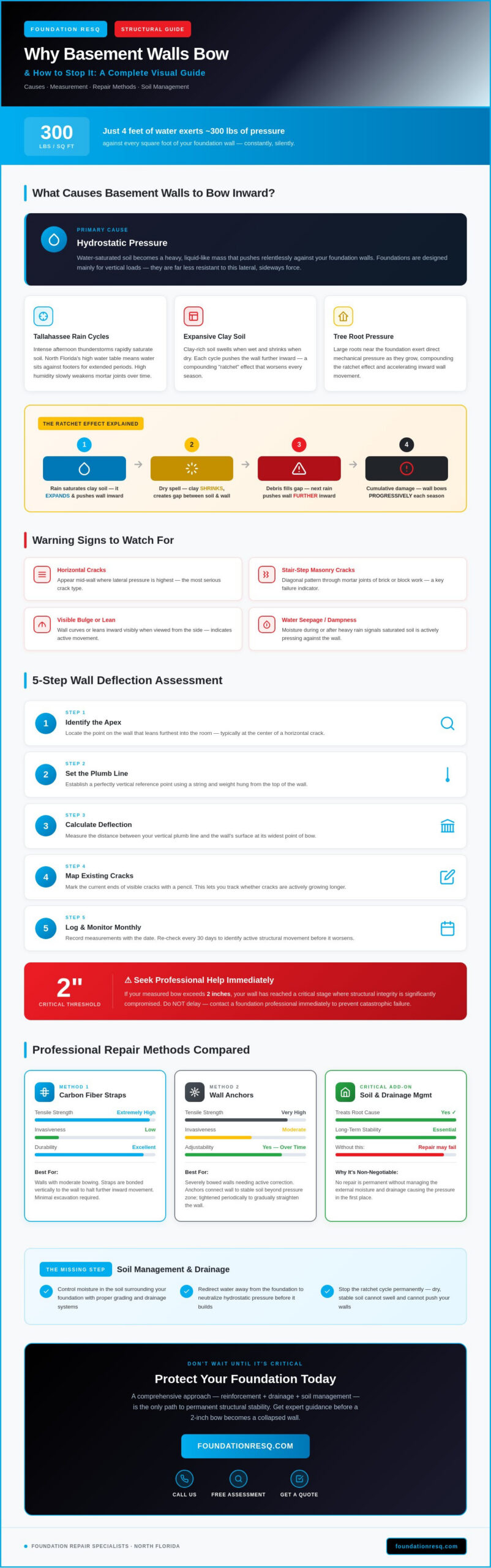
Did you know that just four feet of water can exert nearly 300 pounds of pressure against every square foot of your foundation? When soil becomes saturated, these hidden forces work tirelessly against your home’s structure. Understanding what causes basement walls to bow is the first step toward reclaiming your peace of mind and protecting your largest investment. It’s natural to feel a sense of unease when you notice a curve in your foundation or a new crack in the masonry. You’re likely looking for a dependable answer that cuts through the confusion of competing repair methods while ensuring your home remains structurally sound.
We’re here to provide the professional guidance you need to move from uncertainty to an informed resolution. This guide will help you identify the specific environmental triggers affecting your foundation and explain the exact steps required to measure and repair the damage. You’ll gain a clear roadmap for restoring structural integrity, from analyzing soil conditions to selecting the right reinforcement technology. By addressing the root cause of the pressure and neutralizing external forces, you can secure your home’s future and maintain its long-term stability.
Key Takeaways
- Identify how hydrostatic pressure and saturated soil create the specific environmental forces that cause basement walls to bow inward.
- Learn a simple 5-step assessment to accurately measure wall deflection and determine if your foundation requires immediate professional intervention.
- Compare proven reinforcement methods, such as carbon fiber straps and wall anchors, to find the most durable solution for your home’s unique structural needs.
- Understand why managing external soil moisture and drainage is a critical component of a permanent remedy for long-term stability.
- Discover how a comprehensive approach to restoration protects your property from future movement and restores your home’s structural integrity.
What Causes Basement Walls to Bow Inward?
Bowing is a specific type of structural failure where a foundation wall begins to curve or lean inward. This movement happens when the external force exerted by the surrounding environment exceeds the structural resistance of the masonry. While a wall might appear solid, it is constantly battling the weight of the earth around it. Understanding the engineering principles of a foundation helps homeowners realize that these structures are designed primarily to manage vertical loads from the house. They are often less prepared for lateral, or sideways, pressure. Hydrostatic pressure is the primary catalyst for wall failure.
This pressure is generated by the weight of water-saturated soil pushing against the basement walls. In our region, this is often exacerbated by specific geological factors and local weather patterns. You can often spot these issues early if you know what to look for. Common warning signs that your home is struggling with these forces include:
- Horizontal cracks, typically appearing mid-way up the wall where the pressure is greatest.
- Stair-step masonry patterns in the mortar joints of brick or block work.
- Visible leaning or a “bulge” in the center of the wall when viewed from the side.
- Water seepage or dampness during periods of heavy rain.
The Impact of Tallahassee’s Heavy Rain Cycles
Tallahassee is known for intense afternoon thunderstorms that dump significant amounts of water in a short window. This rapid saturation transforms the local soil into a heavy, liquid-like mass. When this happens, the weight against your foundation increases exponentially. High water tables in North Florida also mean that water often sits against the footers for extended periods, creating constant pressure. Additionally, the high seasonal humidity can slowly weaken mortar joints over time. This makes it easier for moisture to penetrate and for the structure to lose its original rigidity.
Expansive Soils and the ‘Ratchet’ Effect
The clay-rich soil common in our area is highly expansive. When it rains, the clay particles absorb moisture and swell, pushing hard against the foundation. During dry spells, the clay shrinks and pulls away, creating a small gap between the soil and the wall. This leads to the “ratchet” effect. Loose soil and debris fall into these newly created gaps. When the next rain cycle arrives, the soil expands again, but because the gap is filled, it pushes the wall even further inward. Large tree roots near the foundation contribute to this problem by exerting direct mechanical pressure as they grow. This combination of factors is exactly what causes basement walls to bow over several seasons.
How to Measure Wall Deflection: A 5-Step Assessment
Quantifying the inward movement of your foundation helps you transition from a state of worry to a state of informed action. While identifying what causes basement walls to bow is the first phase of the process, measuring the physical deflection provides the data needed to choose the correct stabilization method. A simple settling crack usually runs vertically and remains stable over years. In contrast, an active bowing failure often presents as a horizontal fracture that widens as the soil pressure increases. To establish a baseline for your home, follow this systematic assessment to determine if the movement is slight or critical.
- Identify the Apex: Locate the point on the wall that appears to lean furthest into the room. This is typically found at the center of a horizontal crack.
- Set the Plumb Line: Establish a perfectly vertical reference point using a string and weight.
- Calculate Deflection: Measure the distance between your vertical line and the wall’s surface at its widest point.
- Map Existing Cracks: Use a pencil to mark the current ends of any visible cracks. This allows you to see if they are growing longer over time.
- Log and Monitor: Record your measurements and the date in a dedicated notebook. Check these points every thirty days to track active structural movement.
Safety is the most important factor during this assessment. If your measurements show a bow exceeding 2 inches, the wall has reached a critical stage where structural integrity is significantly compromised. At this point, you should seek professional guidance immediately to prevent further failure. For homeowners looking to understand the relationship between soil saturation and these structural shifts, this University of Minnesota Extension guide offers excellent technical context on moisture management.
The Plumb Line Test for Accuracy
The plumb line test is a reliable, low-cost way to get precise data. Start by securing a heavy masonry string to the top of the foundation wall, near the floor joists. Hang a weight, such as a plumb bob or a heavy nut, so it sits just above the floor without touching it. This creates a perfectly vertical line regardless of the wall’s lean. Use a tape measure to find the gap between the string and the wall at the top, middle, and bottom. The difference between these numbers represents your total deflection.
Mapping Cracks and Shear Failure
Monitoring the “shear” is equally vital. This occurs when the bottom row of blocks slides inward over the concrete footer, often due to intense hydrostatic pressure at the base. You can use a crack monitor tool for millimeter-level tracking or simply mark the edges of blocks with a pencil to see if the gap is widening. If you notice rapid changes after a heavy Tallahassee rainstorm, it’s time to schedule a professional foundation inspection to discuss permanent stabilization options.
Professional Methods to Repair Bowing Foundation Walls
Once you’ve measured the deflection in your foundation, the next step is selecting a restoration method that addresses the specific severity of the movement. While understanding what causes basement walls to bow helps you identify the environmental triggers, professional remediation focuses on neutralizing those forces permanently. Modern structural engineering has moved beyond temporary patches. We now utilize targeted technologies that match the degree of wall failure, ensuring the home remains stable for decades. The chosen method depends entirely on the data gathered during your assessment.
Professional repairs prioritize structural integrity while also considering your future plans for the space. Many of these solutions are non-invasive, preserving valuable interior square footage and allowing for easy cosmetic finishing later. These permanent fixes often come with a transferable lifetime warranty, providing essential security for your property’s value. To better understand the engineering behind moisture control and basement health, the Building Science Corporation provides extensive research on how these systems interact with the surrounding soil.
Carbon Fiber Wall Reinforcement
For walls with less than two inches of deflection, carbon fiber is often the gold standard. This material provides incredible tensile strength, roughly ten times stronger than steel. When applied as a series of straps, it binds to the masonry and prevents any further inward movement. One of the primary advantages of carbon fiber for foundation wall repair is its low-profile nature. The straps are nearly flush with the wall, meaning you can easily paint over them or finish the basement without losing space to bulky hardware. It’s a clean, efficient way to stabilize a structure before the damage becomes critical. Before committing to a repair plan, reviewing the specific variables that affect carbon fiber wall reinforcement cost can help you budget accurately and understand what factors influence your total project investment.
Wall Anchors and Helical Tiebacks
When bowing exceeds two inches or involves significant shear at the base, wall anchors offer a more robust mechanical solution. This method involves placing a steel plate on the interior wall and connecting it to a second plate buried in the stable soil of your yard. By tightening the connecting rod, we can leverage the strength of the undisturbed earth to pull the wall back toward its original position over time. In tight spaces where excavation isn’t possible, helical tiebacks provide a similar corrective force. These large, screw-like anchors are driven deep into the ground at an angle, creating a protective barrier against the lateral pressure that defines what causes basement walls to bow in the first place. These systems don’t just stop the movement; they provide the mechanical leverage needed to restore the wall’s vertical alignment. For a deeper understanding of how these methods fit into a broader structural plan, our foundation stabilization guide for Tallahassee homeowners covers the full range of options available in 2026, including how updated Florida Building Code standards affect your repair choices.
The Missing Step: Soil Management and Drainage
Structural reinforcement provides the strength needed to resist movement, but it doesn’t address the environmental forces that defined what causes basement walls to bow in the first place. A truly permanent resolution requires a remedy-based framework. This means we first stabilize the structure and then immediately focus on neutralizing the external pressure. If you ignore the water, you’re only treating the symptom while the root cause continues to work against your home’s safety. Professional drainage management acts as the final line of defense for your foundation’s health.
Think of your foundation as a protective barrier. When the soil around it becomes oversaturated, that barrier is under constant attack. While carbon fiber and wall anchors provide necessary support, they are only half of the solution. To ensure long-term stability, you must remove the weight of the water-saturated soil. This proactive approach prevents the ‘ratchet effect’ described earlier and ensures that your structural repairs aren’t fighting an uphill battle against nature.
Correcting Exterior Grading and Runoff
Your home’s first line of defense is its gutter system. When gutters are clogged or downspouts dump water directly at the base of the wall, they create a localized zone of high pressure. We recommend the “6 inches in 10 feet” rule. This means the soil should slope away from the house at least six inches over the first ten feet. Be cautious with mulch beds; while they look good, they often trap moisture against the masonry. Extending downspouts at least ten feet away from the foundation ensures that roof runoff doesn’t contribute to the saturation of Tallahassee’s clay soil.
Internal Water Management Systems
Sometimes, exterior management isn’t enough to relieve hydrostatic pressure near the footers. In these cases, internal systems like French drains and high-capacity sump pumps are essential. These tools work in tandem with your structural reinforcements by collecting and removing water before it can exert force. Maintaining a dry environment also protects the strength of your masonry blocks. For homes with specific regional challenges, crawl space encapsulation Tallahassee provides a comprehensive barrier against North Florida’s high humidity and groundwater levels.
If you are concerned about active water pressure around your home, schedule a comprehensive drainage assessment to ensure your structural repairs are fully protected.
Stabilizing Your Home with Foundation ResQ
Addressing the environmental forces that define what causes basement walls to bow requires a partner who understands the specific geological profile of Leon County. At Foundation ResQ, we combine extensive resources with the specialized knowledge of a steadfast local expert. While generic contractors might offer a temporary patch, our team focuses on the ultimate resolution of structural issues. We’ve spent over a decade protecting homes in our community from the unique pressures of North Florida’s expansive clay soils. This local experience ensures that every repair is tailored to the specific soil behavior and rain cycles found in our region.
Choosing a professional remedy means prioritizing the long-term health of your building. We provide high-quality foundation repair Tallahassee homeowners can depend on for permanent stability. Our solutions don’t just hide the damage; they restore the physical integrity of the structure. For many families, the greatest benefit is the peace of mind that comes with our transferable lifetime warranties. This protection ensures that your home remains a safe, stable asset for as long as you own it and provides a clear advantage when it’s time to sell.
Localized Structural Solutions
Our approach to restoration utilizes proprietary technology engineered specifically for the challenges of Florida soil. We’ve mastered the application of carbon fiber wall repair Tallahassee, offering a modern, low-profile method for stabilizing masonry without taking up interior space. When the pressure is more severe, our helical piers and tiebacks are driven deep into stable soil layers to provide a permanent anchor against lateral force. Every project we undertake is guided by a decade of hands-on experience in Leon County, allowing us to anticipate and neutralize the specific factors that cause basement walls to bow in our neighborhoods.
Why Professional Inspection is Non-Negotiable
One of the greatest risks to a home is misdiagnosing a bowing wall as simple cosmetic settling. A homeowner might see a crack and assume it’s a minor age-related issue, but these fractures are often signs of active structural movement. Our experts use precision sensors to detect wall deflection that is often invisible to the naked eye. This methodical assessment allows us to identify the root cause before the damage leads to a critical failure. Don’t leave your home’s safety to chance. Schedule your free inspection with Foundation ResQ today and let our specialists provide the clear roadmap you need for a stable, secure foundation.
Restoring Your Foundation’s Integrity
By identifying exactly what causes basement walls to bow, you can move from a state of concern toward a proactive restoration plan. True structural health requires more than just a temporary patch; it demands a comprehensive approach that combines precision reinforcement with active water management. Whether your home needs carbon fiber straps or heavy-duty wall anchors, the goal is always to neutralize external forces and ensure long-term durability. You now have the knowledge to monitor your foundation and understand the specific drainage solutions required for our local environment.
Foundation ResQ brings over 10 years of Tallahassee structural expertise to every project. We utilize Groundworks-backed proprietary technology to deliver results that are as permanent as they are dependable. Our commitment to your home’s safety is reflected in our lifetime transferable warranties, providing security for your family and your property value. You don’t have to navigate these structural challenges alone. Protect your home with a free structural inspection from Foundation ResQ and take the first step toward a stable, worry-free foundation. Our team is ready to help you safeguard your investment with the professional care it deserves.
Frequently Asked Questions
Is a bowing foundation wall an emergency?
A bowing wall is a serious structural concern that requires immediate professional attention. While it may not result in an instantaneous collapse, it indicates that the masonry can no longer withstand the external pressure from the surrounding soil. If you notice a bow exceeding two inches or if cracks are widening rapidly, the situation is critical. Addressing the issue early prevents total wall failure and reduces the complexity of the eventual restoration.
Can I fix a bowing basement wall from the inside?
Many effective structural repairs are performed entirely from the interior of the home. Carbon fiber straps and steel I-beams are common internal solutions that stabilize the wall without requiring extensive yard excavation. While these methods stop the inward movement, they are most effective when paired with external drainage improvements. This dual approach addresses what causes basement walls to bow by reinforcing the structure while managing the water pressure outside.
How much does it cost to repair a bowed wall with carbon fiber?
The total investment for carbon fiber reinforcement depends on the length of the affected wall and the number of straps required for stabilization. Professionals typically place these straps every four feet to ensure even distribution of the load. Because every foundation is unique, an on-site structural assessment is necessary to determine the exact scope of work. For a detailed breakdown of the variables that influence your project budget, our guide on carbon fiber wall reinforcement cost provides comprehensive pricing context for 2026. Early intervention usually results in a more straightforward and efficient repair process.
Will my homeowners insurance cover bowing wall repair?
Most standard homeowners insurance policies don’t cover repairs for bowing walls. Insurance companies generally view foundation movement caused by hydrostatic pressure or soil expansion as a gradual maintenance issue rather than a sudden, accidental event. It’s best to review your specific policy or speak with your agent to understand your coverage. Investing in preventative drainage management can help you avoid these out-of-pocket expenses.
What is the difference between a settling crack and a bowing wall?
A settling crack is typically vertical and occurs as the house naturally sinks into the soil over time. In contrast, a bowing wall is characterized by horizontal cracks and an inward curve. This happens when lateral pressure from the earth pushes against the side of the foundation. While minor settling is common in many Tallahassee homes, horizontal movement is a clear sign of structural failure that requires professional stabilization.
How long do carbon fiber wall straps last?
Carbon fiber reinforcement is designed to be a permanent solution for foundation stabilization. The material doesn’t stretch, rust, or degrade over time, making it an incredibly durable choice for structural support. When installed correctly by a professional, these systems are often backed by lifetime transferable warranties. This ensures the wall remains secure for the remaining life of the home.
Can a bowing wall be straightened, or just stabilized?
A bowing wall can be either stabilized or straightened depending on the severity of the damage and your goals for the property. Stabilization stops further movement and keeps the wall in its current position. Straightening is a more intensive process that involves excavating the soil outside and using hydraulic jacks to push the masonry back into place. A structural expert can help you decide which path is right for your home’s specific condition.
What happens if I ignore a bowing wall in my crawl space?
Ignoring a bowing wall leads to progressive structural failure and significantly increased repair costs. Over time, the inward pressure can cause the wall to buckle or collapse, which threatens the safety of the entire building. In crawl spaces, this movement often creates gaps that allow moisture and pests to enter, leading to mold growth and wood rot. Addressing the issue now protects your home’s value and prevents a localized problem from becoming a total structural disaster.