What if the most expensive part of fixing your basement isn’t the structural repair itself, but the damage caused by the heavy machinery used to get there? If you’ve noticed a new curve in your foundation, you’re likely feeling the weight of uncertainty. It’s stressful to watch a wall shift, and even more daunting to imagine your yard being excavated just to reach the problem. Understanding the cost of bowing wall repair Tallahassee homeowners face in 2026 requires looking beyond the initial quote to the long-term health and value of your property.
We agree that your home should be a place of safety, not a source of structural anxiety. This guide will help you navigate the specific geological pressures of Leon County and explain why modern carbon fiber reinforcement is often the most cost-effective, permanent solution available today. You’ll learn how to stabilize your foundation without invasive construction and discover how professional reinforcement protects your home’s market value. We’ll examine the different repair methods, local permit requirements, and the factors that determine your total investment in a dry, upright, and secure home.
Key Takeaways
- Understand how Tallahassee’s unique “Red Clay” creates intense hydrostatic pressure that forces foundation walls to bow and crack.
- Learn why the total cost of bowing wall repair Tallahassee homeowners invest in is often lower with carbon fiber, which avoids the need for expensive yard excavation.
- Identify the critical factors that influence repair pricing, including the number of reinforcement points and whether the wall has shifted more than two inches.
- Compare the long-term ROI of aerospace-grade carbon fiber against traditional steel I-beams and wall anchors for residential stabilization.
- Discover the benefits of working with local experts who provide structural solutions backed by dependable, long-term warranties.
What Causes Bowing Walls in Tallahassee Homes?
A bowing wall occurs when the external pressure from the surrounding soil exceeds the structural capacity of the foundation. In a perfect environment, your home’s walls remain vertical and stable. However, the ground is rarely static. When the weight of the earth pushes inward with more force than the wall was designed to resist, the masonry begins to deflect. This movement often starts as a subtle curve that is difficult to see with the naked eye, but it eventually develops into visible cracks and leaning. Homeowners often worry about the cost of bowing wall repair Tallahassee projects require; however, understanding the environmental “why” behind the damage is the first step toward a permanent remedy.
While this guide focuses on Tallahassee, homeowners in other areas like Northeastern Ohio can read more about regional foundation issues and professional repair solutions.
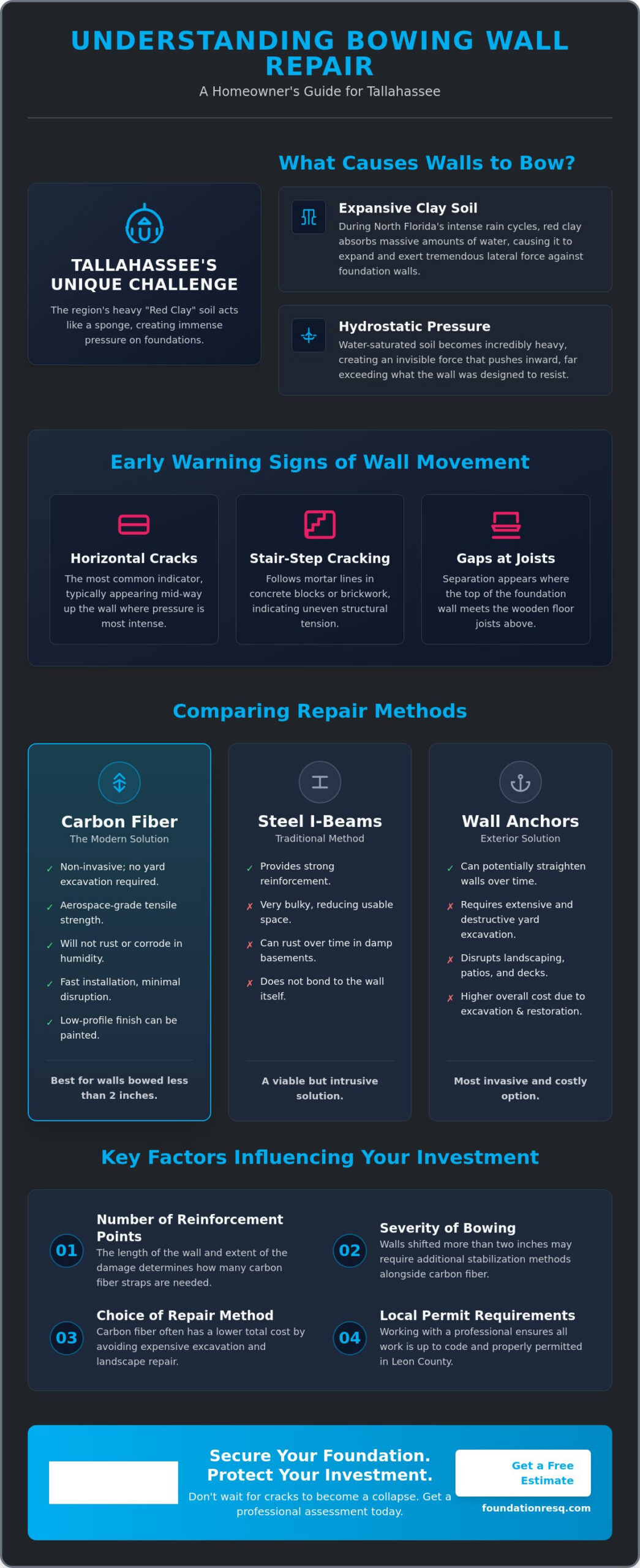
Tallahassee’s geography presents a unique challenge known as the “Red Hills” region. Unlike the sandy coastal soils found further south, our local ground is rich in heavy red clay. This clay is highly expansive, meaning it acts like a sponge. When our intense North Florida rain cycles hit, this clay absorbs massive amounts of water and expands significantly in volume. As the soil grows, it exerts tremendous lateral force against your foundation. In older neighborhoods like Levy Park or Betton Hills, many homes were built before modern reinforcement standards were common. These aging structures are particularly susceptible to the relentless seasonal expansion and contraction of the local clay.
Hydrostatic Pressure: The Invisible Force
When the soil around your home becomes saturated, it creates a phenomenon known as hydrostatic pressure. Think of this water-logged soil as a heavy lever constantly leaning against your basement or crawl space walls. Because Retaining walls and foundation walls are designed to hold back dry earth, the added weight of trapped water can be catastrophic. Hydrostatic pressure is the primary driver of foundation wall failure in humid climates like ours. This pressure is often worsened by poor gutter drainage or downspouts that discharge water too close to the home, creating localized “hot spots” of extreme pressure that force a specific section of the wall to buckle inward.
Early Warning Signs of Wall Movement
Identifying structural shift early can prevent a total wall collapse. You should regularly inspect your foundation for these specific indicators of distress:
- Horizontal Cracks: These are the most common indicator of a bowing wall, usually appearing mid-way up the wall where the pressure is most intense.
- Stair-Step Cracking: Often seen in exterior brickwork or interior concrete blocks, these cracks follow the mortar lines and suggest the wall is under uneven tension.
- Gaps at the Joists: Look for separation where the top of the foundation wall meets the wooden floor joists of your home.
If you notice these signs, the structural integrity of your home is already compromised. Addressing the issue while the movement is minimal often allows for less invasive stabilization methods, helping to manage the overall cost of bowing wall repair Tallahassee residents might expect for more severe failures.
Carbon Fiber Reinforcement: The Modern Solution for Bowing Walls
When a foundation wall begins to lean, the immediate concern for most homeowners is the potential for a total structural failure. In the past, the only way to address this was through bulky steel I-beams or invasive exterior anchors. Today, carbon fiber reinforcement has revolutionized the industry. This material is an aerospace-grade technology that offers a high-tensile solution for home stabilization. It doesn’t just stop the wall from moving; it integrates with the existing structure to provide a permanent barrier against soil pressure. This modern approach often lowers the total cost of bowing wall repair Tallahassee residents face because it eliminates the need for heavy excavation and yard restoration.
The material’s durability is particularly relevant given our local climate. According to the Florida Department of Environmental Protection’s research on What Causes Bowing Walls in Tallahassee Homes?, our regional soils are prone to significant volume changes that stress masonry. Carbon fiber handles these shifts without stretching or snapping. Unlike steel, it won’t rust or corrode when exposed to the high humidity common in North Florida crawl spaces. This makes it a one-time remedy that protects the home’s structural health for decades without requiring ongoing maintenance.
The Science of High-Tensile Strength
Carbon fiber straps are engineered to be incredibly strong yet remarkably thin. During installation, the straps are bonded to the wall using a high-strength epoxy resin. This process integrates the fiber into the concrete itself, creating a unified structure that is stronger than the original wall. The tension is distributed across the entire height of the masonry, preventing the localized stress points that cause cracking. While the initial cost of bowing wall repair Tallahassee homeowners encounter depends on the severity of the bow, carbon fiber remains the most efficient long-term investment. For a deeper look at the technical specifications, you can read our guide on Carbon Fiber Wall Repair in Tallahassee.
Non-Invasive Installation Benefits
Homeowners often choose this method because it is entirely non-invasive. There is no need to dig up your yard, move landscaping, or disturb your porch. Most residential projects are finished in just one day, allowing you to return to your normal routine quickly. The straps are nearly flush with the wall, which is a major advantage for anyone planning to finish their basement or use the space for storage. You can simply paint over the straps to make them virtually invisible. If you’re looking for a discreet way to secure your home, Carbon Fiber Wall Reinforcement provides the stability you need without the visual clutter or construction mess of traditional repairs.
Key Factors That Influence the Cost of Repair
The total investment for foundation stabilization depends on several physical and environmental variables. While carbon fiber is a highly efficient remedy, our specialists must evaluate the specific condition of your masonry to provide an accurate estimate. The primary driver of your quote is the total number of reinforcement points required. Generally, reinforcement straps are installed every four to five feet along the length of the affected wall. If you have a longer foundation or multiple walls showing signs of distress, the material and labor requirements will naturally increase. This is why the cost of bowing wall repair Tallahassee homeowners receive can vary significantly from one property to the next.
Integrating moisture control is another vital consideration for long-term success. In North Florida, foundation movement is almost always tied to water. Addressing the structural bowing without fixing the source of the moisture is often a temporary fix. For many homes, we recommend pairing structural work with crawl space encapsulation Tallahassee services to ensure the soil remains stable and the new reinforcements are protected from the elements. Other factors like crumbling mortar joints or existing structural damage can also necessitate additional prep work before the stabilization process begins.
Severity and Structural Integrity
The cost of bowing wall repair is directly proportional to the amount of deflection measured in the wall. When a wall has shifted less than two inches, carbon fiber is usually the ideal solution because it can be applied directly to the surface to halt further movement. However, once a wall exceeds that two-inch threshold, it often reaches a “point of no return” where surface-level straps alone are insufficient. In these severe cases, more aggressive bracing or even wall anchors may be necessary to pull the structure back toward its original position. Early intervention is the most effective way to minimize your total repair costs; it allows us to utilize the least invasive methods before the damage escalates into a potential collapse.
Site Preparation and Labor
Tallahassee’s high water table and specific geological makeup can complicate even interior repairs. Before installation begins, the workspace must be accessible. If your basement is finished, removing drywall or clearing out crawl space debris can add to the labor hours required. Obstructions like utility lines, HVAC ductwork, or complex plumbing systems also impact the final quote, as these elements must be safely navigated or temporarily relocated.
A professional estimate should always include oversight that meets industry standards for structural safety. This ensures that the remedy isn’t just a quick patch, but a calculated engineering solution. At Foundation ResQ, we focus on a methodical approach that accounts for these hidden variables, providing a transparent breakdown of the work needed to restore your home’s integrity. By addressing these factors upfront, we protect your property from future movement and ensure the repair stands the test of time.
Comparing Costs: Carbon Fiber vs. Wall Anchors and I-Beams
Choosing the right repair method is about more than just the initial quote. It’s about the total lifecycle cost of the project. When evaluating the cost of bowing wall repair Tallahassee homeowners often compare carbon fiber reinforcement with traditional steel I-beams or wall anchors. While the upfront material price for carbon fiber is competitive, the real savings come from the reduced labor and equipment requirements. Carbon fiber installation is a clean process that uses hand tools and high-strength epoxy. In contrast, installing heavy steel beams or anchors involves significant physical labor and specialized machinery, which naturally drives up the final bill.
Space-saving value is another factor that many people overlook. Steel I-beams are effective, but they are bulky. They protrude several inches from the wall, which can make finishing a basement or installing storage shelving difficult. Carbon fiber is nearly as thin as a penny. It bonds directly to the masonry, allowing you to maintain the full square footage of your home. Additionally, carbon fiber is a “set it and forget it” remedy. Because the material is non-corrosive, it won’t rust or degrade in our humid North Florida environment, unlike steel components that may require long-term monitoring or paint touch-ups to prevent oxidation.
The Hidden Costs of Invasive Repairs
Invasive repairs often carry high secondary expenses that don’t appear on the foundation contractor’s estimate. Wall anchors, for example, require “deadman” plates to be buried in the soil outside your home. In established Tallahassee neighborhoods, this means excavating your yard. You must factor in the cost to replace sod, mature shrubs, or even portions of a deck or patio that were disturbed during the process. These restoration costs can add thousands to your total investment. Because carbon fiber is applied entirely from the interior, it preserves your home’s curb appeal and keeps your landscaping intact.
When to Use Each Method
The best method depends on the severity of the structural shift. Carbon fiber is the gold standard for walls with minor to moderate bowing. However, if the soil pressure has caused the foundation to sink as well as bow, a different approach is needed. In cases where the building’s footprint is settling into unstable earth, Professional Helical Pier Installation may be required to reach deeper, more stable soil strata. If you aren’t sure which solution fits your home’s needs, contact Foundation ResQ for a professional structural assessment to identify the most efficient path forward.
Why Foundation ResQ is Tallahassee’s Choice for Wall Stabilization
Foundation ResQ stands as the steadfast local expert for homeowners facing structural instability in North Florida. We understand that the cost of bowing wall repair Tallahassee residents invest in must result in a permanent, worry-free resolution. Our team brings years of experience navigating the specific geological challenges of the Red Hills region, where expansive clay and heavy rainfall create unique pressures on residential foundations. By choosing a local specialist, you ensure that your repair is handled by professionals who live and work in the same environment. This regional knowledge allows us to anticipate how local soil will behave during our intense seasonal rain cycles, providing a level of precision that general contractors often overlook.
Every structural project we undertake is supported by Foundation ResQ’s robust, long-term warranties. This commitment provides our clients with the security of lasting protection, combined with the personalized, attentive service of a local neighbor. We don’t just offer a service; we provide a protective barrier between your home and the elements. Our goal is to instill confidence through methodical, transparent processes that lead you from a state of structural concern to one of informed resolution.
The Foundation ResQ Remedy-Based Framework
Our approach is built on a remedy-based framework that prioritizes the long-term health of your building over temporary patches. We recognize that a bowing wall is a symptom of a larger environmental issue, typically related to hydrostatic pressure. Because of this, we often integrate structural stabilization with mold remediation and moisture control systems. We utilize only the highest-grade carbon fiber materials, ensuring that the reinforcement is both low-profile and incredibly durable. This comprehensive strategy is detailed further in our guide on Foundation Repair Tallahassee, which explores the full spectrum of our stabilization techniques. We focus on the root cause to ensure the “bow” never returns.
Protecting Your Home’s Value
Investing in professional stabilization is a critical step in maintaining your property’s market value. Homes with visible foundation issues often lose significant market appeal and can see a decrease in appraisal value. When you work with Foundation ResQ, you receive professional documentation proving the wall has been permanently stabilized according to engineering standards. This paperwork is invaluable during the home selling process, providing potential buyers with the peace of mind they need to proceed.
Attempting a “DIY” wall fix in our high-humidity climate is a dangerous gamble. Improper materials can fail under the weight of saturated red clay or lead to hidden mold growth behind wall coverings. A professional assessment ensures the job is done right the first time, protecting your family’s safety and your financial investment. The total cost of bowing wall repair Tallahassee homeowners encounter is always more manageable when the issue is addressed before it escalates into a total wall failure. Contact Foundation ResQ today for a free bowing wall assessment and let our team provide the professional guidance you need to secure your home’s future.
Securing Your Home’s Structural Future
Addressing a bowing wall is an essential step in protecting your property’s long-term health and market value. You’ve learned how Tallahassee’s expansive red clay creates the hydrostatic pressure that compromises masonry, and why modern carbon fiber reinforcement is the most efficient solution for North Florida homes. By choosing a non-invasive stabilization method, you avoid the secondary expenses of yard restoration while ensuring your foundation remains upright and secure. The total cost of bowing wall repair Tallahassee homeowners invest in is ultimately a commitment to safety and peace of mind.
Since 2013, Foundation ResQ has served as the region’s steadfast local expert. Our A+ rated structural stabilization systems are backed by Groundworks-backed lifetime warranties, providing a final line of defense for your building. Don’t wait for a minor curve to become a major structural failure. Schedule Your Free Foundation Inspection with Foundation ResQ today to receive a professional assessment tailored to your home’s unique needs. We’re here to help you restore the stability your home deserves.
Frequently Asked Questions
How much does it cost to repair a bowing wall in Tallahassee?
The total investment depends on the length of the wall, the degree of the bow, and the number of reinforcement points required for stabilization. While national averages exist for structural work, the specific cost of bowing wall repair Tallahassee homeowners encounter is determined by local soil conditions and the severity of the deflection. We provide transparent, project-specific estimates after a thorough structural inspection of your property to ensure you only pay for the necessary remedies.
Will carbon fiber straps really stop my wall from moving?
Carbon fiber straps are engineered to permanently halt wall movement by integrating with the masonry and resisting the lateral pressure from expansive soils. This aerospace-grade material has a high tensile strength that is significantly stronger than steel. When bonded with industrial epoxy, the straps distribute tension across the entire height of the wall. This prevents further bowing and ensures the structural integrity of your home remains secure for decades.
Is bowing wall repair covered by my Florida homeowners insurance?
Most standard Florida homeowners insurance policies don’t cover foundation repairs caused by hydrostatic pressure, soil expansion, or general settlement. These issues are typically classified as maintenance or “earth movement,” which are often excluded from coverage. However, it’s always advisable to review your specific policy or speak with your agent. We can provide the professional documentation and engineering reports you might need to support a claim if a specific covered event caused the damage.
How long does the carbon fiber installation process take?
The majority of residential carbon fiber reinforcement projects are completed in a single day. Because this method doesn’t require heavy machinery or exterior excavation, our team can move quickly through the preparation and bonding phases. The process is clean and efficient, allowing you to return to your normal routine without the weeks of disruption associated with traditional construction. The speed of installation is one reason this is a preferred remedy for modern homeowners.
What happens if I ignore a bowing foundation wall?
Ignoring a bowing wall eventually leads to a total structural collapse, which is significantly more expensive to remedy than early stabilization. Over time, the pressure from Tallahassee’s red clay will cause cracks to widen, allowing water to enter your home and compromise the interior. Eventually, the wall will lose its ability to support the weight of the building above it. This creates a dangerous environment and can lead to a complete loss of property value.
Can I finish my basement or crawl space over carbon fiber straps?
You can easily finish any space where carbon fiber straps have been installed because they are nearly flush with the wall surface. Unlike bulky steel I-beams that protrude several inches into the room, carbon fiber is roughly the thickness of a coin. You can paint directly over the straps or install drywall and paneling right over them. This low-profile advantage makes it the ideal choice for homeowners who want to utilize their basement or crawl space for storage or living.
Do I need to dig up my yard to fix a bowing wall?
You don’t need to dig up your yard if you choose carbon fiber reinforcement for your foundation stabilization. This method is performed entirely from the interior of your home, which preserves your landscaping, sod, and decks. Traditional methods like wall anchors require exterior excavation to place plates in the soil, but carbon fiber avoids this invasive step. This non-invasive approach is a primary factor in managing the total cost of bowing wall repair Tallahassee homeowners expect.
What is the difference between carbon fiber and wall anchors?
Carbon fiber is a low-profile interior strap that bonds to the wall to stop movement through tension, while wall anchors are mechanical devices that use an exterior plate to pull the wall back. Carbon fiber is ideal for minor to moderate bowing and requires no digging. Wall anchors are sometimes used for more severe cases where the wall needs to be physically moved toward its original position. Each method has specific applications based on the measured deflection of your masonry.