
A brick home is often the pride of a Tallahassee neighborhood, but its greatest strength is also its biggest vulnerability: weight. Unlike wood-framed structures, brick masonry doesn’t flex; it fractures. You’ve likely noticed those stair-step cracks creeping through your mortar or a window that suddenly refuses to budge. It’s natural to feel a sense of dread when you see your home’s exterior pulling apart, especially when you consider the potential costs of masonry repair or the fear of a structural collapse. Fixing a sinking foundation on a brick home requires more than just patching the surface; it demands a solution that reaches deep into the soil to find stability.
This guide will show you how to identify the early warning signs and diagnose the underlying soil issues correctly. You’ll learn why professional piering systems are the gold standard for permanent stabilization. We will explore the technical differences between helical and push piers and explain how modern remediation can restore your home’s integrity while protecting its classic aesthetic for years to come. By understanding the science of soil and the precision of structural engineering, you can secure your home’s future with confidence.
Key Takeaways
- Identify the critical warning signs of settlement, such as stair-step mortar cracks and separating window frames, before they lead to structural failure.
- Understand how Tallahassee’s “Red Clay” soil and the heavy vertical load of masonry contribute to the unique challenges of fixing a sinking foundation on a brick home.
- Learn why professional piering systems are the industry gold standard for bypassing unstable surface soil and providing permanent structural stability.
- Compare the specific benefits of helical and push piers to understand which specialized remediation method is best suited for your property’s soil conditions.
- Discover how a methodical, step-by-step restoration process protects your home’s aesthetic value and ensures long-term safety for your family.
Warning Signs of a Sinking Foundation on a Brick Home
Brick homes offer a timeless aesthetic and incredible durability, but their rigid nature makes them highly sensitive to soil movement. Unlike wood siding that can flex or shift slightly without showing damage, brick masonry is brittle. When the ground fails, the house doesn’t just sag; it breaks. Recognizing these early indicators is crucial for fixing a sinking foundation on a brick home before the masonry requires total reconstruction or the structural integrity is compromised beyond simple repair.
The most prominent red flag is the stair-step crack. These diagonal fractures follow the mortar joints between bricks, resembling a set of stairs. They typically appear near corners or windows where the structural load is highest. While some small, vertical cracks might be simple shrinkage, diagonal movement almost always points to a deeper issue. To gain a professional perspective on why this happens, one must understand what is foundation settlement? effectively. In short, it is the downward movement of the ground that leaves the heavy brickwork unsupported and vulnerable to gravity.
Why Stair-Step Cracks Are Not Just ‘Settling’
Homeowners often hope these cracks are just a house “finding its seat.” However, brick is a rigid material that only cracks when the foundation loses its ability to support the vertical load. Cosmetic cracks are usually thin and uniform, whereas structural settlement cracks grow wider at one end. A stair-step crack is a primary indicator of vertical foundation movement that requires professional stabilization rather than a simple mortar patch. If you ignore these signs, the gaps will continue to expand as the home continues its downward trajectory.
Beyond the cracks, look for secondary indicators. Gaps often form between the top of the brick wall and the soffit or roofline. You might also notice window frames pulling away from the masonry, leaving visible daylight or drafts. If your chimney looks like it’s “leaning” away from the house, or if the front porch is separating from the main structure, the foundation beneath those heavy elements is likely failing. These heavy masonry components often settle faster than the main house, providing an early warning of unstable soil conditions.
Internal Symptoms of External Brick Problems
The exterior masonry often tells only half the story. Inside the home, the same structural shifts manifest as sticking doors and windows that no longer fit their frames properly. You may notice floors that feel uneven or slope toward a specific corner. Often, drywall cracks will appear in the same locations as the external brick damage, mirroring the stress the entire building is under. These internal signs confirm that fixing a sinking foundation on a brick home is a necessity to protect the entire structural envelope and restore the home to a safe, level state.
Why Brick Foundations Sink: The Tallahassee Context
Brick homes carry a massive physical burden compared to their wood-framed counterparts. A single brick may seem light, but an entire exterior facade exerts thousands of pounds of vertical pressure on the footer and the soil beneath it. In many cases, the ground simply isn’t prepared to hold that weight indefinitely. When fixing a sinking foundation on a brick home, it’s essential to understand that the soil, not the brick, is usually the primary failure point. The foundation settlement standards established by professional engineering bodies highlight how soil bearing capacity is the most critical factor in structural longevity.
Tallahassee presents a unique geological challenge for masonry structures. Our region is famous for its “Red Clay,” a highly expansive soil that reacts aggressively to moisture. During North Florida’s humid summers and tropical storms, this clay absorbs water and swells, exerting immense upward and inward pressure. Conversely, during the dry autumn months, the clay shrinks and pulls away from the foundation. This constant movement creates voids. Because brick is a rigid material, it cannot bend with these shifts; it simply cracks as it follows the subsiding soil.
The Role of Expansive Clay in North Florida
Clay soils act like a sponge. When they saturate, they create hydrostatic pressure that can actually push against your foundation walls. The “shrink-swell” cycle is particularly violent in our local climate. While a wood-framed home might creak or settle slightly without visible damage, a brick home lacks that flexibility. This rigidity is why brick structures are often the first to show signs of distress when the clay beneath them begins to fail. Over time, this cycle weakens the soil’s ability to support the heavy vertical load of the masonry.
Hydrostatic Pressure and Brick Facades
Water management is often the most overlooked aspect of foundation health. When gutters are clogged or downspouts discharge too close to the home, water pools at the base of the brick ledge. This saturation leads to “soil washout,” where sandy pockets in the Tallahassee soil are literally carried away, leaving the heavy brickwork hanging in mid-air. Water can also become trapped behind the brick veneer, accelerating the deterioration of the footer. To prevent these moisture-related issues, many homeowners consider crawl space encapsulation Tallahassee services to manage humidity and drainage from the inside out.
Managing the environment around your home is a vital part of fixing a sinking foundation on a brick home. If you suspect your soil is no longer supporting your masonry, it’s wise to consult with a local specialist who understands Tallahassee’s specific geological strata and can provide a permanent remedy before the damage spreads.
Comparing Solutions: Helical Piers vs. Push Piers
When fixing a sinking foundation on a brick home, the primary goal is to transfer the building’s massive vertical load from unstable surface soil to deeper, competent strata. Professional piering systems are the industry standard for achieving this permanent stabilization. In the Tallahassee area, we primarily utilize two types of structural piers: push piers and helical piers. While both systems provide a remedy for settlement, the specific engineering choice depends on the weight of your masonry and the depth of the load-bearing soil layers.
The selection process requires a methodical evaluation of the home’s construction. Brick is significantly heavier than wood or vinyl siding, which influences how a pier interacts with the structure. If the wrong system is chosen, it may fail to reach the necessary depth or lack the strength to support the concentrated weight of a brick facade. Understanding these mechanical differences ensures that the stabilization is both effective and permanent.
When to Use Steel Push Piers
Steel push piers are often the preferred choice for heavy, multi-story brick homes. These piers consist of high-strength steel tubes that are driven into the ground using the building’s own weight as a counter-force. A hydraulic ram pushes the pier sections through the Tallahassee clay until they reach high-capacity load-bearing strata, which can often be several dozen feet below the surface. This process continues until the pier hits a layer of soil or rock that can support the required load.
The distinct advantage of this system is that it uses the building as a reaction force. Because brick masonry is so dense, it provides the necessary resistance to drive the piers deep into the earth. Once the piers reach a stable layer, the home’s weight is transferred through steel brackets directly to the pier. This provides immediate stabilization and, in many cases, allows for the careful lifting of the foundation toward its original level. For homeowners dealing with significant settlement in a heavy structure, push piers offer a robust, long-term solution.
The Advantage of Helical Pier Installation
Helical piers operate on a different mechanical principle. Instead of being pushed into the ground using the building’s weight, they are “screwed” into the soil using a high-torque hydraulic motor. Each pier is equipped with screw-like blades, known as helices, that pull the pier into the ground. This makes helical pier installation the ideal choice for lighter structures where the building’s weight isn’t sufficient to drive a push pier effectively.
These are particularly effective for stabilizing brick chimneys, porches, or single-story brick-veneer additions. The helices provide immediate support in both tension and compression, regardless of the building’s mass. Because they don’t rely on the structure for leverage, they can be installed in areas with very soft surface soil where a push pier might not find the necessary resistance. Choosing the right pier is a critical step in fixing a sinking foundation on a brick home, ensuring the remedy protects the home’s structural health for decades.
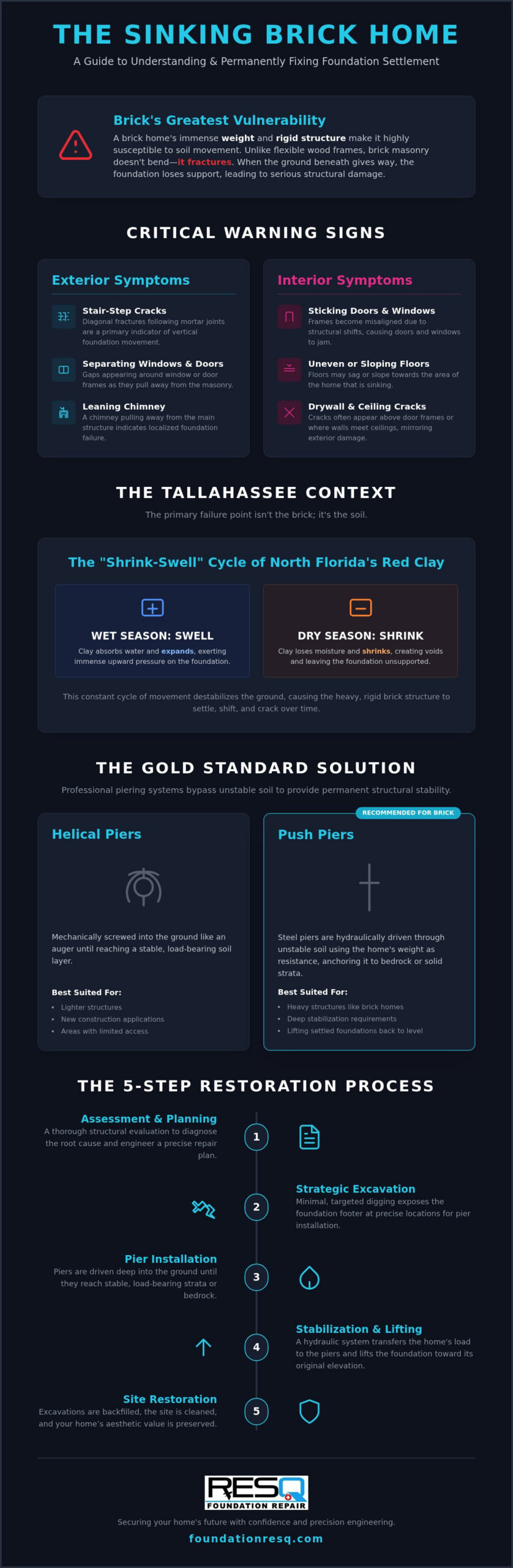
The Step-by-Step Process of Fixing a Sinking Brick Foundation
Fixing a sinking foundation on a brick home is a methodical engineering process that requires precision at every stage. Because brick masonry is heavy and rigid, the remediation must be handled with extreme care to avoid causing additional stress to the structure. Our process begins with careful excavation. We dig small, strategic access holes to expose the foundation’s concrete footer. This allows our team to inspect the condition of the footer and prepare the surface for the attachment of heavy-duty steel brackets.
Once the footer is prepped, we secure the brackets directly to the foundation. These brackets serve as the anchor point for the piering system, transferring the home’s weight from the soil to the steel piers. We then drive the piers through the brackets and deep into the Tallahassee soil until they hit a stable, load-bearing layer. We monitor the hydraulic pressure constantly during this phase to ensure each pier reaches its required capacity. The final technical phase involves the lift. We use a synchronized hydraulic system to apply even pressure across the brackets, gently moving the home back toward its original level.
Stabilization vs. Lifting: What to Expect
While many homeowners focus on closing every visible crack, it’s important to understand that permanent stabilization is the primary goal. Lifting is a controlled secondary benefit. Because brick is so brittle, attempting to force a home back to a perfectly level state can sometimes cause more masonry damage than it fixes. We prioritize a controlled hydraulic lift that minimizes stress on the brickwork. This approach ensures your home is structurally sound without compromising the fragile mortar joints that hold your facade together.
Restoring the Aesthetic: Masonry Repair After Piering
With the structural stability of the home restored, many residents choose to proceed with further property enhancements. If you are interested in high-quality craftsmanship for your next project, you can discover Lotz Renovations, Inc. and their extensive remodeling services.
Once the foundation is permanently stabilized, the focus shifts to the home’s appearance. You should always wait for the foundation to reach its final resting state before repointing mortar or patching cracks. Matching mortar colors is essential to ensure the repair is virtually invisible and preserves your home’s curb appeal. In cases where the sinking has caused basement or crawl space walls to bow inward, we may recommend carbon fiber wall repair Tallahassee to reinforce the structural envelope from the inside and prevent further lateral movement.
If you’ve noticed stair-step cracks or shifting masonry, don’t wait for the problem to worsen. You can schedule a professional inspection with our team to start the stabilization process today and protect your home’s long-term health.
Why Foundation ResQ is Tallahassee’s Choice for Brick Repair
Tallahassee’s rolling hills and unique red clay require a specialist who understands the region’s geological quirks. Fixing a sinking foundation on a brick home isn’t a task for a general contractor; it requires a deep understanding of how heavy masonry interacts with Florida’s shifting soils. At Foundation ResQ, we’ve spent years protecting the structural integrity of local properties, from historic brick estates in Midtown to modern veneers in Killearn. Our approach is methodical and thorough, ensuring that every remediation project we undertake is built for long-term stability.
We believe in providing a permanent remedy rather than a temporary cosmetic patch. Because brick is so unforgiving, the precision of the repair is paramount. Our team focuses on the ultimate resolution of the physical issue, addressing the soil instability that causes the settlement in the first place. This commitment to durability is why we are seen as a protective barrier between your home and the environmental forces that threaten it.
Local Expertise Meets National Strength
We pride ourselves on being the steadfast local experts for foundation repair Tallahassee homeowners trust. Our team lives and works in this community, so we’ve seen firsthand how the shrink-swell cycle of local clay affects different types of footers. However, we don’t just rely on local knowledge. As a Groundworks brand, we back our local expertise with national-level engineering resources. This means our clients receive products that have been tested and refined across thousands of installations, ensuring our helical and push piers meet the highest industry standards.
We offer more than just a fix for a single crack. Our structural health checks are comprehensive, covering everything from crawl space moisture management to concrete lifting. We understand that a sinking brick facade is often a symptom of a larger environmental issue. By addressing the root cause, whether it’s poor drainage or unstable deep-soil strata, we provide a permanent solution that restores both safety and property value.
Your Next Steps for a Stable Home
Structural issues don’t resolve themselves; they only become more expensive and difficult to manage over time. If you’ve noticed the warning signs discussed in this guide, the most responsible action you can take is to seek a professional evaluation. Fixing a sinking foundation on a brick home starts with an accurate diagnosis. During a Foundation ResQ inspection, one of our specialists will conduct a thorough walkthrough of your property, use precision levels to check for settlement, and provide a clear, solution-focused plan for restoration.
We treat every home as if it were our own, offering honest guidance and dependable results. Our mission is to be the final line of defense for your home’s structural health. Don’t let uncertainty about your foundation’s stability weigh on you any longer. Schedule your free foundation inspection today and take the first step toward a permanently stabilized home.
Securing Your Brick Home for the Decades Ahead
Protecting a brick residence in Tallahassee requires a specialized understanding of how heavy masonry interacts with local soil cycles. You now know that identifying stair-step cracks and window gaps early is the first step in preventing a total structural failure. Fixing a sinking foundation on a brick home is a methodical process that relies on high-capacity piering systems to bypass unstable surface layers. By choosing a solution that reaches deep into the earth, you aren’t just patching a symptom; you’re ensuring the permanent health of your building.
Foundation ResQ stands as your steadfast local expert, combining regional specialized knowledge with the engineering power of Groundworks brand authority. We don’t believe in temporary fixes. Our team provides stable, dependable remediation backed by lifetime transferable warranties available for your peace of mind. This commitment to durability ensures your home remains a safe haven for your family, regardless of Florida’s weather patterns. Protect your home’s legacy; schedule your free structural inspection with Foundation ResQ today. we’re ready to help you restore your property’s value and your confidence in its stability.
Frequently Asked Questions
Can you fix a sinking brick foundation without tearing down the wall?
Yes, professional piering systems allow for the stabilization of your home without the need for costly masonry demolition. By installing steel push or helical piers beneath the existing footer, we transfer the building’s weight to stable soil layers deep underground. This process preserves the original brickwork while providing a permanent remedy for structural settlement. It is a methodical approach that avoids the mess and expense of tearing down and rebuilding exterior walls.
How much does it cost to fix a sinking brick foundation in Tallahassee?
The total investment for fixing a sinking foundation on a brick home in Tallahassee depends on several technical factors. These include the number of piers required to support the structure, the depth of the stable soil strata, and the accessibility of the foundation. Since every property in North Florida sits on unique geological formations, a professional structural evaluation is necessary to determine the specific requirements and provide an accurate project scope for your home.
Is it normal for a brick house to have small cracks in the mortar?
While minor hairline cracks might result from thermal expansion or mortar shrinkage, stair-step cracks are never considered normal. These diagonal fractures follow the mortar joints and indicate that the foundation is no longer supporting the heavy vertical load of the brick. In Tallahassee’s expansive red clay, these signs often point to active soil movement. If you notice cracks wider than a few millimeters, it is time to consult a structural specialist for a health check.
How long does the piering process take for a standard brick home?
A standard stabilization project for a residential brick home typically takes between one and three business days to complete. Our team works efficiently to excavate the access points, install the high-strength steel brackets, and drive the piers to the required hydraulic pressure. While larger homes or those requiring deeper pier depths might extend the timeline slightly, we prioritize a steady pace that ensures your property is restored with minimal disruption to your daily routine.
Will foundation piers be visible after the repair is finished?
No, the piering system is completely subterranean once the installation is finished. We install the steel brackets and piers below the foundation footer, which is located well beneath the ground surface. After we complete the stabilization and any necessary hydraulic lifting, we carefully backfill the excavation sites and restore the surrounding soil. Your home will remain stable and secure without any visible mechanical components or hardware affecting your property’s curb appeal or landscaping.
Can I just use mortar to fill the cracks in my brick foundation?
Can I just use mortar to fill the cracks in my brick foundation?
Applying new mortar to cracks without addressing the underlying soil issue is only a temporary cosmetic fix. If the foundation continues to settle, the new mortar will eventually crack as the masonry shifts further. To ensure a permanent resolution, you must first stabilize the structure using professional piering. Once the foundation is secure, a mason can repoint the joints with a matching mortar color to restore the home’s aesthetic and protect it from moisture. For those interested in the technical aspects of moisture management in brickwork, you can visit CavClear to learn more about specialized cavity wall solutions.
Most standard homeowner insurance policies in Florida don’t cover repairs related to foundation settlement or earth movement. Insurance companies typically view settlement as a maintenance issue rather than a sudden, accidental loss. However, there are rare exceptions if the sinking was directly caused by a specific covered event, such as a major plumbing failure. It’s always best to review your specific policy details with your insurance agent to understand your coverage limits and potential riders.
What happens if I ignore a sinking foundation on my brick home?
Ignoring the warning signs of settlement leads to progressively more expensive and dangerous structural failures. Over time, small cracks will widen, window frames will distort, and the heavy brick facade may begin to pull away from the main structure entirely. In the worst cases, the lack of support can lead to a partial structural collapse. Addressing the problem early when fixing a sinking foundation on a brick home protects your equity and prevents extensive masonry reconstruction.