
That zigzagging line following the mortar joints of your home isn’t just a cosmetic eyesore; it’s the “check engine light” for your entire foundation. For many homeowners, the discovery of these gaps leads to immediate concerns about resale value and the daunting cost of structural repairs. You’ve likely spent hours wondering if you need a quick patch or a total overhaul. When you are fixing stair-step cracks in brick walls Tallahassee conditions require a specialized approach that accounts for our unique local geology. We understand that uncertainty, and we know how important it is to feel secure in your own home.
You’ll learn why our local rolling clay hills and karst terrain create unique challenges for Florida brickwork. This guide provides a clear roadmap to help you distinguish between superficial masonry issues and serious foundation settlement. We’ll preview the essential steps for a permanent diagnosis, including how the 2026 Florida Building Code updates influence modern repair standards. By understanding the root cause of the movement, you can move from a state of worry toward a durable solution that keeps your family safe and your property protected for the long term.
Key Takeaways
- Identify stair-step cracks as diagonal fissures that follow mortar joints, acting as a primary indicator of structural stress in your home.
- Understand that cosmetic masonry repairs only mask symptoms; permanent stability requires addressing the underlying foundation settlement.
- Learn why fixing stair-step cracks in brick walls Tallahassee properties often involves professional piering systems that reach stable soil or bedrock.
- Discover the “Tape Test” and other practical methods to monitor crack progression and determine if your foundation is actively moving.
- Recognize the importance of a professional structural inspection to diagnose the root cause and ensure your home remains safe and secure.
What Are Stair-Step Cracks in Tallahassee?
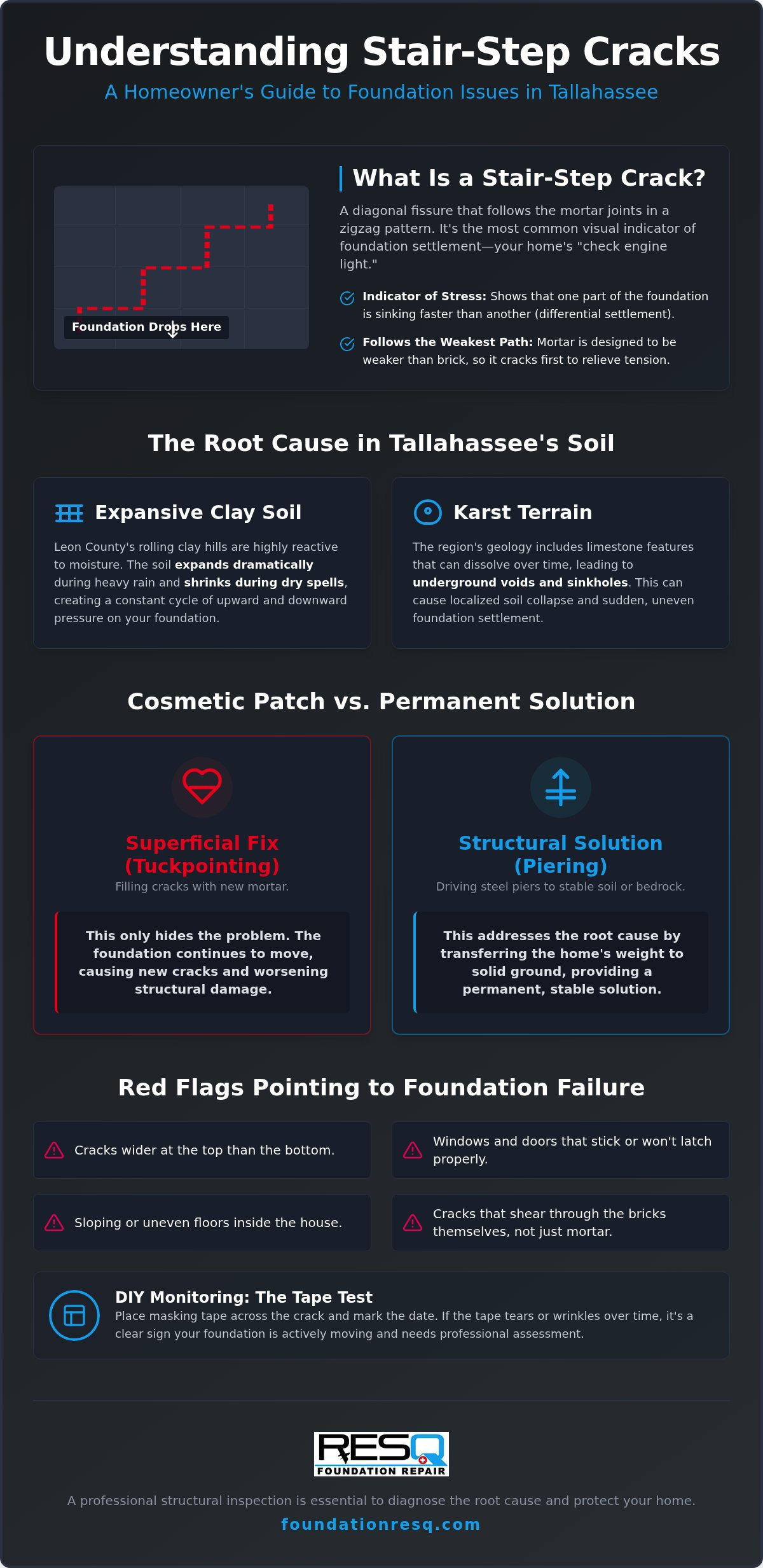
Stair-step cracks are diagonal fissures that follow the horizontal and vertical mortar joints between bricks, creating a zigzag pattern that resembles a set of stairs. While they might look like a simple masonry flaw, these cracks are a physical manifestation of stress within the building’s envelope. In Tallahassee, these patterns often appear near the corners of a home or around window and door frames where the structure is most vulnerable to movement.
The physics behind this pattern is straightforward. Mortar is intentionally designed to be the “weakest link” in a brick wall. It acts as a sacrificial material that absorbs minor thermal expansion and contraction. However, when the force exerted on the wall exceeds the mortar’s flexible capacity, it shears apart. This is why the crack travels through the joints rather than through the bricks themselves. When you’re considering fixing stair-step cracks in brick walls Tallahassee homes often exhibit, it’s vital to recognize that the crack is merely a symptom of a deeper issue below the surface.
The Role of Tallahassee’s Soil and Climate
Leon County’s unique geology plays a significant role in how foundations behave. Our region is characterized by rolling clay hills and karst terrain, which creates a volatile environment for heavy masonry structures. The soil here is often a complex mix of sand and expansive clay. During the heavy rainfall seasons of 2026, this clay absorbs massive amounts of water and expands, putting upward pressure on the foundation. Conversely, during dry spells, the soil shrinks and leaves voids beneath the concrete slab or footings.
This constant cycle of expansion and contraction leads to erosion and fluctuating water tables. High hydrostatic pressure from saturated ground can push against foundation walls, while karst features like limestone cavities can lead to localized soil collapse. These environmental stressors make fixing stair-step cracks in brick walls Tallahassee a common necessity for maintaining structural integrity against the elements.
Anatomy of a Zigzag: Why Mortar Fails First
The zigzag pattern is distinct from horizontal or vertical cracks, which often indicate different types of pressure or material failure. A diagonal stair-step crack almost always points toward the area of the greatest movement. It signifies that one section of the foundation is no longer supported by the soil at the same level as the rest of the house. Because the brick veneer is rigid, it cannot bend to accommodate this uneven sinking.
Differential structural settlement is the root cause of 90% of stair-step cracks, occurring when one portion of a home’s foundation sinks faster or deeper than the surrounding areas. Instead of the bricks snapping, the mortar joints pull apart to relieve the tension, creating the characteristic stair-step visual that alerts homeowners to a failing support system beneath their feet.
Is It Just Cosmetic? Distinguishing Settlement from Aging
A common misconception among Tallahassee homeowners is that a simple tuckpointing job can resolve zigzagging fissures. Many believe that by filling the gap with new mortar, they’ve solved the problem. In reality, masonry patches only hide the symptoms while the structural failure continues to worsen beneath the surface. If you ignore these signs, you’re leaving your home vulnerable to water intrusion, mold growth, and pest entry. These secondary issues often cost more to remediate than the initial crack repair itself.
Understanding the difference between active and dormant cracks is crucial. A dormant crack may have occurred years ago due to initial settling and has since stopped moving. An active crack, however, is a living problem. It widens or lengthens as the seasons change, indicating that your foundation is still in motion. When you’re fixing stair-step cracks in brick walls Tallahassee properties often require more than a cosmetic fix to ensure the home remains a safe haven for your family.
Red Flags That Point to Foundation Failure
Not all cracks are created equal. One of the most significant red flags is a crack that’s wider at the top than at the bottom. This suggests that a portion of the foundation is dropping or “rotating” away from the main structure. You should also look for internal warning signs of a bad foundation. These include windows that are difficult to open, doors that no longer latch, or sloping floors. If the fissure actually shears through the physical brick rather than just the mortar joints, the structural stress has reached a critical level that demands immediate professional attention.
When It’s ‘Just’ Masonry (And Why You Still Shouldn’t Ignore It)
Occasionally, hairline cracks result from thermal expansion. Bricks expand when heated by the intense Florida sun and contract at night. While these might be “just” masonry issues, they shouldn’t be dismissed. Even small gaps allow moisture to seep behind the brick veneer and reach your Tallahassee crawl space. This trapped humidity creates an ideal environment for wood rot and mold. Much of this instability is driven by Florida’s problem soils, which lack the load-bearing capacity needed for heavy masonry without proper stabilization. Because the stakes are so high, having a professional eye confirm the origin of the movement is the only way to avoid costly mistakes. If you’re unsure about the severity of a new gap, requesting a structural evaluation can provide the clarity you need before the next heavy rain.
Assessing the Severity of Brick Cracks in Your Home
Once you’ve identified a zigzag pattern, the next step is determining how quickly the damage is progressing. Monitoring this movement provides the essential data needed for fixing stair-step cracks in brick walls Tallahassee residents often face after a particularly wet season. You can perform a simple “Tape Test” by placing a piece of heavy-duty masking tape across the widest part of the crack. Use a pen to mark the exact edges of the fissure on the tape. If the tape tears or the marks no longer align after a few weeks, the foundation is actively shifting and requires professional stabilization.
Mapping the location of these cracks is equally important for a proper diagnosis. Are they concentrated near a chimney or a specific corner of the house? These areas are structural hot spots where the weight of the masonry is greatest. If exterior cracks correlate with new diagonal tears in your interior drywall, the entire wall assembly is likely tilting or sinking. This internal-external connection is a clear sign that the issue has moved beyond the veneer and into the home’s skeleton. Keeping a log of where these cracks appear helps experts identify which section of the foundation is failing.
The Scale of Concern: Hairline to Structural Gap
A hairline crack, typically measuring under 1/16 of an inch, might only require observation. However, once a gap exceeds 1/4 of an inch, it’s classified as a structural failure. The location matters just as much as the width. Cracks appearing in the concrete foundation block beneath the brick are especially concerning. While brick is often a veneer, the block is the actual load-bearing component. A crack that travels from the brick down through the foundation indicates that the footings themselves have lost their grip on the soil.
Secondary Symptoms to Look For
Look beyond the wall for other signs of distress that confirm soil instability. Check for uneven concrete on nearby walkways or the driveway, as this confirms localized soil failure. You might also notice gaps forming between the brick veneer and window frames or door trim where the wall is pulling away. In some cases, the pressure from shifting soil causes the walls to lean or bulge. If you detect a slight curve in the wall’s profile, carbon fiber wall repair may be necessary to reinforce the structure. Combining these observations ensures a more accurate diagnosis for fixing stair-step cracks in brick walls Tallahassee properties require for long-term safety.
Professional Solutions: Fixing the Root Cause, Not Just the Crack
Permanent remediation is the only way to stop the cycle of recurring cracks in your masonry. If you simply patch the mortar, the next heavy rain in Leon County will likely reopen the gap as the foundation continues to shift. True structural health requires reaching past the unstable, expansive clay to find stable soil or bedrock. This approach ensures that the repair lasts for the life of the home rather than just a single season.
Think of professional piering systems as deep-seated stilts for your house. These systems transfer the massive weight of a brick home from the shifting surface soils down to competent load-bearing strata. The process of fixing stair-step cracks in brick walls Tallahassee residents rely on starts with this deep-soil stabilization. By bypassing the “active zone” of the soil, we create a permanent remedy that protects your home’s resale value and structural integrity. Our team uses specialized, compact hydraulic equipment designed to work in tight residential spaces without destroying your landscaping.
Helical Piers vs. Push Piers
Choosing the right pier depends on your home’s weight and the specific soil conditions on your property. For lighter structures or areas with high water tables, helical pier installation is often the preferred choice. These piers feature screw-like plates that are rotated into the ground until they reach a specific torque, indicating they’ve hit stable soil. In contrast, push piers use the existing weight of your home as a counter-force to drive high-strength steel tubes deep into the earth. Structural underpinning is the industry term for this essential stabilization process, and it must occur before any cosmetic masonry work begins.
The Restoration Process
A methodical approach is necessary to ensure the home is secure before the zigzagging cracks are addressed. The restoration typically follows these four professional steps:
- Step 1: Excavation and Bracket Attachment. Small sections of soil are removed around the foundation to attach heavy-duty steel brackets to the footings.
- Step 2: Driving Piers to Competent Soil. Piers are driven or screwed deep into the ground until they reach the required load-bearing capacity.
- Step 3: Controlled Stabilization. Using hydraulic jacks, the foundation is either stabilized to prevent further sinking or carefully lifted toward its original level.
- Step 4: Final Masonry Restoration. Once the structure is secure, the stair-step cracks are tuckpointed with fresh mortar to restore the home’s aesthetic appeal.
To determine which system is right for your property, you can schedule a free structural inspection with our Tallahassee-based experts today.
Why Tallahassee Homeowners Trust Foundation ResQ
Tallahassee’s geological landscape is diverse, and a one-size-fits-all approach doesn’t work here. Since 2013, our team has developed a deep understanding of the local soil variations that affect neighborhoods across Leon County. Whether you live in the historic sections of Midtown, the sprawling estates of Killearn, or the planned communities of Southwood, we’ve likely stabilized a home near yours. We combine this local specialized knowledge with extensive resources and a commitment to industry-leading warranties, giving you the best of both worlds: neighborly service and lasting peace of mind.
Our commitment to long-term results is what sets us apart from general contractors or masons. When homeowners focus on fixing stair-step cracks in brick walls Tallahassee experts know that the wall is just the messenger. We treat the underlying soil failure rather than just the visible fissure. By addressing the root cause, we ensure that the cracks don’t return after the next tropical storm or heavy rain cycle. This methodical, remedy-based framework is designed to protect your home’s structural health and your family’s safety.
The Foundation ResQ Difference
We use specialized equipment and engineered products that are specifically tested for the mix of sand and expansive clay found in North Florida. Our crews are trained to be methodical and thorough, treating every project with the weight it deserves. We also know that a foundation project can feel overwhelming, so we maintain a professional environment that respects your property. We work to stabilize your home while minimizing the impact on your landscaping, leaving your yard as tidy as we found it. This focus on durability and professional integrity ensures your home remains a stable sanctuary for decades.
Take the First Step Toward a Stable Home
Stop wondering if that zigzagging line is a sign of a major failure. A professional inspection is the essential first step in reclaiming your home’s stability. We’ll walk you through the diagnosis, explain the physics of the movement, and provide a clear plan for permanent repair. During the evaluation, we look at the entire structure to ensure we aren’t just treating a symptom. You deserve to feel confident in the ground beneath your feet and secure in the value of your property. Knowledge is the best defense against structural decay.
Schedule your free foundation inspection with Foundation ResQ today.
Secure Your Home’s Foundation for the Future
Identifying the zigzag pattern in your brickwork is the essential first step toward protecting your investment. While cosmetic patches might offer a temporary visual fix, they fail to address the shifting soils that cause the damage. True peace of mind comes from a remedy-based approach that stabilizes the foundation before you invest in masonry repair. When you are fixing stair-step cracks in brick walls Tallahassee properties require, you need a solution that reaches past the surface clay to find permanent, load-bearing support.
Since 2013, Foundation ResQ has provided Tallahassee homeowners with specialized piering and stabilization technology backed by Groundworks certified structural solutions. We understand the specific environmental challenges of Leon County and are committed to helping you maintain a safe, secure home for your family. Don’t let uncertainty about structural safety or resale value weigh on you any longer. Our team is ready to provide the professional guidance you need to move forward with confidence and clarity. Protect your home’s value, schedule a free structural inspection with Foundation ResQ.
Frequently Asked Questions
Are stair-step cracks in brick always a sign of foundation trouble?
Stair-step cracks are the most common indicator of foundation settlement, though they can occasionally result from thermal expansion. If the crack is wider than 1/16 of an inch or is widening over time, it’s likely a structural issue. A professional inspection is the only way to confirm if the movement is cosmetic or requires deep-soil stabilization to protect the home’s integrity.
How much does it cost to fix stair-step cracks in Tallahassee?
Industry data for Tallahassee shows foundation repair costs typically range from $2,300 to $8,200 in 2026. Minor crack injections might cost between $400 and $1,500, while piering systems range from $1,300 to $2,900 per pier. Your final investment depends on the number of piers required to reach stable soil and the total severity of the settlement affecting the structure.
Can I just use mortar to fill the cracks myself?
Filling cracks with mortar is a cosmetic fix that doesn’t address the root cause. If the foundation is still shifting, the new mortar will simply crack again within a few months. When you are fixing stair-step cracks in brick walls Tallahassee homes require a permanent solution. You must stabilize the structure first to ensure any masonry work actually lasts for the long term.
How long does professional foundation stabilization take?
Most residential stabilization projects are completed within one to three days. The timeline depends on the number of piers needed and the depth of the load-bearing soil on your property. Our crews work efficiently to minimize disruption to your daily life. Once the piers are installed and the foundation is secure, the final masonry restoration can usually be finished shortly after.
Will fixing the foundation also close the cracks in the brick?
Stabilization prevents the crack from getting worse, and controlled lifting can often close the gap significantly. However, you shouldn’t expect the bricks to knit back together perfectly on their own. After the home is secure, a mason will need to perform tuckpointing to fill the remaining void. This ensures the wall is watertight and restores the home’s original aesthetic appeal and value.
Does insurance cover foundation repair for stair-step cracks?
Most standard Florida homeowners insurance policies don’t cover repairs for settlement or earth movement. Coverage is typically limited to sudden, accidental damage like a burst pipe. You should review your specific policy for sinkhole riders or catastrophic ground collapse coverage. Since these repairs are often considered maintenance, it’s important to address them before they lead to more expensive secondary damage.
What happens if I ignore stair-step cracks for another year?
Ignoring these fissures allows them to widen, which invites water intrusion, mold growth, and pest infestations. Over time, the structural integrity of the wall continues to degrade, making the eventual repair more complex and expensive. Delaying the fix also negatively impacts your home’s resale value; most buyers are wary of visible structural distress and will demand significant price concessions.
How do I know if my Tallahassee home needs helical piers or push piers?
The choice between helical and push piers depends on the weight of your home and the depth of Tallahassee’s stable soil layers. Helical piers are often better for lighter structures or areas with high water tables. Push piers are generally used for heavier masonry homes to reach deeper, more competent strata. A structural evaluation is necessary to determine the most effective remedy for your property.