
What if that sloping kitchen floor isn’t just the “character” of an old Tallahassee home, but a warning sign that your crawl space is losing its fight against North Florida’s humidity? You’ve likely noticed the signs: a door that won’t quite latch, a growing gap beneath your baseboards, or a bounce in your step that shouldn’t be there. It’s frustrating to feel your home’s value and stability literally sinking. It’s natural to wonder if these issues are just part of owning a historic property, but ignoring them often leads to more costly repairs. This guide will show you why uneven floors are rarely just about age and how professional floor leveling companies Tallahassee can restore your home’s structural integrity for good.
We understand that your home is your most significant investment. We will explore common causes like wood rot and foundation shifts, the impact of the 8th Edition Florida Building Code on repairs, and the permanent stabilization methods used to keep your floor level and safe. You’ll learn how to distinguish between normal settling and structural failure, giving you the peace of mind that comes with a stable, solid foundation. By addressing these concerns now, you can prevent further sinking and ensure your home remains a safe haven for years to come.
Key Takeaways
- Identify the critical difference between a foundation slant and a structural sag to target the root cause of your uneven floors.
- Explore how Tallahassee’s unique Red Hills soil and crawl space moisture interact to weaken the footers of homes built between 1920 and 1950.
- Learn why professional floor leveling companies Tallahassee focus on permanent structural stabilization rather than just masking issues with cosmetic compounds.
- Follow a practical, two-step inspection checklist to assess slope severity and map interior symptoms like wall cracks or misaligned doors.
- Discover the methodical approach to restoring structural health by stabilizing the foundation first before addressing environmental moisture.
Understanding Uneven Floors in Tallahassees Historic Homes
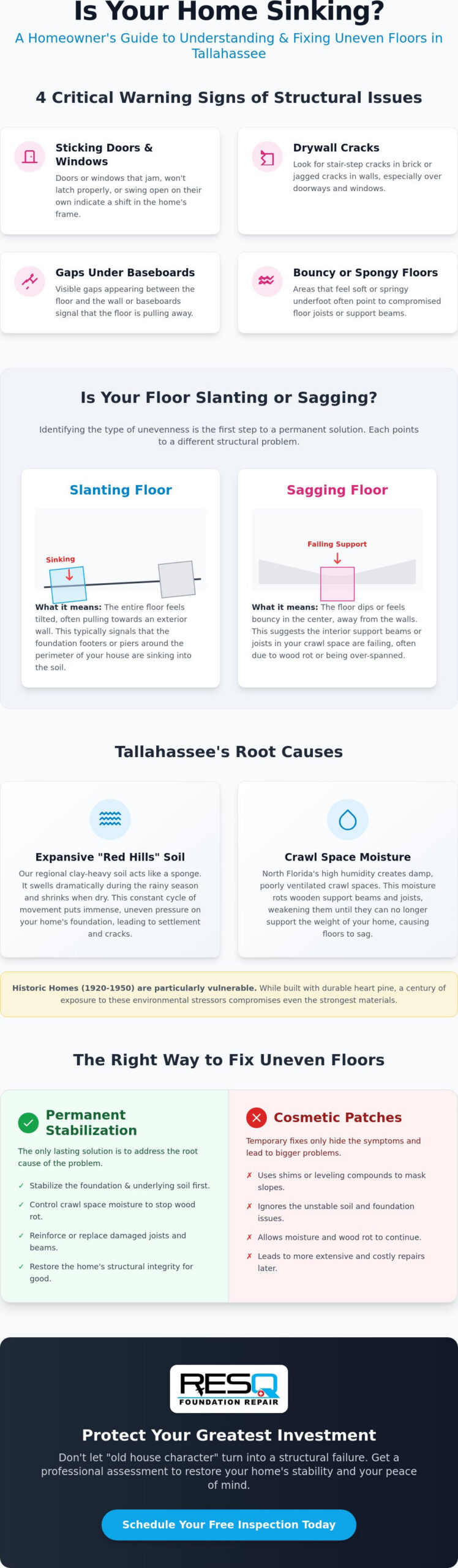
Many homeowners in neighborhoods like Los Robles or Levy Park view a slight tilt in the floor as a charming quirk of an older property. This “old house character” often masks underlying structural issues that worsen over time. Delaying maintenance can lead to expensive repairs that go far beyond simple floor leveling. Recognizing the difference between a minor cosmetic issue and a structural threat is the first step toward protecting your home’s value. If you notice any of the following red flags, it’s time to look closer at what’s happening beneath your feet.
- Sticking Doors: Doors that suddenly rub against the frame or swing open on their own.
- Baseboard Gaps: Visible separations between the bottom of the baseboard and the floor surface.
- Drywall Cracks: Hairline or stair-step cracks appearing in walls, especially above door headers or windows.
- Bouncy Spots: Areas in high-traffic hallways that feel soft or springy when you walk over them.
Slanting Floors vs. Sagging Floors
If your floor feels like it’s pulling you toward the exterior walls, you’re likely dealing with a slant. This usually indicates that the foundation piers or footings under the perimeter of the house are sinking into the soil. In contrast, a “sag” or a central dip suggests that the interior support beams or floor joists are failing or over-spanned. Understanding Uneven Floors requires looking at the soil beneath your home and how it shifts seasonally. Differential settlement is the primary cause of slanting in Tallahassee homes. When the ground moves unevenly, it places immense stress on the rigid structure above, leading to the slopes you feel underfoot. Identifying whether the issue is at the perimeter or in the center of the home helps floor leveling companies Tallahassee determine the most effective stabilization method.
Why Tallahassee History and Architecture Matter
Tallahassee’s residential expansion between 1920 and 1950 relied heavily on Florida Vernacular styles. These homes were typically built on pier-and-beam foundations to allow airflow in our subtropical climate. While the heart pine used in these structures is incredibly durable, it isn’t invincible. A century of North Florida humidity and frequent rain cycles can eventually compromise even the strongest timber. When wood remains damp in a poorly ventilated crawl space, it loses its structural capacity to hold the weight of the home. Modern furniture and heavy appliances add weight that these historic joists weren’t originally designed to carry. This is why many residents search for floor leveling companies Tallahassee to address the unique intersection of historic building materials and local environmental stressors. Professional restoration ensures that the “character” of your home doesn’t come at the cost of its structural safety.
The Root Causes: Red Hills Soil and Crawl Space Moisture
Tallahassee is famous for its rolling hills and canopy roads, but the very geography that makes our city beautiful often creates significant challenges for homeowners. The ground beneath your home isn’t a static platform. It’s a dynamic environment that reacts to every seasonal weather shift. When you notice your floors beginning to dip or pull away from the walls, the problem rarely starts with the floorboards themselves. Instead, the issue is typically rooted in the interaction between our unique local geology and the persistent humidity of the Florida Panhandle. Understanding these environmental forces is essential before contacting floor leveling companies Tallahassee for a permanent fix.
Tallahassee Soil and Foundation Movement
The Red Hills region is characterized by clay-heavy soils that are notoriously “expansive.” This means the soil acts like a sponge; it swells significantly when saturated during the Florida rainy season and shrinks during our dry spells. This constant cycle of expansion and contraction exerts immense pressure on historic footings. The Root Causes: Red Hills Soil are often found in this geotechnical instability, which leads to differential settlement. As the soil shifts, it can cause the piers under your home to tilt or sink unevenly. When this happens, the entire frame of the house moves with the foundation. To stop this movement, many homeowners require professional foundation repair in Tallahassee to stabilize the structure before any floor leveling can be successful.
Hydrostatic pressure also plays a major role. During heavy downpours, water pools against the foundation, pushing against the masonry and weakening the ground that supports your home’s weight. Over decades, this pressure can cause even the sturdiest historic footings to fail, leading to the sloping floors many residents experience.
The Humidity Factor: Wood Rot and Mold
While soil movement affects the foundation, crawl space moisture attacks the wooden skeleton of your home. Most older Tallahassee houses were built with open crawl spaces intended to provide ventilation. However, our high humidity levels mean that the air under your home is often saturated with moisture. This damp air enters the crawl space and condenses on cooler wooden joists and subflooring. Over time, this constant moisture leads to wood rot, which softens the timber and causes it to compress or sag under the weight of the house.
This environment is also a breeding ground for fungi. If your floors feel spongy or you notice a musty odor, you likely need professional mold remediation in Tallahassee to restore a healthy living environment. Mold doesn’t just impact air quality; it actively accelerates the breakdown of organic materials like floor joists. Because these issues are so deeply linked, the most effective floor leveling companies Tallahassee will always inspect the crawl space for moisture and rot before recommending a structural remedy. If you’re concerned about the air quality or stability of your crawl space, a comprehensive encapsulation can provide a permanent barrier against these elements.
Professional Solutions vs. Cosmetic Fixes for Sloping Floors
Pouring a self-leveling compound over a dipping floor often creates more problems than it solves. While these products are excellent for smoothing out minor surface imperfections before installing new tile or hardwood, they’re frequently used as a “band-aid” to hide structural failure. When a floor is slanting or sagging, the issue is almost always occurring in the foundation or the crawl space. Masking these symptoms with layers of heavy cement doesn’t stop the underlying movement. It merely hides the danger while the structural integrity of your home continues to decline.
The Dangers of Hiding the Problem
Adding a leveling compound to a sinking floor introduces a significant amount of “dead load” weight to an already compromised system. If your foundation is struggling because of the expansive clays found in Florida’s problem soils, adding hundreds of pounds of extra weight can actually accelerate the rate of settlement. This cosmetic approach fails to address active wood rot or the seasonal soil shifts we discussed previously. Eventually, the floor will begin to slope again, often cracking the new leveling material and the expensive flooring placed on top of it. Experienced floor leveling companies Tallahassee prioritize identifying the root cause before any surface work begins to ensure the repair is permanent.
Another common but often insufficient fix is “sistering” floor joists. This involves bolting a new piece of lumber alongside a damaged or sagging one. While this can strengthen a localized area of wood rot, it doesn’t solve the problem if the entire support system is sinking. In historic homes, sistering often fails to provide a level surface because it doesn’t actually lift the floor back to its original position. It simply reinforces a floor that’s already out of alignment.
Structural Stabilization Methods
True restoration requires lifting the home back to its intended level and securing it against future movement. For exterior walls that have slanted due to foundation settlement, helical pier installation is the professional standard. These steel piers are screwed deep into the earth, bypassing unstable topsoil to reach competent load-bearing strata. Once installed, they provide a stable platform that allows the foundation to be lifted and permanently supported.
For sagging interior floors, adjustable steel crawl space jacks offer a far superior solution to old-fashioned wooden posts or concrete blocks. These jacks are installed on a solid base and can be precisely adjusted to slowly move the floor back to a level plane. Unlike wood, they won’t rot or compress over time. By combining these structural methods, floor leveling companies Tallahassee can provide a comprehensive remedy that protects your home’s value and ensures your floors remain stable for decades to come.
How to Assess Your Floor Damage: A Tallahassee Inspection Checklist
Performing a preliminary assessment of your home’s floors doesn’t require specialized engineering tools. You can gather valuable data with common household items to help floor leveling companies Tallahassee understand the scope of your needs. This checklist provides a methodical way to document the physical symptoms of structural movement before a professional arrives. Identifying the severity of movement early can prevent minor settling from becoming a total structural failure.
- Step 1: The Marble Test and Level Check. Place a marble on the floor in several rooms. If it rolls quickly toward an exterior wall, you’ve identified the direction of the slope. Use a 4-foot level to measure the severity; a drop of more than an inch over a ten-foot span is a sign of significant concern.
- Step 2: Interior Symptom Mapping. Walk through your home and look for cracks in the drywall, especially those radiating from the corners of door frames or windows. Check if doors that used to close smoothly now stick or have uneven gaps at the top of the frame.
- Step 3: The Crawl Space Visual. If you can safely access the crawl space, look for standing water, damp soil, or signs of previous flooding. Observe the piers and beams for any evidence of “shimming,” which indicates a history of amateur repairs.
- Step 4: The Screwdriver Test. Take a flathead screwdriver and gently probe the floor joists and the sill plate. If the tool sinks into the wood with little resistance, you’ve confirmed active wood rot that requires immediate professional attention.
- Step 5: Professional Evaluation. While a homeowner can spot the symptoms, only a structural specialist can diagnose the root cause. A professional will use high-precision levels and moisture meters to provide a final verdict and a permanent remedy plan.
Signs of “Shimming” and Amateur Repairs
Shims are thin wedges of wood or metal used to fill gaps between a support pier and the floor beam. In Tallahassee’s humid environment, wood shims are a temporary fix at best. They eventually compress, rot, or shift, causing the floor to sink again. If you see stacks of scrap wood or shingles stuffed into your foundation system, it’s a clear sign that previous owners tried to mask a structural issue rather than solving it. These amateur repairs lack the durability needed to keep a home stable over the long term.
When to Call a Foundation Specialist
A general rule of thumb used by industry professionals is that any slope exceeding 1 inch every 10 feet indicates a structural failure rather than minor settling. This is the moment where DIY solutions must stop. If you have an attached garage or patio slab that is sinking independently of your main floor system, you should also look for concrete leveling in Tallahassee to address those specific areas using PolyRenewal injection. Addressing these issues now protects your home’s resale value and structural integrity. Schedule a professional structural inspection to receive a clear, methodical plan for restoring your home’s stability.
Permanent Structural Stabilization with Foundation ResQ
Foundation ResQ serves the community as a Steadfast Local Expert, bringing a disciplined approach to the complex geological and structural challenges found in North Florida. While many floor leveling companies Tallahassee might offer a quick fix for a sloping floor, we focus on a comprehensive remedy that addresses both the foundation and the environment surrounding it. Our methodology prioritizes permanent stabilization, ensuring your home remains a safe and stable structure for the next generation. We don’t believe in temporary patches; we believe in protecting the physical health of your building through methodical, engineering-based solutions.
We operate on a “stabilize-first” principle. Before any floor can be truly leveled, the foundation must be secured against the shifting Red Hills soil we discussed in previous sections. Once the building’s skeleton is protected, we move to eliminate the environmental stressors that cause wood rot and structural softening. A critical component of this defense is crawl space encapsulation, which creates a permanent barrier against ground moisture and humidity. By sealing the crawl space and managing the air quality with professional dehumidifiers, we stop the decay of floor joists and sills that leads to sagging. If your home also shows signs of foundation wall movement, we utilize carbon fiber wall reinforcement to provide high-tensile strength and prevent further bowing.
The Foundation ResQ Process
Our team designs custom-engineered solutions tailored to the specific needs of your property. We utilize helical piers and push piers to bypass unstable soil layers and transfer the weight of your home to competent load-bearing strata. This process allows us to carefully lift the foundation and restore structural integrity without the need for a total floor replacement. It’s a methodical, precise operation that treats the root cause of the failure rather than just the symptoms visible in your living room. This approach minimizes disruption to your daily life while providing a level of stability that cosmetic fixes simply cannot match.
Protecting Your Investment Long-Term
The long-term return on investment for structural repair far outweighs the mounting costs of neglect. An unaddressed sloping floor is more than a nuisance; it’s a liability that can significantly decrease your home’s resale value and lead to catastrophic failure. By choosing one of the premier floor leveling companies Tallahassee, you’re investing in the permanence and safety of your property. We provide the technical precision and local knowledge required to protect your home from the elements and the earth beneath it. Schedule a free structural inspection with Foundation ResQ today to take the first step toward a stable, level, and secure home.
Secure Your Tallahassee Home’s Future Stability
Restoring a level floor in a historic Tallahassee home requires more than just masking the symptoms. You’ve learned that the interaction between Red Hills soil and crawl space humidity creates unique structural challenges that cosmetic fixes simply can’t solve. By distinguishing between a foundation slant and a structural sag, you can target the root cause and ensure your home remains safe for years to come. While many floor leveling companies Tallahassee offer quick surface solutions, permanent restoration relies on engineering-based methods like Helical Piers and PolyRenewal concrete lifting.
Foundation ResQ specializes in the specific climate and geological conditions of North Florida. We provide the technical precision and local expertise needed to protect your most significant investment from the ground up. Don’t let structural uncertainty linger while wood rot or soil movement continues to progress. Get a Free Structural Inspection for Your Tallahassee Home and gain the peace of mind that comes with a stable, secure foundation. Your home deserves a permanent remedy that stands the test of time.
Frequently Asked Questions
Is it normal for a 100-year-old house to have uneven floors?
While minor settling is expected in historic properties, significant slopes or sags aren’t a normal part of a home’s aging process. These issues usually signal that the foundation or the floor joist system is failing due to soil movement or moisture. In Tallahassee, the combination of aged timber and humid crawl spaces makes historic homes particularly vulnerable to structural shifts that require professional attention to stop further decline.
How much does it cost to fix uneven floors in an old house?
The cost to repair uneven floors depends entirely on the root cause, such as localized wood rot or deep foundation failure. Factors like the number of helical piers required, the extent of joist replacement, and whether crawl space encapsulation is needed all influence the final investment. Because every historic home has a unique structural footprint, reputable floor leveling companies Tallahassee provide a detailed inspection to determine the specific scope of work required.
Can I fix a sagging floor myself by adding more jacks?
Attempting to fix a sagging floor yourself with temporary jacks often leads to further structural damage or personal injury. DIY jacks are frequently placed on unstable soil or thin concrete pads that can’t support the home’s weight, causing the floor to sink even further. Professional stabilization requires custom-engineered steel jacks installed on deep, stable footings to ensure the lift is controlled, safe, and permanent.
Will fixing my foundation also level my floors?
Foundation stabilization is the essential first step toward leveling your floors, but it may not always return them to a perfectly flat plane immediately. Stabilizing the perimeter with piers stops the sinking, while interior adjustable jacks are used to slowly lift the floor frame back into place. This methodical approach ensures that the house is supported from the bottom up before any cosmetic floor leveling is performed.
How do I know if my uneven floors are caused by mold or wood rot?
Soft or springy spots in high-traffic areas are common indicators that moisture has compromised your floor joists. If you notice a persistent musty odor or see visible fungal growth on the wooden beams in your crawl space, mold is likely accelerating the structural softening. When you consult with floor leveling companies Tallahassee, they will inspect the wood density and moisture levels to confirm if rot is the primary cause of the sag.
Does homeowners insurance cover fixing uneven floors in Tallahassee?
Standard homeowners insurance policies typically don’t cover floor leveling or foundation repairs caused by gradual settling, wood rot, or environmental humidity. Insurance is generally designed to cover sudden and accidental events, such as a burst pipe or a fallen tree. It’s best to review your specific policy details, but most structural maintenance and stabilization are considered the responsibility of the property owner.
What is “floor shimming” and is it a permanent fix?
Floor shimming involves inserting thin wedges of wood or metal between a support pier and a floor beam to fill a visible gap. While this might temporarily stop a floor from rattling, it isn’t a permanent structural fix. In Tallahassee’s humid climate, wood shims can rot or compress under the home’s weight, leading to the return of the original slope. Permanent solutions require addressing the pier’s stability rather than just filling the gap.
Can uneven floors lead to a house collapse?
While a total house collapse is rare, uneven floors signal that your home’s structural integrity is significantly compromised. Over time, failing supports can lead to severe interior damage, including ruptured plumbing lines and electrical issues. Ignoring these warning signs allows the damage to spread to the walls and roofline, eventually making the home unsafe for occupancy. Addressing these symptoms early protects your safety and the home’s long-term value.