
Thinking an “As-Is” contract shields you from disclosing a cracked foundation is a mistake that could cost you your entire home equity in a post-closing lawsuit. Florida law is clear that sellers must reveal any known structural issues that materially affect a property’s value, regardless of the contract type. Selling a home is already a complex process. It’s natural to worry that being honest about past settling or stabilization work will cause a buyer to walk away or demand a lower price.
You deserve a smooth transition to your next home without the looming threat of legal disputes. By understanding the foundation repair disclosure laws Florida homeowners must follow in 2026, you can turn a potential liability into a verified asset. This guide breaks down the essential legal standards, from the landmark Johnson v. Davis ruling to the new 2025 inspection requirements for structural integrity. We’ll show you how professional remediation and clear documentation protect your financial interests and provide peace of mind for everyone at the closing table.
Key Takeaways
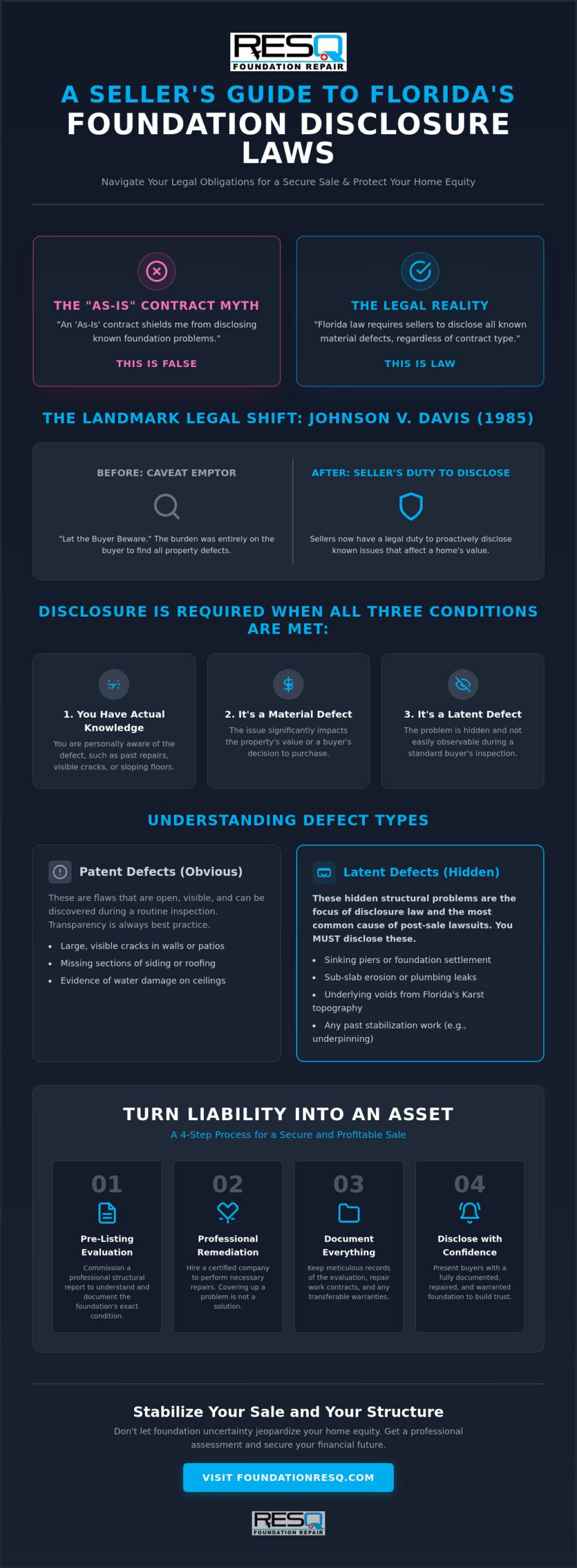
- Understand the legal shift from “buyer beware” to your responsibility as a seller to disclose known structural issues under the landmark Johnson v. Davis standard.
- Learn what qualifies as a material defect under foundation repair disclosure laws Florida, especially concerning settlement issues common in the state’s Karst topography.
- Debunk the misconception that an “As-Is” contract exempts you from disclosing foundation problems and understand your specific obligations under FAR/BAR agreements.
- Discover why a pre-listing structural evaluation is a critical step in protecting your property value and avoiding post-closing litigation.
- See how professional remediation and transferable warranties can transform a structural concern into a powerful negotiation tool that secures your home equity.
Understanding the Johnson v. Davis Standard in Florida
The legal landscape for selling a home in Florida shifted permanently in 1985 following the landmark Supreme Court ruling in Johnson v. Davis. Prior to this case, the state operated under the principle of Caveat emptor, which essentially meant “let the buyer beware.” Under that old standard, the burden of discovery rested almost entirely on the buyer’s shoulders. If a buyer failed to spot a flaw or ask the right questions, the seller often escaped liability for failing to mention it.
The Johnson v. Davis decision replaced that outdated approach with a clear duty for sellers to be proactive. It established that when a seller knows of facts materially affecting the value of a property which are not readily observable and are not known to the buyer, the seller is under a duty to disclose them. This applies even if the buyer never asks about the condition of the home. Under current foundation repair disclosure laws Florida, your obligation is defined by three criteria: you must have actual knowledge of the issue, the issue must significantly impact the property’s value, and the defect must be one that a typical buyer wouldn’t find through a basic inspection.
The Duty to Disclose Material Facts
A “material fact” in residential real estate is any information that would reasonably influence a buyer’s decision to purchase or the price they’re willing to pay. Foundation integrity is perhaps the most significant material fact a home can have. A stable foundation is the core of a building’s safety and longevity. Because structural issues can lead to high repair costs or even render a home uninsurable, they’re always considered material.
The legal standard hinges on “actual knowledge.” You aren’t expected to be a structural engineer with x-ray vision. If a deep-seated geological void exists 50 feet below your home and you have no way of knowing it’s there, you aren’t liable for failing to disclose it. However, if you’ve noticed recurring cracks in your drywall or floors that have begun to slope, you possess knowledge of potential defects. Attempting to hide these signs doesn’t just put the sale at risk; it opens the door for significant legal trouble after the keys change hands.
Latent vs. Patent Defects
Understanding the difference between patent and latent defects helps clarify your disclosure responsibilities. Patent defects are those that are open and obvious to any observer. A large, visible crack in a concrete patio or a missing section of siding is a patent defect. While it’s still best practice to be transparent, these issues are generally considered observable during a standard walk-through.
Latent defects are the hidden structural problems that a buyer cannot see, such as sinking piers, deteriorating organic matter in the soil, or sub-slab erosion. These hidden issues are the most common catalysts for post-sale lawsuits. Because a buyer cannot easily identify a latent foundation issue, the law places the responsibility on you to reveal what you know. Providing a history of past stabilization or structural remediation isn’t just a legal requirement; it’s a way to build trust and ensure the long-term health of the transaction.
Defining “Material Foundation Defects” for Florida Sellers
Identifying what constitutes a “material defect” is the first step in complying with foundation repair disclosure laws Florida. In our region, these defects are often tied to the unique Karst topography that defines the Florida Panhandle and Tallahassee area. This geological structure consists of porous limestone that can dissolve over time, creating underground voids. When the soil above these voids shifts, the foundation of a home can settle unevenly. This movement is a material fact because it compromises the structural integrity of the building and significantly impacts its market value.
A common question homeowners ask is whether they must disclose a problem that has already been repaired. If you have previously invested in stabilization, you are legally required to share that history with potential buyers. Transparency regarding past work, such as the installation of push piers or helical piers, provides a clear record of the home’s maintenance. Just as Florida Statutes § 689.261 mandates specific disclosures regarding property taxes to ensure buyer awareness, the disclosure of structural history ensures the buyer understands the long-term stability of their investment.
Structural Signs That Require Disclosure
Structural distress often leaves physical clues that a seller cannot ignore. Stair-step cracks in exterior brickwork or interior drywall fractures that reappear after being patched are primary indicators of foundation movement. If you have noticed your floors are no longer level or that doors are sticking in their frames, these are signs that must be documented. Reviewing a foundation repair Tallahassee history can help you identify which past signs were addressed and which might still be active. Bowing foundation walls are particularly critical; they indicate hydrostatic pressure from the surrounding soil is pushing against the structure, a condition that always requires professional remediation and full disclosure.
Crawl Space and Moisture Issues
Environmental hazards in the crawl space are just as material as a cracked slab. High humidity, standing water, and wood rot can weaken the floor joists and support beams that hold up your home. If these conditions have led to fungal growth, you must address the requirements for mold remediation Tallahassee FL before or during the sale process. Past flooding or recurring drainage failures are not just temporary inconveniences; they are ongoing threats to the home’s health that a buyer has a right to know about. Taking the time to secure a professional evaluation of your crawl space can help you identify these issues early, allowing you to present a stabilized, healthy home to the market.
The “As-Is” Contract Myth and Foundation Liability
Many Florida homeowners believe that selecting an “As-Is” contract on the standard FAR/BAR form absolves them of all liability once the closing is complete. This is a dangerous and costly misconception. While an “As-Is” agreement means the seller isn’t obligated to pay for or perform repairs, it doesn’t waive the fundamental duty to disclose known defects. According to foundation repair disclosure laws Florida, the seller remains legally bound to inform the buyer of any structural concerns that aren’t readily visible during a casual walkthrough. If you know your foundation is failing but choose to keep quiet, the “As-Is” clause will not protect you from a lawsuit if the buyer discovers the issue later.
The standard FAR/BAR “As-Is” contract actually includes specific language that reinforces the seller’s duty to disclose. It explicitly references the requirement to reveal any known facts that materially affect the value of the property. Ignoring this clause doesn’t just put the sale at risk; it creates a liability that can follow you for years after you’ve moved out of the home. Transparency is the only reliable way to ensure that “As-Is” truly means the end of your responsibility for the property.
Why “As-Is” Isn’t a Get-Out-of-Jail-Free Card
Florida courts consistently prioritize the safety and financial protection of buyers over the fine print of contract clauses. When a seller intentionally hides a foundation crack behind a fresh coat of paint or a strategically placed piece of furniture, they are engaging in what legal professionals call “silent fraud.” This active concealment is a serious breach of trust that can lead to significant legal consequences. Beyond just being forced to pay for the eventual repairs, a seller found guilty of intentional nondisclosure might face punitive damages. These are additional financial penalties intended to punish the wrongdoer rather than just compensate the victim for their structural losses.
The Role of the Home Inspection
Relying on a buyer to miss a structural issue is a high-stakes gamble that rarely pays off. Modern home inspections are incredibly thorough. Professional inspectors are trained to spot the subtle red flags of settlement, such as minor floor slopes or hairline fractures in the slab, that a homeowner might try to overlook. Once an inspector uncovers a latent defect, it immediately becomes a patent issue. This discovery often triggers a stressful renegotiation phase where the buyer gains all the leverage. They may demand a steep price reduction that far exceeds the actual cost of repair or choose to walk away from the deal entirely. It’s almost always more advantageous to disclose the issue upfront and provide documentation of a professional solution. This strategy maintains your credibility and prevents the sale from collapsing during the critical inspection period. Being transparent about the home’s history allows you to control the narrative and prove that the structure is now stable.
Best Practices for Disclosing and Remedying Structural Issues
Taking a proactive stance before your home hits the market is the most effective way to navigate foundation repair disclosure laws Florida homeowners face today. Instead of waiting for a buyer’s inspector to find a problem, conducting your own assessment allows you to control the narrative. This approach transforms a potential deal-breaker into a documented home improvement. When you identify and address issues early, you eliminate the uncertainty that often leads to collapsed contracts and post-closing litigation.
The Pre-Listing Disclosure Checklist
Before you list your property, walk through your home with a critical eye. Look for specific red flags that a professional inspector will undoubtedly flag. Use this checklist to evaluate your home’s current structural health:
- Examine exterior masonry for stair-step cracks or gaps in the brickwork.
- Check every interior door and window to ensure they open and close smoothly without sticking.
- Look for hairline fractures in drywall, particularly above door frames and in corners.
- Note any musty odors or dampness originating from the crawl space or basement.
If your home has a history of stabilization, gather all relevant paperwork. This includes receipts, engineering reports, and building permits for any previous helical pier installation. Being honest on the “Seller’s Property Disclosure” form isn’t just a legal requirement; it’s a strategy to build buyer confidence. Providing a complete file of past repairs proves you’ve been a responsible steward of the property.
Remediation vs. Price Reduction
Sellers often debate whether it’s better to lower the asking price or fix a structural issue before listing. In most real estate transactions, a “fixed” house is far more attractive than a “problem” house with a discount. Buyers typically overestimate the cost of foundation work and may walk away out of fear. When you perform the work yourself, you remove that fear from the equation. For example, investing in crawl space encapsulation Tallahassee doesn’t just resolve moisture issues; it improves indoor air quality and protects the wooden subfloor from rot, which are major selling points.
A professional repair also comes with a significant negotiation tool: the transferable warranty. Buyers prefer a home that includes a guarantee of future stability over a price reduction that leaves them with a potential liability. By presenting a home that has been professionally stabilized and warranted, you maintain your asking price and ensure a faster closing. To protect your equity and ensure your home meets all legal standards, request a professional structural evaluation before you list your property.
How Foundation ResQ Stabilizes Your Sale and Your Structure
Foundation ResQ acts as a definitive partner for homeowners who need to navigate the complexities of foundation repair disclosure laws Florida. We recognize that structural integrity isn’t just a construction concern; it’s a financial one. Our team provides the permanent remediation required to satisfy legal standards and buyer expectations. By using engineer-designed solutions, we help you transition from a state of uncertainty to one of verified stability. When you present a buyer with a home that has been professionally stabilized, you’re proving that the investment is protected for years to come.
The Transferable Warranty is perhaps the most significant asset we provide during a real estate transaction. Uncertainty is often what kills a deal during the inspection period. Our warranty stays with the structure itself, providing the next owner with immediate protection and long-term security. This documentation is also vital for satisfying the strict requirements of modern lenders and insurance providers who need proof of a home’s structural health before approving a mortgage. Having a clear record of professional stabilization ensures that the path to closing remains clear.
Professional Stabilization and Leveling
We utilize advanced technologies to resolve specific concerns that frequently appear on disclosure forms. If your property has settled unevenly, creating hazardous surfaces on driveways or walkways, we use concrete leveling Tallahassee via PolyRenewal to restore the surface. This high-density foam injection is a fast and permanent fix for trip hazards. For homes experiencing lateral pressure, carbon fiber wall repair Tallahassee offers a low-profile solution for bowing foundation walls. These carbon fiber straps are significantly stronger than steel and can be painted over, providing a remedy that’s both structurally superior and aesthetically discreet. Each solution is engineered to meet building codes and satisfy even the most thorough disclosure requirements.
Securing Your Real Estate Transaction
Foundation ResQ works closely with Tallahassee realtors and sellers to ensure that structural concerns are resolved before they become obstacles. Our remedy-based framework focuses on the ultimate resolution of the home’s health rather than just masking symptoms. We provide the technical precision and authoritative documentation needed to move a sale forward with confidence. By acting as a final line of defense for your property, we help you maintain your equity and avoid the pitfalls of post-sale litigation. Transparency, backed by professional stabilization, is the most effective way to protect your financial future. Protect your sale and your home; schedule a free foundation inspection today.
Secure Your Property Value and Future Peace of Mind
Navigating the complexities of foundation repair disclosure laws Florida homeowners face is the first step toward a successful and stress-free sale. By prioritizing transparency and addressing structural issues before they reach the inspection phase, you protect yourself from the risk of post-closing litigation and maintain the full value of your home equity. A proactive approach transforms a potential liability into a verified asset that provides confidence to any potential buyer.
Foundation ResQ offers the specialized Tallahassee soil expertise needed to provide permanent stabilization for your home. Backed by the Groundworks National Network, we deliver engineer-designed solutions that meet the highest industry standards. Our Transferable Lifetime Warranties ensure that the protection we provide stays with the property, creating a powerful incentive for buyers and lenders alike. You don’t have to let structural uncertainty derail your real estate transaction or jeopardize your financial security.
Get a Free Foundation Inspection and Protect Your Equity today. You can move forward with your sale knowing your home is stable and your legal obligations are fully met.
Frequently Asked Questions
Do I have to disclose a foundation crack if I patched it and it hasn’t returned?
Yes, you must disclose past cracks even if they have been patched and appear stable. A cosmetic repair doesn’t address the underlying structural cause, and failing to mention the history of the crack can be interpreted as concealing a material fact. Under foundation repair disclosure laws Florida, transparency regarding the home’s structural history is essential to protect yourself from future legal claims and ensure the buyer is fully informed.
Does Florida law require a specific foundation disclosure form?
Florida law does not mandate a specific state-wide disclosure form for foundation issues. However, most residential real estate transactions utilize the standard Florida Realtors property disclosure form, often referred to as the FAR/BAR form. This document provides a structured way to list known defects, including structural concerns, ensuring you meet your legal obligation to inform the buyer of facts that materially affect the property’s value.
What happens if a buyer discovers a foundation issue after the sale is final?
If a buyer discovers a latent defect that you knew about but failed to disclose, you may face a lawsuit for fraudulent nondisclosure. Florida courts can hold sellers liable for the total cost of repairs and, in some instances, punitive damages for active concealment. Being upfront about structural history is the only reliable way to ensure a clean break from the property and avoid the stress of post-closing litigation.
Are sinkhole disclosures different from general foundation disclosures in Florida?
Yes, Florida has specific statutory requirements for sinkhole disclosures that go beyond general structural rules. If a seller has made a sinkhole claim and received insurance proceeds, they must disclose in writing whether those funds were actually used to repair the damage. While general foundation issues fall under the broader Johnson v. Davis standard, sinkhole activity has its own set of strict reporting rules due to regional geological risks.
Can I sell my Florida home “As-Is” if it has known structural damage?
You can sell a home “As-Is” with structural damage, but the contract type doesn’t remove your legal duty to disclose. In Florida, an “As-Is” clause only means you aren’t required to perform or pay for repairs; it doesn’t give you permission to hide known defects. You must still inform the buyer of any foundation problems to remain compliant with state disclosure standards and protect your equity from future claims.
How does Tallahassee’s soil impact my disclosure requirements?
Tallahassee’s unique Karst topography, which consists of soluble limestone and underground voids, makes the region prone to foundation settlement. Because these geological conditions are a known local risk, any signs of shifting, such as sticking doors or wall fractures, are considered material facts. You are legally obligated to disclose these signs or any past stabilization work to ensure the buyer understands the environmental challenges associated with the property.
Is mold in a crawl space considered a material defect in Florida?
Will disclosing foundation repairs lower the value of my home?
While an unrepaired issue will certainly lower your home’s value, a professionally repaired foundation often maintains its market worth. Providing documentation of permanent stabilization, such as a transferable lifetime warranty, reassures buyers that the home is secure and safe. Transparency combined with a professional remedy prevents the steep price reductions that typically occur when structural problems are left unaddressed or discovered late in the sales process.