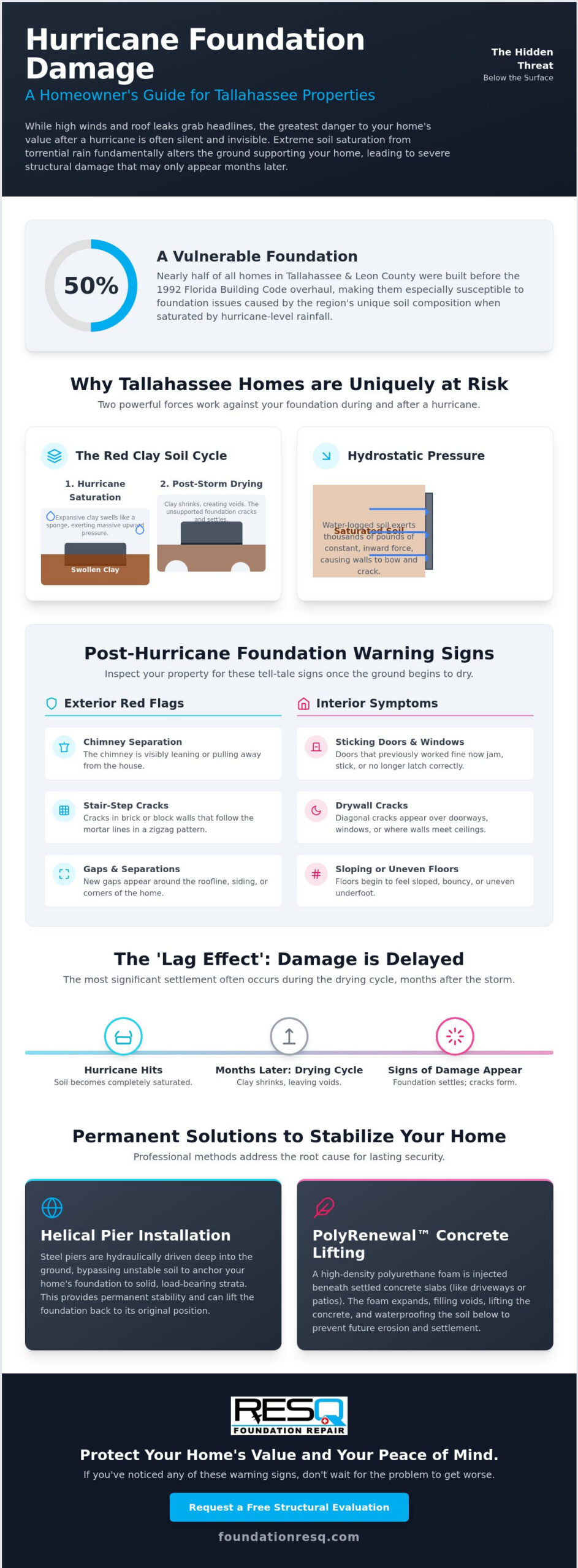
Did you know that nearly 50% of the properties in Tallahassee and Leon County were built before the major Florida Building Code overhaul of 1992? These older homes are especially vulnerable to a hidden threat that often stays invisible until months after the storm clouds clear. While most people focus on roof leaks, foundation damage after hurricane Tallahassee is frequently a ground-up problem caused by extreme soil saturation and shifting earth.
It’s natural to feel a sense of dread when you spot a new crack in your drywall or a door that no longer closes properly. You’re likely wondering if these are just signs of normal settling or if your home’s structural integrity is at risk. We understand the anxiety that comes with potential repair costs and the confusion over insurance coverage. This guide will help you move from uncertainty to action by showing you how to identify the specific warning signs of hurricane-related structural shifts and providing a clear path toward a permanent solution that protects your home value.
We’ll examine how our unique local geology reacts to hurricane-force rains, explain the 2026 building code requirements for Leon County, and preview the professional stabilization methods that keep your home secure for decades to come.
Key Takeaways
- Understand how Tallahassee’s unique red clay and hydrostatic pressure from heavy rains can compromise your home’s structural integrity.
- Learn to identify the subtle warning signs of foundation damage after hurricane Tallahassee, from sticking windows to new cracks in your home’s exterior.
- Discover why structural issues often remain hidden for months and how the post-storm drying cycle leads to significant foundation settlement.
- Explore permanent restoration methods like helical pier installation and PolyRenewal concrete lifting to stabilize your property against future weather events.
- Get actionable advice on improving drainage and gutter systems to protect your foundation from soil saturation during future hurricane seasons.
How Hurricane Soil Saturation Impacts Tallahassee Foundations
While news reports focus on wind-battered roofs and downed power lines, the most significant threat to local homes often lies hidden beneath the surface. Foundation damage after hurricane Tallahassee is frequently a consequence of extreme soil saturation rather than direct floodwater. Even if your property sits on a hill and never sees a drop of rising water, the sheer volume of rain delivered by a major storm can fundamentally alter the ground supporting your home’s weight.
The Role of Leon County Soil in Structural Shifts
Leon County is famous for its dense red clay. This soil is highly expansive, meaning it absorbs water like a sponge and increases in volume. When a hurricane drops 10 or more inches of rain in a short window, this clay swells significantly, exerting massive upward and inward pressure on your foundation. Conversely, as the ground eventually dries in the months following a storm, the clay shrinks. This shrinkage leaves dangerous voids that cause the structure to settle unevenly. This cycle is further complicated by our region’s karst topography. Heavy runoff can wash out the supporting soil under concrete slabs or trigger shifts in the underlying limestone, leading to sudden sinkage. When soil loses its load-bearing capacity due to saturation, your home’s weight is no longer distributed safely, making professional stabilization a necessity.
Hydrostatic Pressure: The Invisible Force
Hydrostatic pressure is the technical term for the weight and force exerted by water-saturated soil. During a major hurricane event, the ground surrounding your home becomes a heavy, liquid-like mass. This mass presses against your foundation walls with thousands of pounds of force. Unlike wind, which is intermittent, hydrostatic pressure is constant and relentless. It often results in bowing crawl space walls and distinct horizontal cracks. These aren’t just cosmetic issues; they are signs that the wall is failing under the external load. The danger is highest during rapid saturation events where the drainage systems cannot keep up with the rainfall. Recognizing this invisible force is the first step toward implementing a permanent structural remedy that acts as a protective barrier for your property. Understanding these geological factors helps you move from fear of the unknown to a clear plan for restoration.
Identifying Post-Hurricane Foundation Warning Signs
Most homeowners walk their property immediately after a storm to check for missing shingles or broken tree limbs. However, a structural inspection of the base of your home is equally vital. Foundation damage after hurricane Tallahassee often presents as subtle shifts that can easily be mistaken for seasonal changes. Catching these early prevents a small settlement issue from becoming a total structural failure. Because our local soil reacts so dramatically to moisture, you should conduct a thorough walkthrough once the ground begins to dry.
Use this checklist to identify potential issues:
- Stair-step cracks: Look for cracks in exterior brickwork that follow the mortar lines in a zigzag pattern.
- Chimney separation: Check if your chimney is pulling away from the main structure of the house.
- Door and window functionality: Note any sudden sticking or doors that no longer latch properly.
- Drywall fractures: Inspect the corners of interior door frames and windows for diagonal cracks.
- Floor changes: Feel for new slopes or “bouncy” areas in your flooring, especially over crawl spaces.
Exterior Red Flags in Your Brick and Siding
Look closely at the mortar between your bricks. If you see stair-step cracks climbing the wall, it’s a classic sign of foundation settlement. When heavy rains saturate the soil, the weight of the home causes one section to drop faster than the rest. You should also inspect your roofline and corners for new separations or gaps. One of the most reliable indicators of deep structural failure is a leaning chimney. Because chimneys are heavy and often sit on a separate footing, they’re frequently the first part of a home to show signs of soil failure after a storm. If you’ve noticed these symptoms, you can request a structural evaluation to confirm the stability of your home.
Interior Symptoms of a Shifting Foundation
Inside the home, your doors and windows act as sensors for structural health. If a door that used to swing freely now sticks or refuses to stay closed, the frame has likely moved out of square. This isn’t just a nuisance; it’s a symptom of the structure twisting or sinking. Look for diagonal cracks in the drywall specifically starting at the corners of door and window frames. In homes with crawl spaces, pay attention to the feel of your walk. Floors that feel bouncy or appear to slope toward one side indicate that the support piers beneath have shifted due to the saturated clay. These interior signs often appear alongside foundation damage after hurricane Tallahassee and require professional attention to prevent further deterioration.
The ‘Lag Effect’: Why Damage Appears Months After the Storm
Many homeowners breathe a sigh of relief once the immediate danger of a storm passes. They often assume that if the walls didn’t crack while the winds were howling, their property escaped without harm. This is a common misconception. Foundation damage after hurricane Tallahassee is frequently a delayed reaction known as the “lag effect.” Structural issues rarely manifest immediately; instead, they emerge during the long transition from saturated to dry ground. This period of transition can last for several months, making it easy for homeowners to miss the connection between the storm and new structural symptoms.
The Saturated Soil Drying Cycle
Tallahassee’s red clay is notorious for its ability to hold water due to its high density and fine particle size. During a hurricane, this clay swells to its maximum volume, creating immense pressure against your home. As the weeks pass and the moisture slowly evaporates, the clay undergoes a process of desiccation. This shrinkage is rarely uniform across your entire property. It creates large gaps, or voids, directly beneath your home’s footers where the soil has pulled away. Without the consistent support of the soil, the weight of the house causes it to settle into these newly formed empty spaces. The most severe settlement often happens 3-6 months post-storm as the soil reaches a critical state of dryness and loses its structural volume.
Weakened Structural Integrity
Repeated storm cycles act as a slow-motion wrecking ball for older foundations, especially since nearly 50% of Tallahassee properties were built before the 1992 building code overhaul. These structures often lack the reinforcement needed to handle modern storm intensity. A minor shift that occurred years ago might be pushed to a breaking point by the next heavy rainfall event. Small cracks are particularly dangerous because they allow future water intrusion to reach the interior of your foundation walls and the steel reinforcements within. This moisture further weakens the concrete and the soil it sits upon. Getting a professional foundation repair Tallahassee assessment after any named storm is a prudent step for any homeowner. It’s much easier to stabilize a minor shift now than to wait for a major failure that requires extensive underpinning and costly structural remediation. Proactive inspections provide the peace of mind that your home is ready to withstand the next Florida storm season without the risk of a sudden collapse or catastrophic shift.
Permanent Solutions for Hurricane-Related Damage
Addressing foundation damage after hurricane Tallahassee requires more than just filling cracks or cosmetic repairs. True structural recovery involves bypassing the unstable, saturated topsoil to reach load-bearing strata. We focus on engineered solutions that provide a permanent barrier against future environmental shifts. These professional methods ensure that your home remains level and secure, even when the next major storm event arrives.
Foundation Piering and Stabilization
When your home’s footers have settled into the voids left by drying clay, we use steel piering systems to restore stability. For many local properties, helical pier installation is the most effective choice. These piers are mechanically screwed deep into the earth until they reach stable soil layers that are unaffected by surface moisture. Alternatively, push piers utilize the weight of the building itself to drive steel sections into the ground. Unlike temporary “fixes” like concrete shimming, which can fail as the soil continues to shift, steel piers provide a permanent foundation that is independent of local soil fluctuations.
Concrete Lifting and Moisture Management
Heavy storm runoff often creates washouts under driveways, patios, and garage floors. We use PolyRenewal concrete lifting to restore these sunken slabs. This high-density foam is injected through small holes, where it expands to fill voids and lift the concrete back to its original position. This process is fast, waterproof, and far more durable than traditional mudjacking. However, the exterior is only half the battle. Because hurricane rains leave crawl spaces damp for months, crawl space encapsulation Tallahassee is a critical component of a holistic recovery plan. This system seals out moisture and prevents the growth of mold that often follows a saturated storm season.
For homes with foundation walls that have bowed inward due to hydrostatic pressure, we install carbon fiber wall reinforcement. These high-strength straps are bonded directly to the wall, providing a low-profile solution that stops further movement. To ensure your foundation stays dry year-round, we also integrate sump pumps and professional-grade dehumidifiers. These tools act as a final line of defense, managing groundwater before it can cause pressure to build up again. If you’re ready to secure your property, you can schedule a professional foundation inspection to determine which of these permanent remedies is right for your home.
Protecting Your Tallahassee Home for Future Seasons
Recovery from a major storm isn’t just about fixing what broke; it’s about making sure it doesn’t break again. While we’ve discussed the technical aspects of piering and stabilization, the ultimate goal for any homeowner should be a comprehensive structural health plan. Professional stabilization acts as a permanent safeguard, but maintaining the environment around your home is what ensures those repairs last for the life of the building. Acting now to reinforce your home’s defenses helps you avoid the inflated labor and material costs that often follow a declared disaster. Preventing foundation damage after hurricane Tallahassee is far more cost-effective than remediating a total structural collapse later.
Proactive Drainage and Grading
Grading your yard is your first line of defense. You want the soil to slope away from your foundation at a rate of at least six inches over the first ten feet. This simple change prevents water from pooling against your walls and creating the hydrostatic pressure that leads to bowing. Pair this with functional gutters and downspout extensions that discharge water at least five to ten feet away from the structure. These small adjustments significantly reduce the risk of soil washouts and the saturated clay shifts common in Leon County. When you control where the water goes, you control the stability of your soil.
The Value of a Professional Inspection
A Foundation ResQ structural evaluation is a methodical and thorough process. We examine both the interior and exterior of your property to identify hidden vulnerabilities that might not be obvious to the untrained eye. You’ll receive a detailed written report that documents the current state of your foundation and provides a clear path for any necessary remedies. This document is a powerful tool for insurance claims and provides essential transparency when you eventually decide to sell your home.
With the 9th Edition of the Florida Building Code scheduled to take effect in late 2026, ensuring your home meets modern resilience standards is a sound financial investment. A stable foundation is the bedrock of your home’s value and your family’s safety. Don’t wait for the next storm cycle to test your home’s integrity. Taking a proactive approach today ensures that your property remains a safe haven for years to come. Schedule your free foundation inspection with Foundation ResQ today.
Restoring Peace of Mind and Structural Stability
Protecting your home’s structural health after a major storm is a long-term commitment. We’ve explored how Tallahassee’s unique red clay and karst topography create a delayed “lag effect” that can lead to foundation damage after hurricane Tallahassee months after the initial impact. By recognizing early warning signs like sticking doors or stair-step cracks, you can address minor shifts before they escalate into costly failures. Permanent solutions are available to restore your home’s integrity and protect its long-term market value.
Foundation ResQ is locally owned and operated right here in Tallahassee. We specialize in professional helical and push pier installation, and our work is supported by Groundworks-backed lifetime warranties. We understand the specific geological challenges of North Florida and provide the steady, reliable guidance you need to move forward with confidence. Don’t let uncertainty about your home’s safety weigh on you. Request Your Free Post-Storm Foundation Inspection today to confirm your home’s status and find a permanent remedy. We’re ready to act as your final line of defense against the elements.
Frequently Asked Questions
Does homeowners insurance cover foundation damage from a hurricane?
Standard homeowners insurance policies often exclude “earth movement,” which many carriers use to categorize foundation shifts. However, if the structural damage is a direct result of a covered peril, such as a falling tree or catastrophic ground cover collapse, coverage might apply. You should review your specific policy to see if it includes endorsements for hydrostatic pressure or flood-related soil saturation.
How long do I have to file a claim for storm-related foundation issues?
In Florida, homeowners generally have one year from the date of the storm to file an initial property insurance claim. It is important to note that federal assistance deadlines often expire much earlier than state insurance windows. For example, the deadline to apply for certain federal disaster loans for physical damage from storms occurring in late 2025 was January 6, 2026.
Can heavy rain cause a foundation to sink even without flooding?
Yes, extreme rainfall is a leading cause of foundation damage after hurricane Tallahassee even if your home never sees standing water. The volume of rain saturates our local red clay, causing it to swell and exert pressure against your walls. As that soil eventually dries and shrinks, it leaves behind empty voids that cause the foundation to settle and sink unevenly.
What is the most common sign of foundation failure after a Florida storm?
The most reliable indicator is the appearance of stair-step cracks in your exterior brickwork or mortar joints. These zigzagging fractures signify that one portion of your home is sinking faster than the rest of the structure. You should also look for new gaps where the chimney meets the siding, as chimneys often show signs of soil failure first.
Is it safe to live in a house with hurricane-related foundation cracks?
Most small hairline cracks are not immediate safety threats, but they do require professional monitoring. If you notice bowing walls, sagging floors, or doors that won’t stay latched, the structural integrity of your home may be at risk. A professional evaluation can determine if the movement has stabilized or if active remediation is necessary to keep the building safe.
How much does it cost to repair a foundation after a hurricane in Tallahassee?
The total cost for structural restoration depends on the number of support piers required and the depth of the stable soil layers beneath your property. Factors such as the severity of the settlement and the specific stabilization method, like helical or push piers, will influence the project scope. A professional inspection is the only way to receive an accurate assessment for your home’s unique geological needs.
Can crawl space encapsulation prevent future storm damage?
While encapsulation doesn’t stop the ground from shifting, it acts as a critical barrier against the secondary effects of hurricane-level rains. By sealing the crawl space and installing a dehumidifier, you prevent the wood rot and mold growth that weaken your home’s support system during the long drying cycle. This keeps your structure’s “skeleton” strong enough to handle future weather events.
Why are my doors suddenly sticking after the recent hurricane rain?
Sticking doors are a classic symptom that your home’s frame has moved out of square due to foundation settlement. When the saturated clay soil beneath your footers shifts or shrinks, it causes the entire structure to twist slightly. This warping changes the shape of your door and window openings, preventing them from opening and closing as they should.
While specialists like Liberty Door Repair serve the Metro Atlanta area, their expertise in realigning doors highlights why fixing the foundation first is critical for a lasting repair.