
In Tallahassee, a building permit is far more than just a legal hurdle; it’s your property’s best defense against the unique challenges of our local red clay and limestone soils. Many homeowners worry that starting structural work will trigger a wave of fines or bureaucratic delays, especially with the 9th Edition of the Florida Building Code taking effect in late 2026. Understanding the specific foundation repair permit requirements Tallahassee mandates is the first step toward a stable home and total peace of mind.
It’s understandable to feel overwhelmed by the differing rules between the City of Tallahassee and Leon County. You want your home fixed correctly without the anxiety of unpermitted work hanging over your head. This guide will help you move forward with confidence by clarifying the $7,500 permit threshold and explaining how to verify your contractor’s history. We’ll also provide a clear roadmap of the 2026 inspection timeline so you know exactly what to expect from the first plan review to the final sign-off.
Key Takeaways
- Identify whether your property falls under City of Tallahassee or Leon County jurisdiction to ensure you use the correct permit portal and fee schedule.
- Understand how the $7,500 cost threshold and structural scope define the foundation repair permit requirements Tallahassee residents must meet to avoid double-fee penalties.
- Prepare for the 2026 Florida Building Code updates by ensuring your structural repairs include the specific engineering and soil analysis required for local red clay.
- Learn how to navigate the inspection process and verify your contractor’s permit history through the official online jurisdiction portals.
- Discover the peace of mind that comes from partnering with a local expert who manages the entire Growth Management Department coordination and permitting process for you.
Understanding Tallahassee’s Foundation Permit Landscape in 2026
Tallahassee homeowners often view the permitting process as a bureaucratic hurdle. However, the Tallahassee Growth Management Department views these regulations as a vital safety net for our community. Building codes exist to ensure that every structural modification protects the inhabitants and the surrounding property. In 2026, the foundation repair permit requirements Tallahassee enforces have become even more critical as the state transitions toward the 9th Edition of the Florida Building Code, which emphasizes structural resilience against extreme weather and shifting ground conditions.
It’s essential to distinguish between a simple cosmetic fix and a permitted structural repair. Patching a hairline crack in your drywall or applying a fresh coat of paint is a maintenance task. In contrast, installing helical piers or carbon fiber wall reinforcement is a structural intervention that alters the load-bearing capacity of your home. The 2026 regulations prioritize deep-foundation stabilization because North Florida’s unique geology demands more than a surface-level solution. A permit ensures that a licensed professional has reviewed the math behind your home’s stability.
Why Tallahassee Soil Requires Stringent Permitting
Tallahassee is famous for its rolling hills, but those hills are often composed of heavy red clay and hidden limestone pockets. This soil expands when wet and shrinks during our humid dry spells, creating a “yo-yo” effect that wreaks havoc on concrete footings. Because of these environmental variables, local officials require an engineered plan for any helical pier installation to ensure the piers reach stable load-bearing strata. Obtaining a permit for these repairs serves as a verified record of structural integrity that protects your home’s resale value during future real estate transactions.
Property investors who need to finance these types of critical structural improvements or close quickly on a new acquisition can visit JGL Capital LLC for fast, asset-backed private money loans.
The Legal Risks of Skipping the Permit Process
Cutting corners by skipping the permit process can lead to significant financial and legal headaches. If the City of Tallahassee or Leon County discovers unpermitted structural work, they can impose a penalty of two times the original permit fee plus enforcement costs. Beyond immediate fines, unpermitted work creates a “cloud” on your property title that can stall a sale for months. Many homeowners insurance providers will refuse to cover claims related to structural failures if the underlying repair work was never permitted. During a home sale, a savvy inspector will check permit histories; unpermitted work often forces the seller to pay for after-the-fact permitting, which is far more expensive and time-consuming than doing it right the first time.
When structural issues are ignored and lead to physical accidents, the legal consequences can be even more severe. For those seeking expert representation in such matters, Mission Focus Legal Group offers specialized support in personal injury and liability law, helping clients navigate the aftermath of safety-related incidents.
The $7,500 Rule vs. Structural Repair Requirements
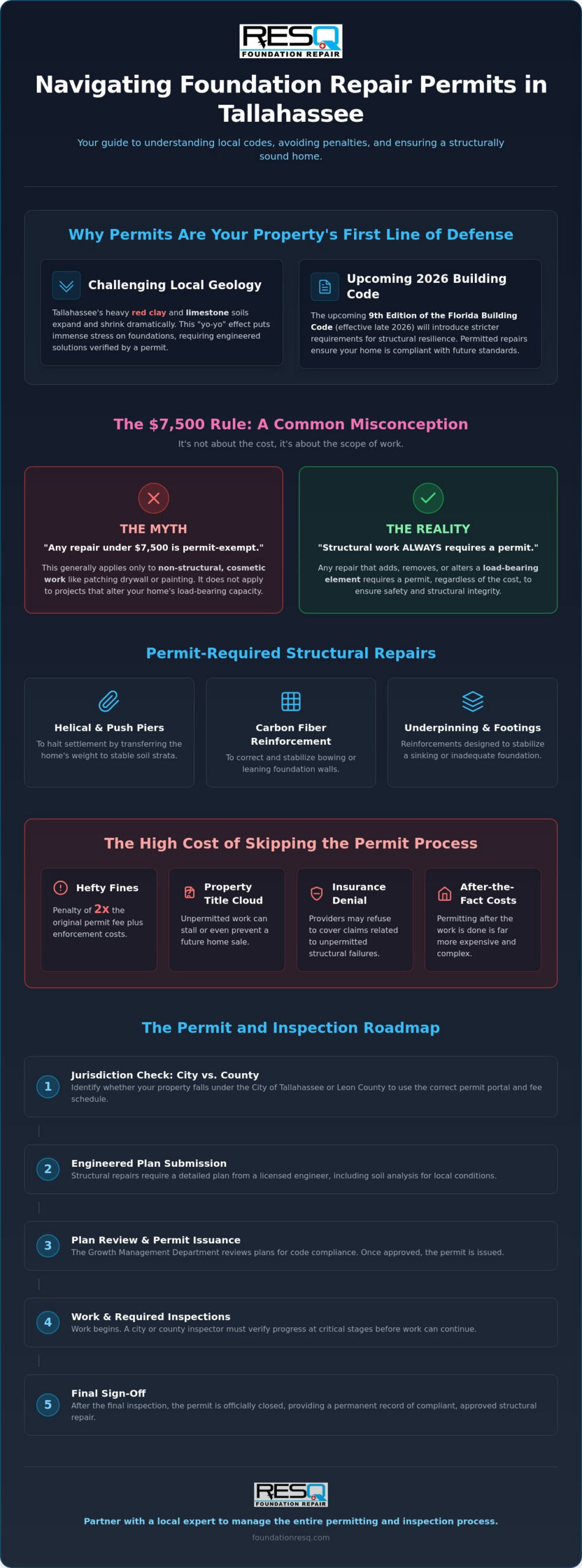
A common point of confusion for homeowners involves the $7,500 threshold mentioned in local building FAQs. You might think that if a repair costs $5,000, you’re in the clear. That isn’t always the case. Tallahassee’s Growth Management Department distinguishes between general maintenance and structural interventions. While general cosmetic work under $7,500 might not need a permit, any project that changes the structural integrity of your home requires official oversight regardless of the price tag. This dual-layered approach ensures that high-value projects and safety-critical repairs both receive proper inspection.
Understanding the foundation repair permit requirements Tallahassee enforces means looking at the scope of work rather than just the invoice. If you are adding, removing, or repairing a load-bearing element, the city requires a permit. This is why major stabilization projects don’t fall under the $7,500 exemption. The city needs to verify that the solution won’t negatively impact the rest of the structure or the local environment. For complex jobs, you may also see “sub-trade” permits. These are specific permits for specialized tasks like electrical work for a sump pump or plumbing adjustments that happen alongside the foundation fix.
Structural Foundation Repairs That Require a Permit
Structural foundation repairs involve components that keep your home upright and level. In 2026, the city remains strict about these specific tasks:
- Installation of helical piers or push piers to stop settlement and transfer weight to stable soil.
- Underpinning and footing reinforcements designed to stabilize a sinking foundation.
- Carbon fiber wall reinforcement used to correct bowing or leaning foundation walls.
These projects require an engineered plan because they are permanent alterations to the building’s skeleton. If you’re unsure where your project falls, it’s best to consult with a local foundation specialist who can review the scope of work.
Non-Structural Repairs: When You Might Not Need One
There are instances where a permit might not be required. If you’re sealing a minor hairline crack in a concrete walkway or performing cosmetic mortar repair on brick siding, you’re likely safe. These are considered maintenance tasks that don’t alter the home’s ability to support itself. However, once you cross that $7,500 mark for labor and materials, even non-structural projects trigger the need for a permit. It’s a protective measure that ensures large-scale renovations meet modern safety standards and zoning laws.
Jurisdiction Check: City of Tallahassee vs. Leon County
Before you can fulfill the foundation repair permit requirements Tallahassee residents face, you have to know which office holds the keys to your project. Living in Tallahassee doesn’t automatically mean you’re under city jurisdiction. Many neighborhoods, such as those in the northern reaches or the southern rural stretches, fall under Leon County’s authority. Using the Tallahassee/Leon County Jurisdiction Finder Map is the most reliable way to confirm your status. This digital tool allows you to enter your address and see a clear boundary line, preventing you from submitting paperwork to the wrong department and losing valuable time.
Your contractor’s licensing status is just as important as the property’s location. A professional must be registered with both the state of Florida and the specific local jurisdiction where the work occurs. When a contractor is already vetted and registered in the city or county system, the process of pulling a permit becomes much faster. This accountability ensures that the expert stabilizing your home is recognized by local building officials and held to the rigorous standards of the 2026 building codes.
City of Tallahassee Growth Management
If your property is within the urban core, you’ll work with the City of Tallahassee’s Growth Management department. Their online portal, tlcpermits.org, serves as the central hub for application submissions and inspection tracking. Urban properties, particularly those in historic districts like Myers Park or Los Robles, often face additional layers of review. These areas require repairs that preserve the home’s aesthetic character while ensuring structural safety. If you’re unsure about your specific zoning, calling the Growth Management department at 850-891-7001 provides a direct line to a specialist who can clarify your property’s needs.
Leon County DSEM (Unincorporated Areas)
For homeowners in unincorporated areas like Killearn, Woodville, or Chaires, the Leon County Department of Place & Economic Development (DSEM) handles the oversight. Leon County’s requirements often focus on environmental impact and land use considerations, especially if your home is near a sensitive watershed or a protected canopy road. Verifying your parcel’s jurisdiction before you request a quote helps your contractor provide a more accurate timeline for the permitting phase. DSEM ensures that structural repairs don’t just fix the building, but also align with the county’s broader environmental and development goals.
The Step-by-Step Permit and Inspection Process
Moving from the planning phase to actual construction requires a methodical approach. The foundation repair permit requirements Tallahassee enforces follow a specific sequence to ensure no detail is overlooked. It begins with a comprehensive soil analysis. Because our local geology is prone to shifting, a structural engineer must determine the exact depth needed for stabilization. Once the data is collected, your contractor compiles the technical drawings and submits them through the appropriate digital portal.
The foundation repair permit requirements Tallahassee residents must follow generally include these four milestones:
- Engineering and Soil Analysis: A structural engineer assesses the red clay conditions at your specific site to determine load requirements.
- Portal Submission: Technical drawings and load calculations are uploaded to the City or County permitting system.
- Plan Review: Local officials verify the plans against the 2026 Florida Building Code.
- Milestone Inspections: On-site checks happen during the repair to verify pier depth and torque before the project is closed.
The Plan Review phase is where local officials verify that the proposed solution aligns with safety standards. Thanks to Florida law HB 267, local governments must now process complete permit applications for single-family residential structures within 30 business days. This change has significantly reduced the waiting periods that used to stall home repairs. After the permit is issued, work can begin. On-site inspections occur at critical points to confirm the installation matches the approved engineering plans.
Working with a Structural Engineer
Tallahassee building officials require a “sealed” engineering plan for any structural modification. This seal is a professional guarantee that the repair is designed specifically for your home’s unique load requirements. During the installation of helical or push piers, the engineer or a qualified technician monitors the torque and depth to ensure the house is resting on competent soil. This level of precision is covered in detail in our Professional Foundation Repair in Tallahassee: A Guide for 2026. Having these documents on file is your best protection during future home inspections or property transfers.
Utilizing Tallahassee’s “Text-to-Inspect” Service
One of the most helpful modern conveniences in Leon County is the “Text-to-Inspect” service. This allows licensed contractors to schedule inspections via a simple text message, often securing a slot for the very next business day. Real-time digital updates mean you don’t have to wait weeks for a paper trail to catch up with the work being done. Digital portals and streamlined communication tools have shortened approval times in 2026, allowing homeowners to complete their structural remedies and return to their normal lives faster than ever before. If you’re ready to start this process with a team that handles every technical detail, request a structural evaluation today.
How Foundation ResQ Simplifies Structural Compliance
Foundation ResQ approaches every project with the mindset of a steadfast local expert. We understand that complying with the foundation repair permit requirements Tallahassee has established is a vital part of protecting your home’s structural integrity. Instead of leaving you to decode complex building codes or wait on hold with the Growth Management Department, our team manages the entire administrative process. We coordinate directly with structural engineers to create the sealed plans required for a successful permit application, ensuring your project begins on a foundation of legal and technical certainty.
Our team handles the heavy lifting of permit submission and follow-up. We ensure that every specialized remedy, such as carbon fiber wall repair, is fully documented and meets the stringent safety standards of the 2026 Florida Building Code. By acting as the primary point of contact for city and county officials, we prevent the communication gaps that often lead to project delays. We don’t just fix the physical problem; we provide a comprehensive service that shields you from the stress of regulatory compliance.
Beyond the actual repair, we prioritize long-term property health. Once the final inspection is signed off, we provide you with all the necessary post-repair documentation for your home’s permanent records. This documentation serves as a “clean bill of health” for your foundation. It’s an invaluable asset if you ever decide to sell your property or if you need to verify the work for your homeowners insurance provider. Meeting the foundation repair permit requirements Tallahassee enforces for 2026 is much simpler when you have a partner who treats your home with the same care as a neighbor would.
Why a Specialized Contractor Matters
A general builder might understand the basics of construction, but foundation stabilization is a highly technical field that requires specialized equipment and localized knowledge. Foundation ResQ’s long-standing relationship with local Tallahassee building inspectors means we know exactly what they look for during the “milestone” checks. We don’t just aim to pass an inspection; we aim to provide a permanent remedy that lasts for the life of the building. Our experts are trained to navigate the specific challenges of Tallahassee’s red clay, ensuring that every pier and reinforcement is installed to exceed local requirements.
Schedule Your Free Structural Evaluation
During our initial structural evaluation, we perform a thorough walkthrough of your property to identify the root cause of your foundation issues. We provide a clear explanation of the necessary repairs and a transparent breakdown of how the permitting process will unfold for your specific jurisdiction. We also take the time to explain the city or county permit fees so there are no surprises on your final invoice. Protect your Tallahassee home today with Foundation ResQ and gain the peace of mind that comes from professional, permitted structural restoration.
Securing Your Home’s Future with Professional Compliance
Navigating the permit process doesn’t have to be a source of anxiety. Understanding whether your property falls under City or County jurisdiction is the first step toward a successful project. While the $7,500 threshold exists for general work, any structural modification requires official oversight to protect your home’s long-term stability. By adhering to the foundation repair permit requirements Tallahassee enforces, you’re investing in both the legal and physical health of your building.
Foundation ResQ is proud to be locally owned and operated in Tallahassee. As part of a major structural network, we combine national structural backing with a deep understanding of our region’s specific red clay and limestone challenges. We handle the engineering and permitting details so you don’t have to. Our team is committed to providing durable, permitted solutions that satisfy local building officials and ensure your home remains a safe haven for years to come.
Ready to stabilize your property with confidence? Request Your Free Foundation Inspection and Permit Consultation today. Let’s work together to protect your home with an expert remedy that meets every modern safety standard.
Frequently Asked Questions
Do I need a permit for foundation repair in Tallahassee if the cost is under $7,500?
Yes, you still need a permit if the work is structural in nature. While the city allows an exemption for minor cosmetic repairs under $7,500, any project that involves installing, removing, or repairing a load-bearing wall or partition is exempt from that cost floor. Structural stability is a safety priority, so stabilization efforts like piering always require official oversight to satisfy the foundation repair permit requirements Tallahassee mandates.
How long does it take to get a foundation repair permit approved in Leon County?
You can typically expect a decision within 30 business days for residential foundation projects. This timeline is mandated by Florida law HB 267 to help homeowners begin their repairs without unnecessary delays. Working with a contractor who uses the online portal can often lead to faster results, especially when the initial engineering plans are complete and accurate from the very first submission.
Can I pull my own building permit for structural foundation work as a homeowner?
Florida law allows homeowners to act as their own contractor for their primary residence, but it’s rarely recommended for structural work. Foundation projects require sealed engineering plans and specialized equipment that most homeowners don’t possess. Most residents prefer to have a licensed specialist pull the permit to ensure the work meets the 2026 foundation repair permit requirements Tallahassee building officials demand for long-term safety.
What happens if I sell my Tallahassee house and the foundation repair was never permitted?
Selling a home with unpermitted structural work often leads to failed inspections and delayed closings. You may be required to obtain an after-the-fact permit, which involves double the original fees and potential invasive testing to prove the repair is safe. It’s much simpler to ensure all stabilization work is permitted and finaled by a building official before you list the property on the market.
How much do foundation repair permit fees typically cost in Tallahassee?
Permit fees in the City of Tallahassee are valuation-based, starting at $62.25 for the first $2,000 of project value plus $12.50 for every additional $1,000. In unincorporated Leon County, fees have historically followed a flat schedule, though these rates are subject to annual adjustments. Your contractor can provide a specific breakdown of these government fees during your initial consultation so there aren’t any surprises on your final invoice.
Do I need a separate permit for crawl space encapsulation or mold remediation?
You likely need a permit if the encapsulation includes electrical work for a dehumidifier or plumbing for a sump pump. While basic vapor barrier installation might not always trigger a permit, the mechanical components of a modern crawl space system usually do. Mold remediation itself is a specialized service that focuses on biological cleanup rather than structural modification, but it’s often performed alongside permitted structural repairs.
What documentation is required for a helical pier permit application?
You must submit a site plan and a sealed engineering drawing that specifies pier locations and load-bearing requirements. Building officials also require data from a soil analysis to verify that the piers will reach stable strata below the red clay. These documents prove that the proposed repair is a permanent remedy tailored to the specific geological conditions of your Tallahassee property and the weight of your home.
Who is responsible for scheduling the final building inspection after the repair is done?
The licensed contractor who pulled the permit is responsible for scheduling all milestone and final inspections. Once the structural work is complete, the contractor uses the city or county digital portal to request a visit from a building official. After the official verifies the work matches the approved plans, the permit is finaled, and you’ll receive the documentation for your home’s permanent records.